Showing posts with label shots. Show all posts

Thursday, November 17, 2011

Hay-bale blinds, where legal, are the warmest winter blinds

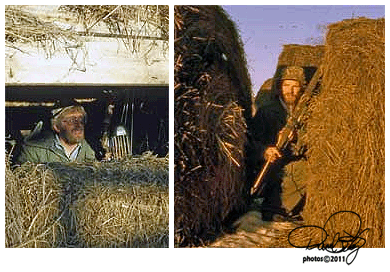
Two types of hay bale blinds. Sit back away from shooting area


The deadliest, most unconventional and warmest blind in the deer hunting woods has escaped many hunters. At first guess, many December hunters feel a heated on-the-ground or elevated stand is best.

Not me. For my money, a hay bale blind beats whatever else might come in second. It has many advantages, and only one disadvantage. Hunters afflicted with hay fever shouldn't hunt from a hay bale blind.

However, in Michigan where baiting rules exist, a hay bale blind could be considered illegal unless it is in a hay field with other hay bales, Even then, people who think they'd like to hunt from one should personally contact the conservation officer in their hunting area for advice.

Assume responsibility to learn if such blinds are legal


A group of retired conservation officers I am friends with say they feel it would be up to the individual officer to determine its legality.

Personally, I hunted from them many years ago before Michigan adopted laws and rules on baiting. However, that was then and this is now. I loved a hay bale blind years ago, and would jump at the chance to hunt from one again providing it was deemed legal. It may be legal in other states, and it's up to each hunter to determine whether the method is legal or not.

The solid points in favor of them are many and all are valid. Here are some good reasons to use such a blind in late November and December.

  • Hay bale blinds can be constructed from big round bales or the smaller and more manageable rectangular bales.
  • A round bale blind is made by putting two round bales together at an angle to form a capital "V". Put a sheet of one-inch marine plywood over the top, and stack six or eight rectangular bales on top to provide a warm roof over your head.
  • A rectangular blind requires quite a few rectangular bales. Pile as many bales up on the left and right sides, and behind you, and put a chair inside to sit on. Stack the bales at least two high in the front, and leave just enough room to shoot. Cover the top with plywood and more bales, and you are set. The disadvantage of this blind is if one or two bales get bumped, the blind could fall like a house of cards.
  • Of the two, my favorite is made from round bales. Five minutes with a tractor to move the two round bales together, laying a sheet of plywood on top and several rectangular bales on top of that and in front to form a shooting window will complete the blind.

It's possible to hunt from behind or between hay bales


  • Any hay blind placed before October in a key location will pay off when December rolls around. The deer get used to it, and by the time the winter archery season rolls around, it will entice deer to your area.
  • Key spots for a hay-bale set is near the edge of a cornfield, in an open field where two or more trails converge, or in a hay field that has abundant deer traffic.
  • This blind is warm. Unless the shooting window faces directly into the wind, this is the warmest blind there is. Wet hay builds a certain amount of heat, and hunters can stay warm in the most bitter weather.
  • Human odor isn't a problem with hay blinds. The heavier odor of hay serves to cover any human scent inside the blind.
  • It would be difficult to consider a hay-bale blind as a bait site although deer could occasionally eat some of it while a hunter is inside.
  • Of major importance to me, and to others who use such blinds, is they offer straight-out, horizontal shots at whitetails. There is none of the problems of shooting downward while sitting or standing in a cold tree stand or elevated coop, and deer often walk within six feet of a hay-bale blind. The shots can be impossibly easy to make unless the hunter suffers from buck fever.

Many things favor such blinds if regulations are not against them


  • The hay absorbs almost any noise. I've coughed, sneezed, and done other noisy things in a hay-bale blind in the past without having nearby deer hear me. Of course, any movement visible through the narrow shooting window can be spotted.
  • Is it too late to build a hay-bale blind? It depends on deer numbers in your area, the available food supply, whether you bait or don't bait, and how quickly the blind can be constructed. Deer often take three or four days, and sometimes as much as a week, to become accustomed to the blind.
If I were a hunter with a new hay blind, I would not sit in it for a week. The one exception to that would be if a major winter storm was due to hit that evening. Every deer in the area will be on the prowl before dark, and I'd suggest being in the new stand no later than 2 p.m.

If snow falls before the deer move, so much the better. It will help cover any human scent, and it can produce the occasional big buck.

Hay-bale blinds are not difficult to make, and they provide everything a December bow hunter could ask for: no scent, being as warm as toast, and being in a blind while the deer nibble around the edges of it. It doesn't get much better than that.

Just remember: It is your sole responsibility to determine whether such blinds are legal where you hunt. If you don't check first, it's your bad because you've been warned.

Tuesday, April 26, 2011

Gobbler hunting with a bow


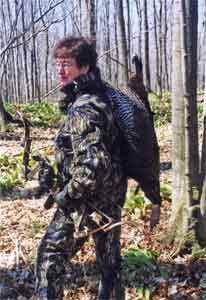
Kay Richey with a jake gobbler she shot with bow and arrow.


There are any number of ways to hunt these sharp-eyed birds, but one thing is a constant. Hunters must have some way of concealing the movements necessary when drawing a bow on a strutting gobbler.

Trust me, it's not easy. Turkeys see well, hear well, and there often is enough of them around a gobbler that coming to full draw isn't easy.

One way of doing it, and the most effective way, is to use a pop-up ground blind of camouflage material. These blinds take hardly any time to set up, and a bit of natural grasses or broken tree branches can allow a hunter and his blind to blend right in.

One way to do it is to locate a gobbler or two the night before, watch them fly up to roost, and return the next morning well before dawn. Set up the blind in the dark as quietly as possible, climb inside, sit down and stay quiet.

Sometimes gobblers will gobble first, but often small birds will be chirping and then the crows start to fly. The cawing of crows often triggers a spirited gobble.


Don't get impatient and hurry a bow shot before it's time.


I prefer to let the birds gobble two or three times before making a soft and short yelp. That's it, just one very soft call. Gobblers aren't deaf, and if they hear it and haven't been spooked, they will answer.

Just sit tight. It's not necessary to answer every gobble. In fact, let them gobble one or two more times, and make one more soft tree yelp. Listen for the birds to gobble from the roost, and then beat old turkey wing feathers against tree branches like a hen flying to the ground.

The gobblers will hear that, and often gobble again, and one more soft yelp is usually all it takes. If you are using decoys, there are different schools of thought on decoy placement.

I like to use two hen decoys and one jake decoy. I like the jake decoy facing the blind and the hens five or six yards farther out. When the gobblers come to the decoys, it's best to place the jake about 18 to 20 yards away and facing the pop-up blind. This will normally put the live gobbler between the jake decoy and you.

Gobblers almost always will head for the jake decoy, and I've watched adult gobblers jump up on the jake decoy, knock it over, and start putting the spurs to the decoy.

Shooting the gobbler is pretty easy with a shotgun, but it is much more difficult with a bow. Gobblers can stand still for long minutes, but when they come to the call and decoys, they are moving around.

Two certain shots are possible. A shot taken at a gobbler facing directly at the hunter is fairly easy but I know many people who wind up killing the bird but slicing off the beard in the process.

Wait for the bird to drop his wing-tips, spread his tail feathers, and prance around. Once the bird stops, aim for a spot just below where the beard comes out of the chest, lower the sight three or four inches, and try to hit just to one side or other of the beard. Done properly, this will kill the bird quickly.

The other way is to wait for the bird to start strutting, and let the gobbler turn all the way around to face the jake decoy. Aim for the center where all the tail-feather quills go into the back end of the turkey, and take a well-aimed shot.

Place the jake decoy in front of you and shoot when the gobbler goes to it.


A mortally wounded turkey will almost always shoot 10 to 12 feet straight up into the air, and fall back dead. I strongly suggest using a Game Tracker unit, because if the bird is not mortally wounded, it will fly or run off. The bird may not travel too far, but if it goes out of sight, they can become nearly impossible to find. A  string tracker can be a big help in recovering the bird.

Do not take side shots at a gobbler. The wing bones and feathers are heavy, and it's difficult to place an arrow through the wing feathers. I've talked to a few turkey hunters who say they shoot their bird at the juncture of the head and neck with an arrow, but it would be a difficult shot because a gobbler's head is always moving.

Of utmost importance is to position the blind so a shot can be taken sitting down. If the tent has horizontal and vertical windows, position a vertical window in front of you. Sit back, with full camouflage on, and wait for the bird to get into the proper position for a shot.

My wife has shot two gobblers with a bow.


My wife has shot two nice gobblers with her bow, and everything must into place in order to be successful. It is even more of a heart-pounder if a longbeard is taken with stick and string.

Turkey hunting with a bow is a major challenge. It's not easy with a bow, but when it works, it offers a surge of adrenaline that will be hard to forget.


Tuesday, December 07, 2010

Some funny bowhunting errors


The sight of a nice buck in December can lead to mistakes.


Over the years, I've seen people commit some of the dumbest errors while sitting in an elevated coop or a tree stand or while hunting from a ground blind. Most are funny but some could have been dangerous or fatal.

The reason I write about some of these is there are things that can be learned. Benefit now from the mistakes of others.

One time I had a new hunter sitting in a ground blind. There was a sliding Plexiglas window in that coop, and when I dropped him off, I suggested he keep the window closed until a deer got close, and then silently slide it open, draw, aim and shoot.

Somewhere from spoken word to memory, he got lost.


He did some of it right and failed on other parts. He saw a small 8-point walking toward him, and he waited until the deer stopped, quartering-away at 12 yards, and he drew back and shot.

Cr-a-c-k! He'd forgotten to slide the Plexiglas window open, and shattered it. The buck obviously disappeared, and probably never walked past that blind again.

Another time, another guy was sitting in a ground blind with a sliding wooden window. He saw a buck and doe coming, and when the doe walked past the window, the buck crossed the window, and he shot. His arrow struck the sliding portion of the wood window, glanced off it, missed the buck entirely but the ricochet nailed the doe in the heart. It was a great shot, but it was a killing hit on the wrong deer.

Then there was a time when another hunter drew down on a doe, studied the animal as it walked in front of him and stopped. He held his draw until she started to turn, and he aimed for the heart and lung area. He made a great hit, but again, on the wrong deer.

A doe fawn, standing out of sight, darted in next to its mother, and saved her mother's life. This mistake has often happened, and it is the result to tunnel vision on the target animal and not watching to see what other nearby deer are doing. The venison was really tender, I heard.

It was bitter cold that day and the hunter got too cold.


Once, during the December bow season, a bow hunter was sitting in a pine tree near an alder run. He'd shot several bucks over the years from that tree, and sat out in hopes of seeing another one. The air temperature was about 10 above, and a strong north wind was blowing.

He toughed it out until shooting time ended. He lowered his bow to the ground, shrugged his shoulders several times to restore circulation, and rubbed his hands together. He'd lost most of the feeling in his hands and feet, and tried to get warm and limbered up before starting down.

He took the first two steps, and then one of his feet slipped on a snow-covered ladder step. He had three contact points -- two hands and one foot -- but all were too cold to respond when his foot slipped. He knew he was going down, and pushed himself away from the tree and tumbled eight feet off tree limbs and into the snow. He wasn't hurt from the fall but was a bit disoriented for a moment until he figured out what had happened. Anytime a hunter can walk away from a tree stand fall is indeed fortunate.

Another time a hunter was in that same tree, and it was a cold day, and suddenly a nice buck appeared. He normally had a 60-pound draw weight, but had forgotten to crank it down a bit to compensate for cold, still muscles and bulky clothing.

A buck came walking slowly by. Our hero started his draw, and the arrow fell off the rest. He was shooting with fingers, and the extra effort to draw the weight when cold and over-dressed, caused him to roll the bow string. It flipped the arrow off the rest and it fell, tinkling, to the ground as the buck looked up at the first sound.

Loose nocks, too much clothes, heavy bow weight rolled arrows off.


The buck stared upward, and the hunter didn't move, and eventually it went back to its business of checking an old scrape. He nocked another arrow, tried drawing on the buck again, and again the arrow rolled off the rest and tumbled off branches to the ground.

The hunter, sat and stared at the curious buck, but finally common sense apparently set in and the deer raced off through the snow as the hunter looked down at the red nocks standing upright in the snow.

I've got one ground blind with a low. A sign tells people to watch their heads, but one person managed to smack his head going into the blind. And, to add insult to injury, banged his head when he left. He no longer likes to sit in that stand.

Deer hunting is mighty serious business for most of us, but some of these things are a bit too funny to ignore. And it's a wise hunter who can laugh and benefit from his mistakes.

Posted via email from Dave Richey Outdoors

Monday, November 15, 2010

No deer seen on the firearm opener


A buck like the one on the right was my goal today.


Weather-wise, in the northern Lower Peninsula at least, it was a great firearm deer opener. A bit cool, a bit of morning sleet and snow, a fair number of rapid-fire shots that seldom produce, but for me it was nothing special.

I hunted all day, first in a tree stand and then in a one-man pop-up tent, and never saw a deer. People with crop damage permits put the big hurt on some does, and I only heard of one buck being taken from my circle of friends.

Many of us were looking for something a bit larger than a year-and-a-half-old buck. Most favor a buck with substantial bone on their head, and such bucks are in a minority in the counties I hunt -- Benzie, Grand Traverse, Kalkaska and Wexford. Our doe and buck numbers are low in this region, and it shows little chance of getting better.

The northwest corner of the Lower Peninsula has a shortage of deer.


I hunted hard with Old Faithful -- my pre-1964 Winchester Model 70 in .264 Winchester Magnum. It can, and has on countless occasions, delivered an air-mail 140-grain package to a nice buck. That didn’t happen today although 15 more days of firearm season, more bow hunting and a brief muzzleloader season is on tap for next month. There’s still lots of time for a shot.

There are a number of open fields, cut corn fields and the like in my area. My land is mostly heavily wooded, and most of the morning was spent watching a field between two woodlots, and this strategy has paid off in past years but not this time around. The afternoon was spent hunting a high hill overloooking a thick swale and bedding area.

The thick stuff is usually better for a good buck, but today wasn’t the day for any bucks or does me to see. The deer seemed to be on some state land west of us, and that’s where the heaviest pressure was and the most shooting. This flies in the face of the fact that private land has held more deer than public land for two or three decades. So … maybe it’s  the state-land hunter’s turn to see the most deer.

Is a return to limited baiting on tap for next year. It does draw more hunters.


It’s not my style to go looking for something to argue about, but we are entering our third year of a three-year moratorium on baiting, and many people I speak to are adamant in their desire to return to a limited brand of baiting for those who wish to do so. Hunters have switched around from setting for two hours, and then still-hunting in the past decades. Now, most people are setting in coops and elevated blinds, and they don’t move. With no bait and no moving hunters, there isn’t much to keep the deer up and moving about.

Now a one-man pop-up tent doesn’t offer much room, and the funniest thing that happened to me today was a big header. There I was, in my tiny pop-up stand, and I leaned a bit too far to the right to check out  a run-way 40 yards away. I could tell it when I shifted my weight that everything was going down, and the little tent began to lean, and over we went. I cradbled Old Faithful in my arms like a new-born child, and the landing was soft and easy.

I was laughing about it on the short fall to the ground, and the hardest thing about it was extricating my rifle and body from the twisted-up tent. No injuries, no harm to the rifle or tent, and it felt good to chuckle about my own mishap.

But now the hour is getting late, and I’m beginning to nod off at the keyboard, and that’s never a good thing. So, if you’ll excuse me now, it’s time for a bit of shut-eye.

Z-z-z-z-z-z.

Posted via email from Dave Richey Outdoors

Thursday, October 21, 2010

Getting the shot ... photos


Many people visit my blog on a daily basis, and those who do know that killing a deer isn't the most important part of my hunting life. There have been too many deer taken over 55 years to shoot a small buck.

So, I sit patiently in a ground blind, elevated coop or tree stand, and wait. I bought a new Canon digital camera with two lens, and it set me back more than $3,000, but I can now reach out and get some of the deer photos that were impossible to get in the past.

My new hobby is taking more and more deer photos. You see, besides getting more photos to illustrate my daily weblogs, it offers one more reason to study deer.

Shooting deer photos teaches hunters about whitetails.


I carry my bow while photographing, but have yet to see a shooter buck this year. So, if there are no good bucks around just yet, I'm content to kick back and watch the passing movements of these animals. Time, as it passes, is working in my favor.

So far, in three weeks, I've passed up three small bucks within easy bow range. I've seen an 8-pointer, a spike and a tiny 4-pointer. I saw one animal on the archery opener that looked like a nice buck with its head down, but it was back in the dark timber, and I just couldn't grow antlers on it. I think it was a buck but couldn't tell.

Taking photos is good practice for a bow hunter. A classic example. Last night I clicked off several shots of a nice 8-point, and he illustrated my blog. The breeze was in my face and he was upwind of me, and most photos came while the wind was blowing. It stopped blowing just as I clicked the last photo, and he heard the shutter noise. You can't shoot photos of deer without that happening on occasion. Often, the deer run off but sometimes the noise doesn't both them.

Even more important than shooting a deer, with bow or camera, is to enjoy the outing. Each day is counted as a blessing, and I look at the bright side of every day.

Yesterday we had 15 minutes of sunlight when the deer moved, and today was windy until sundown. I look for the unusual things, and that satisfies my artistic bent. A beautiful sunrise or sunset is perfect, but so too is the cobalt blue skies that often grace us during October. I enjoy framing deer with natural objects when photos are taken, but it's not always possible, but I seek unusual shots.

For all intents and purposes, our leaf drop has ended. Today's harsh wind and last night's short-lived rain, combined to encourage what few leaves that were left to drop. The woodlots are mostly open now, and seeing deer will become a bit easier from now on.

The chasing phase of the rut will kick off any day now.


The first stage of the rut -- the chasing phase, which is my favorite -- is due to kick off within the next week. With luck, spotting other bucks will be much easier providing they decide to move before sundown. My hint to most sportsmen is to hunt the mid-day hours whenever possible.

I study deer every day I'm in the field, and it's that constant study and attention to minute detail, that allow me to be a good deer hunter. Sure, I study wind currents, stay downwind of the deer, and put myself into situations where the deer will move my way.

These are things learned through constant deer studies. A tail flick can mean one thing to most people, but to me it means that animal may be getting ready to move out of the area. Reading a doe or buck's body language is important because it tells me what is going on around me.

Head-up and alert deer means something can be heard but not seen. Is it another deer or danger? The head-down approach of one buck to another means one of two things: the approaching buck is spoiling for a fight or he is intimidating a subordinate buck.

Posturing is a big part of a deer's world, and watching them pull their ears back and make the neck hairs rise is a cue that something nasty could happen. Often, other deer read these signs accurately, and bail out of the situation before it turns ugly.

Buck fights during the rut can be painful or deadly.


It's been my pleasure to have watched a knock-down, drag-out fight between two evenly matched bucks, and those who believe deer live in a Bambi-like world haven't spent any time in the field during the rut. A serious buck fight is nasty, and often one buck or the other is seriously injured and sometimes killed.

I've seen bucks gored, eyes poked out by an antler tine, skin ripped off their skull, animals with dangling ears or tine holes in their rump, and it's not pretty but it's part of the real world. And I count myself fortunate to be able to watch some of these whitetail pre-rut actions, and hopefully will be able to photograph a major buck fight this fall.

So, if you'll excuse me, I've rambled on long enough. It's time to see what images I've got, and those photos do nothing but whet my appetite for more deer-watching tomorrow.

Posted via email from Dave Richey Outdoors

Thursday, September 02, 2010

Remembering some old hunting stands


Today seemed to be one of reflection. My topic on this somewhat rainy day is about some tree stands and ground blinds from many years ago. Many were memorable but some where very bad.

It is rather amazing how a stand can be productive for several years, and then fall flat and into disfavor. It's not so much the blind or stand wouldn't still produce a nice whitetail buck, but for whatever the reason, I no longer hunt there anymore. In a few cases, the tree had fallen during a windstorm and no other good tree was nearby.

Sometimes a stand dies a sudden death because crops are planted elsewhere, or because another nearby stand turns hot. In some cases it is because the stand is no longer just right for the prevailing wind direction, is uncomfortable to sit in, or for many other reasons.

Very few huntings continue to produce year after year.

Thirty years ago I had a crooked tree that was so uncomfortable to sit in that a person needed a Posturpedic mattress, chiropractic adjustment  and time in bed to recover. The tree produced plenty of bucks over the years but anyone who hunted there needed a new mattress, and that set became known as the Posturpedic tree. It’s still there but the tree stand was moved to a more comfortable spot.

Another old favorite tipped over years ago. It was a dead popple tree near a fence crossing, and it was in steady demand by me and some friends. It was great on an east wind and unters could sit there, watch deer walk to the fence hole, step through and offer a clear shot.

I hunted it one night, heard a creak deep in the dead tree, and didn't move after that. I climbed down, and walked away, looking back at what once was a popular stand. It fell down the next day, and no other nearby tree could offer such an advantage. When it went down, a long-standing tradition went down with it.

The old Execution Knob was a pit blind on a hill. It offered a great view of the area, and it was made for firearm hunting only. I can't remember how many bucks were taken from that stand. but if I had a Ben Franklin ($100 bill) for each one, it would go a long ways toward paying me a healthy payment this year.

The Knob grew into disfavor. Why? Who knows, but I quit hunting it once we were able to hunt from elevated stands with a firearm. A new bow coop now sits on Execution Knob, and it produced a really big whitetail buck last season.

The Lakeshore coop was another favorite. There were two elevated coops, one on the south and one on the north side of the beaver pond, but this corner coop set on the ground alongside the main north-south road. The area also has an elevated coop now.

If offered clear shots for 200 or more yards to the north and south along the shoreline, and people who sat there during the firearm season always shot bucks that the hunters in the other two nearby stands never saw. It too fell into disfavor, and was moved elsewhere.

Anything that has been there long enough can be used for a stand.

There once was an old foundation back in a field, and it was crumbling and falling into the basement. One day a buddy had a bright idea, and pushed the rest of the cement into the basement, filled it with dirt, packed it down, put more dirt on top, and built a 15X30-foot building filled with windows on all four sides.

It offers shots in four directions. The only bad thing is that hunting in the old foundation was like hunting from a gigantic pit blind. Every day an ermine would come out for a visit, stare at the hunter, and go on about his business of killing and eating. The ermine disappeared when the foundation was filled in.

Another stand that died a quick death stood 15 feet up an old willow tree. A person could only hunt from it on a calm day because it swayed in any kind of breeze. It got hit by lightning, and lost most of its branches. The tree is still there, but it hasn't been used as a stand in many years.

There are many other ground blinds and tree stands that have disappeared, but whenever I pass one of the better ones that is no longer being used, a bit of nostalgia settles in.

Nothing lasts forever, and that can certainly be said for ground blinds and tree stands. The deer change their patterns, move elsewhere, follow different runways dictated by food-plot locations and they stop getting used, and new and better stands take their place.

One of many pit blinds we’ve used are good bets.

A current favorite for my wife is a pit blind behind the house. It has a roof overhead, and small walls, and it’s been there long enough for all the deer in our area to have become used to it. This year I’ll have at least two stands set up  specifically for an east wind. Both should be in great spots.

But, on occasion, I still like to remember some of those blinds and stands that have gone before. All were good at one time, and were then replaced. It is like so many things in life. They get used until they are used up, and are quickly discarded.

It's fun, however, to remember way back when …

Posted via email from Dave Richey Outdoors