Showing posts with label long. Show all posts

Saturday, January 01, 2011

The squirrel wars


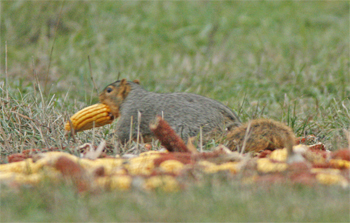
Hunting squirrels after the corn picker comes along will work.


The fox squirrel was making his move. He was putting a stalk on our backyard bird feeder.

Squirrels must have poor memories. They spend all summer and fall hoarding food for winter, but they apparently forget where they left their stash of goodies. This bushytail was advancing on our bird feeders in a flanking maneauver, and I waited for him to start up the tree.

The door was rattled, and I swear that bushytail cleared 10 feet and hit the snowy ground running. He will wait until he can get away with it, and try to empty the sunflower seed feeder.

Black, fox, grey & red squirrels have a never-give-up attitude for our bird seed.


Squirrel season used to end at the end of December, but now the season runs through March 1. And it's a made-to-order hunt on those days when the snow is skimpy or nonexistent, and when the weather is warm on a winter's day.

Would I shoot one off the bird feeder? Of course not, but between chipmunks, red squirrels and their larger cousin -- the fox squirrel -- it has been a war around here for years.

Bought a 50-pound bag of sunflower seeds lately. How about thistle seeds or Niger seeds? No, well they are expensive and the prices for seed never goes down.

I don't believe there is any such thing as a squirrel-proof bird feeder. I've seen them shinny up a fiberglass pole attached to the railing. It was supposed to be squirrel-proof, but they figured out a way to climb it anyway.

One squirrel will make a mess of the bird feeder. If two or three nutcrackers move in, and nothing is done about it, they will empty a bird feeder every day. They run off, their cheeks puffed out with bird seeds until they look like they have a goiter, and five minutes later, they head back on another raid.

Deer hunting ended today amid a howling wind and snow. There is still snow in the woods for hunting cottontails or snowshoe hares, and it's over three months until the turkey season opens, so if you hanker a bit of excitement, go winter squirrel hunting.

Winter squirrel season never has to take you far from home.


There was a corn field near our house last summer, and some corn kernels still litter the ground. The corn will attract squirrels, but with the  earlier deep snow, bushytails found themselves out of a food source. Most of the corn from the nearby fields has been eaten by deer, geese and squirrels, and they are now looking for another free handout.

I'm tired of them at the bird feeder. I don't share the same opinion of squirrels as some people who have unsuccessfully fought squirrel wars for more years than they can remember. They call these critters tree rats or wood rats, and other less complimentary mixes of strong Anglo-Saxon words. which, I believe, has led to the longer winter season.

They are persistent little buggers. It's that nevergive-up attitude of theirs that makes them a nuisance.

The best way to fight the squirrel wars is to grab up the shotgun and head for the woods. Sit down near a trail of squirrel tracks, sit still, and wait for them to show their long tails. They never expect to be hunted during the winter, and it takes a while for them to smarten up.

Shoot one squirrel, and just sit still. Other nearby squirrels may chatter and carry on but soon their curiosity will get the best of them. They head out to get something else to eat, or to investigate the noise, and it's fairly easy to shoot five squirrels on a sunny and warm afternoon.

What works? Black-powder pistol or shotgun, .22 rifle or a shotgun.


Don't worry. Taking a limit of fox squirrels isn't going to hurt their population one bit. Shoot their numbers down, and you soon learn one of Nature's truisms: Nature abhors a vacuum.

Once some squirrels are taken, other squirrels move in to fill the empty space. It becomes a never-ending problem.

Years ago, when I was a kid, most people hunted nutcrackers with a rifle. The bullet from a puny .22 can carry over a mile if someone was to shoot at a squirrel up in the tree-tops. There are too many people around now, and the wide-open spaces of years ago are all filled up with houses and people.

Be safe and smart, and use a shotgun. Don't forget your Hunter Orange clothing, and you'll be able to shoot them on the ground or up in a tree. Use No. 6 shot, and it will be deadly medicine.

One thing about hunting nutcrackers. You'll put some mighty fine food on your table with five winter squirrels, and there will be fewer of the animals around next spring to invade your bird feeders.

And that's just fine with me.

Posted via email from Dave Richey Outdoors

Thursday, October 21, 2010

Getting the shot ... photos


Many people visit my blog on a daily basis, and those who do know that killing a deer isn't the most important part of my hunting life. There have been too many deer taken over 55 years to shoot a small buck.

So, I sit patiently in a ground blind, elevated coop or tree stand, and wait. I bought a new Canon digital camera with two lens, and it set me back more than $3,000, but I can now reach out and get some of the deer photos that were impossible to get in the past.

My new hobby is taking more and more deer photos. You see, besides getting more photos to illustrate my daily weblogs, it offers one more reason to study deer.

Shooting deer photos teaches hunters about whitetails.


I carry my bow while photographing, but have yet to see a shooter buck this year. So, if there are no good bucks around just yet, I'm content to kick back and watch the passing movements of these animals. Time, as it passes, is working in my favor.

So far, in three weeks, I've passed up three small bucks within easy bow range. I've seen an 8-pointer, a spike and a tiny 4-pointer. I saw one animal on the archery opener that looked like a nice buck with its head down, but it was back in the dark timber, and I just couldn't grow antlers on it. I think it was a buck but couldn't tell.

Taking photos is good practice for a bow hunter. A classic example. Last night I clicked off several shots of a nice 8-point, and he illustrated my blog. The breeze was in my face and he was upwind of me, and most photos came while the wind was blowing. It stopped blowing just as I clicked the last photo, and he heard the shutter noise. You can't shoot photos of deer without that happening on occasion. Often, the deer run off but sometimes the noise doesn't both them.

Even more important than shooting a deer, with bow or camera, is to enjoy the outing. Each day is counted as a blessing, and I look at the bright side of every day.

Yesterday we had 15 minutes of sunlight when the deer moved, and today was windy until sundown. I look for the unusual things, and that satisfies my artistic bent. A beautiful sunrise or sunset is perfect, but so too is the cobalt blue skies that often grace us during October. I enjoy framing deer with natural objects when photos are taken, but it's not always possible, but I seek unusual shots.

For all intents and purposes, our leaf drop has ended. Today's harsh wind and last night's short-lived rain, combined to encourage what few leaves that were left to drop. The woodlots are mostly open now, and seeing deer will become a bit easier from now on.

The chasing phase of the rut will kick off any day now.


The first stage of the rut -- the chasing phase, which is my favorite -- is due to kick off within the next week. With luck, spotting other bucks will be much easier providing they decide to move before sundown. My hint to most sportsmen is to hunt the mid-day hours whenever possible.

I study deer every day I'm in the field, and it's that constant study and attention to minute detail, that allow me to be a good deer hunter. Sure, I study wind currents, stay downwind of the deer, and put myself into situations where the deer will move my way.

These are things learned through constant deer studies. A tail flick can mean one thing to most people, but to me it means that animal may be getting ready to move out of the area. Reading a doe or buck's body language is important because it tells me what is going on around me.

Head-up and alert deer means something can be heard but not seen. Is it another deer or danger? The head-down approach of one buck to another means one of two things: the approaching buck is spoiling for a fight or he is intimidating a subordinate buck.

Posturing is a big part of a deer's world, and watching them pull their ears back and make the neck hairs rise is a cue that something nasty could happen. Often, other deer read these signs accurately, and bail out of the situation before it turns ugly.

Buck fights during the rut can be painful or deadly.


It's been my pleasure to have watched a knock-down, drag-out fight between two evenly matched bucks, and those who believe deer live in a Bambi-like world haven't spent any time in the field during the rut. A serious buck fight is nasty, and often one buck or the other is seriously injured and sometimes killed.

I've seen bucks gored, eyes poked out by an antler tine, skin ripped off their skull, animals with dangling ears or tine holes in their rump, and it's not pretty but it's part of the real world. And I count myself fortunate to be able to watch some of these whitetail pre-rut actions, and hopefully will be able to photograph a major buck fight this fall.

So, if you'll excuse me, I've rambled on long enough. It's time to see what images I've got, and those photos do nothing but whet my appetite for more deer-watching tomorrow.

Posted via email from Dave Richey Outdoors

Saturday, October 09, 2010

Remembering some very long shots


Granted, we are already in the archery deer season, not the firearm season, but one recurring thought today kept running through my head like a needle stuck in the groove of an old 45 rpm record.

I got to thinking of several of my long shots. Long shots made with a rifle on caribou, mule deer and whitetails. The ones that tell you that you've practiced long-range shots, know how the rifle shoots, and are capable of taking and making such shots.

A long shot means different things to different hunters. There is a television show that specializes in one-shot long-range kills. I've watched it several times in the past, and they've stretched things out a bit farther that I have but not by much.

Long shots requires lots of practice and a flat-shooting rifle.

I own a Winchester pre-1964 Model 70 in .264 Winchester Magnum, and my first scope was a 1.5X8-power Weaver with fine crosshairs. It hit the market, if memory serves me right in 1961 and I bought the rifle and scope  in 1962 and 48 years later it still shoots better than I can hold it.

Back in those days I did all my own reloading of ammunition for that cartridge, and I played with loads ranging from a 77-grain Norma to a 165-grain Hornaday. Each bullet weight would shoot to the same point of impact, and my vision was keen back then, and I could shoot.

One year, while hunting the Sleeping Bear National Lakeshore sand dunes, I had my son David with me. I told him where to lay on the ice-cold dunes, and where to watch, and that if a buck came out on a deer drive, it would almost run over top of him.

I saw the buck come out, and just as straight as a string, it ran at my son. No shots, and it went past him on a dead run, only to stop between 325 and 350 yards away on another dune. I took a quick sitting position, locked in on that buck and sent a 140-grain airmail package at him. He dropped, and that was it.

Another year, while hunting near the Platte River, I spotted one of the biggest does I'd ever seen walking on the far bank of the river. It was an honest 300 yards away, and when the rifle cracked, the deer fell to a well-placed shot.

A few years ago, while hunting the Kaibab along the north rim of the Grand Canyon, a good mule deer jumped up at 200 yards, went bounding off in that bouncing pace of theirs. Contrary to popular belief, mule deer bucks don't always stop to look back. This one never stopped.

He ran down a valley that led down into a side canyon. My guide and I ran just below the rim on one side, and we could see the buck and a doe running across the opposite side of the canyon. The buck and doe finally stopped when they felt it was safe, and started browsing.

We worked as close as possible, and this was the last day of my hunt, and the guide said: "That buck is 400 yards away. Can you hit and kill him at that distance? We can't get any closer."

Could I hit that muley buck that far away?

I found a scrub tree nearby, scraped some pointed rocks away so I could sit down to hold the rifle steady. I cranked up that Swarovski  scope to 12 power, studied the buck with a firm rest. I settled the crosshair at the top of his back (my rifle was sighted in to be three inches high at 100 yards), took a deep breath and shot downhill at the buck. A second passed before I heard the bullet hit that mulie buck, and down he went. It was a clean one-shot kill.

The longest shot I ever made was in Canada's Northwest Territories a dozen years ago. I was hunting Central Canada Barren Ground caribou, and the guide and I found a huge herd of 3,000 to 4,000 animals down in a big mountainous bowl. There was no cover for a stalk.

My guide held my ankles as I leaned over a steep cliff, and I shot free-hand at the largest bull that was bedded down directly below us. I had no support, and it was a dumb thing to do but I hit that huge bull.

The caribou -- every last one of them -- left that bowl, climbed a ridge across from us, and finally my bull stopped. We went down into the bowl, made our way across it, and eventuall we ran out of cover, and the bull was staring at us.

"I say 500 yards," was my guess while the guide thought it was farther. I took a firm rest after laying my backpack on the last big boulder of the right height, and I studied that great stag. I'd be shooting into a stiff cross-wind at a wounded animal at least 500 yards away.

I know my rifle, know what it can do, and in my early 20s when the rifle was purchased, I shot crows at 300-350 yards in an open field. I felt this shot was possible, and with great patience, I leaned into the stock, settled the crosshairs for where I thought I should hold, and squeezed.

Two second later came the sound of the bullet hitting that bull and down he went. I paced off the distance, and I was doing my best to take 36-inch steps, and 535 steps later, I walked up to that great bull.

It was the longest shot of my life at a wounded animal.

That animal was big, but I had no clue just how big he was until we later put a tape measure to him. He wound up the first year in the No. 9 position in Boone & Crockett. The last I looked he was down to about 100, and I could care less. Whenever I look at him, and the great long rear points, I relive the long-range shot of my lifetime.

Long-range shooting isn't something I encourage. There is too much risk of missing, but if a hunter shoots often and knows his rifle and where it will hit at 250 yards, making a 350-400-yard shot is fairly simple. Luck was riding on my shoulder on the 535-yard shot even though I was confident I could make it.

In the end, people don't ask "Can you?" Instead, they ask "Did you?" And I did.

Posted via email from Dave Richey Outdoors