Showing posts with label being. Show all posts

Monday, August 27, 2012

Thinking and being alert to deer is easy

DRO-big bucks
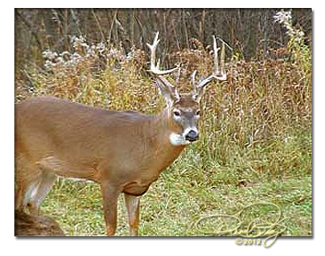
This buck has a larger rack than you think; Count the points
photo c.  Dave Richey Outdoors
My mind seemingly has tunnel vision. The only two things i seem focus intently on while bow hunting is studying deer, which really doesn’t make me all bad. I could care less about ball parks, Nascar races, or tournament golf.

Whitetails excite me; almost everything else is far less interesting, and certainly a lot less fun.

People question how I can only think about these two items most of the time. It must be easy because both passions have consumed my thoughts for more than 50 years.

Both thoughts are of equal importance, and without my intense study, there would be less hunting success. A number of years ago, I was asked a question at a bow-hunting seminar I was giving.

Another seminar attendee asked if the only thing I thought about was writing. I gave the man a straight answer.

It's a wise hunter who can act and think at the same time


"Writing is what I do," I said. "It's how I make a living, and to do my job properly, I'm always thinking about the next story. It has to be what I think about on a daily basis. I'd be dead in the water without the next story idea. The same thing applies when I bow hunt for whitetails."

My answer is based on these reasons. For me, hunting whitetails with a bow, and studying the animals at every opportunity, is what I do. To stop studying deer is to stop learning about whitetail deer. To stop learning means less opportunities and decreased success.

When I hunt, I become totally focused and immersed in my surroundings, and what the deer are doing. I never lose my concentration on deer, but I continue to focus and watch other deer. I can solve all kinds of deer hunting problems while sitting in my ground blind or in an elevated coop or tree stand.

Stay focused on your surroundings and remain alert


When working, my thoughts are always on deer hunting or trying to figure out why a particular deer did what it did the night before. Most people forget yesterday's hunt but not me.

Some people find it hard to think about two things at once or have trouble chewing gum and walking. That often happens when deer hunting: I'll be trying to solve a knotty little deer travel pattern problem, and a nice buck will walk out. My reflexes take over, and I can shoot that buck while shifting mental gears, and then I will shift back to solving other problems after shooting the deer or passing up a shot.
Solving any bow-hunting problem is always easier while bow hunting. Any hunting area always has some natural noises, but out there, the phone doesn't ring to distract me.

Years ago I learned that many of my award-winning articles and columns came to me while sleeping. One part of my brain kicked into gear, and I would wake up, slip out of bed, head for my office and write it while the idea was still fresh in my mind.

The same thing happens while bow hunting. A problem may bother me for weeks, and then one night while sound asleep, the answer wakes me up faster than a face slap with an ice-cold wash cloth. I suspect that being asleep allows the subconscious to kick in, provide the needed answer, and usually the answer is so simple I wonder why it didn't come to me much sooner.

Hunting and thinking is just as easy as walking and talking


I'm able to study deer, think about various deer patterning problems, and be ready and able to shift gears automatically, and shoot the buck. It's what I've trained my body and mind to do, and anyone else can do it providing they've learned the basic fundamentals of drawing and properly aiming a bow and making a smooth release. Do those things long enough, and do them properly, and it becomes simple.

This sort of thing often happens while I'm hunting. When my two main thoughts meld while aiming at a big buck, it is one of the most memorable events of my life.

Wednesday, October 27, 2010

What is an archery deer hunter?


The above title is a question that has been asked of me many times, and it's always a very difficult  one to answer. A true bow hunter is a combination of many things, all of which are upstanding and good.

*A bow hunter is ...

*A person who revels in nature, loves the outdoors, seeks a difficult challenge,  equals the odds between hunted and hunter as much as possible, and who is finely tuned to the ways of the game we seek.

We know why we hunt and never have to justify it.


*One who seeks his or her game on a one-on-one basis, and who strives to get close enough to deliver a quick and certain death from a well-placed arrow.

*A person who masters accurate arrow placement, and one who spends long hours testing personal mettle against a whitetail buck that is more attuned to its surroundings than we are. This person shrugs off rain, forgets about windy weather, and laughs at a snowstorm. Deer hunters hunt deer, and weather conditions are meaningless. We become one with the weather, and use it whenever possible, to our advantage.

*A hunter who thrills at the small things, and takes brief moments each day to savor the wildness of the animal being hunted and the land where such game lives. We don't live for the kill; we live to have had the opportunity in this free society to hunt in a well regulated manner.

*Someone who knows that getting close to game means knowing and playing the wind, studying the habits of deer, knowing how and when to move, and being one with his bow and the land. He or she finds more love in the act of hunting than in the act of killing although the two are ever-entwined and a respect for the game we hunt is most important.

*One who enjoys the fine feel of a smooth bow, the effortless drawing of the string, the smooth feel of a carbon arrow shaft, and the "whisst" of an arrow leaving the bow. It's the silent but straight flight of a well-tuned arrow, and seeing the broadhead hit where we aim.

We practice shooting hard and hunt even harder.


*Having the knowledge of deer habits that allow us to defeat the most important senses that deer possess: the sense of a deer hearing the faint whisper of clothing against rough bark; a flicker of movement as a hunter comes to full draw prior to a shot; or the deer's sense of smell that allow them to pinpoint a careless human presence.

*More than just someone who takes but gives nothing back to nature. A bow hunter is more than a person dressed in camo clothing with a hunting license in his pocket. We are caring, giving folks, who pursue deer with a passion. We are superb hunters because we must be to get close shots at 15 to 20 yards. We are the supreme two-legged hunting predator, and we take pride in our accomplishments without having to brag or gloat.

Part of bow hunting is passing along the tradition to our children.


*It is teaching our children, and our grandchildren, this ancient art of hunting. What we do is a time-honored tradition, and it is a way of life for us and for others who will follow the bow hunter's creed.

We, as avid bow hunters, are above-average in our hunting skills. We rely less on luck, and work hard to elevate those hunting skills that allow us to succeed. We hunt, not because our friends do, but because we must. We need to hunt and we must hunt in order to achieve these skills, and it is through long hours of practice that we become proficient.

We are bow hunters, and we are very proud of it.

Posted via email from Dave Richey Outdoors

Thursday, October 21, 2010

Getting the shot ... photos


Many people visit my blog on a daily basis, and those who do know that killing a deer isn't the most important part of my hunting life. There have been too many deer taken over 55 years to shoot a small buck.

So, I sit patiently in a ground blind, elevated coop or tree stand, and wait. I bought a new Canon digital camera with two lens, and it set me back more than $3,000, but I can now reach out and get some of the deer photos that were impossible to get in the past.

My new hobby is taking more and more deer photos. You see, besides getting more photos to illustrate my daily weblogs, it offers one more reason to study deer.

Shooting deer photos teaches hunters about whitetails.


I carry my bow while photographing, but have yet to see a shooter buck this year. So, if there are no good bucks around just yet, I'm content to kick back and watch the passing movements of these animals. Time, as it passes, is working in my favor.

So far, in three weeks, I've passed up three small bucks within easy bow range. I've seen an 8-pointer, a spike and a tiny 4-pointer. I saw one animal on the archery opener that looked like a nice buck with its head down, but it was back in the dark timber, and I just couldn't grow antlers on it. I think it was a buck but couldn't tell.

Taking photos is good practice for a bow hunter. A classic example. Last night I clicked off several shots of a nice 8-point, and he illustrated my blog. The breeze was in my face and he was upwind of me, and most photos came while the wind was blowing. It stopped blowing just as I clicked the last photo, and he heard the shutter noise. You can't shoot photos of deer without that happening on occasion. Often, the deer run off but sometimes the noise doesn't both them.

Even more important than shooting a deer, with bow or camera, is to enjoy the outing. Each day is counted as a blessing, and I look at the bright side of every day.

Yesterday we had 15 minutes of sunlight when the deer moved, and today was windy until sundown. I look for the unusual things, and that satisfies my artistic bent. A beautiful sunrise or sunset is perfect, but so too is the cobalt blue skies that often grace us during October. I enjoy framing deer with natural objects when photos are taken, but it's not always possible, but I seek unusual shots.

For all intents and purposes, our leaf drop has ended. Today's harsh wind and last night's short-lived rain, combined to encourage what few leaves that were left to drop. The woodlots are mostly open now, and seeing deer will become a bit easier from now on.

The chasing phase of the rut will kick off any day now.


The first stage of the rut -- the chasing phase, which is my favorite -- is due to kick off within the next week. With luck, spotting other bucks will be much easier providing they decide to move before sundown. My hint to most sportsmen is to hunt the mid-day hours whenever possible.

I study deer every day I'm in the field, and it's that constant study and attention to minute detail, that allow me to be a good deer hunter. Sure, I study wind currents, stay downwind of the deer, and put myself into situations where the deer will move my way.

These are things learned through constant deer studies. A tail flick can mean one thing to most people, but to me it means that animal may be getting ready to move out of the area. Reading a doe or buck's body language is important because it tells me what is going on around me.

Head-up and alert deer means something can be heard but not seen. Is it another deer or danger? The head-down approach of one buck to another means one of two things: the approaching buck is spoiling for a fight or he is intimidating a subordinate buck.

Posturing is a big part of a deer's world, and watching them pull their ears back and make the neck hairs rise is a cue that something nasty could happen. Often, other deer read these signs accurately, and bail out of the situation before it turns ugly.

Buck fights during the rut can be painful or deadly.


It's been my pleasure to have watched a knock-down, drag-out fight between two evenly matched bucks, and those who believe deer live in a Bambi-like world haven't spent any time in the field during the rut. A serious buck fight is nasty, and often one buck or the other is seriously injured and sometimes killed.

I've seen bucks gored, eyes poked out by an antler tine, skin ripped off their skull, animals with dangling ears or tine holes in their rump, and it's not pretty but it's part of the real world. And I count myself fortunate to be able to watch some of these whitetail pre-rut actions, and hopefully will be able to photograph a major buck fight this fall.

So, if you'll excuse me, I've rambled on long enough. It's time to see what images I've got, and those photos do nothing but whet my appetite for more deer-watching tomorrow.

Posted via email from Dave Richey Outdoors