Showing posts with label shotgun. Show all posts

Monday, April 16, 2012

Ever taken a gobbler with a muzzleloading shotgun?

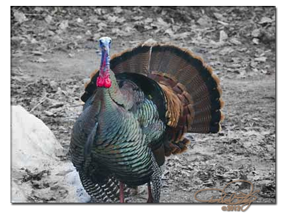
A nice beard on a very nice spring gobbler

Nice bearded tom turkey
Blackpowder and spring turkey hunting are like soup and sandwich; they go together - just keep the moisture out of the mix.
photo Dave Richey ©2012
Several years ago I killed a 24 1/2-pound long-beard gobbler while hunting in Iowa. My firearm of choice was a Knight muzzleloading shotgun with 150 grains of Pyrodex and two ounces of copper-plated No. 5 shot.

My first day of hunting with Tony Knight saw us spook a pair of roosted gobblers while opening a rusted and squeaky farm gate. Later, as we proceeded to look for unspooked birds, we stopped and began to call.

A nearby gobbler answered, walked right down the edge of an open field in broad daylight, gobbling his brains out, and one shot at 40 yards took care of him.

An easy shot with a muzzleloading shotgun

Mind you, 150 grains of Pyrodex and a two-ounce load of shot, produces a good bit of felt recoil. It wasn't excessive, but 100 grains of powder suits my moods much better.

The load isn't the issue here. I'm trying to decide in advance of April 30 whether to try with a muzzleloader this spring during my hunting period. It worked well for me three years ago, and it was great fun, and the Knight muzzleloading shotgun is very tightly choked, and it works like a dream when shooting at 40-50 yards.

Mind you, I don't like to shoot gobblers that far out unless I can boost the downrange velocity without scattering bird-shot all over the place. I have no qualms with shooting a 50-caliber front-loader with an extra-full choke  and two ounces of shot and three Pyrodex 50 grain at that range.

Five years ago, I sat down, and began calling an hour after daybreak, as rain and snow fell in a deluge. Fifteen hens and gobblers filed past me at 20 yards. The two big gobblers in the bunch had several hens between me and them.

Moisture in the barrel turned to sludge when mixed with snow

They disappeared from sight, and I waited another 30 minutes for those birds to move off, yelped once, and here comes a single gobbler running across an open field. He ran every step of the way until he was 30 yards out, and then he stopped, raised his head and began looking around.

I had a red-dot sight on my muzzleloading shotgun, and put the dot where his head and neck meet, and pulled the trigger. A sharp pop sounded, and the gobbler ran off like the hounds of hell were eating at his tail feathers.

The old adage of "Keep Your Powder Dry" came to mind, and I walked out to the car and drove 10 miles home. The muzzleloader was taken apart, the saboted shot cup and shot, and the black gooey stuff that used to be Pyrodex pellets, was pushed out the barrel. I had forgotten to put a latex thumb from a rubber glove over the muzzle to keep the rain out while i quickly set up my one-man tent blind.

What works is patterning a regular or muzzleloading shotgun

I really wanted to take another gobbler with the muzzleloading shotgun, but I have a Remington Model 870 pump 3-inch magnum 12 gauge shotgun that looks as it has been used to sink fence posts, but the shotgun is over 30 years old, and it shoots copper-plated No. 5 shot very well.

It comes with a sling, as does my muzzleloader, and it has produced gobblers from Alabama to Michigan. When the trigger is pulled, the bird dies. With it, my choice is to shoot birds at 30-35 yards. It has a full choke, but not the extra-full turkey choke found on many muzzleloading shotguns.

It is like an old friend. The stock fits well against my cheek, and nestles comfortably against my shoulder, and my good right eye lines up easily with the fiber optic sight.

The 12 gauge is a bit lighter than a muzzleloading shotgun to carry, and on a cross-country hike to find gobblers after the initial dawn action, that regular shotgun can be a big point in its favor. However, the muzzleloader has an extra-tight choke, and can easily kill birds at 50 yards if I choose to take a shot at that distance (which I've only done once). Make a decision which one to use and pattern it well.

Either firearm is fine by me, and in all honesty, shooting a gobbler isn't what tugs me gently into the turkey woods before dawn. It is the opportunity to attempt calling another bird within easy shotgun range. Sometimes it works and sometimes it doesn't, but for me, being there and having a gobbler circle me at dawn is what my hunt is all about.

Pulling the trigger and killing the gobbler is nothing more than a heavy layer of frosting on my turkey-hunting cake.

Sunday, January 29, 2012

Ever taken a gobbler with a muzzleloading shotgun?

Make certain the firearm is properly patterned for a gobbler

big-gobbler
Several years ago I killed a 24 1/2-pound long-beard gobbler while hunting in Iowa. My firearm of choice was a Knight muzzleloading shotgun with 150 grains of Pyrodex and two ounces of copper-plated No. 5 shot.

My first day of hunting with Tony Knight found us spooking a pair of roosted gobblers while opening a rusty and squeaky farm gate. Later, as we proceeded to look for unspooked birds, we stopped and began to call.

A nearby gobbler answered, walked right down the edge of an open field in broad daylight, gobbling his brains out, and one shot at 40 yards took care of him.

An easy shot with a muzzleloading shotgun

Mind you, 150 grains of Pyrodex and a two-ounce load of shot, produces a good bit of felt recoil. It wasn't excessive, but 100 grains of powder suits my moods much better.

The load isn't the issue here. I'm trying to decide in advance of April whether to try with a muzzleloader this spring during my hunting period. It worked well for me three years ago, and it was great fun, and the Knight muzzleloading shotgun is very tightly choked, and it works like a dream when shooting at 40-50 yards.

Mind you, I don't like to shoot gobblers that far out unless I can boost the downrange velocity without scattering birdshot all over the place. I have no qualms with shooting a 50-caliber frontloader with an extra-full choke  and two to 2 1/2 ounces of shot and three Pyrodex 50-grain for shooting at that range.

Five years ago, I sat down, and began calling an hour after daybreak, as rain and snow fell in a deluge. Fifteen hens and gobblers filed past me at 20 yards. The two big gobblers in the bunch had several hens between me and them.

Moisture in the barrel turned to sludge when mixed with snow

They disappeared from sight, and I waited another 30 minutes for those birds to move off, yelped once, and here comes a single gobbler running across an open field. He ran every step of the way until he was 30 yards out, and then he stopped, raised his head and began looking around.

I had a red-dot sight on my muzzleloading shotgun, and put the dot where his head and neck meet, and pulled the trigger. A sharp pop sounded, and the gobbler ran off like the hounds of hell were eating at his tail feathers.

The old adage of "Keep Your Powder Dry" came to mind, and I walked out to the car and drove 10 miles home. The muzzleloader was taken apart, the saboted shot cup and shot, and the black gooey stuff that used to be Pyrodex pellets, was pushed out the barrel. I had forgotten to put a latex thumb from a rubber glove over the muzzle to keep the rain out while i quickly set up my one-man tent blind.

What works is patterning a regular and muzzleloading shotgun

I really wanted to take another gobbler with the muzzleloading shotgun, but I have a Remington Model 870 pump 3-inch magnum 12 gauge shotgun that looks as it has been used to pound fence posts, but the shotgun is over 30 years old, and it shoots copper-plated No. 5 shot very well.

It comes with a sling, as does my muzzleloader, and it has produced gobblers from Alabama to Michigan. When the trigger is pulled, the bird dies. With it, my choice is to shoot birds at 30-35 yards. It has a full choke, but not the extra-full turkey choke found on many muzzleloading shotguns.

It is like an old friend. The stock fits well against my cheek, and nestles comfortably against my shoulder, and my good right eye lines up easily with the fiber optic sights.

The 12 gauge is a bit lighter than a muzzleloading shotgun to carry, and on a cross-country hike to find gobblers after the initial dawn action, that regular shotgun can be a big point in its favor. However, the muzzleloader has an extra-tight choke, and can easily kill birds at 50 yards if I choose to take a shot at that distance (which I've only done once). Make a decision which one to use and pattern it well.

Either firearm is fine by me, and in all honesty, shooting a gobbler isn't what tugs me gently into the turkey woods before dawn. It is the opportunity to attempt calling another bird within easy shotgun range. Sometimes it works and sometimes it doesn't, but for me, being there and having a gobbler circle me at dawn is what my hunt is all about.

Pulling the trigger and killing the gobbler is nothing more than a heavy layer of frosting on my turkey-hunting cake.
Friday, January 20, 2012

A walk in the woods for bunnies

hunter

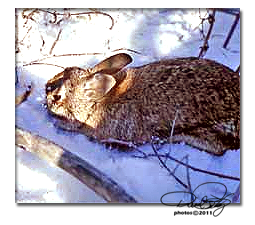
Winter snow and cottontails are made for each other

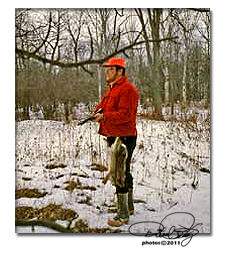
The shotgun was just a prop. The real reason I carried it on a walk around my 20 acres was in case I kicked up a cottontail rabbit. I’ve done a good bit of judicious timber cutting, and many brush piles hold bunnies.

I stoked the twin tubes of my Winchester 12-gauge over-and-under with low-brass No. 6 shot, and whether a bunny bounced out of a brush-pile or not wasn't the point.

The major attraction was an opportunity to be outdoors, firearm in hand, and going for a walk. Six inches of snow fell overnight, and it was just too nice and too pretty of a day to miss an opportunity by staying indoors.

A good day for a walk in the snowy woods, shotgun in hand

I donned a Hunter Orange hat and vest, tied up my boots, grabbed some sunglasses to prevent too much glare, and went for a hike.

The snow was fairly deep and it covered many fallen limbs, and that made me aware of potential hazards. If I didn't watch where I was going, there was the possibility of tripping over an unseen object.

A shuffling step or two would be taken, and then a long pause. The brush-piles stood out in somber and stark relief to the whiteness of the woods, and I encountered two or three fresh bunny tracks. Was it three different cottontails or just one animal making a lot of tracks?

Just walk slow, stop often and it’s like still-hunting deer

bunny
I'd follow each one along, stopping often, looking ahead, and crossed the tracks of three deer (one had a big hoof-print), but it was accompanied by a deer with a small foot, and my suspicion was a doe and fawn. One other track was seen, and it was traveling alone. Buck or doe? No clue.

There were several fox squirrels moving about, and one offered a shot but it wasn't taken. I watched the bushytail poke around on the ground only 30 yards away, and it offered an obvious easy shot but there are plenty of days left to hunt squirrels, but there was no interest today.

I noticed a weasel track nosing into one of the brush-piles, but it may have had a burrow to go down, because the white coat of the ermine wasn't visible. Years ago, I trapped a few ermine and always respected the vicious little animal for its hunting ability.

Kicking brush piles can be a good hunting method

My intentions were to stay on level ground, and I didn't want to risk traveling downhill to hunt through this much snow. Such downward hikes require climbing back up, which isn't a bother, except it provides a greater opportunity of slipping or losing my balance.

Only one cottontail was seen and it was boosted from a brush-pile just before the ground fell away into a ravine. I came up with the shotgun but the bunny was 40 yards out, running hard and it quickly ducked into another pile of brush part-way down the hill.

The situation appeared to be one where some caution was required, and on further reflection, my brain questioned the sanity of risking a downhill traverse to the brush. Perhaps I'd get a shot, but another brush-pile lay only 20 yards from where the rabbit took cover.

It appeared to be a rather foolish temptation, and it didn't take long to reject the idea. One rabbit wouldn't feed my wife and I, and later in the season, it would be tempting to take the trail of that cottontail again.

Better to do it later than now. My cap was tipped to the rabbit, and I retraced my steps, kicked around two or three other piles of brush without rousting another cottontail, and my hike ended with simply some great exercise.

The shotgun was nothing more than an excuse for taking a hike. But, with a shotgun in hand, I was hunting and having a good time and on a cold winter day, it was the best excuse I had for spending time outdoors.

Sunday, April 24, 2011

Take common sense into the turkey woods tomorrow


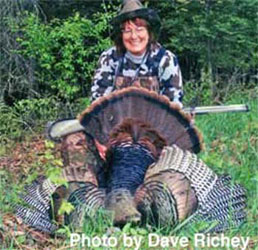
Cathy Beutler with a nice gobbler she shot while hunting with me.


Turkey hunting mistakes and the shotguns we use don't necessarily go together, but in many cases, they may come together whether we like it or not. People with much better eyesight than me can get along just fine, thank you, with just the bead on the front end of a shotgun.

They believe there is no reason to trick out their shotgun. That doesn't work for me or my wife. I use a scope while she uses a Bushnell Holographic sight. Each one works well for us.

My 3-inch magnum 12 gauge shotgun wears a scope with crosshairs. It more than allows me to aim with confidence at an incoming gobbler. A well identified gobbler can be seen with the naked eye but the scope helps me pick a hole in the brush through which I can positively identify and shoot my bird. It helps reduce wounding of a turkey as well.

Hoping that today's weather holds for tomorrow's turkey opener.


Kay's Holographic sight has a red ring that can be placed on the gobbler's head and neck, and the brightness can be turned up or down to match her needs on a bright or very cloudy day.

They were both sighted in a month ago, and we'll add new batteries just before our second-season hunt begins. We are fine as long as we don't fall or bang the scope or sight off a tree limb or a big rock. I once fell while hunting in southwest Texas, and knocked my scope so far out of kilter that I couldn't have hit the inside of a barn if I'd been standing inside it.

Several states are under my belt when it comes to turkey hunting. And even though the Michigan turkey season will be opening tomorrow, anyone who ventures out for wild turkeys this spring  should have some type of checklist. It certainly will help prevent forgetting some key element that is needed. I made that mistake once, got into my position well before the dawn, and reached  for my shotgun shells and they weren't there.

I then remembered leaving them sitting on the table as my coffee was hurriedly quaffed. My hunting vest was pulled on, my empty and cased shotgun was picked up, and out the door I went. It was a wonderful morning, and two longbeards slipped in to within 35 yards even though I wasn't calling and there were no decoys set out.

I sat still, watched the birds without spooking them, and still had a wonderful time. But hunting is not quite the same without a bow or loaded shotgun in hand.

In the heat of the moment, it's easy to forget where items are or which pocket they were put in the turkey vest for safe keeping. I generally go through a mental or written checklist the day before a hunt, put everything in my car, and it stays there until I finish hunting that season.

A mistake made on opening day several years ago.


I write occasionally about turkey hunting mistakes. Here is one of mine. I took off one morning, drove to my hunting area, got there long before sun-up in preparation for a half-mile hike to my chosen hunting area, slipped on my turkey vest and reached for my shotgun. It wasn't there.

It had rained the previous day while hunting, and I took the shotgun in the house to dry it off, clean it up, and forgot to put it back in its case and in the car. So, by the time I drove home, the sun was well up and another great turkey-hunting opportunity had been wasted.

What should this turkey hunting checklist contain? Obviously, it should have everything you'll need for turkey hunting. Once pulled together, leave all gear locked in the vehicle to avoid a problem like mine.

We'll start with the bare essentials. This would include

  • camouflage clothing
  • face mask, boots
  • camo cap
  • gloves
  • turkey vest
  • bow or shotgun

    Don't forget the shotgun shells and rain gear if needed. Of great importance is your spring turkey hunting license. It must be carried with you while hunting. Don't leave it in the car or truck.

    Next comes the less obvious but very important items. Anyone who checks many places for bird sign, and has patterned turkeys in several areas, should have a map showing these locations along with details of where birds roost, travel at dawn, move during the day, and how they return to their roost site. A handheld GPS unit can store a bunch of turkey hotspots, and it doesn't take up much room.

    Decoys have become an important part of a turkey hunter's gear, and don't forget them. Some people roll them up and stuff two hens and one jake decoy in the back of their hunting vest. I don't because if they stay folded for too long, it's a pain to heat them to pop the decoy back into its original shape.

    Hen and jake decoys are important items for many hunters.


    My old decoys have newspaper rolled up and stuffed inside the body and neck cavities. It makes them a bit slower to move on the stake during a breeze. A fast-moving decoy tends to scare approaching gobblers. I also cut several arrow shafts, glue in an insert and use a target point to stick it into the ground. The opposite end that goes through a decoy that has a washer that fits against the inside hole for the stake. Another target point and washer is placed at the top of the decoy, and the point is screwed into the insert. This allows the decoy to move. Paint these washers black. Just remember that a stiff breeze can still blow them around but there is a cure.

    Two stakes are cut from old aluminum arrow shafts, and have a target point screwed in. These stakes are used to prevent a decoy from spinning completely around on a breezy day. It allow the decoy to swivel 12-14 inches in one direction and that much in the other direction, and this provides the best results for me. It provides some decoy movement that can help sell the deal.

    Make certain any box calls are wrapped in an old dark-colored washcloth with one layer of cloth between the lid and box of the call to prevent unexpected squeaks. Keep all strikers for slate calls rubber-banded together to prevent them from clicking together in your vest. Know where each call is in your vest, and it doesn't hurt to bring a brown towel to lay on the ground. Place all calls to be used on the towel next to your leg for easy access when needed.

    Common sense and hunter safety must be practised while turkey hunting.


    A Hunter Orange cap or vest can be worn when walking into and out of the woods, especially in the predawn darkness. Once you get to the hunting area, take it off. It adds a wee bit of extra hunting safety to your day in the woods.

    Touch up any shiny object with brown, black or green spray paint. Carry shotgun shells, one each in different pockets, to prevent them from clicking together and making an untimely noise.

    Carry a cell phone but turn the thing off. Carry a topographical map of the area if one exists, but stow it somewhere so it doesn't crinkle and make noise as a gobbler approaches. A handheld GPS unit can mark your vehicle's location, the best place to set up, and tell you how to return to the vehicle when hunting strange land. A flashlight is always handy, as is a good compass.

    A foam rubber camouflaged butt pad is a luxury, and I carry one in the back of my vest. The small foam pad that folds down to be used as a seat is left up and in place and used to cushion my bad back.

    I'm still dithering about taking my Ten-Point crossbow or my shot. Bow hunting for turkeys is legal from a treestand, and I'm thinking of trying it tomorrow.

    What else? Anything else that you may need. I carry a turkey wing to slap against a tree or pant legs to simulate the fly-down sound of a bird coming out of a roost tree at dawn. A candy bar, cookies or a sandwich, and a bottle of water, are handy on an all-day hunt but pack them so they make no noise.

    The last two things a turkey hunter should take into the woods on opening day is a combination of common sense and optimism. Go forth with common sense telling you what to do or not do, and the optimistic thought that this is the day you'll take that husky longbeard. Think positively, and good things can happen.

    Saturday, January 01, 2011

    The squirrel wars


    Hunting squirrels after the corn picker comes along will work.


    The fox squirrel was making his move. He was putting a stalk on our backyard bird feeder.

    Squirrels must have poor memories. They spend all summer and fall hoarding food for winter, but they apparently forget where they left their stash of goodies. This bushytail was advancing on our bird feeders in a flanking maneauver, and I waited for him to start up the tree.

    The door was rattled, and I swear that bushytail cleared 10 feet and hit the snowy ground running. He will wait until he can get away with it, and try to empty the sunflower seed feeder.

    Black, fox, grey & red squirrels have a never-give-up attitude for our bird seed.


    Squirrel season used to end at the end of December, but now the season runs through March 1. And it's a made-to-order hunt on those days when the snow is skimpy or nonexistent, and when the weather is warm on a winter's day.

    Would I shoot one off the bird feeder? Of course not, but between chipmunks, red squirrels and their larger cousin -- the fox squirrel -- it has been a war around here for years.

    Bought a 50-pound bag of sunflower seeds lately. How about thistle seeds or Niger seeds? No, well they are expensive and the prices for seed never goes down.

    I don't believe there is any such thing as a squirrel-proof bird feeder. I've seen them shinny up a fiberglass pole attached to the railing. It was supposed to be squirrel-proof, but they figured out a way to climb it anyway.

    One squirrel will make a mess of the bird feeder. If two or three nutcrackers move in, and nothing is done about it, they will empty a bird feeder every day. They run off, their cheeks puffed out with bird seeds until they look like they have a goiter, and five minutes later, they head back on another raid.

    Deer hunting ended today amid a howling wind and snow. There is still snow in the woods for hunting cottontails or snowshoe hares, and it's over three months until the turkey season opens, so if you hanker a bit of excitement, go winter squirrel hunting.

    Winter squirrel season never has to take you far from home.


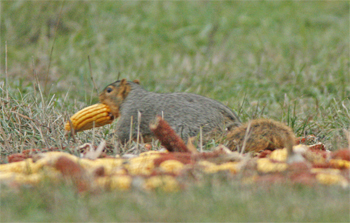
    There was a corn field near our house last summer, and some corn kernels still litter the ground. The corn will attract squirrels, but with the  earlier deep snow, bushytails found themselves out of a food source. Most of the corn from the nearby fields has been eaten by deer, geese and squirrels, and they are now looking for another free handout.

    I'm tired of them at the bird feeder. I don't share the same opinion of squirrels as some people who have unsuccessfully fought squirrel wars for more years than they can remember. They call these critters tree rats or wood rats, and other less complimentary mixes of strong Anglo-Saxon words. which, I believe, has led to the longer winter season.

    They are persistent little buggers. It's that nevergive-up attitude of theirs that makes them a nuisance.

    The best way to fight the squirrel wars is to grab up the shotgun and head for the woods. Sit down near a trail of squirrel tracks, sit still, and wait for them to show their long tails. They never expect to be hunted during the winter, and it takes a while for them to smarten up.

    Shoot one squirrel, and just sit still. Other nearby squirrels may chatter and carry on but soon their curiosity will get the best of them. They head out to get something else to eat, or to investigate the noise, and it's fairly easy to shoot five squirrels on a sunny and warm afternoon.

    What works? Black-powder pistol or shotgun, .22 rifle or a shotgun.


    Don't worry. Taking a limit of fox squirrels isn't going to hurt their population one bit. Shoot their numbers down, and you soon learn one of Nature's truisms: Nature abhors a vacuum.

    Once some squirrels are taken, other squirrels move in to fill the empty space. It becomes a never-ending problem.

    Years ago, when I was a kid, most people hunted nutcrackers with a rifle. The bullet from a puny .22 can carry over a mile if someone was to shoot at a squirrel up in the tree-tops. There are too many people around now, and the wide-open spaces of years ago are all filled up with houses and people.

    Be safe and smart, and use a shotgun. Don't forget your Hunter Orange clothing, and you'll be able to shoot them on the ground or up in a tree. Use No. 6 shot, and it will be deadly medicine.

    One thing about hunting nutcrackers. You'll put some mighty fine food on your table with five winter squirrels, and there will be fewer of the animals around next spring to invade your bird feeders.

    And that's just fine with me.

    Posted via email from Dave Richey Outdoors

    Saturday, March 06, 2010

    Beginner turkey hunter lessons

    I spent some time today outside listening to turkey talk as the snow quickly melted off the roof in near 50-degree temperatures. It was an immensely beautiful day to listen to the birds.

    It's always been my personal philosophy to teach kids to hunt. My oldest grand-daughter, at the wise old age of 19 years, was asking me about turkey hunting. I took her out several times for whitetails with a bow, and although she didn't shoot a deer, there were opportunities.

    "Are you interested in turkey hunting," I asked. She allowed as how she might be, and I allowed as how I might be talked into calling up a gobbler for her. That is, if she wanted me to.

    Determining whether to hunt turkeys or not can be an issue.

    That's when the questions started. And that's what I love about teaching children that really want to learn.

    "Are you ready to shoot a gobbler if we go hunting," I asked. "We'd be sitting on the ground, and the bird would probably be within 25 yards. The heart-pounding action comes as the bird gets close enough to walk in front of the shotgun. Do you want to kill a gobbler? Hens are off-limits during the spring hunt."

    "You've always told me that there is more to hunting than killing," she replied, nailing me to the spot.

    "That's true," I said, "but calling a bird in close enough for a shot can spook the bird if they spot any movement. A spooked bird may not come to me again or to another hunter. You don't have to shoot if you don't want to, but turkey hunting is altogether different than bow hunting for whitetail deer."

    "I'd like to shoot a gobbler," Jessica answered several years ago, "but I don't know whether I can or not. It's the moment of truth when I must choose to shoot or not shoot that I can't answer right now."

    This was as good an answer as any she could give. I wouldn't want someone to shoot a big gobbler if they had problems with doing so. I also don't want to put enormous pressure on her, nor do I want her to think that I'll be upset if she doesn't shoot or if she missed a bird.

    Seeing a big gobbler like this can give many hunters the shakes.

    "Look," I said, "you have nothing to prove to me other than your willingness to go hunting. A turkey gobbler may show up, four or five might show up, and I just want you to be prepared for what can happen during a turkey hunt."

    She faced her moment of truth with a big doe at 10 yards, and she was at full draw, and she later told me she wasn't ready yet to release the arrow. She is a good shot, but I'd rather see her wait until she was fully confident of her abilities, before she shoots an arrow.

    The same principle applies while turkey hunting. Where we bow hunted from an elevated and ground stand, we'll be sitting outside on the ground with our backs to a tree, and willing that gobbler to come our way.

    Sitting inside elevated or ground coop for deer is one thing. Sitting out, on the ground, and calling to a bird and watching him come -- quickly or slowly -- is a bit of heart-pounding excitement. The heartbeat races, the mouth gets dry, and the breath is sucking in and blowing out as hunters hyperventilate, and it's never easy to sit without moving while a gobbler closes the gap.

    "Do you think I can shoot a gobbler," she asked. "Will I have to shoot a lot to get ready? How would I have to dress? Do you have a shotgun that I could use? Would you call for me?"

    Beginning hunters can spend the next weeks studying turkeys traveling on the snow.

    Of course I would call for her. I'd have a shotgun for her to use, and she could wear the same camo outfit she wore last fall while deer hunting.

    "I'd love to take you turkey hunting," I said. "You'd have to shoot a shotgun enough to get accustomed to the recoil. The big secret to killing a gobbler is to wait for the gobbler to walk in front of your shotgun, and keep your head down on the stock while aiming and firing, and you can't move.

    "A knee jerk, any twinge or twitch, stiff muscles, sore butt, all of it has to be ignored when a bird is coming. They have eyes like an eagle, and hear very well. Any movement at all will spook the bird."

    She is eager but somewhat apprehensive. Trying to allay her fears of making a mistake wasn't easy, but it's my opinion that she has what it takes to shoot a gobbler once she sees a bird or two close enough to shoot. No one is a natural-born turkey hunter.

    First-time turkey hunters must experience a gobbler at close range to know how they will react.

    We all come to turkey hunting the first time without prior experience. That's where an older person can exert some influence, calm the hunter down, and be there for congratulations when they do everything right. Or to offer heartfelt condolences when it doesn't work.

    After all, as Jessica reminded me, hunting isn't all about killing. It can mean simply watching the bird, but one must be prepared with bow or shotgun in hand, in order to properly hunt. One could hunt every day of the season without shooting a bird, but in the end, it must mean releasing an arrow or shooting a load of No. 4, 5 or 6 shot at the bird.

    There comes, for every person who hunts, the Moment of Truth when people are suddenly faced with the prospect of shooting at the bird. Many can do it but there are some that can't, and it's best to learn early in a hunting career whether one can do it or not. There's no shame in not being able to shoot a deer or turkey, but from a personal standpoint, it's a point in a hunter's life that must be addressed.

    Posted via email from Dave Richey Outdoors

    Beginner turkey hunter lessons

    I spent some time today outside listening to turkey talk as the snow quickly melted off the roof in near 50-degree temperatures. It was an immensely beautiful day to listen to the birds.

    It's always been my personal philosophy to teach kids to hunt. My oldest grand-daughter, at the wise old age of 19 years, was asking me about turkey hunting. I took her out several times for whitetails with a bow, and although she didn't shoot a deer, there were opportunities.

    "Are you interested in turkey hunting," I asked. She allowed as how she might be, and I allowed as how I might be talked into calling up a gobbler for her. That is, if she wanted me to.

    Determining whether to hunt turkeys or not can be an issue.

    That's when the questions started. And that's what I love about teaching children that really want to learn.

    "Are you ready to shoot a gobbler if we go hunting," I asked. "We'd be sitting on the ground, and the bird would probably be within 25 yards. The heart-pounding action comes as the bird gets close enough to walk in front of the shotgun. Do you want to kill a gobbler? Hens are off-limits during the spring hunt."

    "You've always told me that there is more to hunting than killing," she replied, nailing me to the spot.

    "That's true," I said, "but calling a bird in close enough for a shot can spook the bird if they spot any movement. A spooked bird may not come to me again or to another hunter. You don't have to shoot if you don't want to, but turkey hunting is altogether different than bow hunting for whitetail deer."

    "I'd like to shoot a gobbler," Jessica answered several years ago, "but I don't know whether I can or not. It's the moment of truth when I must choose to shoot or not shoot that I can't answer right now."

    This was as good an answer as any she could give. I wouldn't want someone to shoot a big gobbler if they had problems with doing so. I also don't want to put enormous pressure on her, nor do I want her to think that I'll be upset if she doesn't shoot or if she missed a bird.

    Seeing a big gobbler like this can give many hunters the shakes.

    "Look," I said, "you have nothing to prove to me other than your willingness to go hunting. A turkey gobbler may show up, four or five might show up, and I just want you to be prepared for what can happen during a turkey hunt."

    She faced her moment of truth with a big doe at 10 yards, and she was at full draw, and she later told me she wasn't ready yet to release the arrow. She is a good shot, but I'd rather see her wait until she was fully confident of her abilities, before she shoots an arrow.

    The same principle applies while turkey hunting. Where we bow hunted from an elevated and ground stand, we'll be sitting outside on the ground with our backs to a tree, and willing that gobbler to come our way.

    Sitting inside elevated or ground coop for deer is one thing. Sitting out, on the ground, and calling to a bird and watching him come -- quickly or slowly -- is a bit of heart-pounding excitement. The heartbeat races, the mouth gets dry, and the breath is sucking in and blowing out as hunters hyperventilate, and it's never easy to sit without moving while a gobbler closes the gap.

    "Do you think I can shoot a gobbler," she asked. "Will I have to shoot a lot to get ready? How would I have to dress? Do you have a shotgun that I could use? Would you call for me?"

    Beginning hunters can spend the next weeks studying turkeys traveling on the snow.

    Of course I would call for her. I'd have a shotgun for her to use, and she could wear the same camo outfit she wore last fall while deer hunting.

    "I'd love to take you turkey hunting," I said. "You'd have to shoot a shotgun enough to get accustomed to the recoil. The big secret to killing a gobbler is to wait for the gobbler to walk in front of your shotgun, and keep your head down on the stock while aiming and firing, and you can't move.

    "A knee jerk, any twinge or twitch, stiff muscles, sore butt, all of it has to be ignored when a bird is coming. They have eyes like an eagle, and hear very well. Any movement at all will spook the bird."

    She is eager but somewhat apprehensive. Trying to allay her fears of making a mistake wasn't easy, but it's my opinion that she has what it takes to shoot a gobbler once she sees a bird or two close enough to shoot. No one is a natural-born turkey hunter.

    First-time turkey hunters must experience a gobbler at close range to know how they will react.

    We all come to turkey hunting the first time without prior experience. That's where an older person can exert some influence, calm the hunter down, and be there for congratulations when they do everything right. Or to offer heartfelt condolences when it doesn't work.

    After all, as Jessica reminded me, hunting isn't all about killing. It can mean simply watching the bird, but one must be prepared with bow or shotgun in hand, in order to properly hunt. One could hunt every day of the season without shooting a bird, but in the end, it must mean releasing an arrow or shooting a load of No. 4, 5 or 6 shot at the bird.

    There comes, for every person who hunts, the Moment of Truth when people are suddenly faced with the prospect of shooting at the bird. Many can do it but there are some that can't, and it's best to learn early in a hunting career whether one can do it or not. There's no shame in not being able to shoot a deer or turkey, but from a personal standpoint, it's a point in a hunter's life that must be addressed.

    Posted via email from Dave Richey Outdoors

    Saturday, February 20, 2010

    The Hunt Is What It's All About

    Anyone who spends any time reading my daily blogs must know I am a turkey-hunting addict. Deer hunting may be what I enjoy most, but the only reason for that is because turkey hunting seasons don't last long enough.

    It's possible to hunt whitetails during October, November, December and January 1. Turkey hunting in Michigan is much different with its short seasons.

    Even if you hunt the whole last season, which is about three weeks long, a hunter will get in the most hunting time, but its still not enough. It's a far cry from three full months of deer seasons. And when I can't turkey hunt, I buy used books on turkey hunting to read. Contact me at < dave@daverichey.com > if you have any turkey books to sell. I'll pay top prices for books in excellent condition..

    My turkey hunting often allows me to pass up a bird or two early in my season, and I've been known to pass up several gobblers that provided easy shots only to end my season without a bird. Why, you  ask?

    It's rather elementary. By not shooting the first, second or third bird that came to my calls, it allowed me the maximum time in the field and the greatest potential to experience everything turkey hunting has to offer.

    Shooting a gobbler, whether a jake or a longbeard, is not why I hunt these keen-eyed birds. I hunt them for the intense satisfaction that comes from making the most of my opportunities.

    That means there are more opportunities to fool a gobbler.  More chances to listen to a big Tom gobble and double-gobble back at me, and more opportunities to watch the blue-white-red head of a highly charged-up gobbler move through the fields and woods in my direction.

    Three years ago I was hunting a strutting zone 10 miles from where I live. Any bird that came to me would have to cross an open ridge, walk down the small hill, and cross another 200 yards of open field to get within shooting range.

    The gobblers greeted the dawn from their roost trees, and behind me were some hen turkeys. Once the first gobbler sounded off, I held off from answering. He gobbled again, and then a big gobbler sounded off with a double-gobble.

    I gave a  soft yelp, and that livened up the hens several hundred yards behind me. The gobblers sounded off again, and I answered softly, and sat back to wait. The hens began calling, and I was perfectly positioned in a strut zone where gobblers and hens would meet. Hens were coming from  behind me, and the gobblers were coming toward me.

    It was like being between two opposing armies as they advanced on my position. There no longer was a need to call or move. The hens were doing the job for me.

    Ten minutes later the gobblers stood atop yonder hill, gobbled again when they saw my two hens and one jake-decoy. They were spread out like soldiers, and began their advance on my position. They would stop and start, and I'm mentally urging them to hurry before the hens arrived and may possibly lead them away.

    The three longbeards and one jake started running when I made scratching sounds in the dry leaves like feeding birds. My shotgun was up and laying across my knees, and I was set up properly. It took those gobblers 10 seconds to cross the remaining 100 yards.

    The lead gobbler ran up to poor Henrietta, my battered and bedraggled hen decoy, and knocked her off the stake while the other gobblers went after the jake decoy.

    Poor Henrietta was laying flat on the ground with the large gobbler astraddle her, and the other birds were working Jakie over in a bad way. I watched this fascinating performance for another 10 seconds, and since it was now late in the season, the gobbler stood erect when he finished his brief job, stood with his head held high, as he surveyed the second hen decoy as a load of 3-inch magnum No. 5 copper-plated pellets took him down.

    The other gobblers stopped, saw the Big Boss Bird laying on the ground, and took off. I heard the hens flush behind me right after the shot, and then, all the real birds were gone.

    I've called in two different gobblers on seperate hunts over the years when my wife shot them with a bow. It was pretty exciting stuff , and each bird went 10 feet straight up into the air as the arrow drove through them, and both fell dead on the ground.

    Turkey hunting is exciting. Shooting the bird is anticlimactic, and the hunt lives on long after the bird has been eaten and thoughts of the hunt have faded away. Calling in a big gobbler, watching him approach, and then offering a shot is what triggers intense feelings in an addicted hunter like me.

    The shot is nothing more than the final act in this outdoor drama. Sometimes the gobbler wins, and sometimes he doesn't, but what counts the most is the actual hunt. This is a pastime where the hunt is far more important than the kill.

    I wouldn't have it any other way.

    Posted via email from Dave Richey Outdoors