Showing posts with label calling. Show all posts

Tuesday, August 21, 2012

Try grunting with a deer decoy

DRO_ Grunting up a buck
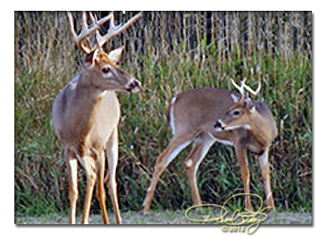
There's always a chance a big buck will investigate a grunt call
photo courtesy Dave Richey Outdoors ©2012
If you've never used a grunt tube to call bucks, you may be surprised in two ways: the call, properly used at the correct time, can call a buck within easy bow range.

The second way to be surprised is the sounds the call will make. It vaguely reminds one of ... ah, how can I put this delicately? Ah, ah, let's see ... ah, well, ah, sort of like someone four hours after eating a big plate of refried beans.

There, that's out of the way. For a first-time buck grunter, one often spends the first sequence of calling smiling and silently giggling. Just often enough, a grunt call will effectively pull a nice buck close enough for a decent shot.


A grunt tube sounds obnoxious but it does work...sometimes


There are two things to bear in mind about using a grunt call. No sounds you can make will scare deer away. The second thing is that it works best when you can see a buck.

Here's the scenario. You are sitting in a ground blind or tree stand, and spot a buck some distance away. A low grunt, breathe and grunt again for three or four seconds may stop a buck if he hears the call.
If the wandering buck stops, appears indecisive about what to do, wait and see what it does do. An amazing thing about grunt calls is that one buck will come to the call, and another one won't. You always work on the basic philosophy that this antlered critter is one that will. Feel it and believe in it.

Watch the deer. The animal knows precisely where the sound comes from, and may work his way cautiously or come on a dead run toward you. If the buck walks, trots or runs in your direction, do nothing but get prepared for a shot.


Pay attention to how a buck reacts to a call; Don't over-call


However, if the buck looks around and acts as if it doesn't know what it heard, wait. If the buck turns, and starts walking away, blow another sequence of calls but do so softly. If the buck stops, turns around and looks, wait to see if he will come. If he turns to walk away, give another calling sequence but even softer and shorter than before. Make it sound as if a doe or another buck is walking away.

That often is all it takes to turn a deer around. Watching how a buck reacts to the deer call is very important. Once they start coming in your direction, get ready for a shot because the buck may move to within 10 feet of your position.

There are any number of grunt calls available. There are calls that a hunter can blow into, but they can freeze up in cold weather. Other grunt calls work by inhaling air through the calls. A few have both features where authentic sounding calls can be made by inhaling and exhaling. This gives a very realistic tending buck grunt.


Try using an extension to position your call on the ground


One company believes that most big bucks are never found in trees, and it has an inhale tube that passes through 18 feet of rubber tubing so the call appears to be coming from ground level. This call appeals to me simply because it come from ground level, and a buddy of mine never sits over 15 feet off the ground and he calls bucks to him regularly.

According to my friend the best time to call bucks is prior to the rut. Bucks, he says, pay little attention to a grunt call during the rut and post-run periods. But other hunters disagree with that philosophy. They feel grunting may work anytime during the hunting season. Nothing about a grunt call  will frighten deer so I believe in using them whenever I but bucks within sight can come if they hear the call. It really can pay off at any time of the season.

Grunting with a nearby deer decoy can be deadly early in the season until just before the rut begins. This same man, who shall remain anonymous by his wishes, uses a deer decoy and a long-tubed grunt call at the same time.


Adding a deer decoy improves the effectiveness of a grunt call


He positions the deer decoy where to whether he plans to shoot a buck or a doe. Bucks will almost always circle and come to a doe decoy from the rear. He uses a small strip of white towel, and tacks it to the hind end of his doe decoy. The cloth is saturated with some type of doe-in-heat lure, and he strings 6-pound mono from him to a screw eye to an overhanging branch near the decoy's rump. He ties one end of the mono to the white cloth strip, runs it through the screw eye(s), and to his position in the tree.

If a buck is spotted, he gives one or two grunt sequences, making them soft and guttural sounding. Once the buck looks his way, he gently pulls on the mono line, and the combination of a grunt, the sex lure and a moving white strip of cloth on the doe's rump, makes it looks like a doe flicking its tail. Bucks often move in with caution.

My buddy thinks calling can be overdone. He begins with a short and soft muffled grunt that last one or two seconds, a pause, another longer and slightly louder drawn-out grunt that lasts several seconds, another pause, and a soft and short grunt, and that's it. If needed, repeat the sequence again, but call every 30 minutes. Sometimes blind calling will attract a buck passing through the area even though it is out of sight.

Using a grunt call isn't for everyone. If you feel self-conscious, leave it home. It the sounds doesn't bother you, and you wish to add two more tools to your deer-hunting arsenal, give a grunt call and doe decoy a try.

Nothing ventured, nothing gained.

Saturday, May 26, 2012

The season's last bird

Last ditch effort to salvage a turkey season. Not the best way to do this, but it can work. Maybe...
Two gobblers crossed the road ahead of the car as my neighbor and I headed for town and a dental appointment. Both birds had long beards, and were traveling together.

I've thought of them the last few hours. They were heading for a distant woodlot, and it's likely they will roost in those woods tonight. Would it be possible to call one in on the last day of the spring turkey season?

It would be a last-ditch effort. My computer has been messed up for three days, and we think the system got zapped by lightning. Who knows what caused the problem, but until today, turkey hunting has been the farthest thing from my mind.

I'm thinking of making an early-morning foray to the woodlot tomorrow. I can get close by sticking near a combination fence line-hedge row, and maybe I can pinpoint their roosting location. If so, there is a chance this late in the season that one or the other will come to the call.

It will be a quick in-and-out hunt. Approach closely, work into position under cover of darkness. sit still and whisper a love-sick hen call at dawn. I'll give them a chance to gobble if they choose to, but if they don't make a sound, I'll see if I can stir a gobble or two out of them. If that doesn't work, I'll be ready for one to come sneaking in to the call.
It's highly likely they won't be there. I should be out right now trying to roost the birds, but computer problems have messed up my schedule. I've just seen too many situations where the birds can travel a mile or two in the last hour or two before dark.

These Toms have been around here all season, and some hens have already had their little feather-ball babies, so perhaps a gobbler or two will come to visit a sexy-sounding hen. And again, maybe they won't move my way at all.
It will be me, light-weight camo clothing, camo hat, face mask, brown gloves and my Remington Model 870 3-inch magnum 12 gauge shotgun stoked with No. 5 copper-plated shot.

If things go as planned, and the gobblers walk out to me and my neighbor (haven't figured out yet whether to take a hen decoy or not), he aims to be ready. This is my last-chance day to call in a bird for him, and I want it to be as good as it can be.

There is no room for errors, and if this hunt works, it will be a first for me. I've never shot a gobbler on the last day of the season, but then again, I've never had to worry about this problem.

Hunting this late in the season has never been necessary. If my buddy is to shoot a bird, I almost always have done it on the first or second day of my hunting season. This year, my golden opportunity was wrecked by two people walking down the road.

I'm not mad at them because they have as much right to be there as I had being where I was at, but I had a gobbler in front of me and another behind me, and both were heading for the hen. It can be the best spot to be in, and it was obvious I hadn't factored in the walkers.

So that took care of my best opportunity. Whatever happens tomorrow morning will be the result of a last-ditch effort.
The gobblers may respond or they may be a mile or two away. I don't know, and I don't care, but I know one thing:
Unless lightning is flashing, and a storm is passing overhead, come dawn tomorrow, I'll be back-up to a big tree, and whining, cutting, purring and yelping for all I'm worth ... if that's what it takes to call in a gobbler.

Because the season ends very soon, and there will be no more chances until next year, so I'll do the best job possible. It will either be good enough to lure a gobbler within 40 yards or it won't. Hopefully, my neighbor's  hunting season will end with a bang.

If not, I've had a good season trying to work birds afflicted with a bad case of the shut-mouth. I like to pretend it's all about skill, but come morning, my buddy will be hoping for a bit of luck.

Thursday, April 12, 2012

Location is KEY

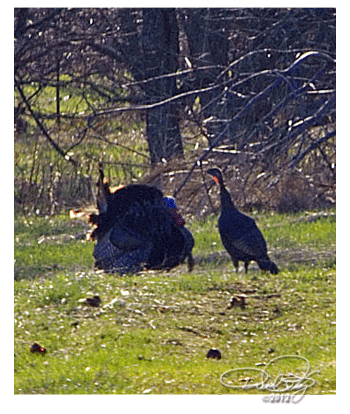
Big gobblers, like the left one, must be played carefully

Timing and Location play key roles in turkey hunting success
Big tom turkey's don't get old or big by being easily fooled. Timeing and location play key roles in turkey hunting success.
photo Dave Richey ©2012
There's an old real estate adage that almost everyone knows. The key thing to remember is  location, location, location. Where the land or home is located means almost everything.

This old saying also holds true for turkey hunters. Location means everything, and if a hunter is going to have any kind of success with a big gobbler, he must be in the right spot at the right time.

So far, I've talked to just two people with a first-season turkey tag, and neither man has found gobblers yet. Both cite high winds, rain and on again, off again cold weather and snow as various excuses.

We had some snow on the ground yesterday

One guy was looking for birds near home, and his brother was scouting a nearby area. My buddy checked where he'd seen a gobbler fly up to roost the night before, and estimated he was 150 yards away.

He waited for dawn, listened to the bird gobble once from the roost tree at about 6:30 a.m., and called twice, and that was all it took.

That bird might have come to him if he'd called, but the season is still about two weeks away," he said. "The bird flew down from the tree, and shut up."

His brother, who had not seen or heard a bird, and had traveled to what would be a new hunting location when their season opened. They walked into the area, sat down with their backs to adjacent trees, and began to listen for birds.

"I soon heard a bird that wasn't very far away," he said. "I listened to him for 40 minutes. He seemed to have a couple of hens and lesser gobblers with him. We sat still and never spooked the birds.

That's one way to play the pre-season scouting game

"At first we thought there was just one bird but it turned out to be two adult gobblers traveling together. Finally, one split away from the other, and came our way only to be spooked by a roaming coyote. Those birds should still be around when the next season opens."

Well, that just might be a bit of wishful thinking. All scouting does right now is show and tell you where the birds are today. They could be, and quite likely will be, two miles away when the season opens. The birds often do return to an area eventually if they are not badly spooked.
I've heard it mentioned many times by turkey hunters that they believe gobblers and hens may be spooking from decoys. If there is no wind, and the decoy doesn't move, the bird won't come in. Obvious, this isn't an across-the-board belief, but some birds seem definitely afraid of one or more decoys, and a scouting hunters should never put out decoys before the season opens.

More and more people are using decoys now than ever before. It stands to reason that some birds are spooked by the fakes.

Being in the right spot at the right time is crucial to success. I don't consider myself a great caller, but I know enough not to call too much once my season opens. Finesse the birds a little, don't call too loud so the bird gets spooky, and chances are good you can close the deal on a gobbler. The trick is to be patient, and don't call too loud or too often.

Years ago, my wife and I drew first-season hunting tags, and we got set up early, and she wanted to take her gobbler with a bow. I had her sitting inside a hunting coop. I had three decoys -- two hens and a jake -- positioned in front of her with the jake only 15 yards away.

I sat outside with my back to a big tree and waited for the first gobbler to sound off. A few crows called, and then he tuned up the volume and rattled the trees in that woodlot. I gave a soft tree yelp, and he gobbled again and again while I remained silent. It's part of the teasing process.

Here's a bit of good advice to try on a solitary gobbler

As a southern buddy used to tell me: "Tell 'em what you think they want to hear, but give them a pack of lies. Make your calls sound too good to be true, be patient and they may come."

Five minutes passed, and the longbeard gobbled again, and I gave a soft tree yelp, waited until he quit gobbling, slapped my pant legs a few quick times to simulate a bird flying down, and could hear that bird busting branches as he flew to the ground.

He gobbled again on the ground, came walking through the woods, walked within three feet of my boots and strutted out to whup on that jake decoy. I could hear him drumming and spitting, and he gobbled out a challenge to the jake decoy, and walked in to smack the fake bird around.

The gobbler offered Kay a good shot, and that was the end of that bird. It wasn't the largest gobbler she has killed, but doing it with a bow was a major accomplishment.

A year earlier, much the same thing played out as I called in a nice gobbler for her, and she took it with a shotgun. In fact, I've called in most of her gobblers over the past twenty years.

A person can be the best caller in the world, but if he is in the wrong spot, there will be no birds racing in his direction. Personally, I'd rather know where the bird is roosted, and be a mediocre caller, than to be in the wrong spot with championship calling skills on my side.

Location to a turkey hunter, as it is to a real estate agent, is the most important part of the hunting equation. It's what can put a tasty bird on a turkey platter this spring.

Just make certain your scouting efforts don't spook birds out of the area, and for Heaven's sake, be smart enough to leave your calls at home while scouting before the season opener. The birds don't need more of an education than they already have, and it pays to scout with binoculars or a spotting scope. Find the birds, drive away, and know where a few birds may be when your turkey season opens.

Thursday, January 26, 2012

Dreaming turkey hunting thoughts

A big boss gobbler fell to a well-placed shot during the spring hunt

kayturkey
It starts every year in late January. I submit my spring turkey application, and sit back and dream turkey thoughts. My turkey hunting vest hangs in the corner of my office. The pockets bulge with box calls wrapped in soft brown wash cloths, and secured with stout rubber bands to prevent an accidental sound at the wrong time.

The back of my vest has a couple of decoys and stakes, and there is a turkey wing I slap against tree trunks and brush to imitate a hen flying down to the ground at dawn.

Other pockets contain slate and glass calls, another pocket has a bunch of diaphragm calls, and scattered here and there is a crow call and an owl call although I rarely use them. There is a gobbler call that I have used perhaps twice in 35 years.

My vest contains everything I'll need for a turkey hunt

Most of my joy about turkey hunting comes from calling them. The idea of a big gobbler strutting his way to the call is a magnificent feeling. It is a wonderful sight, watching that bird react to soft clucks and purrs, and to watch a long-beard sneak through the woods, stop and go into a full strut and a booming gobble, is something I've experienced often.

Now me, I am not a good caller. Guys like Greg Abbas, Bob Garner, Bruce Grant, Arnie Minka, Phil Petz, Al Stewart and many others are good callers. Not me. I think I was tone deaf as a youngster, and never could sing a lick. I couldn't carry a tune in a picnic basket.
Countless records have been listened to, and there's no way the sounds that come from my calls sound anything like those on a record or tape.

The tapes have true sound quality, and the notes are crisp and sharp.

Mine tend to run together. There are calls I can't make, and I never try, but no matter how bad they sound to me, it matters little. It doesn't seem to bother the gobbler. Not one tiny bit!

Maybe the turkeys are as tone deaf as me. No one, write that down for posterity, no one is perfect all the time.

I've heard even expert callers blow a clinker once in a while

One of the secrets of turkey calling that I learned many years ago was that gobblers and hens, like men and women, have different voices. They don't sound the same, and humans are not meant to sound the same either. So if my turkey tunes are a little off, it doesn't bother me if it doesn't bother the birds.

I've argued back and forth with hens, and on more than one occasion, my squabbling with a hen brings him to me. Where she goes, the gobbler follows, and more than a couple gobblers have met their fate by following a snarly old hen to my call.

I've read books on turkey calling, and the author advises leaving the diaphragm home if a hunter can't use it right. I always let the turkeys determine whether it is right or wrong, and even when it sounds wrong to me, the birds seem to accept it.

Turkey calling is the epitome of turkey hunting

Turkey calling, to my way of thinking, is not so much about what you say with a call as how and when you say it. There is a certain rhythm to turkey calling, and if a hunter has the sense to know the string of sounds and put them together in the right order, the birds may come.

There is much good to be said about never calling too much. A hen that stays in one spot, doesn't move and squawks at the gobbler may not call a long-beard in. But, then again, maybe it will.

Try a running call a little bit, perhaps answer one gobble to let him know where you are, and that may be all it takes to lure a big Tom to the gun.

However, having said that, I've long experimented with using two calls at once. If a gobbler sounds hot on the roost, and is gobbling and double gobbling, but won't move in your direction, try using a box call and a diaphragm at the same time. It sounds something like two hens, and sometimes it will cause the gobbler to come running to investigate.

Nothing ever works 100 percent of the time, and I've seen world champion turkey callers mess up. Too much calling at the wrong time is a dangerous practice, and hunters must have the experience needed to know when and how much to call.

Shooting the gobbler isn't why I hunt them. I chase this long-spurred bird because I thrill at seeing a snowball-white head bobbing through the woods as it comes to my call. I've been known to let the bird come in, look for the hen and wander off, just so I can catch the buzz of having a gobbler up close.

It's a thrill I hope never to lose, and I'll be practicing my calling for the next three months. Perhaps the practice will help but it's nothing to worry about. I know that with time I can call in almost every gobbler that wants to come.

The problem is that sometimes gobblers just don't want to come. Go figure.

Sunday, October 09, 2011

Grunt up a buck

Harold Knight calls for fast action.


The 8-pointer was slowly making his way along the edge of a thick tag alder run, and was crosswind to me. I gave one short grunt, and one slightly longer grunt. Both were rather obnoxious sounding.

Not to the buck, though. He stopped in midstride, swiveled his head in my direction, and slowly turned my way. There is only one big-time rule to follow when using a grunt call for deer.

If the buck heads in your direction, don't call again. If the animal comes 50 or 100 yards, stops and looks around in obvious confusion, turn your head away from the deer, and give one soft and muffled call. The buck is looking for a direction, and you can say "Over Here" with one grunt. Put the call away and get ready for a shot.

On came the deer, and he swaggered to within eight yards, and stopped. He milled around for a minute or so, snuffling the air, and then turned broadside. My FirstCut 90-grain broadhead took him behind the front shoulder and exited the brisket. He went 40 yards and folded up.

I've used calls on bobcats, coyotes, deer, ducks, elk, foxes, geese, moose and wild turkeys. If any one thing holds true, it's that animals and birds can usually pinpoint almost exactly where the call comes from.

I've used many calls from a tree until several years ago. I've used all types of deer calls including those made by A-Way, Knight & Hale, Primos, Stratton Game Calls, Woods-Wise and many others.

One problem that has always  concerned me was that I know deer and other critters can lock onto a call's precise location. Who has ever seen a deer grunting from an elevation position? I haven't. H&M Archery Products of Willis, Michigan has a novel call that I've used for several years. Their philosophy is that deer don't climb trees so why should a hunter call from a tree?

They produce a call with a 14-foot length of coil-kink resistant rubber latex tubing that another 12-foot length of tubing can be attached to, and a hunter can sit 15 feet up a tree and lay out the other 11 feet of rubber tubing, and call from a tree but the grunt comes from ground level where it sounds most natural.

Any condensation occurs in the tubing, not in the call. This helps eliminate freeze-up in cold weather.

I begin with the 14-foot length but soon added another length that allows the call to be places off to one side of my tree where an investigating buck will be properly positioned for a shot.

This buck approached, grunting for fast action.


The nice thing is this tubing arrangement will fit most tube-type calls. It puts the sound at ground level where it is most effective.

Many hunters blow a sequence of grunts that is much too long. I keep my grunts short, pause and grunt again for several seconds, and then stop. Ten minutes later try calling again. It also helps to be rattling while calling to re-enact a calling sequence, and it offers a double-barreled approach to calling deer.

There are many different types of deer vocalizations but the grunt call works well. I've had little or no success with a fawn bleat, and only minimal success with a doe bleat. I seldom try them anymore.

One thing that works is to grunt if you see a buck. I've called in numerous bucks that were unseen, but calling works very well on visible bucks. It gives hunters a chance to judge the deer's reaction to the call, but if the deer come and then stop coming, muffle the call and grunt softly one more time. If they keep coming toward you, do nothing but get ready to draw and shoot.

One of the most exciting things about deer hunting is grunting in a good buck. The noises that come out of an inhale, exhale or inhale-exhale call may sound like your hunting camp buddy two hours after a plate of refried beans, but these three types of grunt calls do work.

As is true with everything else about bow hunting whitetail bucks, nothing is 100 percent except Uncle Sam tapping you for a yearly donation and that some day you will pass on to your just rewards. That said, grunt in a good buck and if he charges in with his neck hairs standing up, you will quickly become a convert to calling.

Once, a number of years ago, I spotted a buck 100 yards away. A grunt was made, the buck turned and came to within 15 yards, and no shots were taken. The buck eventually walked off, and another grunt sequence brought him running back again.

This sequence was replayed four times before the buck was allowed to wander off on his own. It seems to work equally well on old or young bucks. Just experiment with calling sequences but just don't call too much or too loud.

Trust me, it can pay off ... on a somewhat regular basis. A grunt call should become a part of every deer hunter's repertoire.

Friday, April 22, 2011

Location, Location, Location


A majestic gobbler lit up by the early sun. Shoot straight!


There's an old real estate adage. Everyone preaches ... Location, Location Location!  Where the land or home is located means almost everything.

This old saying also holds true for turkey hunters. Location means everything, and if a hunter is going to have any kind of success with a big gobbler, he must be in the right spot at the right time.

So far, I've talked to just two hunters with a first-season turkey tag, and neither man has found gobblers yet. Both cite high winds, rain and on-again, off-again cold weather and snow as excuses.

Hunting has been slow during the first turkey season. Blame it on the weather.


One was checking for birds near home, and his brother was hunting in a nearby area. My buddy checked where he'd seen a gobbler fly up to roost the night before, and estimated he was 150 yards away.

He waited for dawn, listened to the bird gobble once from the roost tree at about 6:30 a.m., and called twice, and that was all it took.
"That bird came to me, got to within 25 yards, and then turned and ran off," he said. "The bird flew down from the tree, came on a direct line to me, and then spooked as if frightened by my decoys."

I'm more inclined to think he was spooked by the presence of a hunter toodling on his turkey call. Guys who educate birds by calling outdoors before the season opens deserves to have all his calls taken away.

His brother, who had not seen or heard a bird, and had traveled to what would be a new hunting location when their season opened. They walked into the area, sat down with their backs to adjacent trees, and began to listen for birds.

"I soon heard a bird that didn't wasn't far away," he said. "I listened to him for 40 minutes. He seened to have a couple of hens and lesser gobblers with him. We sat still and never spooked the birds.

At first he thought there was just one bird but it turned out to be two adult gobblers traveling together. Finally, one split away from the other, and came our way only to be spooked vy a roaming coyote. Those birds should still be around when the next season opens."

Turkeys in some hunting areas may be spooked by decoys.


I've heard it mentioned many times by many hunters that they believe gobblers and hens may be spooking from decoys. If there is no wind, and the decoy doesn't move, the bird won't come in. Obvious, this isn't an across-the-board belief, but some birds seem definitely afraid of one or more decoys, and scouting hunters should never put out decoys before the season opens.

Being in the right spot at the right time is crucial to success. I don't consider myself a great caller, but I know enough not to call too much once my season opens. Finesse the birds a little, don't call too loud so the bird gets spooky, and chances are good you can close the deal on a gobbler. The trick is to be patient, and don't call too loud.

Years ago, my wife and I drew a first-season hunt, and we got set up early, and she wanted to take her gobbler with a bow. I had her sitting inside a hunting coop. I had three decoys -- two hens and a jake -- positioned in front of her with the jake only 15 yards away.

I sat outside with my back to a big tree and waited for the first gobbler to sound off. A few crows called, and then he tuned up the volumn and rattled the trees in that woodlot. I gave a soft tree yelp, and he gobbled again and again while I remained silent. It's part of the teasing process.

Five minutes passed, and he gobbled again, and I gave a soft tree yelp, waited until he quit gobbling, slapped my pant legs a few quick times to simulate a bird flying down, and could hear that bird busting branches as he flew to the ground.

Be patient while waiting for a gobbler to close the distance.


He gobbled again on the ground, came walking through the woods, walked within three feet of my boots and strutted out to whup on that jake decoy. I could hear him drumming and spitting, and he gobbled out a challenge to the jake decoy, and walked in to smack the fake bird around.

The gobbler offered Kay a good shot, and that was the end of that bird. It wasn't the largest gobbler she has killed, but doing it with a bow was a major accomplishment.

A year earlier, much the same thing played out as I called in a nice gobbler for her, and she took it with a shotgun. In fact, I've called in most of her gobblers over the past decade.

A person can be the best caller in the world, but if he is in the wrong spot, there will be no birds racing in his direction. Personally, I'd rather know where the bird is roosted, and be a mediocre caller, than to be in the wrong spot with championship calling skills on my side.

Location to a turkey hunter, as it is to a real estate agent, is the most important part of the hunting equation. It's what can put a tasty bird on a turkey platter this spring.

Just make certain your scouting efforts don't spook birds out of the area, and for Heaven's sake, be smart enough to leave the calls at home while scouting. The birds don't need more of an edge than they already have, and it pays to scout with binoculars or a spotting scope.

Find the birds, drive away, and know where a few birds are when your turkey season opens.

Monday, April 18, 2011

Turkeys can make fools of hunters


Is a gobbler like this one in your future. Hunt hard and smart?


It was quiet today. Too quiet for the first day of the first hunt of our Michigan's spring turkey season.

After two days of very strong winds, it dawned fairly windy this morning which would keep the birds roosted longer. I was outdoors a good bit today, and heard nary a gobble or a shot. I made a few phone calls to some turkey-hunting friends around the state, and based on what was seen and heard, the opening day got off to a slow and quiet start.

I've avoided the issue for a variety of reasons, but most importantly, it would never be my intention to play the gas-price hole card to cause people to stay home. But with gas prices that seem determined by supply and demand or price gouging to hit a new high every day, many people are foregoing some of their former outdoor pleasures to save money.

A bad first day of the turkey season doesn't make a hunt.


Trust me, I feel your pain because we've pulled in our horns due to high gas prices. A couple of people I've discussed the issue with feel as I do: people aren't traveling very much. The steelhead runs showed fewer anglers; fishing guides report fewer spring trips; and I suspect when all the votes are counted, many sportsmen may give up their chance to turkey hunt unless they can do it close to home.

The cost of losing one day's wages by taking time off work doesn't appeal to any of us. No one can really afford to go as often as we did a few years ago. The inflated price of gasoline will hurt some of the tourist business in many locations.

But then, is that really the cause of a poor showing today? Who knows? It could be the fault of the weatherman telling us that tomorrow or Wednesday we may see another 10 inches of snow, which certainly wouldn't help turkey hunters.

Can we ignore the possible warnings? I think not, based on the screwy weather we've had since New Year's Day. It's certainly not been like most Michigan winters. We get quite a bit of snow in our area near Traverse City, and I've kept track since the first significan snow-fall last November, and I've tallied 176 inches so far.

Some snow won't bother the gobblers but if the white stuff is accompanied by very much wind, it will keep the limb-hangers in place longer than usual. An old-fashioned blizzard would wreck at least two days of hunting effort.

Hunters must be prepared for any weather eventuality.


We've heard the wind blow before in this section of the north country, and often such storms blow through to the north or south of where we live. It makes little difference: it will have an major effect on hunting success wherever it hits.

In past years of driving back roads while scouting for birds, I've come to accept one fact: the fewer vehicles spotted while scouting usually means fewer hunters in the woods, which can mean a reduced turkey harvest.

Of course, wild turkeys are every bit as unpredictable in their actions as the spring weather. I've hunted lots of years in many areas of the country. And one very important thing I've learned is that predicting the actions of a big old Boss Gobbler is much like predicting your mother-in-law's attitude in advance of her visit. I'd like to talk to someone who has figured out gobblers and moms-in-law, and maybe they could teach me something I should know.

So, is there a moral to this story? You bet, and let's hope it works for you this week and me next week. The short and sweet part of this moral is simple: we can't change the weather, and even if we could, wild turkeys have a strange sense of timing. They always seem capable of throwing a big monkey wrench into any potential turkey hunt, and often do so without provocation.

Lay the best plans in the world, exercise the utmost caution, possess the stillness of a hunting owl, and yet, wild turkey can and will out-wit human hunters. Call like a champion, choose your hunting areas with great care, enter on quiet feet long before dark, sit with the patience of Job, and turkeys may spot the slightest movement, and charge off to parts unknown.

The best of plans often go awry when it comes to gobbler hunting.


The balance of your hunting time may be spent trying to find one gobbler who was in the back of the classroom when hunter savvy was handed out, and he may still find a way to humiliate a grown sportsman. He may zig when you feel he'll zag, and the shot pattern will poke tiny holes in the dirt but not in the bird.

It's nothing personal, you know. Turkeys don't think like we do, and I've seen them come 300 yards as straight as a string, and when they are within five yards of providing a shot, they will stop, strut a bit, turn around and walk back to their original spot. Who knows why?

It's been said many times that there's more to turkey hunting than pulling the trigger. Sometimes us mere mortals just don't stand a chance in the turkey woods. It's just part of the turkey mystique we must accept, even if we never do understand it.

Saturday, April 09, 2011

Murphy’s Law and Turkey Hunting


A turkey decoy (left) and a jake gobbler we passed up on that day.


It was the nicest day of my second turkey season in Area K several years ago. It was clear and cool when we got into a good spot to listen at dawn. My buddy Arnie Minka was giving me a break: no turkey talking for me today. He would do the calling on the last day of my season.

There was no wind, which was a blessing after all of the wind of the past two weeks, and we sat quietly waiting to see if any gobblers sounded off at daybreak. Dawn was a pink blemish on the eastern horizon when the first bird gobbled nearly a mile away.

Five minute later another bird gobbled, hit a double-lick, and then single-gobbled to punctuate his earlier comment. Two minutes later the bird, perhaps 250 yards away, gobbled again and then another bird gobbled a half-mile to the west.

Wild gobblers calling at dawn


We sat patiently, waiting for another gobble, and weren't disappointed. The only thing is this bird was off in the woods several hundred yards away, and the hens were talking up a storm. Arnie let him gobble again, and then stroked out a soft yelp on a box call.

Two birds gobbled hard, took a breath and gobbled again. I'm thinking this is a little bit of alright. Arnie was grinning under his face mask.
He switched, just to see if it would work, to a slate call. The peg rasped out a soft purr and whine, and both birds lit up again. He didn't want to rush the calling too much. He wanted to let it get a bit brighter so it would be easier for me to see an approaching bird.

He picked up the slate call again, drew the peg in a soft J-stroke and the soft yelp turned on one of the birds. He rasped out a throaty gobble, roaring hard, and that forced the bird 250 yards away into a similar respon

Here we were on this wooded hilltop, approximately halfway between two lusty gobblers. The bird farthest away gobbled once, and it sounded as if he was closing the gap. Arnie gave another soft yelp on the slate call, and both birds answered. This was getting pretty exciting.

The neat thing was we were working two birds, and their male ego or whatever turkeys possess wouldn't let either bird give in. Box call or slate, it made no difference to them. Both birds were coming, and he softly teased them with another soft yelp and purr.

Suddenly, both gobblers shut up. Murphy’s Law had struck again.


They gobbled, each bird now within 200 yards, and the furthest bird double-gobbled and I thought I could see him approaching the tempting hen decoy. The other bird gobbled, rattling the woods, and Arnie whined softly on the box call, and that lit him up like a July 4th fireworks display.

All of a sudden, there was no noise. Not a turkey gobble, not a crow cawed, and Arnie hit another soft lick on the box call and slate. Nothing. The birds had gone mysteriously silent.

Why, I wondered, he hadn't hit any bad notes with his calls. Something had to have frightened the birds.

Two people were tending to farm chores. It wasn't hunter harassment, but more like Murphy's Law crimping our style.

We quickly moved our base of operations 100 yards, and tried again. There was no gobbles, no nothing. It was as if the ground had opened up, and swallowed both birds.

There was a vantage point another 100 yards away where we could see where the other bird had been, and we made our way to it. I laid my shotgun aside, and we spent 20 minutes glassing woodlots and open fields on both sides of the road.

We sat back, thought about it, and began glassing an area across the road. A gobbler stood out in the field at least 500 yards away, and was watching the road. He was a half-mile away from us, and there was only one way that might put us within shotgun range.

It would be a mile hike, and we dropped off our hill top vantage point, studied the terrain where the other bird had been, and saw nothing. We moved through the woods, across plowed fields, crossed the road and entered the woods.

We moved slowly and silently through the wet woodlot, and eventually got to within 200 yards of where the bird had been. That joker had disappeared. We walked through a woodlot, and never saw him again.

Several other spots were tried, and we took a long scouting ride, but there were no more turkeys.  We saw one jake with a two-inch beard, and he never received any consideration from me. I'd let him grow into something bigger for next year.

My season ended early that spring when four hens and two jakes were spotted crossing a field and heading for their roosting area. They offered us a brief thrill but we both realized that Mr. Murphy had ridden our backs all day. He proved, once again, that if anything can go wrong on a turkey hunt, it will.

The good thing was our hunt was fun while it lasted.

Sunday, April 03, 2011

Naming some past turkeys


Some turkey gobblers are so special they deserve to be named.


Naming some of the gobblers we hunt lends a certain auro to them. The names also can identify certain Toms, and help us to remember where they were taken or shot at and missed. This practice of naming gobblers seems more prevalent down South than here in Michigan, but I often try to hang some kind of moniker to special birds.

What makes some of these gobblers so special? Many reasons come to mind, but difficulty in hunting them is a primary reason. Names become more common when more than one person knows the location of a particular bird.

Tonight's blog names some special birds I've hunted in Michigan. Countless can make a certain gobbler special.

The Ghost Gobbler


A special bird is the one I called the Ghost Gobbler. As one might expect from it's name, this bird lived for at least four years, and he was an odd bird. I hunted him for three years, and the reason I knew it was him was because he always seemed to show up unexpectedly and alone.

One of his traits was I saw him only once with another bird. He always seemed to travel alone, and he was never vocal. I watched him for two days from a distance of a quarter-mile, and saw him breed one hen. It's the only time I ever saw him with another bird. He actually seemed to avoid other gobblers.

He often roosted some distance from other birds. Once, I was working a different gobbler that eventually came to my shotgun along with two hens. I heard a rustle in the spring leaves behind me, and rather than turn and look, I concentrated on the incoming gobbler. The bird appeared at 20 yard, went into a full strut, and I shot him. Then I wheeled around, not to shoot but to see what was behind me, and it was the solitary heavy-weoght gobbler with a 12-inch beard.

He didn't gobble, and one day I set up in several different locations, trying to get in front of him without being seen or heard. I saw the bird three times that day, and although I did get in front of him, invariably he would go elsewhere. Three seasons passed, and I saw the same lone bird each year, but he never came to the call. He seems to have disappeared last year, and this is the only gobbler I've seen that would breed a hen and vanish. I never heard him utter a sound, and only once was he observed with a hen, and he was breeding her. He was the largest gobbler in 10 square miles, and I never heard of anyone ever taking that bird. He truly was a ghost gobbler.

The High Ridge Gobbler


This bird was one of a large group of turkeys that hung close to a ridge overlooking one of Michigan's major trout streams. Me and another guy hiked in to a spot well before daybreak, and sat and waited quietly. As the tweetie birds began chirping and a crow passed overhead, one gobbler on that ridge gobbled. That single gobble triggered gobbles from a half-dozen other nearby Toms. By the time the last one answered, the first bird double-gobbled, and each bird in turn would double-gobble.

The sound worked up and down the ridge like thunder from a summer storm, and then a solitary gobble came from across the river, and all six longbeards on our side had to answer. The ground=shaking roar of the birds was a wild cacophony of turkey talk that sent shivers up and down my spine. Then, we heard the sounds of heavy bodies breaking tree branches as the six birds flew down 100 yards away.

"Sit there," he whispered softly, pointing to a tall and wide stump. I'll get over behind yonder tree to call. The birds will walk right past you for an easy shot."

That didn't happen. The birds circled around, down the ridge and out of sight, and came up the hill at 75 yards. They spread out, and the biggest bird headed for where my buddy lay, belly on the ground, sweet-talking the birds. They circled around, keeping my ground-hugging friend between me and then. There was no chance for a safe shot.

They kept coming, and the biggest gobbler was double-gobbling, spitting and drumming, and I sat back to watch the show. That bird walked up to my prone partner, stood right between his legs, and gobbled lustily in his ear. I kid you not: my buddy seemed to instantly levitate about two feet off the ground, which spooked all the gobblers. I laughed so hard I was crying, and once the birds had disappeared, he asked: "Why didn't you shoot?"

I was laughing too hard. One more step, and that gobbler would have been standing on his butt. He didn't think it was funny but it was worth not shooting just to watch him jump.

The Cemetery Gobbler


This bird always roosted just behind a very old family cemetary right next to state. Tombstones were crumbling, names were faded, and it appeared to be a homesteader's plot far back from any road. I'd glassed the area from afar, and it was surrounded by state land.

I hunted that bird at dawn, but he seemed to favored an open field some distance away to strut for any nearby hens. This bird was cagey, and one day he would choose a strut zone in one location, and the next day he'd be in another part of the field. There was no pattern to where he would meet the hen at mid-morning.

It was the last day of my season, and I decided to sleep in. That afternoon, I hiked into the area near the cemetary, and since I knew which tree he roosted in, I moved to a spot he always seemed to pass before flying up to roost. It would put me into the right area at the right time, well before sundown.

There would be no calling this day. I was in place for two hours when I saw him moving slowly through the woods to his fly-up point. He walked past me at 20 yards, I checked my time, and I was fine with plenty of legal shooting time left. The bird stopped at 35 yards, and looked around. I put the crosshairs of my Bushnell scope on his head-neck area, clicked off the safety, and whispered "Hey!" His head went up like a periscope, and it was an easy shot. That Michigan gobbler weighed 20 pounds.

There are many other turkey tales about birds I've named, and more will have to wait for another time. Hopefully, these will whet your appetite for the upcoming spring turkey season. Remember this turkey-hunting advice: shoot once, shoot straight and don't miss.

Monday, January 17, 2011

Looking ahead to turkey season


Turkey hunting is fun even if a bird isn’t shot. Calling produced for me.


Anyone who spends any time reading my daily blogs knows I am a turkey-hunting addict. Deer hunting may be what I enjoy most, but the only reason is because turkey hunting seasons don't last long enough. We have more than three months to go but I’m juiced already.

It's possible to hunt whitetails during October, November, December and January 1. Turkey hunting is much different.

Even if you hunt the whole season as has happened in the past, a hunter will get in about six weeks of hunting. It's a far cry from three full months of deer seasons. And when I can't turkey hunt, I buy used books on turkey hunting to read. Contact me at < dave@daverichey.com > if you have any turkey books to sell.

Turkey hunting is like selling a house: Location is everything.


My turkey hunting often allows me to pass up a bird or two early in my season, and I've been known to pass up several gobblers that provided easy shots only to end the season without a bird. Why, you  ask?

It's rather elementary. By not shooting the first, second or third bird that come to my calls, it allows me the maximum time in the field and the greatest potential to experience everything turkey hunting has to offer.

Shooting a gobbler, whether a jake or a longbeard, is not why I hunt these keen-eyed birds. I hunt them for the intense satisfaction that comes from making the most of my opportunities.

That means there are more opportunities to fool a gobbler.  More chances to listen to a big Tom gobble and double-gobble back at me, and more opportunities to watch the blue-white-red head of a highly charged-up gobbler move through the fields and woods in my direction.

Three years ago I was hunting a strutting zone 10 miles from home. Any bird that came to me would have to cross an open ridge, walk down the small hill, and cross another 200 yards of open field to get within shooting range.

The gobblers greeted the dawn from their roost trees, and behind me were some hen turkeys. Once the first gobbler sounded off, I held off from answering. He gobbled again, and then a big gobbler sounded off with a double-gobble.

Gobbles, double-gobbles and more made the ground shake. What a moment.


I gave a  soft yelp, and that livened up the hens several hundred yards behind me. The gobblers sounded off again, and I answered softly, and sat back to wait. The hens began calling, and I was perfectly positioned in a strut zone where gobblers and hens would meet. Hens were coming from  behind me, and the gobblers were coming toward me.

Ten minutes later the gobblers stood atop yonder hill, gobbled again when they saw my two hens and one jake-decoy. They were spread out like soldier, and began their advance on my position. They would stop and start, and I'm mentally urging them to hurry before the hens arrived and possibly lead them away.

The three longbeards and one jake started running when I made scratching sounds in the dry leaves like feeding birds. My shotgun was up and laying across my knees, and I was set up properly. It took those gobblers 10 seconds to cross the remaining 100 yards.

The lead gobbler ran up to poor Henrietta, my battered and bedraggled hen decoy, and knocked her off the stake while the other gobblers went after the jake decoy.

Poor Henrietta was laying flat on the ground with the large gobbler astraddle her, and the other birds were working Jakie over in a bad way. I watched this fascinating performance for another 10 seconds, and since it was now late in the season, the gobbler stood erect with his head up to survey the second hen decoy, and a load of 3-inch magnum No. 5 copper-plated pellets took him down.

Henrietta, my hen decoy, was spurred badly and now looks worse for wear,


The other gobblers stopped, saw the Big Boss Bird laying on the ground, and took off. I heard the hens flush behind me right after the shot, and then, all the real birds were gone.

I've called in two different gobblers on seperate hunts over the years when my wife shot them with a bow. It was pretty exciting, and each bird went 10 feet straight up into the air as the arrow drove through them, and both fell dead on the ground.

Turkey hunting is exciting. Shooting the bird is anticlimactic, and the hunt lives on long after the bird has been eaten and other thoughts of the hunt have faded away. Calling in a big gobbler, watching him approach, and then offering a shot is what triggers intense feelings in an addicted hunter like me.

The shot is nothing more than the final act in this outdoor drama. Sometimes the gobbler wins, and sometimes he doesn't, but what counts the most is the actual hunt. This is a pastime where the hunt is far more important than the kill.

I wouldn't have it any other way.

Posted via email from Dave Richey Outdoors

Wednesday, March 17, 2010

How not to shoot a gobbler

Turkey season is still about a month away but I've been thinking about turkey hunting all day. I wonder: How many ways are there to miss a longbeard? Let me recount several ways to totally miss a big gobbler. Some are easy for most people, and other sportsmen may have some rather innovative ways that can lead to a complete miss.

My neighbor is seeing about 25 birds daily. He was hoping for an early-season tag but settled for a third season hunt, and since I'll do my best to call one within 30 yards for him, I want him to know the many ways that missing a big gobbler can happen.

*Missing a gobbler with a shotgun is something to ponder as opening day approaches. It's been many years since I first teased three Toms close enough for a shot. My hunting companion lifted her head off the stock as she shot, and any head movement causes the shot pattern to go high. All three birds ran off unharmed. Moral: Make a conscious effort to keep your head down on the stock and squeeze off the shot when the sight settles on that area where the head and neck join. Moral: The job is done right when the shotgun goes bang and the gobbler falls over without a wiggle.

I believe shooting gobblers in the woods is easier than hunting the fields.

*Another time a person got so caught up in watching a cautious gobbler approach that when it was time to shoot, she was hyperventilating so bad she felt faint. Her companion shot and killed the bird. Moral: Take a deep breath, relax and concentrate on the shot. Another trick to remember is to take a breath every few seconds.

*A buddy tried to swing around a tree and shoot while a big gobbler approached from the rear. A human has as much chance of swinging around, shooting and killing a gobbler from an awkward-angle as most people have of flipping the light switch and getting out of the room before the light goes out. Moral: Sit still, don't call or move, and wait for the cautious gobbler to walk around your location and step in front of the shouldered shotgun. If the shotgun isn't up to your shoulder long before then, you deserve to not get a shot. You also deserve to miss.

*A buddy of mine wasn't paying attention one morning. He had heard a bird gobble in front of him, and didn't realize it was circling and looking for a hen. He eventually spotted the decoy after he moved his leg to relieve a nasty cramp. Moral: Once a turkey gobbles, and starts moving your way, don't move. Let the cramp develop, wait for the gobbler to stick his head up out of cover, shoot him and then scream with pain.

Sometimes a hunter must tough out the pain to get a shot.

*I can't vouch for this one but it was told to me by a man who speaks the truth. He and a hunter were walking softly through the woods when a gobbler ripped off a full-throated gobble about 50 yards away. The two men sank against nearby trees, the hunter reached into his pocket for a shotgun shell, stuffed it into the breech of his 10 gauge magnum, and silently eased the pump closed. One brief call, and the bird double-gobbled, and stepped out into the open. The hunter was set up perfectly, and the shotgun's front bead settled on the head-neck area, and he softly clicked off the safety and pulled the trigger. A faint click was heard but the gobbler hauled his tail feathers out of the area. Moral: Do not do like he did and put a roll of Life Savers in the same pocket as the shotshells. Nothing happens when the firing pin encounters the end of a roll of candy.

*Don't just slap a scope or red-dot sight on the shotgun, and figure you are set. A guy I once knew gradually learned that scopes or red-dot sights can be an asset in the turkey woods. It's also important to sight them in so you know where the shot charge is going. He didn't do that, and when he shot, a tree limb fell and almost hit the gobbler on the head. Moral: Do your homework and know how the shotgun shoots with a certain load. Never, ever mix up shotshells of the three sizes (No. 4, 5 or 6 shot) in your pocket. My cornshucking pump 12 mag shoots No. 5s very well but a No. 4 or 6 shot leaves shot pattern holes big enough for a gobbler to walk through. Moral: Carry just one size of shot and pattern the shotgun long before the season opens.

*I took a guy out several years ago, and we had a long walk to the hunting area. We stopped so he could take a breather, and he leaned his unloaded scoped shotgun against a tree in the pre-dawn darkness. He got slightly turned around in the dark, bumped his shotgun, and the scope hit a big rock when it fell. I called a nice gobbler to him a half-hour later, and ... you guessed it. The scope was knocked out of kilter, and he missed the bird. Moral: Never lean a loaded or unloaded shotgun against anything. If necessary, unload it, leave the action open, and lay it softly on the ground.

Avoid being surprised by the sudden appearance of a nearby gobbler.

*Almost last are these two dandies. I was calling for a first-time hunter, and this young lady was cautioned that the birds were circling and she had to sit still, don't move a muscle and let the gobbler walk in front of her shotgun. I kept saying in a soft whisper: "Sit still. I can hear the birds 20 yards behind us. Don't move and don't make a sound. Five minutes later a gobbler walked up from behind her, passed within 10 feet of her right elbow, and she gave a startled "Eek!" Moral: This lady missed her bird without firing a shot because even though she was warned, she wasn't mentally prepared for a bird at close range.

*Another woman, this one from out west, came to shoot a gobbler. I eventually called up a nice gobbler to within 20 yards. She missed a standing quartering-away shot with her bow, and I handed her a shotgun. She insisted she had killed the bird but I knew she had missed. She said "I'll shoot it with the shotgun," and proceeded to miss it standing, head-up, now at 30 yards. The shot charge tore up the turf 10 yards from the bird, and again she insisted she had killed it. The bird ran into the woods, and we flushed the big gobbler and it took wing. I told her that was her bird. She insisted her bird was dead so we ended that hunt. Moral: It's easy to miss a gobbler, but if you miss, have enough common sense to fess up and admit it.

Even I, believe it or not, have missed a turkey gobbler. But that was a long time ago, and is a story for another day.

Posted via email from Dave Richey Outdoors

Friday, March 12, 2010

Spring has sprung and some gobblers are calling

A new metal roof was installed on our roof a few years ago. I was outside yesterday before last night's heavy rain, looking up at what little snow that remained, and watched the last of it come down.

Mind you, I understand fishing and hunting, but the mechanics of metal roofs isn't in my bag of tricks. I was standing there, looking up,  and heard a hen turkey nearby cut loose. She sounded as if she was scolding a gobbler that may have been pestering her.

There was a soft rumble, and about 10 pounds of snow landed out in front of my somewhat foolish head. Thankfully, the snow was loose and not loaded with ice as it was several days ago.

There is, I suspect, a short period of education about metal roofs as the thought dawned me. I'm not the sharpest knife in our drawer, and after scraping snow off my head a few times, pulling out my shirt-tail and shaking out the snow that snaked down my back, a light went off telling me that standing under the edge of the roof could be adangerous piece of business to my longtime health.

A flock of hens are kept in line by two gobblers.

I walked away from the roof, stood out of harm's way, and listened as a gobbler 100 yards away and out of sight, gobbled at the hen. It appeared on this bright, warm and sunny day, that he was trying his best to pull together a harem of hens.

It's probably still a bit too early for him to get very excited about breeding hens, but for me, spring fever has set in. I'm eager to go back outside after this is written, and soak up some of the warmth that has been missing from my life since early last fall.

It's about 50 degrees, and one must stretch their imagination a bit to say that 50 degrees is warm, but all things are relative. Fifty degrees is warm when compared to the teens and the 20s of a week ago.

It's a day for doing very little except trying to get accustomed to a bit of warmth in the air. I still had to shovel off the front deck to clean things up, but that is fine by me.

It is a trade-off. Warm weather makes snow slide off my roof. In places, it misses the deck and falls over the railing. In other places it lands with a dull thud on the deck, shakes the house, and just lays there making a mess of things. In open spot, there is a deck railing that was destroyed two weeks ago by falling ice and snow.

I could do, as I once did, and figure if the Good Lord wanted snow there, He put it there and could make it go away. It seems the going-away part gets lost in the translation of my thoughts, and it also means that it's time to go to work.

I'm no longer fond of snow.

Shoveling snow isn't one of my favorite winter chores, but it is a necessary evil. Last summer I reached the age of 70, and with the vision loss in one eye, meant crawling up on the roof to clean it off three or four times a year was foolhardy and stupid. I agreed with that.

My balance is bad on slanted surfaces, and even worse when those surfaces are snow and/or ice-covered. My depth perception is off a twitch or two, and my family could see me sliding off the roof. Even worse than falling to the deck would be to fall and spread-eagle myself on the deck railing. It would probably ruin not only a day but many days, and it seems an unnecessary risk I wouldn't take.

So ... the metal roof was installed. All I need to do now is get a hard hat to wear, start paying more attention when the roof snow starts to melt, and pay more attention to my roof than listening for turkeys gobbling.

Listening to gobbler music is more fun than almost anything.

Oops, there was another gobble. I must be learning, because I'd moved away from the edge of the roof in time to escape the last  little bit of wet snow.

I stood, listening to him rattle the woods and kept trying to spot him through the trees. I haven't seen a hen or gobbler today, but I'm about to start looking for birds.

Maybe a couple of birds will come to stand back in the woods and watch the foolish human as he listens to them. Those birds are smarter than me. They walk around, eat and I've yet to see one with a show shovel.

Whoever said turkeys are dumb have no clue. I know better.

Posted via email from Dave Richey Outdoors

Sunday, March 07, 2010

Calling gobblers can be easier than you think

It was a simple question. A man asked a few days ago if i was a great turkey caller.

The answer was a resounding "no." Great callers are guys such as Greg Abbas, Chris Boesel, Paul Butski, Bob Garner, David Hale, Rob Keck, Dick Kerby, Harold Knight, Arnie Minka, Will Primos, Carl Salling, and a host of others. I'm not a great turkey caller, and must fight hard to make even a passable yelp on my diaphragm call.

However, after many successful years of turkey calling and hunting, I am OK. I can call most birds I encounter. I considered the question put to my by the young man, and it's obvious he's looking for some help. I can't help him much by telling him how to blow a better yelp with a mouth call.

I didn't have much time to talk with him that day but will see him again this week. In the meantime, I can teach him a few tricks about calling and hunting turkeys.

There are two basic things to remember about turkey calling: Don't call too often and don't call too loud. Let's take a look at these aspects of calling.

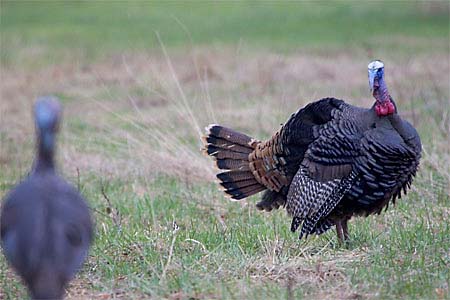
Gobblers like those fanned out are to call when with hens.

Someone who toodles too often on a turkey call usually winds up spooking birds. They tend to call too often and too loud, and occasionally at the wrong time, thereby spooking gobblers that may be coming to the call. They also may blow a "clinker," a sound that is not natural to a turkey's limited vocabulary. That can send a bird scurrying into the next county ... but not always.

Hunters are wise to limit their calling in most cases. As a general rule, let a gobbler do most of the talking. Call just enough to keep him interested. A bird that calls but keeps getting farther and farther away, is not going to come at that time. After the gobblers and hens separate about 10-11 a.m., the talkative gobbler may return to where he heard a hen call. Patience is one of the best friends a hunter has. Sitting still for three or four hours can be a painful exercise but gobblers often return to where they heard an early-morning hen.

My young friend is trying to learn how to run a diaphragm call, perhaps the second-most difficult call to learn. The hardest call to run is a wingbone yelper. I've met a few guys that could play Dixie on a wingbone call but those that can make great turkey music are few and far between.

The easiest call to operate is the push-pull call. Push on a plunger, and it moves the lid over a wedge-shaped piece of wood, and it produces a realistic turkey call providing it isn't used too much. The next two calls -- a box call and an aluminum, glass or slate call -- are far easier to work. Done properly, they can produce great sounds that imitate an amorous hen turkey.

Learn to use all forms of turkey calls (right).

Everything, within reason, about using a turkey call, is a matter of cadence. There is a certain flow or rhythm to turkey calls, and those calls are difficult to make with a diaphragm call  without a great deal of experience and practice, and knowing what each call is supposed to sound like. Go out as soon as the snow melts, take along a foam cushion to sit on, leave your calls home, and just listen to wild birds calling. Go home, or out in your car with the windows up so you don't drive your wife nuts, and practice. A few people pick up on the sounds they should make quickly, but for most people, it may take two or three years of constant  practice before they can run a good yelp.

The box and slate calls are far easier to use. Box calls can be held horizontally, as I prefer, or vertically as many southern hunters prefer. It makes no difference how you hold the call. What is important is how you bring the handle or lid of the call across the top of the sound chamber. Play with this a little bit to get a good feel for it.

Some years ago, and a few months before my twin brother died in 2003, I was guiding a man and my brother wanted to hunt as well. I didn't want to take out two people at once so in the predawn darkness, I helped George set up a jake and hen decoy in front  of one of my hunting blinds. I gave him a one-minute course on making a yelp. I bid him good luck, and the other guy and I went off to where we were going to hunt. I worked a big gobbler for an hour that morning but the bird wouldn't complete the circle and come out in front of us.

We eventually gave up on that bird when he finally walked off after spitting and drumming for 20 minutes behind us. There was something a bit off about my set-up, and I knew  I could take that bird on another day. We drove to where George was hunting, and there were two gobblers in front of him. I shut down the car without spooking the birds, and watched through binocuars as he shot the largest gobbler. He was geeked to think he'd called in not one but two gobblers on his first hunt.

George shot that bird, and both men wanted breakfast so we headed for town to eat. My brother headed home with his prize, but I managed to snag back my prized call that I'd let him use. The man I was guiding shot his gobbler about an hour later.

Four different box calls that I use (left).

One thing I didn't tell the man who had questioned me about turkey calling was that on any given day a gobbler will respond to only one call. A hunter may start out with what normally works, and the birds pay no attention to it. Learning just one technique or calling can be rather limiting. When next I see him, I'll try to coax him into learning three methods: box call, slate call and diaphragm call, and in that order.

The box call user can become reasonably proficient in an hour or two. The yelp should be the one call used most often, and for many hunters  it's the one that draws in the most gobblers. A whine or purr is easy on a box and slate call but difficult on a diaphragm call. He told me he is trying to perfect his fly-down cackle call, and I asked why. Soften up and shorten up on a yelp, and you've got a close approximation to that call. The trick is to learn the yelp, and how to make a soft and semi-loud call.

Timing is important, and I prefer to put gobblers to bed at sundown. That way I  know about where they will be in the morning, and can sneak in fairly close (100-125 yards) of the roost tree. Know your terrain, and don't try to call birds across water. It can be done, and I've done it a couple of times, but birds often hang up at water. Call to birds you know are on your side of the waterway.

Gobblers often sound off from the trees about the same time as the little tweety birds and larger crows begin mouthing off. Let the gobbler call two or three times in an attempt to determine where all the nearby hens are. Then give a soft three-to-five-note yelp, and hush up. The bird will usually pause and then answer, as will other gobblers in the area, and after he calls a couple of time, give the same soft call again. Keep it soft. Turkeys have amazing hearing and eye sight.
Some old turkey calls from 35 years ago (right).
Once the gobbler starts coming, call only if the bird seems to have stopped or lost his direction. This is not the time to over-call or call too loud. If you have decoys out, keep the jake or gobbler decoy closest to you, because gobblers usually head for the jake to kick his tail feathers although sometimes they single out the hen to jump on.

Have your shotgun up and across your knees with butt of the shotgun stock against your shoulder. The bird may try to circle or may head right for the decoys. Wait until his head comes up to look around, and shoot once, shoot straight and don't miss. Don't shoot at birds over 40 yards away/ Sure, with today's high powered shotguns, it's possible to kill the occasional bird at 60 yards but there too much margin for error.

Calling turkeys is easy, and since no two turkeys sound alike, the notes of your call may be off just a bit. Get the cadence right, stay hid with good camouflage, and don't move. The gobblers often come running, and this, my friends, is what turkey hunting is all about.

It's not just about shooting a big longbeard. It is about calling that heavily bearded limb-walker to the gun. That is what endears wild gobblers to those camo-clad hunters who get up long before dawn to hunt them. It's really all about calling the bird, and the excitement is breathtaking as a bird moves closer. It's what causes sane men and women to forsake a warm bed in favor of sitting with their back against a big tree. Hardly anything in hunting can beat calling a big bird within shotgun range.

Posted via email from Dave Richey Outdoors

Saturday, March 06, 2010

Beginner turkey hunter lessons

I spent some time today outside listening to turkey talk as the snow quickly melted off the roof in near 50-degree temperatures. It was an immensely beautiful day to listen to the birds.

It's always been my personal philosophy to teach kids to hunt. My oldest grand-daughter, at the wise old age of 19 years, was asking me about turkey hunting. I took her out several times for whitetails with a bow, and although she didn't shoot a deer, there were opportunities.

"Are you interested in turkey hunting," I asked. She allowed as how she might be, and I allowed as how I might be talked into calling up a gobbler for her. That is, if she wanted me to.

Determining whether to hunt turkeys or not can be an issue.

That's when the questions started. And that's what I love about teaching children that really want to learn.

"Are you ready to shoot a gobbler if we go hunting," I asked. "We'd be sitting on the ground, and the bird would probably be within 25 yards. The heart-pounding action comes as the bird gets close enough to walk in front of the shotgun. Do you want to kill a gobbler? Hens are off-limits during the spring hunt."

"You've always told me that there is more to hunting than killing," she replied, nailing me to the spot.

"That's true," I said, "but calling a bird in close enough for a shot can spook the bird if they spot any movement. A spooked bird may not come to me again or to another hunter. You don't have to shoot if you don't want to, but turkey hunting is altogether different than bow hunting for whitetail deer."

"I'd like to shoot a gobbler," Jessica answered several years ago, "but I don't know whether I can or not. It's the moment of truth when I must choose to shoot or not shoot that I can't answer right now."

This was as good an answer as any she could give. I wouldn't want someone to shoot a big gobbler if they had problems with doing so. I also don't want to put enormous pressure on her, nor do I want her to think that I'll be upset if she doesn't shoot or if she missed a bird.

Seeing a big gobbler like this can give many hunters the shakes.

"Look," I said, "you have nothing to prove to me other than your willingness to go hunting. A turkey gobbler may show up, four or five might show up, and I just want you to be prepared for what can happen during a turkey hunt."

She faced her moment of truth with a big doe at 10 yards, and she was at full draw, and she later told me she wasn't ready yet to release the arrow. She is a good shot, but I'd rather see her wait until she was fully confident of her abilities, before she shoots an arrow.

The same principle applies while turkey hunting. Where we bow hunted from an elevated and ground stand, we'll be sitting outside on the ground with our backs to a tree, and willing that gobbler to come our way.

Sitting inside elevated or ground coop for deer is one thing. Sitting out, on the ground, and calling to a bird and watching him come -- quickly or slowly -- is a bit of heart-pounding excitement. The heartbeat races, the mouth gets dry, and the breath is sucking in and blowing out as hunters hyperventilate, and it's never easy to sit without moving while a gobbler closes the gap.

"Do you think I can shoot a gobbler," she asked. "Will I have to shoot a lot to get ready? How would I have to dress? Do you have a shotgun that I could use? Would you call for me?"

Beginning hunters can spend the next weeks studying turkeys traveling on the snow.

Of course I would call for her. I'd have a shotgun for her to use, and she could wear the same camo outfit she wore last fall while deer hunting.

"I'd love to take you turkey hunting," I said. "You'd have to shoot a shotgun enough to get accustomed to the recoil. The big secret to killing a gobbler is to wait for the gobbler to walk in front of your shotgun, and keep your head down on the stock while aiming and firing, and you can't move.

"A knee jerk, any twinge or twitch, stiff muscles, sore butt, all of it has to be ignored when a bird is coming. They have eyes like an eagle, and hear very well. Any movement at all will spook the bird."

She is eager but somewhat apprehensive. Trying to allay her fears of making a mistake wasn't easy, but it's my opinion that she has what it takes to shoot a gobbler once she sees a bird or two close enough to shoot. No one is a natural-born turkey hunter.

First-time turkey hunters must experience a gobbler at close range to know how they will react.

We all come to turkey hunting the first time without prior experience. That's where an older person can exert some influence, calm the hunter down, and be there for congratulations when they do everything right. Or to offer heartfelt condolences when it doesn't work.

After all, as Jessica reminded me, hunting isn't all about killing. It can mean simply watching the bird, but one must be prepared with bow or shotgun in hand, in order to properly hunt. One could hunt every day of the season without shooting a bird, but in the end, it must mean releasing an arrow or shooting a load of No. 4, 5 or 6 shot at the bird.

There comes, for every person who hunts, the Moment of Truth when people are suddenly faced with the prospect of shooting at the bird. Many can do it but there are some that can't, and it's best to learn early in a hunting career whether one can do it or not. There's no shame in not being able to shoot a deer or turkey, but from a personal standpoint, it's a point in a hunter's life that must be addressed.

Posted via email from Dave Richey Outdoors