Showing posts with label right. Show all posts

Friday, April 22, 2011

Location, Location, Location


A majestic gobbler lit up by the early sun. Shoot straight!


There's an old real estate adage. Everyone preaches ... Location, Location Location!  Where the land or home is located means almost everything.

This old saying also holds true for turkey hunters. Location means everything, and if a hunter is going to have any kind of success with a big gobbler, he must be in the right spot at the right time.

So far, I've talked to just two hunters with a first-season turkey tag, and neither man has found gobblers yet. Both cite high winds, rain and on-again, off-again cold weather and snow as excuses.

Hunting has been slow during the first turkey season. Blame it on the weather.


One was checking for birds near home, and his brother was hunting in a nearby area. My buddy checked where he'd seen a gobbler fly up to roost the night before, and estimated he was 150 yards away.

He waited for dawn, listened to the bird gobble once from the roost tree at about 6:30 a.m., and called twice, and that was all it took.
"That bird came to me, got to within 25 yards, and then turned and ran off," he said. "The bird flew down from the tree, came on a direct line to me, and then spooked as if frightened by my decoys."

I'm more inclined to think he was spooked by the presence of a hunter toodling on his turkey call. Guys who educate birds by calling outdoors before the season opens deserves to have all his calls taken away.

His brother, who had not seen or heard a bird, and had traveled to what would be a new hunting location when their season opened. They walked into the area, sat down with their backs to adjacent trees, and began to listen for birds.

"I soon heard a bird that didn't wasn't far away," he said. "I listened to him for 40 minutes. He seened to have a couple of hens and lesser gobblers with him. We sat still and never spooked the birds.

At first he thought there was just one bird but it turned out to be two adult gobblers traveling together. Finally, one split away from the other, and came our way only to be spooked vy a roaming coyote. Those birds should still be around when the next season opens."

Turkeys in some hunting areas may be spooked by decoys.


I've heard it mentioned many times by many hunters that they believe gobblers and hens may be spooking from decoys. If there is no wind, and the decoy doesn't move, the bird won't come in. Obvious, this isn't an across-the-board belief, but some birds seem definitely afraid of one or more decoys, and scouting hunters should never put out decoys before the season opens.

Being in the right spot at the right time is crucial to success. I don't consider myself a great caller, but I know enough not to call too much once my season opens. Finesse the birds a little, don't call too loud so the bird gets spooky, and chances are good you can close the deal on a gobbler. The trick is to be patient, and don't call too loud.

Years ago, my wife and I drew a first-season hunt, and we got set up early, and she wanted to take her gobbler with a bow. I had her sitting inside a hunting coop. I had three decoys -- two hens and a jake -- positioned in front of her with the jake only 15 yards away.

I sat outside with my back to a big tree and waited for the first gobbler to sound off. A few crows called, and then he tuned up the volumn and rattled the trees in that woodlot. I gave a soft tree yelp, and he gobbled again and again while I remained silent. It's part of the teasing process.

Five minutes passed, and he gobbled again, and I gave a soft tree yelp, waited until he quit gobbling, slapped my pant legs a few quick times to simulate a bird flying down, and could hear that bird busting branches as he flew to the ground.

Be patient while waiting for a gobbler to close the distance.


He gobbled again on the ground, came walking through the woods, walked within three feet of my boots and strutted out to whup on that jake decoy. I could hear him drumming and spitting, and he gobbled out a challenge to the jake decoy, and walked in to smack the fake bird around.

The gobbler offered Kay a good shot, and that was the end of that bird. It wasn't the largest gobbler she has killed, but doing it with a bow was a major accomplishment.

A year earlier, much the same thing played out as I called in a nice gobbler for her, and she took it with a shotgun. In fact, I've called in most of her gobblers over the past decade.

A person can be the best caller in the world, but if he is in the wrong spot, there will be no birds racing in his direction. Personally, I'd rather know where the bird is roosted, and be a mediocre caller, than to be in the wrong spot with championship calling skills on my side.

Location to a turkey hunter, as it is to a real estate agent, is the most important part of the hunting equation. It's what can put a tasty bird on a turkey platter this spring.

Just make certain your scouting efforts don't spook birds out of the area, and for Heaven's sake, be smart enough to leave the calls at home while scouting. The birds don't need more of an edge than they already have, and it pays to scout with binoculars or a spotting scope.

Find the birds, drive away, and know where a few birds are when your turkey season opens.

Monday, November 01, 2010

Fooling that buck


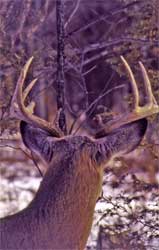
Take quartering-away shots at bucks like this.


Killing a nice buck with a bow is easy. Don't believe me, just ask any hunter who has done it several times.

It's a bit like your first kiss, first love, first child or the first of anything. Doing it the first time is most difficult, and each time after that it gets a bit easier.

Much of shooting a good buck is how the hunter sets everything up. Stand positioning in relationship to buck travel is part of it. Knowing when to draw on a buck is part of it, as is knowing your personal limitations. A big part of shooting a buck involves planning ahead.

Know where & when bucks travel to meet the does.


Deer move through certain areas, and follow special patterns. Bucks, in particular, are used to going wherever they want and doing what they please. Bucks often are bullies, the swaggering dude on the beach, and they are used to everyone giving way except a larger buck.

Bucks are accustomed to does and fawns, and lesser bucks, getting out of their way. If the does are found in certain areas, regardless of whether it is a pre-rut, rut or post-rut situation, the bucks won't be far away and somewhere en route to the girls is the best spot to be.

If hunters can control their scent, have safe and noiseless stands, and know when to draw, shooting one of these egotistical bucks can be very easy. But planning ahead is part of the key.

Learn long before the season opens where the bucks will go to meet up with the girls. Does are the main attraction after Oct. 20, and hunters who know those locations are a leg up on other hunters.

Bucks occasionally come together with does before they enter the feeding areas. The does and fawns then head out, and bucks often move back and forth through heavy cover 50 to 100 yards from the feeding areas, and then when they are so inclined, the bucks move out.

Studying any interaction between bucks and does now can pay off later as the rut phases change. Right now we're on the cusp of the full rut as the chasing phases slows down.

Bucks know where does are now, and you should too. That’s where bucks will be.


Bucks often follow their own routes out to the fields where the does are found, but sometimes they move off the trail as they follow along behind the does. Sometimes bucks will use the same trail used by does and fawns.

The secret is to find where they stage before moving out, and set up a stand downwind. Sometimes, in these key locations, it may be wise to have stands set for the primary wind direction and another for the secondary wind direction.

Choose your own poison but my preference is for a cedar or pine tree within 20 yards of the trail the bucks use to approach this staging area. Most hunters want to see the buck coming for a long distance, but it makes no sense to set up that way. If you can see a buck or doe coming for a long distance, those animals can see you as well.

My preference is for the deer to pass me on my left side (I'm right-handed), and approach from behind me. I'm tucked back into the shadows, regardless of the time of day, and since I know where the deer will come from, I am well camouflaged. I've wearing my Scent-Lok clothing, have sprayed my rubber boots with a scent eliminating spray, and know the wisdom of being still and quiet.

By having the deer come from behind me, and on my left side, I can often hear their approach, and can be at full draw before they get even with my position. I time my shot when they are quartering-away, and aim to hit the off-side shoulder blade with my two-blade broadhead.

Pass-through shots are OK but I want my broadhead inside & cutting the buck.


Don't holler at me about pass-through shots. I've seen too many pass-through hit miss all the vitals. I want my arrow to stay inside the deer, and with every running step the animal makes, it continues to cut. I seldom have a buck go past 70 yards with the arrow inside him.

Pre-planning is an important thing. If your plan is perfect, and you execute all facets of the hunt properly, the deer will offer an easy shot and arrowing the animal is a given.

Don't believe me, give it a try. Your set-up for a shot often is the one factor that controls the success or failure of your hunt.

Posted via email from Dave Richey Outdoors