Showing posts with label from. Show all posts

Monday, November 01, 2010

Fooling that buck


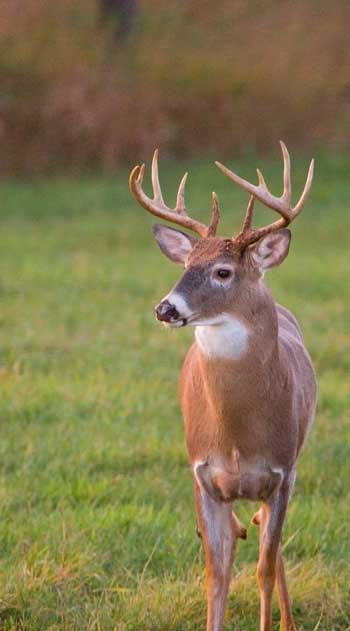
Take quartering-away shots at bucks like this.


Killing a nice buck with a bow is easy. Don't believe me, just ask any hunter who has done it several times.

It's a bit like your first kiss, first love, first child or the first of anything. Doing it the first time is most difficult, and each time after that it gets a bit easier.

Much of shooting a good buck is how the hunter sets everything up. Stand positioning in relationship to buck travel is part of it. Knowing when to draw on a buck is part of it, as is knowing your personal limitations. A big part of shooting a buck involves planning ahead.

Know where & when bucks travel to meet the does.


Deer move through certain areas, and follow special patterns. Bucks, in particular, are used to going wherever they want and doing what they please. Bucks often are bullies, the swaggering dude on the beach, and they are used to everyone giving way except a larger buck.

Bucks are accustomed to does and fawns, and lesser bucks, getting out of their way. If the does are found in certain areas, regardless of whether it is a pre-rut, rut or post-rut situation, the bucks won't be far away and somewhere en route to the girls is the best spot to be.

If hunters can control their scent, have safe and noiseless stands, and know when to draw, shooting one of these egotistical bucks can be very easy. But planning ahead is part of the key.

Learn long before the season opens where the bucks will go to meet up with the girls. Does are the main attraction after Oct. 20, and hunters who know those locations are a leg up on other hunters.

Bucks occasionally come together with does before they enter the feeding areas. The does and fawns then head out, and bucks often move back and forth through heavy cover 50 to 100 yards from the feeding areas, and then when they are so inclined, the bucks move out.

Studying any interaction between bucks and does now can pay off later as the rut phases change. Right now we're on the cusp of the full rut as the chasing phases slows down.

Bucks know where does are now, and you should too. That’s where bucks will be.


Bucks often follow their own routes out to the fields where the does are found, but sometimes they move off the trail as they follow along behind the does. Sometimes bucks will use the same trail used by does and fawns.

The secret is to find where they stage before moving out, and set up a stand downwind. Sometimes, in these key locations, it may be wise to have stands set for the primary wind direction and another for the secondary wind direction.

Choose your own poison but my preference is for a cedar or pine tree within 20 yards of the trail the bucks use to approach this staging area. Most hunters want to see the buck coming for a long distance, but it makes no sense to set up that way. If you can see a buck or doe coming for a long distance, those animals can see you as well.

My preference is for the deer to pass me on my left side (I'm right-handed), and approach from behind me. I'm tucked back into the shadows, regardless of the time of day, and since I know where the deer will come from, I am well camouflaged. I've wearing my Scent-Lok clothing, have sprayed my rubber boots with a scent eliminating spray, and know the wisdom of being still and quiet.

By having the deer come from behind me, and on my left side, I can often hear their approach, and can be at full draw before they get even with my position. I time my shot when they are quartering-away, and aim to hit the off-side shoulder blade with my two-blade broadhead.

Pass-through shots are OK but I want my broadhead inside & cutting the buck.


Don't holler at me about pass-through shots. I've seen too many pass-through hit miss all the vitals. I want my arrow to stay inside the deer, and with every running step the animal makes, it continues to cut. I seldom have a buck go past 70 yards with the arrow inside him.

Pre-planning is an important thing. If your plan is perfect, and you execute all facets of the hunt properly, the deer will offer an easy shot and arrowing the animal is a given.

Don't believe me, give it a try. Your set-up for a shot often is the one factor that controls the success or failure of your hunt.

Posted via email from Dave Richey Outdoors

Thursday, October 28, 2010

Study the does & shoot a rutting buck


The doe was acting a bit shaky last fall. She would stop, start, and move a bit, but from my elevated stand, my attention was riveted on the late-October whitetail doe.

Her actions were keeping me informed on where the buck was standing, out of sight. I couldn't see the antlered buck from my vantage point downwind of the doe and buck, but the antlerless deer was some agitated. The buck was nearby, of that there was little question, and her sides were heaving from being chased.

The buck had apparently bird-dogged the doe across the field and through the woods, but this was the chasing stage, one of my favorite times to hunt. She was close to estrus, but she wasn't quite ready for breeding. It primes the pump, so to speak.

Panting does have been chased a long distance.

The buck knew that, and there seems to be a direct correlation between the chasing phase and the beginning of the rut. Biologists feel a buck chasing the doe gets both animals  ready for the breeding period.

My bow was ready, and although I suspected a big buck was chasing this doe, I had yet to see the animal. The doe, by her actions, told me where the buck was, and whether he was standing still or moving.

She kept peering back into the heavy brush, and try as I may, the buck was impossible to see although there was no doubt in my mind that he wasn't there. The doe was twitchy; moving, stopping, switching her tail, and turning to face the brush before turning and facing her body away from the buck but looking back over her shoulder.

She was sending body language signals to the buck, and he was moving slightly. Her ears would twitch up, swivel toward some sound unheard by me, and then the buck would apparently stop. I was beginning to think these two deer would carry on like this for hours.

In reality, as the sun headed toward the western horizon, the doe moved slightly toward the buck, and then wheeled and ran off 20 yards before stopping to look back. She was getting this old boy fired up, and her message apparently was getting through to him.

Her head movements pinpointed the buck’s location, and it took 10 minutes of probing the alder brush before my binoculars picked out the white bone of an antler tine. The buck was standing stock still, not moving, and contently letting the doe lead the show.

I knew this wouldn't last forever, and sooner or later the buck would make his move. The doe would let me know when that was about to happen.

Her ears perked up again, her head changed positions, and I knew the buck had moved again. The binoculars scanned the area where the buck had stood, and sure enough, he was gone. I followed the direction of her head, and after five minutes of looking, found the buck again.

Watch the doe & she’ll lead you to the buck.

He was getting closer to the edge of cover, and by now, the sun had set. There was less than 30 minutes of shooting time left, and I knew he would soon take up the chase again. The big question was whether he would offer a shot or choose to circle the doe, and force her into running off with him in hot pursuit.

Ten minutes of shooting time remained when the action started. The doe whirled at the sound of his first tending grunt, and she cut a lick for the open field, running hard. The buck was patient, and he slowly moved toward the edge of cover on a wooded ridge, and watched her go. He knew he could track her down.

He had only to move 10 yards in my direction, and it would be possible for a shot. He moved half that distance, stopped, and my bow was up and ready. When he moved, he exploded from cover like a ruffed grouse taking wing, and was at an instant gallop.

He offered me no opportunity for a shot, even though I was ready, and as he began moving, it was easy to tell he was a high and wide 10-point with good mass. He crashed off through the brush, and there is no doubt that he caught and bred that doe that night.

The lesson behind this anecdote is to study does during the pre-rut and rut seasons. They can, by their head and body language, tell the hunter where the buck is and what he is doing.

Be patient & play the waiting game.

There are many times when this leads to a shot, and there are times when luck is riding along with the buck. However, study this body language as often as possible, and learn more about hunting bucks. The does can teach hunters this important lesson, and bow hunters who don't spook does but study their actions will often take a nice buck.

You can bet on it.

Posted via email from Dave Richey Outdoors

Thursday, October 14, 2010

Learn from the deer ...


Whitetails can keep a hunter honest.

This doesn’t mean that my valued readers are dishonest. It simply means that deer have the ability to make hunters think and learn.

They also can make hunters pretty humble when sportsmen start thinking they know everything about deer hunting. Hunters who feel superior about their hunting skills often get humble pie to eat.

Be quiet and pay attention around good hunters and you’ll learn.

One thing I’ve learned over many years is to watch hunters. It doesn’t take long to determine who are the great sportsmen, and who are braggarts. I’ve hunted in many camps over the past 44 years, and the loudest and most aggressive hunters are usually the ones who make the dumbest mistakes.

An old saying goes like this: it’s better to keep your mouth shut and be thought a fool than to open it and remove all doubt. The best rule is to keep the mouth closed and pay attention, and you’ll learn more.

Picking people’s brains, and learning what they know, is fun and can provide valuable information. Savvy hunters never venture an opinion unless they know what they are talking about. That is especially true when talking about hunting whitetail deer.

Southern folk have some great sayings. They’ve been distilled from years of hard work and minding their manners. One saying that has a whole bunch of learning in it is “My momma didn’t raise no fools.”

Folks who gather around savvy hunters should keep that thought in mind. That means less talking and much more listening.

Experience is a great teacher. Asking questions can help.

Last year a man took his son hunting. The boy met the other hunters, made a dumb remark about deer hunting while several of us planned our evening hunts. We were tossing around ideas, and discussing where everyone would sit, and checking the prevailing wind direction.

The boy kept nattering on and on. He was taking up precious planning time by constantly interrupting with foolish statements.

One of the guys eventually spoke up rather bluntly and loudly, and said: “Boy, you better learn more about deer hunting before speaking your mind. You want to learn about deer hunting, sit down, shut up and listen. You’ll learn more than you ever will by talking nonsense about a topic you know nothing about.”

The kid didn’t follow directions well.

The boy sat and listened for a minute, spoke up, and one man looked pointedly at him, and the kid went running out the door. His daddy had money, and it’s almost certain that no one had every talked that way to him before.

I’ve been around whitetails all my life, and spent more than 50 years hunting and studying the critters, but there are many others who know many things that I don’t know. I listen intently to them and learn.

There are countless ways to learn things but in-the-field experience is the best teacher when it comes to learning about whitetails. Hunting the animals, and studying them as you hunt and during the off-season, is the best way to accumulate knowledge. Reading about it, and absorbing that knowledge and putting it to good use, is another. What is most important is the hunter must learn to convert that knowledge into an action plan that works in the woods.

Experience will put a fine point on your acquired knowledge. Some of my early deer-hunting knowledge came from talking to old-time hunters and guides, and using some of that information on my hunts.

The more days spent afield will continue to add to a solid footing, and one day after learning a great deal about deer hunting, you’ll know you’ve come a long ways in your gathering of deer-hunting knowledge.

That will be the day when you can honestly look yourself in the morning mirror, and confess: “I don’t know as much about deer hunting as I thought I did.” And then you go out and learn some more.

Posted via email from Dave Richey Outdoors