Showing posts with label get. Show all posts

Thursday, March 24, 2011

Don’t kill yourself over a dead deer


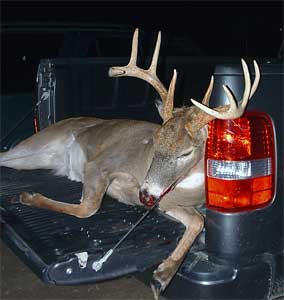
The trick is getting a big buck into a truck bed without killing yourself.


It happens every year. Joe Hunter sits in his stand, patiently waiting for a buck to come sneaking along.

He's hunting alone, and after a period of inactivity, he looks out and spots the buck of his dreams moving his way. He readies his bow or firearm, and when the time comes, he shoots and kills the buck.

His heart is racing like a horse coming out of the gate, and he walks to the animal, admires the buck and rack, and proceeds to field dress it.
About this time, the thought comes to him that he is alone. It's impossible to get his vehicle close to the deer, and he begins the arduous task of trying to drag the buck out alone, which is never a good idea.

Don't try to be macho, and drag a deer alone. Get some help!


Somewhere along the way, he feels a pain in his chest, and it increases in intensity, and over he goes with a heart attack. Some fortunate hunters survive the ordeal, and sadly, others do not.

Somewhere, every season there's an army of solitary hunters preparing to drag out a buck by one antler. Trust me, it doesn't work very well.
We always have a lengthy (36 to 48-inch) piece of one-inch wood dowel. With it is several feet of strong rope.

I'm not big nor am I strong but I've dragged out several deer by myself with this rig. It works best with snow on the ground, but the important thing is to get both front legs and the head off the ground.

Gut the buck and roll it onto its back. Tie antlers, head and front legs to dowel.


Roll the buck over onto his back, and place the wood dowel on the ground and under its neck near the base of the antlers. This will keep the buck's back and hind end on the ground. If you do it the other way around, and have its abdominal cavity on the ground, within 10 feet, it will be filled with dirt, grass, rocks and other debris.

Lash the buck's head and neck to the wood dowel, and tie it tight. Save plenty of rope to tie both front legs to the dowel and to the antlers. Center the buck's head and neck in the middle of the dowel, and if alone, lift the head, neck and front legs off the ground.

Don't wear yourself out. If you can only drag it 10 feet at a time, do so, and rest often. Don't get too winded and start sucking air. If it takes three hours to drag it out, do it slowly and don't over-exert yourself.

Too many people think it's macho to drag out a buck alone. Not only is it not a macho move, it is a stupid one. None of us are accustomed to dragging out deer single-handedly. Get help or go slow.

It becomes much easier if two people are hunting nearby, and the other offers to help drag. Lash the front legs, head and neck securely to the dowel, and put one person on one end of the dowel and one on the other end. Two people dragging causes less exertion but it involves weaving around brush piles, saplings or trees.

There are devices with wheels that allow the animal to be placed inside it, and then the cart and deer can be pulled or pushed through the brush. This doesn't work well in a tag alder thicket or cedar swamp.

It's much easier (some of the time) in many locations because we can often drive near to the fallen animal. We can usually get to within 100 yards of the deer, if a good shot has been made, and there are always two or three people around to help in getting the deer loaded.

This becomes very important if someone shoots a truly huge buck. Some animals will weigh 250 to 300 pounds, and it's almost impossible for one person to lift that much weight to place it in the back of a truck.

Don't die while deer hunting. A partner, 4-wheeler or truck eliminates exertion.


Another scenario that works, especially with several inches of snow on the ground, is to tie the deer to the back end of a four-wheeler. I try to get the head off the ground, and tie it in place, and than drive slowly to drag it out to a more convenient location.

Dragging deer out of the swamp or woods can be hard work. Older (and even some younger hunters) would be wise to seek help whenever possible. If alone, try my dowel trick and drag it a ways, stop and rest and allow your heart rate to slow down, and drag some more.

There isn't a buck in the world worth dying for. Take your time, and live long enough to enjoy seeing that handsome rack on the wall and medium-rare tenderloins on your dinner plate.

Wednesday, December 15, 2010

Give us a break from snow


When food gets scarce, does fight anything for food … even their fawns.


I spent some time outdoors today, and found myself wondering what to do. The weather is the pits, and although it wasn't snowing today, the wind was brisk.

One of the best things to come from this spate of nasty,  anowy weather that has bombarded us for the past week. Walking around outside means fighting through deep snow in a vain search for deer that are looking forsomething to eat.

There is at least 24-30 inches of snow everywgere in my neighborhood, and although deer seldom stray too far from thick cover, there is little food available to them. Most of the deer movement comes after dark but a few grouse are feeding on catkins

The snow is deep and few deer are moving during shooting time.


This weather isn't a blessing for deer. Small deer often starve to death during the winter because they are too small to move through deep snow. They become easy pickings for coyotes.

With the weather in the mid-20s during the day, the weather and lack of nutritious food doesn't offer bucks a chance to regain some weight and stamina. Pregnant does are hoping to find food to build up their fat reserves if the winter continues to be ugly, and fawns born last spring will soon be starving to death if the weather doesn't improve.

There are very few standing corn fields this year. The fall weather allowed farmers to complete their harvest, and most of the grain left behind is gone.

Hunting pressure, for the most part, has been minimal or nonexistent  the muzzleloader season is winding down. Some bow hunters are out, but we were treated to an almost daily diet of heavy snow for 10 days. Most deer aren't moving until long after dark.

Few hunters are out after deer, and fishing in streams has been poor.


I spotted a doe fawn feeding today along the edge of a field. She was working on the remnants of my neighbor's corn field, but she looked pretty pathetic. She never strayed far from heavy cover.

There doesn't seem to be many turkeys around, and they are widely scattered with the deep winter snow. I've seen some in recent weeks, and they always seem to be on the move. Gobblers, hens and poults are trying to feed as they travel, and watching them cross a field is a lesson in watching heads bob up and down. There is a lot of pecking but little food to eat.

Song birds are coming to the feeders at the house, and there is a constant parade of various birds. What I'm not seeing this winter, which is fine by me, are the large groups of mourning doves that waste more bird seed than they eat.

These birds often use the back part of my deck as a place to roost for the night, and they poop constantly. Cleaning the deck is difficult during most winters, and this year, they aren't here. Perhaps they only roost on my deck when the weather turns nice.

Fishing pressure on area rivers has about dried up, and although there still are some steelhead in some of the rivers, there doesn't seem to be much interest. Everyone is waiting for winter ice to form on area lakes, and that won't happen now for a couple of weeks providing the weather turns cold and more snow holds off.

We need a break although snowmilers and cross-country skiers are happy.


I'm willing to bet that unless we get a tremendous cold snap with no wind, it's my guess that most of the larger lakes may not form safe ice until January or February. Lakes like Big Glen, Crystal, Higgins, Houghton and others are not showing any indication that ice will form anytime soon. Deep snow still covers many lakes, and it acts like an insulating blanket.

Live bait dealers are starving because of a lack of ice, and the skiing and snowmobiling industries are happy with the snow conditions. The week between Christmas and New Years is always the busiest weekend of the year, but not so far this season.

One thing about it, I've been riding my snowblower too much so far this winter. I'm not sure this kind of weather really appeals to me.

When the deer don't move much, and no one is moving to push the deer, it makes for a long dead spell right now. Hopefully the weather will change soon.

Posted via email from Dave Richey Outdoors

Tuesday, November 30, 2010

Remember this: deer can’t count


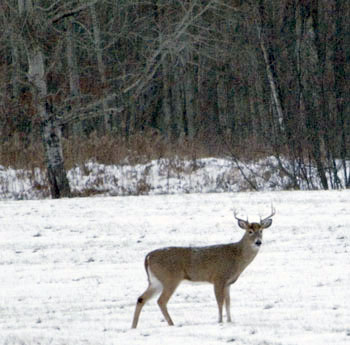
This buck has someone pegged, and it may cause the deer to leave the area.


It happens every November and December now people continue to hunt the same blinds day after day. Two or three mornings or evenings of climbing into the same stand means the deer will soon have you patterned.

What happens after they pattern the hunter is they seldom show up at that spot during legal shooting time. I proved it to a friend two nights ago.

He told me that every deer that steps out seems to be looking at his stand. He couldn't understand why.

Try to change your routine every day. Try new stands and way in and out/


He had shot a doe that night and it ran into the woods 50 yards before dying. We followed the deer after dark, and I suggested he look around the edges of the heavy cover.

"You'll see deer beds everywhere within 20 yards of the edge of the cover," I told him. "Those deer watch you walk in from the road, and see you climb into your stand. The deer have you patterned."

Shifting from one stand to another, and never hunting the same one two nights in a row, eliminates much of the problem. It's difficult to sneak into anywhere when snow covers the ground, but one trick that that does work in farmland country, providing the snow doesn't get too deep, is for one person on a four-wheeler or a truck to drop the other hunter off.

Deer can't count. If they see and hear a four-wheeler or pickup truck come in, and both people get out, one stays and the other leaves, and nearby deer seem to think that everyone has left. That is unless the hunter makes too much noise, moves around or is spotted by the animals.

The same can hold true in the evening. If a hunter is pinned down by deer out in front of them, and they climb down, every nearby deer is educated to the human presence. However, if a four-wheeler or truck comes putt-putting in after dark, it scares off the deer, and then leaves, the animals are not overly frightened by the vehicle. Deer see cars or trucks every day, and we've used this method effectively for mptr years than I can remember.

This trick is so easy. Just ease into an area, park where deer can see, and one hunter can climb into the stand. Once he is in place, the other person drives off.


The vehicle is what spooks the deer, not the hunter climbing down in front of the deer. The whitetails run off, the hunter climbs down and gets into the vehicle, and the deer are none the wiser.

I know a guy that goes for a walk every evening he hunts, and his wife and their dog tag along. When he gets to his stand, he quietly gets into in and his wife and the pooch walk off. He shoots bucks every year with this little trick.

Ofte, deer are gone by full dark. We can then climb down and walk out without spooking any animals. Just take the arrow off the string and lower it to the ground, and wait for the deer to move off naturally. Give them several minutes, and then climb down.

Late November and December can be hard on bucks that are recovering from the rigors of the rut. They need to feed heavily in a short period of time to build up enough body fat to carry them through the winter. Anything that disrupts their schedule of moving out to feed can lead to stress, and in areas like this one with very low deer numbers, we try not to stress the deer any more than necessary.

Learn what stresses December deer, and perhaps you’ll score in the late season.


Stress can be caused by a variety of reasons. If deer traditionally bed near a stand, and night after night a hunter walks in to that same spot, the deer get a mite spooky and often hold off on their travels until full dark. Or ,,, they will move elsewhere.

Changing stands, changing arrival times at a hunting spot, or giving a stand a rest for a few days allows deer to settle down and start getting back to their normal travel patterns.

Whatever hunters can do to make human impact on deer even less will often result in better deer hunting. The more stress we put on nearby deer, the poorer the hunting becomes.

Right now we are already putting a bit of stress on deer with some light snow. We are supposed to get snow daily for the next couple of days. If any major accumlation falls, it will only make matters worse for the animals.

Try a new approach with the rest of the bow and muzzleloader hunting seasons. Move around, change the times you arrive and leave a stand, and if possible, have someone drop you off. It certainly doesn't solve every problem, but it can lead to slightly better hunting if the animals aren't stressed out by too much hunting pressure.

Posted via email from Dave Richey Outdoors

Monday, November 29, 2010

Remember how to arm-wrestle?


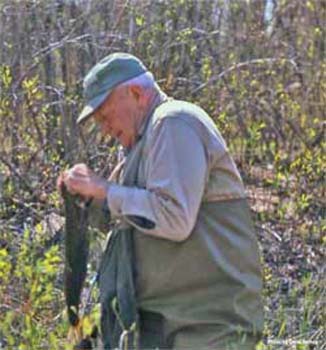
The late George Yontz with a steelhead. Look at those upper arms & shoulders.


A reader mentioned the Sturgeon River near Wolverine and Indian River in an recent email roday, and it set me to remember things from 55-60 years ago. We traded a pair of comments, but his mention of the river brought back a great flood of pleasant memories.

One was of a former Pennsylvania Dutchman by the name of George Yontz. He owned the old Hillside Camp cabins and tackle shop three miles north of Wolverine on old M-27. He taught me a good bit about steelhead fishing, catching walleyes on Burt Lake, and about being willing to gamble when the situation demanded such actions.

Yontz was a plumber and pipe-fitter by trade, and was long-waisted and short-legged. He wasn't tall but had biceps as big as my thighs, and was as hard as granite. He had developed a far-flung reputation as an arm wrestler of merit who had never been beaten, and people came from near and far to test him. They would arrive by car, swagger into the tackle-shop building, looked at my friend, dismissed him and asked for the legendary George Yontz.

The poor guy didn’t realize what he was walking into.


"You found him," Yontz would say in an ugly tone. "You want something?"

"Understand you arm-wrestle some. Want to give it a try with me? I've never been beaten."

A glimmer of a smile always crossed Yontz's face as he answered: "Got any money? I don't arm-wrestle for fun. I always like to take money from people who have never been beaten. Everyone but me has been beaten at least a time or two."

"I got money. How about $50?"

"Let's go for a hundred. Which arm-wrestling method do you prefer: lit candles or razor blades?"

"Say what?" The gent with the big fancy car suddenly found himself out of his league and sputtering. "What's this about lit candles and razor blades? Never heard of that before."

"Give your Ben Franklin to my man here," Yontz said, pointing at me. "He will hold your cash and mine, and he will give all of it to the winner. You have a choice: my man can light two candles. We will assume the position and he’ll measure where my hand will hit the table if you whip me and he'll measure where your hand will hit the table if I win. One candle will go under your hand at my end and one under my hand at your end. Any serious problems with that?

"Or ... I have two special devices here that will hold a single-edge razor blade with the sharp edge pointing up. You can get your hand cut or burned. It's your choice, bud. Time's a-wastin', and I ain't much on talking about it. Let's arm-wrestle!"

The muscle-bound gent had that look deer get when caught in the headlights of a speeding car. It was so quiet you could hear yourself sweat. He looked at Yontz with apprehension as he rolled up his sleeves over forearms that looked like Popeye's, and stood grinning at the dude.

The man wasn't grinning back as sweat began beading on his forehead.

I began a behind-the-counter search for somethinng that didn’t exist.


He didn't know whether to cut and run or try to finish what he started. One look told me and Yontz this guy was wired and wondering what he'd walked into.

"C'mon, make your choice," Yontz hissed, baring his teeth slightly in a frightening grimace.

"Make up your mind: Lit candles or razor blades. What will it be? Dave, go fetch the candles, razor blades and the things to hold the blades while our gentleman friend here gets himself ready to get whupped real bad."

I turned and started looking under the counter. I knew there were no candles, razor blades or special devices to hold the razor blades. It was part of Yontz's dog-and-pony show, and it was beginning to show on the stranger’s face.

"Hey, hey," the guy sputtered. "Let's keep this a friendly test of strength. Let's just arm-wrestle for the Bennies. No need for any rough stuff, is there?"

"It makes no difference to me but I never arm-wrestle friendly," Yontz said. "I want your money and you want mine. How can that be friendly? I just thought a guy that drove clear up here would want to make this a bit more interesting. You've never been beat, I've never been beat, so why not add a touch of danger and pain to it as well?"

"Let's just arm-wrestle for $100," the man said, eyeballing the size of Yontz's forearms as he took off his flannel shirt, and stripped to a lightweight T-shirt from the waist up. There were muscles visible now that few people had ever seen, and only those people who were willing to arm-wrestle for $100 would ever see. Well, that’s not quite true. His “man” had a front-row seat and could see the muscles bulging in his arms, shoulders and wrists. It was an impressive sight.

It soon became apparent to everyone that the stranger was out of his league.


Yontz flexed his arm muscles, and for a man in his 50s at the time, he was a remarkable specimen. His arm and shoulder muscles rippled like waves washing a beach. The other man was well built from lifting weights, but so far he just didn't have a clue how much trouble he was really in. They locked hands, and Yontz needed a thick book under his elbow to match up.

"Your challenge, you start," Yontz said as they locked hands again. Yontz stared hard into the challenger's eyes, and nodded for him to start.

The man tried to do it hard and fast, and it barely rocked Yontz as he held his hand straight up with the stranger's hand in his. The old pro felt a challenging taunt was in order.

"Get it going," Yontz said, "I don't want to sit here all day holding hands with another man. Show me what you're made of. Bring it to me. Arm-wrestle or I'll break your wrist!"

The contest was already won but the visitor just didn't know it yet. He gathered his strength, took a deep breath, let it out and gave it everything he had. He couldn't budge Yontz's hand. He nearly lifted himself off the chair with the effort but his try was ill conceived and a case of too little, too late.

"Done messin' ‘round yet," Yontz snarled. "If you can't bring more than that to the arm-wrestling table, it's time to finish it right now."

He slammed the stranger's knuckles against the hardwood table with great force. Had he wanted to, he could have broken the other man's hand. He did it hard enough to make the knuckles swell up and turn an angry red color.

Adding insult to injury.


"I'll give you a chance to get your money back," Yontz said. "Want to go again, left-handed? I'm pretty weak in my left arm. Hurt it a bit when I was young. You might take me left-handed. You game for double or nothing?"

The man looked Yontz in the eye, and saw something there he didn't like. He also saw that a man twice his age was well equipped and more than ready to whip him left-handed.

"Nope, I've had enough," the man said. "Boy, give him my one hundred dollars."

"Hold on there," Yontz hollered, standing up fast, tipping over the table and flexing his muscles. "I told you that my man would hold the money. Don't be calling him no boy. Treat him right. He did his job, I did mine and you didn't do yours. Apologize!"

"I'm sorry," the guy said to me as he headed out the door. "Young man, please give Mr. Yontz my money. It's disappointing to lose, but I was beaten by a better man."

Yontz later told me that it was true he had never been beaten arm-wrestling. He also said he had learned early in his arm-wrestling career to get into the other guy's head fast and make him sweat. Break his confidence before you sit down at the table, he said, and you've won the battle.

I served as Yontz's "man" for almost 10 years, and after each win, he would slip me ten bucks. Ten dollars back in 1952 through 1961 was a pile of money to a kid, but most of all, I learned an important lesson from him other than how to catch trout: don't back down, don't give up, and make the other person question your abilities. Do that, and half the battle is won before it starts.

His advice has served me well for many years in other ways. But I never could arm-wrestle, but then, I never had to. I usually could talk my way out of trouble.

Posted via email from Dave Richey Outdoors

Monday, November 01, 2010

Fooling that buck


Take quartering-away shots at bucks like this.


Killing a nice buck with a bow is easy. Don't believe me, just ask any hunter who has done it several times.

It's a bit like your first kiss, first love, first child or the first of anything. Doing it the first time is most difficult, and each time after that it gets a bit easier.

Much of shooting a good buck is how the hunter sets everything up. Stand positioning in relationship to buck travel is part of it. Knowing when to draw on a buck is part of it, as is knowing your personal limitations. A big part of shooting a buck involves planning ahead.

Know where & when bucks travel to meet the does.


Deer move through certain areas, and follow special patterns. Bucks, in particular, are used to going wherever they want and doing what they please. Bucks often are bullies, the swaggering dude on the beach, and they are used to everyone giving way except a larger buck.

Bucks are accustomed to does and fawns, and lesser bucks, getting out of their way. If the does are found in certain areas, regardless of whether it is a pre-rut, rut or post-rut situation, the bucks won't be far away and somewhere en route to the girls is the best spot to be.

If hunters can control their scent, have safe and noiseless stands, and know when to draw, shooting one of these egotistical bucks can be very easy. But planning ahead is part of the key.

Learn long before the season opens where the bucks will go to meet up with the girls. Does are the main attraction after Oct. 20, and hunters who know those locations are a leg up on other hunters.

Bucks occasionally come together with does before they enter the feeding areas. The does and fawns then head out, and bucks often move back and forth through heavy cover 50 to 100 yards from the feeding areas, and then when they are so inclined, the bucks move out.

Studying any interaction between bucks and does now can pay off later as the rut phases change. Right now we're on the cusp of the full rut as the chasing phases slows down.

Bucks know where does are now, and you should too. That’s where bucks will be.


Bucks often follow their own routes out to the fields where the does are found, but sometimes they move off the trail as they follow along behind the does. Sometimes bucks will use the same trail used by does and fawns.

The secret is to find where they stage before moving out, and set up a stand downwind. Sometimes, in these key locations, it may be wise to have stands set for the primary wind direction and another for the secondary wind direction.

Choose your own poison but my preference is for a cedar or pine tree within 20 yards of the trail the bucks use to approach this staging area. Most hunters want to see the buck coming for a long distance, but it makes no sense to set up that way. If you can see a buck or doe coming for a long distance, those animals can see you as well.

My preference is for the deer to pass me on my left side (I'm right-handed), and approach from behind me. I'm tucked back into the shadows, regardless of the time of day, and since I know where the deer will come from, I am well camouflaged. I've wearing my Scent-Lok clothing, have sprayed my rubber boots with a scent eliminating spray, and know the wisdom of being still and quiet.

By having the deer come from behind me, and on my left side, I can often hear their approach, and can be at full draw before they get even with my position. I time my shot when they are quartering-away, and aim to hit the off-side shoulder blade with my two-blade broadhead.

Pass-through shots are OK but I want my broadhead inside & cutting the buck.


Don't holler at me about pass-through shots. I've seen too many pass-through hit miss all the vitals. I want my arrow to stay inside the deer, and with every running step the animal makes, it continues to cut. I seldom have a buck go past 70 yards with the arrow inside him.

Pre-planning is an important thing. If your plan is perfect, and you execute all facets of the hunt properly, the deer will offer an easy shot and arrowing the animal is a given.

Don't believe me, give it a try. Your set-up for a shot often is the one factor that controls the success or failure of your hunt.

Posted via email from Dave Richey Outdoors