Showing posts with label disappointment. Show all posts

Saturday, April 09, 2011

Murphy’s Law and Turkey Hunting


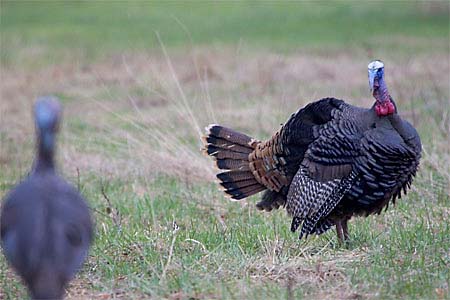
A turkey decoy (left) and a jake gobbler we passed up on that day.


It was the nicest day of my second turkey season in Area K several years ago. It was clear and cool when we got into a good spot to listen at dawn. My buddy Arnie Minka was giving me a break: no turkey talking for me today. He would do the calling on the last day of my season.

There was no wind, which was a blessing after all of the wind of the past two weeks, and we sat quietly waiting to see if any gobblers sounded off at daybreak. Dawn was a pink blemish on the eastern horizon when the first bird gobbled nearly a mile away.

Five minute later another bird gobbled, hit a double-lick, and then single-gobbled to punctuate his earlier comment. Two minutes later the bird, perhaps 250 yards away, gobbled again and then another bird gobbled a half-mile to the west.

Wild gobblers calling at dawn


We sat patiently, waiting for another gobble, and weren't disappointed. The only thing is this bird was off in the woods several hundred yards away, and the hens were talking up a storm. Arnie let him gobble again, and then stroked out a soft yelp on a box call.

Two birds gobbled hard, took a breath and gobbled again. I'm thinking this is a little bit of alright. Arnie was grinning under his face mask.
He switched, just to see if it would work, to a slate call. The peg rasped out a soft purr and whine, and both birds lit up again. He didn't want to rush the calling too much. He wanted to let it get a bit brighter so it would be easier for me to see an approaching bird.

He picked up the slate call again, drew the peg in a soft J-stroke and the soft yelp turned on one of the birds. He rasped out a throaty gobble, roaring hard, and that forced the bird 250 yards away into a similar respon

Here we were on this wooded hilltop, approximately halfway between two lusty gobblers. The bird farthest away gobbled once, and it sounded as if he was closing the gap. Arnie gave another soft yelp on the slate call, and both birds answered. This was getting pretty exciting.

The neat thing was we were working two birds, and their male ego or whatever turkeys possess wouldn't let either bird give in. Box call or slate, it made no difference to them. Both birds were coming, and he softly teased them with another soft yelp and purr.

Suddenly, both gobblers shut up. Murphy’s Law had struck again.


They gobbled, each bird now within 200 yards, and the furthest bird double-gobbled and I thought I could see him approaching the tempting hen decoy. The other bird gobbled, rattling the woods, and Arnie whined softly on the box call, and that lit him up like a July 4th fireworks display.

All of a sudden, there was no noise. Not a turkey gobble, not a crow cawed, and Arnie hit another soft lick on the box call and slate. Nothing. The birds had gone mysteriously silent.

Why, I wondered, he hadn't hit any bad notes with his calls. Something had to have frightened the birds.

Two people were tending to farm chores. It wasn't hunter harassment, but more like Murphy's Law crimping our style.

We quickly moved our base of operations 100 yards, and tried again. There was no gobbles, no nothing. It was as if the ground had opened up, and swallowed both birds.

There was a vantage point another 100 yards away where we could see where the other bird had been, and we made our way to it. I laid my shotgun aside, and we spent 20 minutes glassing woodlots and open fields on both sides of the road.

We sat back, thought about it, and began glassing an area across the road. A gobbler stood out in the field at least 500 yards away, and was watching the road. He was a half-mile away from us, and there was only one way that might put us within shotgun range.

It would be a mile hike, and we dropped off our hill top vantage point, studied the terrain where the other bird had been, and saw nothing. We moved through the woods, across plowed fields, crossed the road and entered the woods.

We moved slowly and silently through the wet woodlot, and eventually got to within 200 yards of where the bird had been. That joker had disappeared. We walked through a woodlot, and never saw him again.

Several other spots were tried, and we took a long scouting ride, but there were no more turkeys.  We saw one jake with a two-inch beard, and he never received any consideration from me. I'd let him grow into something bigger for next year.

My season ended early that spring when four hens and two jakes were spotted crossing a field and heading for their roosting area. They offered us a brief thrill but we both realized that Mr. Murphy had ridden our backs all day. He proved, once again, that if anything can go wrong on a turkey hunt, it will.

The good thing was our hunt was fun while it lasted.

Friday, July 23, 2010

Never hunt angry


If you trust nothing else, remember this: hunting success can always get worse. Success depends, in large part on wind, weather conditions, hunting pressure and hunter skills. It's easy to control hunting pressure in some areas, but other people often must hunt on federal or state land. Wherever we hunt, we cannot change the wind or weather conditions.

I had to conquer anger, wait for the wind to die, and in walks this nice 8-point.

So our hunts may have been planned for a week and the weather doesn't cooperate. We spit and sputter, gripe and complain, and then we go out and hunt, and act madder than a hornet.

That can be a very big mistake. And it’s one we all have made in the past.

Hunting angry doesn't help a thing. If anything, being mad about something we can't control just messes up our hunting judgment. It makes us make even more and often costlier mistakes.

We just goof up. We get upset, and that makes us feel worse, and we begin to fidget. We move around, make the occasional noise, and any deer that may have come to us might see a movement and be long gone.

Som why get mad? I've hunted deer for too long, and over more than five decades, have become somewhat philosophical about bad weather. Learn to take the good with the bad, and think happy thoughts rather than about how angry you are. That line of thinking only makes us madder, and that only increases our problems.

Don't sweat the small stuff. Instead of focusing on the things  we can't control, change your thoughts and think about those things that can be changed.

Change those things that can be fixed, and don’t sweat the small stuff.

Climb a tree, if need be, and set in an elevated coop and do whatever can be done to beat the wind. Or ... do what some hunters do and that is to go home and take a nap. There is always tomorrow for many hunters.

Taking the good with the bad doesn't always mean that a bad day can't turn productive. I've sat out, and had the wind ripping leaves off the trees, and about 30 minutes before shooting time ends, the wind gusts taper off and die away to nothing. It then becomes whisper quiet, so quiet you are soon wishing for a soft breeze.

If some light rain falls when the wind dies, there can be some very good deer movements. It seems as if the deer are happy to see the falling rain.

Deer caution often is more likely when they move after a strong wind and rain storm. Hunters must learn to keep their cool,
and to take the weather conditions as they come even though we seem to be have more bad weather in the early season than ever before. Is this part of the global warming trend. If so, deer and hunters will soon get used to it.

Last-minute weather changes have paid off for me more times than I can remember. Heading in to the house, and skipping the evening hunt, often means hunters quite possibly will miss the finest 30 minutes of the day as the wind and rain dies.

The weather often changes in that 30 minutes after sundown. Wait for it.

It's far better to consider the weather, whether good or bad, as part of the deer-hunting experience. Such last-minute weather changes don't happen often enough that we can plan around them, but they can pay off often enough that they should be one more trick in our deer-hunting repertoire.

It's an awesome feeling when we've rode out the bad weather, and than see the last-minute change that we had hoped for. We no longer are mad at the weather, and things start looking up. When the bad weather suddenly changes, and the good hunting weather moves in and the deer start to move, we feel blessed as we sit in a ground blind or tree stand.

Look up at the sky, nod and  say "thanks," and get ready for a nice buck to step out of heavy cover and be within easy bow range. Just remember this advice as long as you hunt deer: it never pays to hunt angry.

Posted via email from Dave Richey Outdoors