Showing posts with label hunt. Show all posts

Saturday, September 01, 2012

REMINDER: Read 'Hunt Pre-Rut Bucks'

buckingrass

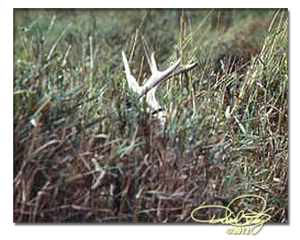
Bone-white antlers of a resting buck show above weeds during the pre-rut


This method has worked for me, and can work for you regardless of where you hunt.

Try it this fall and see if it doesn't produce action at a time when no one is hunting. It's rut hunting's biggest secret, and now only you, me and several hundred thousand other people will know.

Mark this blog and go back and read it again in mid-October, and maybe it will produce a nice buck for you next fall.

OK. Here's your reminder.  Re-Read, "Hunt Pre-Rut Bucks' and go get your mid-day buck.

Saturday, May 26, 2012

The season's last bird

Last ditch effort to salvage a turkey season. Not the best way to do this, but it can work. Maybe...
Two gobblers crossed the road ahead of the car as my neighbor and I headed for town and a dental appointment. Both birds had long beards, and were traveling together.

I've thought of them the last few hours. They were heading for a distant woodlot, and it's likely they will roost in those woods tonight. Would it be possible to call one in on the last day of the spring turkey season?

It would be a last-ditch effort. My computer has been messed up for three days, and we think the system got zapped by lightning. Who knows what caused the problem, but until today, turkey hunting has been the farthest thing from my mind.

I'm thinking of making an early-morning foray to the woodlot tomorrow. I can get close by sticking near a combination fence line-hedge row, and maybe I can pinpoint their roosting location. If so, there is a chance this late in the season that one or the other will come to the call.

It will be a quick in-and-out hunt. Approach closely, work into position under cover of darkness. sit still and whisper a love-sick hen call at dawn. I'll give them a chance to gobble if they choose to, but if they don't make a sound, I'll see if I can stir a gobble or two out of them. If that doesn't work, I'll be ready for one to come sneaking in to the call.
It's highly likely they won't be there. I should be out right now trying to roost the birds, but computer problems have messed up my schedule. I've just seen too many situations where the birds can travel a mile or two in the last hour or two before dark.

These Toms have been around here all season, and some hens have already had their little feather-ball babies, so perhaps a gobbler or two will come to visit a sexy-sounding hen. And again, maybe they won't move my way at all.
It will be me, light-weight camo clothing, camo hat, face mask, brown gloves and my Remington Model 870 3-inch magnum 12 gauge shotgun stoked with No. 5 copper-plated shot.

If things go as planned, and the gobblers walk out to me and my neighbor (haven't figured out yet whether to take a hen decoy or not), he aims to be ready. This is my last-chance day to call in a bird for him, and I want it to be as good as it can be.

There is no room for errors, and if this hunt works, it will be a first for me. I've never shot a gobbler on the last day of the season, but then again, I've never had to worry about this problem.

Hunting this late in the season has never been necessary. If my buddy is to shoot a bird, I almost always have done it on the first or second day of my hunting season. This year, my golden opportunity was wrecked by two people walking down the road.

I'm not mad at them because they have as much right to be there as I had being where I was at, but I had a gobbler in front of me and another behind me, and both were heading for the hen. It can be the best spot to be in, and it was obvious I hadn't factored in the walkers.

So that took care of my best opportunity. Whatever happens tomorrow morning will be the result of a last-ditch effort.
The gobblers may respond or they may be a mile or two away. I don't know, and I don't care, but I know one thing:
Unless lightning is flashing, and a storm is passing overhead, come dawn tomorrow, I'll be back-up to a big tree, and whining, cutting, purring and yelping for all I'm worth ... if that's what it takes to call in a gobbler.

Because the season ends very soon, and there will be no more chances until next year, so I'll do the best job possible. It will either be good enough to lure a gobbler within 40 yards or it won't. Hopefully, my neighbor's  hunting season will end with a bang.

If not, I've had a good season trying to work birds afflicted with a bad case of the shut-mouth. I like to pretend it's all about skill, but come morning, my buddy will be hoping for a bit of luck.

Sunday, April 22, 2012

A kill is not always needed

To shoot or not to shoot? That was the major question at the moment

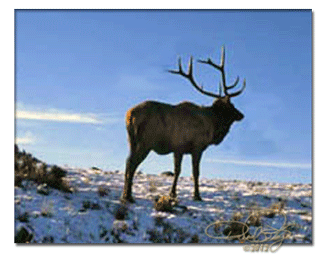
Colorado Elk
Perhaps, because I greatly enjoy the hunt, there is no longer a feeling of the need to kill. Maturity?
photo David Richey ©2012
I was in Colorado 15 or 20 years ago on an elk hunt. My buddy and I had seen several bull elk so far and our hunt still had a few days to go. We spotted a small elk herd from a distance, glassed them to see what they looked like.

"The bull on the far right is a nice 6X5," he whispered. "The middle bull is just a spike, and the left one is partly hidden. I can't see his rack."

The bull then eased from the black timber and offered a us  a long  look

"Wait. He's stepping out, and he's a dandy 5X5 with good ivory tips," the guide said. The right and left bulls are shooters. We have the wind in our favor, and if we can get 75-100 yards closer we can sneak in close for a good shot if cows don't get in our way."

To shoot or not to shoot? Shakespeare never had this problem. For me, it was easily solved. I chose not to make the stalk and take the shot. The bulls were decent racks but not what I'd hoped for. I offered them to my buddy from Michigan.

This hunt took place in September. I was looking for something big; I'm not a trophy hunter, but had fond hopes of getting a big bull. Besides, I wasn't keen on shooting a nice bull elk so early in the hunt.

"Want him?" my buddy asked our guide who also had an elk tag. "The best bull is on the right, and most hunters would be tickled to take him. He's broadside, and after a short stalk it would be an easy bow shot at 40 yards."

He knew I could kill a  bull elk at 40 yards, but I didn't want to shoot the animal
I shook my head no, and the three of us moved quietly from the area to look for a bigger bull. The guide and my friend kept looking sideways at me, probably thinking I was nuts for not shooting.

Sometimes elk hunting should be a solitary sport

The next day we drove as far as possible to get near a water-hole up an old mountainous two-track. We left the truck behind, and then climbed uphill within easy reach of the water-hole. Two hours later, we were there and had scouted the entire area. An elk bugled briefly and we shifted our attention to the sound.

"Here comes a nice bull," the guide said. "He looks great: heavy antler beams, long tines and a 5X5 rack. I'll try calling to see if he's interested."

My neck hairs lifted at the sound of elk music drifting through the mountains, and the bull responded by moving closer. The call had him interested, and for good reason: The bull wanted water from the water-hole, and figured he may have to get past the other bull. He closed to within 100 yards, turned broadside and challenged the unseen bull.

I again shook my head no to the unasked question. My friend couldn't understand my apparent reluctance to shoot a bull. Neither could the guide.

"I shot a beauty here two years ago, and since I have a choice in the matter, I'll wait for something bigger," I told him. "If I see an elk larger than what I've already taken, I'll shoot. Until then, I'll hold off and shoot a deer when I get home."

Many elk were seen but we never fired an arrow at any of them

We saw 16 antlered bull elk on that Colorado hunt, and I passed on each one. My buddy wound up shooting a nice 5X5, and was very pleased with his choice. It was his first elk with a bow, and a wonderful accomplishment.

I shot nothing, and wasn't disappointed. He, a first-time elk hunter was ecstatic, but still couldn't figure out why I wouldn't shoot. He didn't realize that I'd been here before, and had shot my share of bulls, and didn't need to do so again.

I assured him that he'd been a great hunting partner but the simple fact was I hadn't seen an animal I wanted. The hunt offered thrills and many opportunities, and no one could have asked for anything more. I had numerous chances to shoot in a sport where one lost opportunity may be all a hunter ever gets.

A successful hunt doesn't always mean returning home with game. I had many chances to shoot, but there was no need unless I saw an elk I really wanted. The animal I had hoped to take never materialized, but that didn't diminish my time afield.

If anything, it enhanced my hunt, which is difficult for other hunters to understand. My time was well spent, and seeing game in beautiful hunting country was a plus, but I've never regretted my decision.

A kill isn't always needed to produce a meaningful hunting experience. On this and three other elk hunts I passed up nearly 40 bulls. I was happy and proud to see my hometown friend connect on a fine bull.  But he wasn’t sure about my choice.

I hunt for what I please, and what is legal, and if I don't shoot, it's because of one of three reasons: the bulls were too young to shoot or I simply couldn't catch up with them. Perhaps a third choice is possible.

Perhaps because I greatly enjoy the hunt, that when it comes time to shoot, the urge to kill the bull has gone away.

In any respect, the guide and other hunter had a choice and decided, this time, not to shoot either.

For us, the hunt had been enough.

Thursday, March 29, 2012

Me and Max fish the AuSable River

Besides trout, Max Donovan loved to hunt ducks and geese

Max Donovan, consumate sportsman and mentor
Max Donovan, consumate outdoorsman and mentor, admires one element of the beauty of waterfowling.
photo Dave Richey ©2012
Some 55 years ago, my long-time mentor -- Max Donovan of Clio -- took pity on the scrawny blond-haired kid with glasses, and took me north to fish the mainstream AuSable River for trout.

"We're going to be fishing near a place called Wa-Wa-Sum," Max said. "It don't make no difference what fly is hatching today. We'll be using the Adams, a No. 12 or 14, I suspect."

Now, a bit of background history. Max was a hemophiliac, a bleeder. He would bleed for a week or more if he nicked his chin while shaving. He also was, at the time, the oldest living hemophiliac who had part of a leg amputated. His "wooden leg," as he called it, worked quite handily and he could wade well at the time.

He also had forgot more about fishing than many know

The drive proved a lesson in history about the inventor of the Adams fly, which we would soon be using. Max had it down pat.

"This here is my favorite fly and I can catch any kind of trout on it that rises to the surface to feed," and after having shared many fishing trips with Donovan, I knew he could do it. "This fly looks like many other flies, and drift it drag-free over a feeding fish, they will take it like they were starving.

"OK, Len Halladay of Mayfield (just north of Kingsley), invented the Adams fly in 1922 to fish on Mayfield Pond and streams such as the Boardman River. He named the fly after his friend, Judge Charles Adams of Ohio."

The fishing was perfect on a great day

Some feel the Adams closely imitates some mayflies and stoneflies. The fly, born at the Mayfield Hotel and first used on Mayfield Pond, has been imitated but Halladay's original creation, is a wonderful catcher of trout.

"Now, listen up, don't you worry about me," Donovan said after his Len Halladay-Adams  one-sided discussion. "I'm heading downstream. I know this stretch of water well, and know where the deeper spots are. I know where the trout hold and where they don't.

"Got any Adams flies," he asked, knowing full well I didn't. "Here are a half-dozen. Lose them all in the trees and it will be a long day. Watch your back cast, don't pitch the flies into the trees, and find a feeding fish. There will be a quiz later about what you've learned while fishing alone."

His lecture on the Adams fly was forgotten as I headed upstream

Off he went, with a little hitch in his git-along, and he would drill casts under over-hanging branches to fish water most anglers could never reach. I watched him fish around the bend and out of sight, and then headed upstream along the bank.

I was looking for rising fish, and soon found some. I'd work into position, cast so the No. 14 Adams landed a few feet above the rising trout. I mended the line like Max had taught me, and soon hooked a 12-inch brown. Into my creel it went, this being well before the catch and release restrictions.

Mind you, this was in the days of yore, long before this stretch near Wa-Wa-Sum became catch-and-release. For me, at the time, fishing was a philosophy of catch-and-keep.

The fish were fairly easy, and I caught several and put a few down with a sloppy cast. One was a beautiful 14-inch brown, and being young and needing praise from the master, the fish was kept.

Time dragged on as the sun started lowering into the west, and I fished back downstream to the end of Thendara Road where we had parked.

There was just enough rising trout to keep me interested

A good fish rose just upstream from the road-end at Wa-Wa-Sum, and I worked him patiently. I erred on the side of caution on my approach, and eventually worked myself close enough to the fish to drift a fly. I switched to a No. 12, a  larger fly, and knew I'd have but one or two casts.

The brown moved to the fly, tipped up and sipped it off the surface. The fish jumped once, settled into a midstream scrap, and he was finally landed.

Some clapping was heard, and Max stood by the car watching, and offered a "Good job. Let's take a look at him."

Max had a way of making me look better than him

He said he never caught a fish but I didn't believe him, but I showed off five fish including two really nice ones. He studied them and me, asked it I'd had a good day, and he was told that it had been a wonderful day.

Then came the quiz. "When did Len Halladay invent the Adams? I had forgotten about the date and the quiz.

"That's great," he said. "In view of your exceptionally good luck and my poor luck, and because you failed the test, I'm going to let you clean all those fish. We will eat them tonight as we think of our trout fishing day, Len Halladay, the Adams fly, and how you really made me look bad.

"For that, you also get to wash and dry all the dishes. My bum leg is getting a bit tender, so I have get off it, and because I'm all gimped up and can't get away, I suppose you'll torture me to death about your fish-catching prowess."

Somehow, I knew I'd get stuck with the cooking and dishes. But that was the price of admission to learn about trout fishing and fly-tying history from the master.

Bless him. He's been gone for nearly 30 years but it's amazing how many memories I have of me and Max fishing and hunting. All are treasured, and will be trotted out occasionally. Stay tune for another at some future date.

Tuesday, January 31, 2012

Hunting pre-rut bucks

Bone-white antlers of a resting buck show above weeds during the pre-rut

buckingrass
The buck was banging its antlers against a tree, and I listened to him working a scrape for 30 minutes late last October. The buck was within 20 yards of me but he was screened by thick brush and was invisible.

I sat in my tree stand and listened. He was close enough to hear the urine hitting the scrape, and he was upwind and the pungent ammonia odor was strong. He worked that tree over, yanked at the overhead licking branch, and for all the noise and commotion he made, the buck was impossible to see.

I checked the spot the next day. He'd been working two scrapes, and one was eight inches deep and as big around as two large platters. The buck had pulled the old licking branch down, and I replaced it. It suited him because the scrape had tine marks and a hoof print in it, and the new licking branch looked pretty ragged. The second scrape was opened up, and the licking branch was chewed to a frazzle.

A spot with two or more active scrape should produce  if you don’t spook it

What was even more interesting was that the buck had opened up a third scrape. Huge clots of wet earth was piled at the north end of the scrape, and he had made it the night before. How do I know?

Buck scrapes have dirt and debris piled at one end or another, and if the dirt is piled at the end closest to thick cover, it generally means the deer is tending that scrape in the evening as he leaves the bedding area for a night of chasing cute little does.

This told me several things: One is the rut had not started but the chasing phase had set in. This chasing phase lasts several days before the full rut starts. As long as fresh activity is seen at the scrape, and it is being tended one or more times daily, the rut has not begun. Once the scrapes show no sign of activity, that means the rut is underway.

One thing few hunters realize is that the mid-day hours just before and during the rut can produce a fine buck.

This buck may have other nearby scrapes that it had been working, but once a buck is shot and is taken out of the woods, another will take its place. Nature abhors a vacuum, and when a big brown trout or a big whitetail buck is removed, another moves in and takes over.

Hunting from 10 a.m. to 2 p.m. works well during the chasing stage and the rut. If possible, be in your stand by 9 a.m., and sit patiently. The bucks will move during the mid-day hours.

Hunt the mid-day hours during the pre-rut

I first learned of this phenomenon many years ago while hunting ruffed grouse. Two days in a row a buck was seen darting away from me in the same area. I checked the area, found his scrapes, and went back and set up a stand 30 yards downwind of it. The buck came by that first day at about noon, wind-checked the scrape from downwind, and offered me a 12-yard shot.

Hunting the pre-rut and the rut during mid-day hours can pay off. Sure, many hunters can't take time off work to hunt those hours, but keep it in mind for weekends. Hunt near natural funnels between bedding and feeding areas, and once the rut kicks in, start hunting the heavier cover.

My only real problem with hunting the mid-day hours is a personal one. I'm good for three hours maximum in a tree before everything gets sore. I'll stick it out until about 2:30 p.m., grab a bite to eat, and then hunt from 4 p.m. until legal shooting time ends. It means spending long hours in a tree, but it can pay big dividends with a husky buck and the hunting is more fun than writing about it.

This method has worked for me, and can work for you regardless of where you hunt. Try it this fall and see if it doesn't produce action at a time when no one is hunting. It's rut hunting's biggest secret, and now only you, me and several hundred thousand other people will know. Mark this blog and go back and read it again in mid-October, and maybe it will produce a nice buck for you next fall.

Friday, January 27, 2012

Bad winter days rattle my cage

A mellow day on Lake Michigan suits me to a T

lakemichsunset
Our house is structurally sound but some work needed to be done to make it look nicer on the inside and out.

Walls to be painted, carpet pulled up, all of this stuff leaves me cold. Some things got dinged up when my father was alive, and some things have just worn out.

Some changes were needed. I am living proof of a man who likes his home looking nice, but who gets a bit peeved when he can't sit at the table to eat and must sleep in a different bed because new paint is stinking up our bedroom.

Such things I find very annoying. Change doesn't come easy

It's easy to get a bit peckish under such situations, but I go into my office and work. It keeps me out of the way, and I don't have to look at the mess.
Watching people strip walls of old wallpaper leaves me cold. A new sink and other things are coming for the half-bath off our bedroom but only a toilet sets there now.

An old bed that belonged to my grandparents has been my bed for 30 years. Now there will be a new bed. I can accept the change because things will be nice when the job is done.

The question is when will it be done? Things move at a snail's pace, and slow doesn't match my mood. Order this or that, and wait two or three weeks. No one stocks inventory.

Things progress at the speed of maple syrup on a cold day

Some old carpeting has been pulled up, but the new carpeting won't be laid until the rooms are painted, the new doors hung, and the trim work has been completed.

We schedule things, and it always takes longer than planned. We order things and it costs more than we planned. Bathroom sinks and toilets must be ordered, and once everything is done, we'll have to order new carpeting. Who knows what color. We'll know later.

My wife understands this stuff, and I do not. Want a story, call me up and you'll have it tomorrow. Need a photo, it can be scanned and on your computer in 30 minutes. Want a shower pan for the shower, and it's a three-week wait.

I don't do well with house chores;  Never have, never will

I've never been a handyman. My knowledge of tools is pretty much confined to screw drivers and hammers. The more hammers and the larger, the better. I don't understand home improvements, and the cost and work involved in making such wholesale changes is almost unacceptable.

My recliner served me well. It felt great, worked just fine, and is gone along with a sofa, end-tables, another recliner and some carpeting in a trade-off with the builder for doing some work. Cool.

The builder is a good friend, and we both think highly of him. I'd rather he take the stuff in exchange for saving us some labor fees. However, we'll still have to buy a new sofa and some new chairs. I get confused about such things.

Steaming off wallpaper. Now there is a fine mess. It takes time, doesn't smell very good, and steaming means shreds of wallpaper everywhere. One small piece was found sticking to the bottom of my shoe. At least it didn't stink.

We're replacing 13 inside doors. Is that a lucky number or what? We called to donate them to a local charitable organization. They would be out in a week. A week to come to pick up 13 free doors? They didn't show up. Another appointment made for them to get them today. You got it, they didn't show. We're on again for tomorrow morning. I'm willing to take bets that they won't come.

My wife, her sister and a grand-daughter are ram-rodding this project. Guess how many votes I get? There's no place for me but away.
So I'm a bit tight-jawed. I try to keep my mouth shut to avoid hassles. I'm still not at the driving stage after eye surgery so I seek safe refuge in my office.

Don't know how many consecutive days of office-sitting I can take, but I think we may be a third of the way done on this interior rejuvenation. I keep waiting for that silly television program to show up, and within 30 minutes they turn a house into something grand and wonderful.

I used to sit and wait for John Baresford Tipton from the 1960s to arrive from the television show The Millionaire, announce his presence and give me a million bucks. John hasn't showed up in 40-some years, and it's doubtful the home redecorating show will do a 30-minute job either.

So ... it's time to gut it up, tough it out, stay out of the way and keep my mouth shut. This may be a democratic nation, but when refurbishing the house rolls around, all facets of democracy and freedom of speech fly out the window.

If you need me, try my office. Knock three times on the door if you love me.


Thursday, November 24, 2011

Happiness is a Thanksgiving Day deer hunt

Some Thanksgiving Day hunters camp. The object of our attraction.


Thanksgiving Day is something special where we celebrate our good friends, the weather, and a fine chance to hunt with friends.

The weather was a bit blustery today, and it appears this nasty weather will continue into the weekend with possible snow. The first day of a winter storm arrived last week, and the whitetails moved well.

Tonight the deer didn't move as much as last night, but deer sense these upcoming weather changes and increased hunting activity. Weather can kill deer quite quickly if they don't have easy access to heavy cover and an available food supply.

Thanksgiving Day deer hunts with snow are better than without.


We are indeed fortunate that our whitetail herd has plenty of thick cover where they can take refuge against the cold and snow. We have low-lying swamps, huckleberry marshes, tag alder thickets and other areas of thick cedar cover. Many of these spots provide fair to excellent thermal cover against the cold, which is expected to arrive this weekend.

Deer in our area are never found very far from cover or food, but we still experience a certain amount of winter kill. Occasionally, it may be a big buck that succumbs to death after rutting hard, losing 25 percent of its body weight, and not being able to recover that lost weight before deep snow and cold weather sets in.

A few bucks are still chasing an occasional doe, but the rut has pretty much ended, and bucks are going to feed as often as possible. Storms such as last week are the early warning sign for post-rut bucks, and they are eating as often as possible to regain fat reserves to get them through the winter.

Much of any winter kill is attributed to late-born button-bucks and doe fawns that simply do not have the fat reserves needed to make it through a long winter, and I suspect we may have one of those this year. Some whitetail deer biologists feel that button-bucks die before a doe fawn for one very simple reason: button-bucks are more aggressive and always are the first to a feed station or bait site while doe fawns often were forced to forage more for food.

It doesn't make that much difference in this region because there is a continual food supply unlike what is found in many other more heavily hunted areas. I've seen years when button-bucks were dead from starvation by late November or early December when we get early and heavy snow storms. It's nature's way of making the strong stronger and the weaker ones die early of starvation or being pulled down by coyotes in the Lower Peninsula or wolves in the Upper.

Predation in late November and December increases with snow.


There is still a good bit of standing corn fields although my neighbor had his cut yesterday. Since baiting and winter feeding has returned, many people put out small amounts of food (two gallons) and deer with this handout and regular forage, can do fairly well providing we don't get severe ice storms.

Ice storms on top of deep snow is a major killer when combined with a low wind-chill factor and poor thermal cover. Last year, many corn fields were never cut and they provide fairly good winter cover.

Think about it. A big corn field offers continuous cover, an adequate winter food source, and snow melt and frost provide some moisture. An uncut corn field is a magnet for winter deer.

I didn't kill a buck today, but over the years I've managed to shoot a buck 45-50 percent of the time on this day. Driving deer is our major hunting method, and between my in-laws and neighbors, we have a number of people who will participate in a deer drive.

Just hunting on Thanksgiving Day is a treat for most hunters.


We prefer long and narrow strips of heavy cover, and two or three people will move slowly back and forth, with frequent pauses, to let our scent blow down to the deer. We try not to make much noise, and we have people stationed quietly and motionless at key spots along the edges and the downwind end. Drives are the most popular hunting method on Thanksgiving Day, and other than the first three days of the firearm season, Thanksgiving Day is the next best day of the hunting season.

Tonight wasn't a major hunting night except for family. We spent some time hunting, and more time indoors telling old deer stories. We do give thanks for our hunting land, the deer that live around here, and the opportunities we have to spend time afield with family and good friends.

For that, we are most grateful. Happy Thanksgiving!

Wednesday, November 09, 2011

Bob Jennings: Book Review - My Mythical Adventures with Bird Dogs

MY MYTHICAL ADVENTURES WITH BIRD DOGS, by Bob Jennings.

Bob Jennings has this book available for $30 postpaid. Send payment to: 3302 N 190 W., Switz City, IN 47465. Or call, (812)798-0783.

This book is for any hunter who has owned bird dogs, and learned to love them like the author does.

The Dedication of this book states: This booklet is dedicated to all dogs that have passed on and made their way back into the hearts of their owners. I think this wonderful dedication will pertain to any dog lover.

This book, at 42 pages (twice the length of the first book) shares with readers the thoughs about three of his dogs. Anyone who has owned bird dogs, and raised them from pups to adults, can clearly find something in this book to jog their memory about pets they have owned in the past.

I read the book at one setting, and couldn't put it down. The first of the three stories I read was one of the finest dog pieces I've ever read, and the entire book was a great read except for a few misspelled words.

I'm not going to go into great detail, but will keep this short. If you've got a good imagination, I strongly suggest you take my word for it, and buy this book. You'll be reading some of the finest dog stories I've read in a very long time. This book is a spiral bound paperback with many drawings and photos.

Praise doesn't come any higher than that. Happy reading.

Posted via email from Dave Richey Outdoors

Wednesday, September 14, 2011

Different deer hunting strokes


Big bucks like this don’t just happen. One must hunt to see them.


Millions of deer hunters are found across this great nation of ours, and we all seem to have different philosophies on hunting. We seldom agree on wildly varying topics.

Some hunters refuse to hunt east winds. Anything from the east is bad. For years, October featured south and southwest winds and then west and northwest, and by December we were hunting northwest, north and northeasterly winds.

My philosophy is that a deer hunter won't get much hunting in if they sit out every day with a bad wind. I hunt but switch from an open tree stand to an elevated and enclosed coop on such days. A few stands are set up primarily for an east wind, and they are in demand when the wind goes sour.

Many are the deer hunters who believe they should only hunt during the dark of the moon. Others only hunt the week before the full moon, and others never hunt during a full moon.

There are those who believe in hunting the Harvest Moon, the Hunters Moon, the Rutting Moon, and some who will only hunt just before the second full moon after the autumnal equinox. The nice thing about living in a free society is each of us can indulge our personal pleasures.

I personally don't care which day of the week it may be, which way the wind blows, what the moon phase happens to be, or anything else. I find it difficult to kill deer while sitting in the house rather than in a stand while hunting.

There are others who place great emphasis on hunting the rut. Little do they know that the 10 days before the full rut begins, deer go through the chasing stage or the pre-rut. It is a wonderful time to be hunting, regardless of the moon phase or wind direction.

Many feel the rut begins Oct. 20-25, and that is the beginning of the chasing stage, and it will last for about 10 days before the full rut begins. It's possible to find many people who would disagree on when the rut actually begins.

The peak of the rut in my area will occur on or about Nov. 3-4, and it is winding down before the Nov. 15 firearm season kicks off.

There are variations, depending on where you hunt. Weather conditions and people pressure can alter these dates a bit.

Some hunters are addicted to the Solunar Tables. These tables, first invented by John Alden Knight many years ago, are based on the sun and moon and their effect on tides and the earth. They contend there are normally two minor and two major periods each day when fish bite, and when wild game move about.

Some sportsmen hunt according to the Solunar Tables and kill deer, and I know other folks who hunt whenever they can, and they also have good hunting success while hunting outside of these major and minor periods.

I've hunted many years with great success. Good hunting habits bring wonderful hunting success, and simply being afield whenever possible is a good reason for being more successful.

I forget about all this other business, and go on doing what works best for me. That means that I hunt whenever possible, and try to hunt every day of the season.

Take the normal precautions with the wind, stay downwind of the deer, and it becomes fairly easy to build your own deer-hunting success, with or without using all of the old wives tales.

Monday, September 12, 2011

Look for bucks in hard to hunt spots

This big buck was photographed in a very small thicket.


The hunter who pays attention to deer movements will soon find some out-of-the-way spots where big bucks like to lay up. Some of those locations are easily hunted and some are not.

Some of these out-of-the-way spots are found while hunting other game species. Some of the little hidey-holes where bucks hole up are so small that one wonders if there is enough cover for a cottontail rabbit to hide.

Take it from me: it doesn't take much cover to hide a big whitetail buck. Keep that thought in mind.

Some of my friends hunt in widely scattered locations. Many also hunt upland game birds, cottontail rabbits and snowshoe hares, wild turkeys and other game. The observant ones find hard-to-hunt buck hideaways far more often than people who hunt only one place. Always take note where a big buck is seen & where he goes.

A friend pays attention to such things, and as he walked past an overgrown apple orchard after a hard rain, he spotted a big deer track going over the fence. He'd tried to get his pointer to work into it in search of birds, and the dog refused to go.

Being a patient gent, he walked his pooch around the orchard, and found the way the buck left that orchard. He also noticed that the tracks went past a big pine tree. Two days later he scaled that tree in the late afternoon after putting the dog in the truck kennel, and took his bow with him. Thirty minutes before the end of shooting time a buck that grossed 152 points jumped the fence and walked past his tree.

He's no stranger to seeing big bucks. This one passed the tree at 22 yards, and my friend shot him. It is still his largest buck, but it points out the reasons why hunters should be more attentive to deer sign.

Another guy was out chasing ruffed grouse, and walked past a sumac patch on top of a hill with a good view in all directions. The man stopped to re-tie his boot laces, and was 20 feet from the sumac patch, and out busted a big buck. He was laying up there because most people walked past the sumac without stopping, thinking the cover was much too sparse to hold a deer.

A friend tells the story of hunting ringneck pheasants near a river, many years ago. He was hunting along its edge. A rooster flushed wild at 30 yards ahead of the dog, and he swung and winged the bird.

It caught its balance in mid-air, cocked its wings and soared part-way across the river and landed on a tiny island of marsh grass and a few stunted trees. He checked the water depth, and it was only shin deep, and he crossed. His dog caught some scent, pointed, and as he approached the dog, a big buck jumped up and bolted across the river. He watched the buck splash across, crisscrossed the tiny island, and kicked up a pheasant and downed the bird.

He kept that oddball sighting in mind, and once the firearm deer season opened, he and a friend waded across to the island. One went to the upstream end while the other walked through, and sure enough, they jumped the buck and killed it with one shot.

Talk to some farmers, and they all have tales of bucks laying up in tall weeds along their line fences or next to a barn. They push deer out of swampy little tangles perhaps 20 feet across. These bucks hold in such tiny bits of cover because few people think to look there.

The thing is that bow hunters can dare to be different. They don't have to follow a stated doctrine that everyone throws at them. They can walk through an area so small that it takes less than 10 seconds to get through, and often they find the home of a big trophy buck that no one knows about.

Cattail marshes hold bucks, and I remember a nice buck that a friend shot as it came out of the cattails. He knew that buck was there, and when he shot it, the buck wheeled and dove back into the cattails and died there. Cover can’t be too thick for bucks.

Don't stick with the status quo this year when the bow season opens. Check things out. Know where the tiny patches of heavy cover are in your hunting area, look for those little nooks and crannies, and try to figure where a buck will come from or go to when leaving. That information is knowledge you can put to good use this fall.

Try it this year. It may produce a nice buck that you've probably overlooked for years.

Tuesday, August 16, 2011

Bow Quivers ... On Or Off

Bow quiver on when shot is taken. Replace quiver after the shot.


Life is about making personal choices and decisions. None of us must do everything as others do. We can dare to be different if we choose.

This blog post applies to bow hunters. Every stick and string hunter worthy of the name has his or her way of doing things, and often they turn out right. We all learn from our best teacher, experience.

Bow quivers are a case in point. Should hunters leave the quiver on the bow while sitting in a stand and shooting or should they take the quiver off to minimize weight and to remove one unnecessary item that could easily tangle in tree limbs and mess up a shot?

Hunters swing both ways on bow quivers but not me.


I'll go first, and throw my hat in the ring and voice my opinion. I climb into a tree stand after attaching my full-body safety harness to the tree and my body, I sit down, and use the haul rope to raise my bow from ground level. The bow quiver is then removed and placed elsewhere on the tree after an arrow is removed and then nocked. I often hang the quiver on a nearby limb where it will help break up my silhouette but be out of my way.

Once the quiver in hung, I unscrew the broadhead and attach my Game Tracer string behind the 100-grain FirstCut broadhead, and screw it into my Maxima carbon arrow shaft.

I attach the release to the bow string, stuff the lower limb of my C.P. Oneida Black Eagle bow into my left boot, and relax. I hunt and shoot sitting down, and my stands are positioned so bucks usually come from behind me and on my left side.

I shoot sitting down, and stow my bottom limb in my rubber boot.

If the buck follows his normal pattern, he will approach from behind and on my left side. I'm right-handed, so when the buck comes within bow range, and looks the other way, I start my draw and as I reach full draw, the lower limb clears my boot and is clear of my leg, the stand or any tree branches.

This allows for a minimum of movement, is very quiet, and oh so effective once a hunter becomes used to it. This method of drawing a bow wouldn't be possible if my bow quiver was still attached.

The arrow shafts, vanes or even the quiver could get caught up in clothing, limbs or branches. But there is another reason why my quiver comes off my bow when I begin hunting.

It reduces the overall bow weight. Not much, mind you, but when hunting in a variety of locations, sooner or later a bow quiver is going to hang up on something. I remove all possibilities of that happening by taking it off and hanging it some place where it is out of my way.

I want my bow in my hands at all times with my release on the string.


Whenever I watch a television show, or hunt with someone who always leaves his or her quiver on their bow, it makes me wonder how many lost opportunities have occurred because of that quiver.

A bow is a one-shot piece of archery equipment. It's not like hunting with a bolt, pump or semi-automatic firearm. Unless the wind is very strong and noisy, second shots at a buck are so rare as to almost be nonexistent.

A bow quiver on a bow, doesn't speed up getting off a second shot at a deer. It is somewhat awkward to reach to the quiver, pull out another arrow, reach across the bow to nock the arrow and prepare to shoot. Chances are, any self-respecting buck with heavy headgear will be long gone if you miss the first shot.

I often use my bow to help camouflage my upper body and head. I wear a face mask while hunting, and can still turn the bow inside my left boot so the handle and upper limb breaks up my silhouette. If a deer offers a shot, a simple and slow half-turn of the wrist will point the bow toward the animal as the hunter comes to full draw.

A full draw should make your bow and arrow unencumbered by anything.


Such a movement may or may not be necessary, and that is a debatable point, but it would be impossible to do with a bow quiver attached. For me, that is a strong reason for removing the quiver.

Whenever I watch outdoor TV shows, each person is checked to determine if their quiver is on or off. It seems quite evenly divided as to their preference. Those who stand all the time usually have the quiver on while those who sit to shoot take the quiver off.

Many hunters, including some of the television hunters, hang their bow. A deer approaches, and they risk being caught by a sharp-eyed deer. Me, my preference is to hold my bow where there wasted movements that could spook the animal. Holding a bow with quiver attached becomes just too awkward to hold during the hunt.

The slight added weight of a bow quiver (even a three-arrow quiver like I use) can allow a hunter to unknowingly cant the bow to that side. Is it enough, under the pressure of a nearby buck, to throw the arrow off its intended course?

I don't know and don't care to test the theory. My preference is to shoot a bow unencumbered by a quiver. It's my thought that it simplifies things, reduces weight, eliminates canting, drops a few ounces of weight and besides ... it works for me.

Anyone willing to plead their case for keeping a bow quiver on a bow while hunting is encouraged to contact me. You won't change your mind, I won't change mine, but I'd love to hear your philosophy.

Sunday, July 31, 2011

The old ways are not always the best


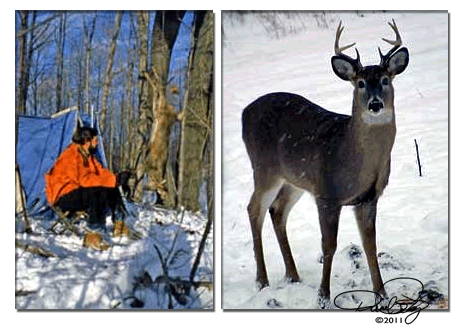
(left) Scouting can lead to a big buck.  (right) This nice buck bedded in high grass.

Some things about whitetail hunting never change. Many deer hunters choose the same tree for a stand, walk the same trail into and out of a hunting area, and nothing changes.

Many will sit on the same stump, along the same deer trail, as they did 10 or more years ago. It's difficult for many sportsmen to break their old habits, and some hunters never try. It becomes a tradition to again hunt where a buck was killed sometime in the far distant past.

Hunters often wonder: If it was good 20 years ago, it will be a good spot now. Right?

Such a hunting attitude cause deer to go elsewhere. If possible move with them.

Maybe not. That tradition of returning, year after year, to the same old spot has probably saved the life of more bucks than poor shooting or a lack of preseason scouting.

Sadly, clinging to a traditional spot, even when it no longer is hot, is a lesson in frustration. It also leads to fiery claims by skunked hunters that the Department of Natural Resources' reports of deer numbers for whitetails are grossly inflated and way out of whack.

Perhaps this season is about time to cast aside the traditional old haunts, and think about trying a new location. Too many people never realize that food and habitat conditions can and will change, and if the landowner doesn't do something to make the land produce more food and offer more cover, the deer will move on. It's as simple as that.

Change is good but it also can be bad. Hunters must study the land, learn what natural forage is present, and nearby farmers plant that deer will eat. To change for the sake of change makes little sense. Hunters must grasp the philosophy that more food is a good thing.

Deer are animals of farmland and woodland. Granted, some deer live in deep forest and many live on farms, and that's a fact of life in this and many other states across the nation.

If recent hunting years have been unsuccessful, change your hunting ways.

If you agree that a new hunting location should be tried, where should hunters start in their search for a new spot to test their luck or skill?

Hunters can start with the DNR. They keep track of deer trends, and know which counties have the highest deer numbers and which ones produce the largest deer. The county extension agent often deals with farmers and other landowners, and they also can help gauge a new area.

Determine if you want to hunt the Upper or Lower Peninsula, but if you've read hunting reports elsewhere about deer hunting prospects, the U.P. is not the place to go. The Upper Peninsula has lots of wolves and fewer deer. The area with the most deer is south of an east-west line from Bay City to Grand Rapids.

Start asking questions. Talk with regional game biologists. Talk to conservation officers.


Learn which counties produce big bucks and lots of deer, and learn why deer numbers are so high in such areas. Determine the availability of state or federal lands nearby, but both state and federal land is often quite sparse and over-hunted. especially in the southern Lower Peninsula.

Spend time scouting two or three different areas. Determine which ones offer the best combination of land, cover, deer foods, bedding cover and access. Walk around the land, and check for well-used deer trails leading from bedding to feeding areas and back. Always be on the lookout for tiny thick covers like and over-grown and abandoned apple orchard. Tiny clumps of heavy brush on the top or side of a hill is often overlooked. Places where human foot traffic is tough are good spots to find deer.

Forget the U.P. Draw a line from Tawas City to Manistee, and hunt south of there.


Look for buck rubs and deer scrapes now. Check barbed wire fences for bits of clinging hair that indicate deer passing through the area.

Talk with landowners to determine their idea of hunting pressure in this spot. Often, in farmland, the major hunting pressure is from the landowner and his or her family and close friends.


Learn where nice whitetail lead bedding cover and how they move.


Consider the possibility of leasing hunting rights. Fees vary depending on length of the lease, property size, whether it is ideal or marginal deer habitat, and what it offers the hunter.

Good land should support good truck crops, mast and other natural forage. Sometimes, an area with some does and some bucks can lead to big bucks if they are given time to grow. If you find a good spot, practice crop rotation and try to build better ground cover.

Remember: deer need five things to grow big racks: three or more years to grow, good cover, good secure bedding areas, plenty of food and water. A sixth key is a lack of steady hunting pressure.

No one owes today's sportsman anything in terms of hunting private property. I manage my land to produce big bucks, and crop lands are rotated and some timber is cut. Doing so helps maintain good hunting, but it's a never-ending learning process to keep up with where whitetails travel after crop rotation and timbering takes place.

Finding a good spot means scouting, being in the right area and being smart.


I spend many hours scouting for good spots. Deer habits change, food supplies change, and hunting pressure can make deer seek quieter areas. A hunter doesn't know these things unless they spend time in the field on a regular basis.

Public lands feature too many hunters in narrowly confined locations, and the hunting pressure is far too high. Food supplies are far better on private land than state or federal lands. Private property holds deer, and, in many areas, it supports more whitetails than public land. For this reason it's easy to understand why more people lease hunting land even though the price of leasing acreage is rising.

Whether a hunter leases private land, hunts on public land, or manages to wangle an invitation from a landowner, scouting is a never-ending problem all year. Hunters who don't scout old land or new land run a major risk of not being successful.

Those who scout properly will never spook deer. Those that make numerous mistakes often chase the deer over onto the neighbors, but don’t expect them to thank you.

Wednesday, July 27, 2011

The Richey Twins on the outdoor trail


George with a 30-pound-plus king salmon.

It was a nice day and it felt good to be cleaning steelhead rods and reels. This job seemed better than working on the computer.

I was puttering with a reel with 4-pound line when a memory jolted me like an electric shock. It was about my late brother George, and he was coming down the Little Manistee River years ago fighting a rampaging steelhead.

"Try and get a net under this guy," he hollered. "I hooked him a quarter-mile up-river, but he's riding the current broadside. Stick your net in the water, and I'll put him head-first into it."

This was the moment of truth with this big steelhead.


My net was pulled from under my belt behind my back. The fish was 10 feet upstream as my net went into the river, and George leaned back to get the fish up on the surface, and at just the right time, he dropped the tip and the fish dove into the net. My sole job was to lift it out of the water.

"Good dip," he said, as we waded ashore. The steelhead, a red-slashed male with bright cheeks and gill covers, was 16 pounds of broad-beamed raw power. George worked the No. 4 wiggler fly out, eased the big guy into the river, and with a splash he was gone. Our trips came and went like that fish.

Several years before George died in 2003, I took him caribou hunting in northern Quebec. From home to Montreal, I told him there were two things you don't do: never shoot the first caribou bull seen, and never shoot a cow caribou. They do have very small antlers.

We hunted together, and I ran him down the sprawling lake in a square-stern canoe with a small outboard motor, pointed to the top of a tall and open "baldie," a treeless hill-top where long-range visibility was superb.

He would use binoculars, and study any caribou seen. My plan was to scout the lake's south end. I found an area where caribou had traveled, and the trail looked like a cattle path. I was looking for a good downwind spot to sit when a shot rang out.

It could only be George. The others in our party were far to the north. I returned to the canoe, motored over to where I'd dropped him off, and saw him trudging down the hill, carrying something. The closer he got, the more it looked like a cow caribou head.

"Didn't I say not to shoot a cow?" I asked. He bowed his head in mock shame, and said: "But I'll have the biggest cow caribou rack in camp."

George admitted shooting a cow caribou and took the razzing.


The other hunters teased him about it, and he made up for it by shooting a very nice bull two days later. The razzing didn't bother him, and he had fun.

Another time we hunted Le Chateau Montebello, a famous Quebec resort. We were there to hunt whitetails, and our guide said we'd be lucky to see a deer. If we did, he said, it would be a shooter.

The guy put on one-man drives, and I've worked deer drives for many years. I can tell good drives from bad, and this guy was an expert. He walked softly, yipped like a beagle puppy occasionally, and never hurried the deer. They just moved slowly ahead of him.

Far off, on the third day, I heard him yip softly to let us know he was coming. It was a large area to watch, but 10 minutes later a white-antlered 8-pointer eased from the woods and stood, side-lit by the sun against a pine tree. It was a beautiful sight.

The buck came out, turned away from me, and I took the close shot.


He turned to look the opposite way, and I slowly raised the rifle and shot. He went down, and George almost beat me to the buck. It was the only deer we saw, but he wasn't disappointed. He loved listening to the wolves howl at night, and was happy that one of us took a good buck.

"Good shot, good buck, and where's the guide?" He asked. "This buck weighs well over 200 pounds, and we will need help moving it."

The guide showed up, we boiled a kettle for tea with our sandwiches, and walked four miles to his truck. It is the only whitetail I've taken in Quebec, but it's important because we shared the hunt in a unique Canadian location.

Neither of us have ever been competitive, but years ago before I wrote the first story about pink salmon runs in Upper Peninsula streams, George was with me to share what might be an adventure. We didn't know if we'd find the humpback salmon or not.

We fished pink salmon in the morning and hunted bears in the afternoon, and soon found fish in the Big Huron River. They usually spawn on odd-numbered years and we found hordes of them on the first gravel bar above the river-mouth.

We'd guided river fishermen for 10 years, and began catching pinkies on flies. An orange fly tied on a No 6 hook produced best, and they were some of George's tried-and-true original steelhead and salmon patterns. The fish weren't big but were aggressive.

Dueling it out for a Michigan state pink-salmon record.


Here's another one," he said. "I'm taking it to the store to weigh it. I figure he'll be just over two pounds. There's no state record for pink salmon so let's set one."

Back he came, and it weighed 2 lbs., 3 oz., and so I tried to beat him. Mine weighed 2 lbs., 4 oz. The next day we caught fish of 2 lbs., 5 oz, and then 2 lbs., six oz. On the last day George caught one that weighed 2 lbs., 7 oz. and it became a state record that stood for several years.

I was tickled for him, and he got a Master Angler award, and the mounted fish hung in the DNR offices in Lansing for years before his record was broken. He didn't care. He'd had his "15 minutes of fame."

And that was the neat thing about brother George. He could go with the flow, be happy doing anything outdoors, and greeted each day with a smile on his face. He had the capacity to make others feel good and feel as if they were the most important person in his life on that day.

He was game for almost anything. I set up a bear hunt in the Upper Peninsula one year, and although he had hunted bruins near St. Helens, he wanted an Upper Peninsula bruin.

We hunted near Marquette and near the Laughing Whitefish River, and it was there on a nice September day that he took a good animal.

It walked in, stopped near the edge of the swamp, stood up to survey the bait site, and slowly dropped to all fours. The bear was cagey and moved slowly to circle the bait. There was no wind, and scenting conditions were bad, but the bruin was cautious.

After catching pink salmon, George shot a nice black bear.


George could see the animal at times, watched the bracken ferns move as it walked through them, but could never see enough for an accurate shot. Finally, apparently satisfied that all was well, the bear strolled slowly into the bait site and stood facing him.

He waited until it turned and offered a broadside shot, and one shot from his 30-06 took out the heart and lungs, and broke the off-side shoulder. His bear weighed a bit over 200 pounds, and it was a wonderful animal for him.

George and I shared 64 years of great fishing and hunting adventures, and I made sure he could accompany me on some of these fishing and hunting trips. Summer is a great time to remember, and these fond memories of the Richey twins on the outdoor trail will always stick with me.

Perhaps one day soon, I'll tell of many other fishing and hunting trips where he and I had wonderful times outdoors, together and sharing our common love for the outdoors. He was a great companion, and I certainly miss him.

Saturday, April 30, 2011

Hunting gobblers will teach a hunter how to sit still


A decoy can help divert some attention away from a caller.


My preaching about sitting still without making noise has become a mantra. Some people might think I keep repeating myself, but this is a most important thing for hunters to keep in mind.

Perhaps I do natter on a bit about it but there is a very good reason for my tedious repetition. If some folks aren't reminded, they tend to forget this very important part of hunting.

Move at the wrong time, and a deer has you pegged. If you are very lucky the deer will run off without blowing and snorting or spooking every deer within hearing.

Sitting still is second nature to me but not to many deer and turkey hunters.


The same thing holds true with making any noise. Click an arrow against the bow, or have brass cartridges rattling around in your pocket, and it's enough to send whitetails bolting for cover a half-mile away. It's just their nature to be jumpy.

Some people believe that because they are in an elevated stand or inside a ground coop that they are well concealed. That's not true. They may be somewhat concealed but movement or sounds are seen or heard.

Anyone who really wants to get an education on sitting without making a movement or noise should practice on wild turkeys. These birds seem to have X-ray vision, and their ability to hear sounds is second to none.

Some friends hunt turkeys with a bow. They are accustomed to sitting still in a deer blind, and it is second nature for them to sit still while turkey hunting.

I've often watched other people hunt birds, and almost all of them wind up spooking the gobbler long before Ol' Longbeard strolls within 100 yards. Think of it this way: all wild animals have the ability to tell almost precisely where a call they hear is coming from. It's almost uncanny how they determine a sense of place where a call originated.

Even a bull moose can pinpoint the position of a call.


Use a deer call on a whitetail passing 100 yards away, and if that buck comes, he will come to within 10 feet of where the call came from. If deer can do that, if moose or elk can do that, so can a turkey.

That bird may come fast or slow, but he will be coming directly to the hunter's location if possible. Some may try to circle a bit but they head straight for the call. So what happens when the bird is 100 yards away, and you decide to reposition yourself for a shot at the wrong time?

The gobbler will have you spotted in a heartbeat. There is an old adage about hunting gobblers that goes: If you can see the gobbler, the gobbler can see you. If a move is necessary, do so when his head is behind a big tree. Don't get caught when he is out in the open.

Cheating on a gobbler involves waiting until the bird goes behind a thick bush or a big tree. If a move must be made, make if fast, smooth and without noise ... and when the bird cannot see you. Never attempt any type of move if a bird is within 35 yards.

Eliminate all movement by being properly positioned for a shot at all times.


OK, if the bird is coming directly to your call, all you need to do is line up on the bird's head. You do have the shotgun stock to your shoulder and the fore-end braced on the palm of your hand and resting on your knees, don't you? It's like having the bow in your hand, the other hand on the release, and being back at full draw and waiting for the shot.

Success at turkey hunting means being prepared, doing everything right, and sitting still. A moving hunter or one that makes a noise other than that made by a hen turkey will probably scare off the bird. Once a turkey is spooked, he's not coming back for a visit any time soon.

That same analogy applies equally well to deer hunting. The sportsman that can't set still for an incoming turkey won't be able to sit still when the buck of a lifetime approaches his stand.

It's great training for those hunters who drew a spring turkey permit. If you didn't draw one, don't practice your sitting still exercises when other people may be in the woods. There is little sense in ruining someone else's hunt.

If you want a top-end experience of learning what and what not to do when game approaches. hunt gobblers. Make one mistake, and you'll have learned your first lesson, which should never be repeated.

Saturday, March 26, 2011

Some memories of brother George


George Richey with a 30-pound Chinook salmon caught on a fly


It was one of those mid-September days when it felt right to be going through my deer-hunting backpack and sharpening broadheads. It was something to do while waiting for Oct. 1 to arrive..

So I was puttering with my bow quiver of sharpened heads when a memory jolted me as it entered my mind without me thinking about it. It was of brother George, and he was coming down the Little Manistee River in high water in early April with a rampaging steelhead on his line.

"Try and get a net under this guy," he hollered. "I hooked him a quarter-mile upstream, but he's riding the current broadside. Stick your net in the water, and I'll put him head-first into the net. Ready?"

George and I always helped each other, and here I helped him land a big steelie


My net was pulled from under my belt behind my back, and my rod butt went in underneath the belt. The fish was 10 feet upstream as my net went into the water, and George leaned back on the rod to get the fish up onto the surface, and just at the right time, he dropped the rod tip and the fish dove right into the net. My job was to lift it from the water.

"Good dip," he said, as we waded ashore. The steelhead, a red-sashed male with bright cheeks and gill covers, was 16 pounds of broad-beamed raw power. George worked the No. 4 wiggler fly free, eased the big guy into the river, and with a mighty splash it was gone.

Another time George and I hunted Le Chateau Montebello, a famous resort in Quebec. We were there to hunt deer, and the guide told us we would be lucky to see a deer. If we did, he said, it would be a shooter.

The guy put on one-man drives, and I've been involved in deer drives for most of my life. I can tell good from bad, and this guy was an expert. He walked softly, yipped like a beagle puppy on occasion, and he never hurried the deer. They just moved slowly ahead of him.

Far off, on the third day, I heard him yip softly to let us know he was coming. It was a large area to watch, but 10 minutes later a white-antlered 8-pointer eased from the woods and stood, side-lit by the afternoon sun against a pine, and he was a beautiful sight to behold.

George liked to deer hunt, and loved hunting from an elevated stand


He turned to look the opposite way at George, and I slowly raised the rifle and aimed. He went down at the shot, and George almost beat me to that buck. It was the only deer either of us saw on that hunt, but he wasn't disappointed not to get one. He loved listening to the wolves howl at night, and was happy that one of us shot a good buck.

"Good shot, good buck, and where's the guide?" He asked. "This buck weighs well over 200 pounds, and we will need help to move it far."
The guide showed up, we boiled a kettle to have hot tea with our sandwiches, and then had us a four-mile hike back to his truck and he drove up to the dead animal. It is the only whitetail I've taken in Quebec, but it's important to me because George and I shared the hunt in a unique part of Canada.

Neither of us have ever been truly competitive with each other, but years ago before I wrote the first story about runs of pink salmon in Upper Peninsula streams, George was with me to share what might or might not be an adventure. We didn't know if we'd find the pink salmon.

We would fish pink salmon in the morning and hunt bears in the afternoon, and we found some fish in the Big Huron River. They usually spawned during September on odd-numbered years and we found hordes of them on the first gravel patch above the river-mouth.

We'd been guiding river fishermen for a few years, and started catching pinkies on flies. An orange fly tied on a No 6 hook seemed to produce best, and they were some of George's tried-and-true steelhead and salmon patterns. The fish weren't big but they were aggressive.

"Here's another one," he said. "I'm taking it in to the store to get it weighed. I figure it to be just over two pounds. There's no state record for these fish so one of us should set the record.

It was brother George who held the Michigan pink salmon record for many years


Back he came, and it weighed 2 lbs., 3 oz., and so I tried to beat him. Mine weighed 2 lbs., 4 oz. The next day we caught fish of 2 lbs., 5 oz, and then 2 lbs., six oz. It was on the last day that George caught one that weighed 2 lbs., 7 oz., and it became the state record that held up for many years.

I was tickled for him, and he got a Master Angler award, and the mounted fish hung in the DNR offices in Lansing for years before his record was broken. He didn't care. He'd had his "15 minutes of fame."

And that was the neat thing about brother George. He could go with the flow, be happy doing anything outdoors, and greet each new day with a smile on his face. He had the capacity to make people feel good.

He's been gone for nearly eight years, and I miss him so much. I'd give anything to go back in times and experience several new experiences with him again.

Sunday, March 20, 2011

Cleaning my turkey calls


The vest hangs where I can't see it from my desk, but I had to go over that way today, and I was a goner. It may as well have had a Pick Me Up sign hanging off it.

Oh well, the turkey bug bit me bad this morning. Each one of my calls came out, and each one was carefully inspected and cleaned. My favorite diaphragms were washed in warm water and allowed to air dry.

All mouth calls work best when kept cool, and there's nothing wrong with keeping your clean diaphragm calls in the refrigerator. Cool temps keep the latex reeds in better condition.

It's time to work on your turkey calls before hunting season begins.


My vest is cool, and when I'm not hunting, I wash the latex reeds and insert a flat (not round) toothpick between the reeds to clean and separate the latex. A few callers I know store their diaphragm calls in the cool and dry basement when not in use, but I don't go that far. Mine never hit the fridge but I keep them away from heat in my vest.

I don't do too much to my box calls. I dust them off, including the paddle and lips of the sound chamber, and make certain there are no twigs or anything else inside them from last season.

A light sanding of the paddle and the edges of the sound chamber will remove chalk residue. It may need a bit of tuning after a light sanding. Just don't use any force when sanding. Keep it light and gentle.

Keep all-wood calls dry and remove excess chalk and any dirt.


Many of my calls require the use of chalk although I also use chalk-free calls ,and I try to lightly remove as much old chalk as possible. Once they are cleaned and dusted off, I allow them to sit on a shelf near my desk. They are thoroughly dry when the time comes to use them, and I try not to let them get damp or wet. Too many wood box or push-pull calls have been ruined by using them in rain or snowy conditions.

My aluminum, crystal, glass or slate calls require little care. I clean the surface with a soft, slightly dampened cloth, and then they are wiped completely dry moments later. The peg or striker is another story.

It took me some time to learn, because I like to experiment with pegs, but gradually it dawned on me that certain pegs perform best with certain calls. I've used wood, plastic, glass and graphite pegs or strikers, and they all work ... on certain calls.

I've yet to find that one peg works on all calls. Use the wrong striker, and you'll sound more like a ruptured duck than an amorous hen.

Clean calls work better, produce truer sounds, and can make gobbler go nuts.


A major problem for some people is they keep all the strikers together, and invariably try to use the wrong peg on the wrong call. The sounds that come forth are not those of any turkey any of us has ever seen.

My trick, if that's what it is, is to keep the peg with the proper call. I try to wrap each call (including my box calls) in an old soft dark colored washcloth. A thick rubber-band is used to keep everything tight so it doesn't rattle or make an odd sound while walking to a spring hunting location in the darkness.

Many hunters have learned to put a layer of dry washcloth across the top of a box call, and then wrap the paddle in another layer of cloth. Rubber-band it tight, and you won't have those telltale squeaks or raspy noises coming out of your vest if your arm bumps the call.

One tip on using a wash cloth. Use an old one that has been washed many times, and choose a dark color. Do not use a blue, red or white wash cloth for obvious safety reasons. A dark brown cloth works well for me. and dark green is my second choice for cloth colors.

A cagey old gobbler, who has made it to three or four years of age, may not hear human footsteps in soft soil or pine needles, but they will hear an untimely squawk if the box call or push-pull call makes a noise at the wrong time. Sometimes the sound may not spook the bird, but why take any chances?

Now is the time to sew up holes in your vest after all of your calls have been made ready for the hunt. Barbed wire or sharp tree stubs have a habit of ripping holes in a hunting vest. If a favorite call falls out, and is lost, you'll never forgive yourself for not doing it when time permitted.

All of this can be done at home in an hour or two. Use that time wisely, make certain all decoys and stakes are ready to go, and when the season opens, grab a bag of decoys, the hunting vest and shotgun (don't forget the shotgun shells and license) and it's off to the woods you go. Double-check that the shotgun shells are No. 4, 5 or 6 and nothing larger or smaller in shot size.

And best of all, your equipment will be in perfect working order when you need it to be that way.

Sunday, March 13, 2011

Making gobbler-hunting plans

Nancy Kerby of Honor, Michigan, poses with a nice gobbler.

This happened several years ago but it's a prime example of why I love hunting spring gobblers.

The big Tom was 75 yards away and moving fast through the spring woods toward us.

He was fixated on Henrietta, my sad-looking and gobbler-hooked old hendecoy, and he seemed committed to a quick romantic dalliance with the old hussy.

The longbeard was almost within shooting range when the hunter in front of me asked, rather loudly: "Is it time to shoot?"

The strutter was just educated by someone who should know better.


The gobbler heard the human voice, hit the skids, hung an immediate hop to the left, ducked behind a tree, and quickly disappeared from sight. He was as lost as last year's Easter egg from that time on. I was never able to locate him again.

Granted, turkey season is still more than a month off but savvy sportsmen are planning their hunting strategies now. Knowing the benefits of solitary hunting can play an important role in future hunting success. The time to learn how to avoid mistakes is now so it won't happen later.

Turkey hunting is considered a one-man game. On occasion I'll take one or two people hunting, but dislike taking more than one. And frankly, I'd much rather hunt alone than with someone although it makes me feel great when I can call a big strutter to the firearm of a first time turkey hunter.

Hunting turkeys is solitary business


The sad fact is that turkey hunting, which begins in mid- to late-April and early May, is not meant to be a community effort. It's not meant to be a social affair, a gathering of friends with similar hopes and desires. It means absolute silence, no movement, and a keen knowledge of how to set up on a bird and how to call it in.

Seldom will two hunters score during the same hunt. A guide and one hunter can work but one guide and two hunters soon becomes a lesson in frustration.

There is much to be said for turkey hunting alone. You choose your hunting spot, and if the birds head the opposite direction, the hunter gets up, starts running while hoping to get ahead of them without being seen. It occasionally works, believe it or not.

It's not easy, but it's much easier for one person than for two or three. Me and two others tend to get in each other's way, and often someone will move when they should be sitting perfectly still. A fidgety hunter will spook every turkey long before they walk within shotgun range.

Often someone wants to talk, and even though an occasional whisper may not be detected, a hunter who is somewhat hard of hearing will attempt to whisper. He whispers loud enough so he can hear himself, and the result is a low conversational tone that is easily heard 100 yards away by a sharp-eyed, keen-eared bird. A group of three hunters wind up making far too much noise, and all too often, both hunters are talkative gents intent on impressing each other.

Some hunters want to idle away slow time by talking. I don't want people talking to me because I must listen, and don't need to hear stories of past hunts, what he expects from this hunt, or to answer hunting questions when we should be motionless and silent.

My idle time is spent trying to get someone into a bird. Sometimes it just doesn't work, and other times, the gobbler comes to the call like I have a rope tied to his neck. Now may be the time to state that I am not a for-hire guide. I only take family and good friends hunting.

Perhaps the finest outdoor writer of all time put the problem this way: "One boy is all boy; two boys is half a boy, and three boys is no boy at all." The man who wrote these words of wisdom was the late Robert Ruark, and his homespun philosophy is worth noting.

Loosely translated, it means that one sportsmen can hunt well alone. Two hunters make twice as much noise and movement, and three hunters are as conspicuous as a black eye.

Hunting alone has much going for it, and frankly, it pleases me immensely. It allows me to go where I want, make decisions whenever they become necessary, and there's no need to worry about someone else and their feelings, whether real or imagined.

One might say it's selfish of me, but who cares? It's my hunt, it's my time, and if I choose solitary hunting, so be it. It's not a case of being antisocial; it's a matter of knowing that one turkey hunter is far more effective than two or more people hunting together.

The odds improve greatly for solitary hunters. The only reason I take another person out for wild turkeys is that I enjoy watching them shoot their first gobbler. Both hunting alone and calling a bird for another hunter are selfish actions. I do them reasonably well on calm birds and with people who pay attention and don't move or talk, and do trips my trigger.

I tell hunters what I expect from them. To me, this turkey hunting is serious business. Don't talk to me when I'm calling, listening, and don't do anything but what you are told to do.

People know I have bad vision, and they are counted on to help me spot incoming or circling birds. No words need to be spoken. An elbow nudge gets my attention, and the movement of a relaxed finger gives me the direction. The birds often are spotted first, but it doesn't always happen in a wooded area with heavy vegetation.

My instructions are simple, and should be easily understood. Sit still, don't move, sit with your back to a shoulder-wide tree, pull your knees up, rest the shotgun against your shoulder and across your knees, don't shot until I tell you to, and listen to what is whispered to you.

I tell them that as the birds approach us or my decoys that they cannot move, even if they have the mother of all charley horses. Be still, don't make a sound and wait for the gobbler to move directly in front of the shotgun at 20 to 35 yards.

A sharp but barely audible putt is made when the gobbler is in the right position for a killing shot. The sound makes the bird stop, and its head goes up to look for danger. Be ready, and shoot the gobbler where the head and neck join. Hunters are warned to keep their cheek down on the shotgun stock, and don't lift their head when they pull the trigger or the shot will go high.

I say when to aim and shoot


There will be plenty of time to palaver and talk once we leave the hunting area. Often other turkeys will have been with the dead gobbler, including other gobblers. Shoot the bird, sit still and don't move, and let the other birds wander off on their own.

Doing it this way doesn't alert them to humans in their midst. A shot could be confused with thunder, which turkeys hear all the time. It's the motion and noise of a moving hunter that jumps out from in front of a tree that sends birds heading for the next township.

Hunting alone removes all of these potential problems. It's one man, going one-up with a gobbler, and without any consideration for anyone else. It's making personal decisions, and living with them whether they prove right or wrong.

The case has been made for hunting alone, and although I take hunters out every spring, I haven't figured out how to hunt error-free yet. Maybe I should hire me a guide and learn something new.

But I won't because I enjoy the quiet solitude. It's what keeps me focused and willing to put up with too little sleep during the spring turkey season. I rarely have it any other way.

Saturday, February 26, 2011

When deer don’t move


This hunter set up closer to a bedding area & shot this buck as he moved out.

It's always been a perplexing time. There comes a period about two weeks after the Oct. 1 bow opener, when the deer seem to stop moving around.
The woods get still. There are few if any sign of does and fawns moving about or feeding, and the bucks have taken an apparent siesta. There is nothing much to be done for it.
Some call it the doldrums, although that applies more to the hot summer months. Many feel the deer are slowly becoming more accustomed to humans in the woods.

The 10-day period is when deer slow down. It‘s time for a new trick.

Some hunters feel this is the time when deer begin shifting to their fall mode or travel as they begin preparing for the upcoming rut that will start the end of October and early November. Still others believe the deer are just starting to settle into their autumn routine.
It makes little difference what causes this slowdown of whitetail deer activity. It's enough to realize it happens, and there is little that can be done to change things.
Over the years I've learned that if a savvy hunter can move in close to the bedding area without making noise, or being winded, that they often can get a better chance at the deer as they move out. Those hunters who are set up along field edges will see few if any deer. Most of the action, such as it is, will happen in or near heavy cover.
Knowing that this annual phenomenon does occur, and that making slight changes in hunting techniques can turn this two-week period around, is important to bow hunters. The month of October begins with deer still following their summer mode of travel, and it is followed by 10 days to two weeks of inactivity, and then the rut kicks in during late October.
Several things can work, and all can fail unless the hunter recognizes the need to be scent-free, and to approach hunting areas with the wind in your face and avoid making noise.
One thing that has worked for many hunters is to get in as close to the bedding area as possible without spooking deer. Make one mistake with this hunting method, and all the deer will head for exits in other parts of the area and you won't see a deer.
Another thing that can produce is to mix a little rattling with a little grunting. Keep it low-pitched, soft and quiet, and make it sound like two deer testing each other without either one wanting to get hurt.

Soft, non-aggressive grunting and rattling can get deer up & moving.

This often occurs if a doe is close to entering estrus. Nearby bucks will push and shove, grunt softly, but neither buck wants to get gored in the eye or become seriously injured if she isn't ready and willing.
Keep the calls soft, and the antler rattling gentle without the violent clashes of bone against bone. Remember that the best response to antler rattling and grunting will come during the pre-rut. Set up shop near travel routes that lead to food sites, and keep the rattling and grunting short, not violent and make certain you are downwind of the bedding area.
There are times when this grunt and rattle routine will draw deer out a bit earlier than normal. Play the weather as well. If a storm is due to move into the area, make certain that you are in a key location to intercept deer as they dash out for a quick feed before the storm arrives.
Another major problem during this period is that the wind direction often shifts and brings in an east wind. Such wind shifts have become all too common in the past several years, and few deer move on an east wind. One can try to establish a blind set up for an east wind, but deer often try to cut the corners on an east wind, and come in from a cross-wind position, and they can and may pick up your scent.
Many hunters give up during this in-between period, and sit out the east wind days and do household chores so they can hunt the rut. That's OK, but it robs hunters of several days when trying different techniques might work.
It's my belief that shooting deer is impossible from the house, and especially from a couch in front of a television set. My thought is to get out in the weather, regardless of what it is doing, and try to puzzle out a workable hunting strategy.
It doesn't always work, and in truth, it seldom works but hunting during bad conditions makes people hunt harder. Those who put in their time, and try different tactics, will occasionally shoot a good buck.

Wednesday, February 23, 2011

Go chase a swamp ghost


Chuck Lunn of the Flint, Michigan area with a hefty snowshoe hare.

The sounds came drifting through the cedar swamp like choir bells on Sunday morning. Three golden-throated beagles were on the hot trail of a snowshoe hare, and the white swamp ghost was giving them a hard run on this winter day.
We'd walked into the swamp, and although snowshoe hare numbers are down in the northern Lower Peninsula, we found several tracks. The  dogs snuffled deep of hare scent in each track, and with a beller that seemed to shake snow off the conifers, away they went.
The chase was underway, and this hunt was more to listen to the deep bawls, the tenor yodeling bark of another hound and the steady chop of our strike dog. The cold trailer led the other hounds for 200 yards, and a minute later the beagles picked up the intensity of their barking.

Hound music is the result of beagles on a hot snowshoe hare track.

A hare was up and running, and the hounds passed within 50 yards of me but the snowie made it impossible to see. The cedars were heavily laden with snow, and seeing a white-on-white hare moving through the snow can be exceptionally difficult.
I moved over that way, cut the tracks, and stood by with a double-barrel Lefever 20 gauge. The other hunters were not in position yet, and the hare avoided any human contact. Ten minutes later the bawls and chops had turned and were heading my way once again, and I knew the dogs could be sight running the hare or be 500 yards behind.
The hare blasted through a narrow opening 20 yards away, stopped behind a cedar to look back, and there wasn't enough of the animal visible to shoot at. The hare wheeled, and disappeared following his original circle. Minutes later a shotgun coughed once 300 yards away through the swamp, and then the hounds fell silent.
We'd bagged one of the hares, and we'd already determined that no more than two hares would be taken from this spot. The hounds cast about for five minutes in search of another hare track, and then they jumped another snowie that had been pushed into moving from one area to another by all of the commotion.
Away went the hounds, inhaling snowshoe hare scent like a Hoover vacuum sucking up dirt. We stood, quietly talking as the hare led the dogs on a long oval loop, and a short time later we could hear the bell-like sounds of hound music heading our way.

Hares, when pursued by a small pack of beagles, are tricky & often hard to see.

We hurried to take up positions, and this hare sneaked past all of us, and then the white hare seemed to lengthen his stride. He took the hounds out of hearing, and 20 minutes later we were trying to cut the last set of tracks that had circled past us, and took up our positions.
Hare hunting is usually done in tight quarters where visibility often is measured in feet rather than yards, and we try to find a place where we can see for 10 to 20 yards. I was closest to it, and the dogs were still 200 yards away when I barely saw puffs of snow flying into the air.
The satchel-footed hare was by me and heading toward another hunter. I whistled loudly to alert the sportsman, but this hare was past him before he could raise his shotgun. The beagles dashed by, looking sideways at me as if to ask why I didn't shoot, and they too disappeared through the snow beneath the cedars.
Again, the snowshoe hare managed to elude us, and his circle again took the hounds out of hearing. It wasn't long before we could hear the chops and yelps of the hounds heading our way. I moved 30 yards, took up a different position as I'm certain the others were doing, and I waited patiently.

Look close when the hounds get near as the hare may right in front of the dogs.

The dogs seemed to be within 50 yards when the hare burst out around a low-growing cedar just 10 yards away. He stopped, turned to look back at the trailing hounds, and one shot ended that chase.
We caught up the dogs, put them on leashes, and decided to try another location. We try not to hunt the same snowshoe hare area twice in a year.
The second location showed a few tracks but nothing was fresh. The dogs couldn't pull enough scent from the track for them to follow, and we decided that two hours of listening to a mix of happy yelps of 13-inch beagles is just about as good as a winter day can get.
We ended the day with two snowshoe hares, and countless memories of  the happy sounds of a small beagle pack and the mad dashes of snowshoe hares. This is a pastime where, if a hunter desires, the hares can be passed up in favor of listening to continuous hound music.
To me, even though I did shoot a hare, the sounds of winter silence are best broken only by dog music. It reaches right down into my soul, and gives me ample reason to be standing knee-deep in a cedar swamp on a cold winter day.
It gives me something wonderful to look forward to each winter. A white hare on white snow can be tricky to spot, but if the truth be known, hound music and feeling snow fall down our neck is why we hunt these animals. Taking one or two snowies is important for the hounds, and in many ways, it helps seal our fate for future hunts.