Showing posts with label birds. Show all posts

Saturday, April 14, 2012

Listening TO Only A Few Spring Gobblers

Jakes – shoot or let them walk by
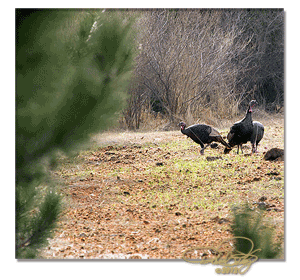
Wild turkey gobblers; listen to only a FEW spring gobblers.
Pick up on a FEW Spring Turkeys and listen closely
photo Dave Richey ©2012
It was a beautiful morning to be alive. I slipped out the door about 6:45 a.m. into 42-degree temperatures, and it felt wonderful.

The sun wasn't up yet but sharp spears of golden light shot upward from the eastern horizon, and my thoughts were on how beautiful the morning was. I stood there, a moment frozen in time, and waited for the sun to start bulging the horizon of the eastern sky.

It seems to start slow, and then the top surface of the ball of fire broke through, and up came the sun, growing more orange and red as it rose. It's a magic that I never tire of watching, and if there is a reason for rising before sun-up, it's to witness the rare beauty of dawn.

Watching a golden sunrise on opening day

I stood, transfixed by its beauty, and asked myself how anything could be any better. And then I learned how.

Off in the distance, so far away it could hardly be heard, came the very soft tree yelp of a hen turkey. She cutt once, just checking on the whereabouts of the other birds, and then a full-throated gobbler chimed in and the sound was loud even from a long distance away.

It's always amazing how loud a gobbler is when he roars as the sun comes up. The volume of sound is impossible to believe unless it is seen and heard up close.

He nailed that gobble with lusty exuberance for the day, and she gave another soft yelp. Big Daddy, still sitting in his roost tree, gobbled and then hit a double-gobble just to show everyone in the nearby trees who the Boss Gobbler in these parts happened to be.

Another Tom gobbled once, and again 10 seconds later, and then the Big Boss Man tuned up the woods again. The hen yelped a little bit more, just enough to keep the gobblers fired up, and then the Toms began gobbling back and forth at each other.

A gobble or double-gobble is pure Michigan excitement

Four individual gobblers were heard, and the fury of this sound was awesome. One or two small jakes tried to gobble but couldn't quite pull it off. Like adolescent boys, their voices were changing but they simply couldn't hit that low bass note and keep it going.

It was one of those days when I wished I could be sitting on the ground in my camo, a shotgun over my knees, and start lighting a real fire in their bellies. I love to listen to that low-pitched humming sound that gobblers make when they are close to a hen.

Many people have heard it, didn't know what it was, but if you are hunting and hear it, don't move because a gobbler is close. The sound doesn't carry far, and two or three years ago I was calling a gobbler for a buddy when I heard it.

"Don't move a muscle," I whispered. "There's a big gobbler behind us and he is very close. Don't move anything. We'll wait him out."

If you hear a gobbler spitting and drumming, sit still and don't move

That bird was within 15 feet of us, and I could hear him pacing back and forth in dry leaves, but he wouldn't circle around. We later learned that he had two big hens with him, and he was trying to lure my two hen decoys to follow along with him.

Unfortunately, I was too far away to hear this sound but I have no doubt that once the hens and gobblers flew down, that it would have been audible if the birds were close.

These birds on this delightful day serenaded the morning for 20 minutes while I stood and listened. And then, as if the switch had been thrown, they shut up and started moving.

I pulled the newspaper from the tube, walked back to the house, and stood on the back deck for another 10 minutes. The birds were indeed on the move, and I heard one gobbler rattle out his love song to the hens as they walked off in the opposite direction.

The turkeys, just like me, appeared happy to see the snow gone off the hillsides. All of winter's snow back in the hollows is gone, but I'll greet the dawn with the birds many times before the hunting season begins.

There's not much need for preseason scouting because I know the pattern of these birds and where they roost. I'll stay far away from them, hope they are not spooked out of the area, and each day they greet my distant presence with a gobble, is another memorable moment in my life.

Calling gobblers is more fun than shooting one

Somehow, I hope that's the way it may turn out but I have some doubts. It's been spring for five weeks, and I doubt many birds will be in the mood this spring. Some hen  birds have been seen on nests, and we're seeing very little gobbler activity if compared to past years.

But when my season open April 30, I'll be out there as usual, to greet the dawn with optimism. And I hope for just one lusty gobbler to call to me and my buddy. One chance may be it for this spring season, and we'll try to make the most of it.

Tuesday, April 10, 2012

Avoid these turkey hunting mistakes

Do everything right, and avoid Mr. Murphy, and you can shoot a bird

Hunt wild turkeys long enough and you're gonna make a blunder or two. That's bankable.
photo Dave Richey ©2012
"Keep your powder dry" was the motto in the 1700 and 1800s when muzzleloading hunters and frontiersmen roamed parts of North America. Those who failed to follow that sage advice often went hungry or had their hair lifted and cut off below the roots.

My list of hunting mistakes with game, especially turkeys, is endless. Years ago, while hunting in a heavy rain with a muzzleloader, I forgot to cover the muzzle. I set my front-loader against a tree with the powder and shot charge in the barrel but the shotgun wasn't primed.

I set out my decoy, retreated to my chosen spot, and primed the muzzleloading shotgun. A large number of gobblers and hens came, and milled around in a tight circle near the decoy, and I couldn't shoot for fear of killing more than one bird. They eventually left, and I called again.

Make certain to learn the exact location of a roosted longbeard

A lone gobbler a half-mile away answered, and I sweet talked him with a soft yelp and some hen jabber with a push-pull call. He came running up. I saw him first at 30 yards, and then he dropped into a little dip in the ground, and popped up again at 20 yards and stopped. The shotgun was up, and when I pulled the trigger, the primer went off with a pop. The powder did not.

I'd forgotten to put a balloon or anything else over the muzzle to keep my powder dry. The Pyrodex was a black semi-liquid. It was a lesson well learned and never forgotten.

I took a guy out one day, late in the season, and spotted a jake 150 yards away. This guy wanted to shoot a gobbler, and beard length didn't matter. It took 30 minutes to bring the jake within 80 yards, and the guy was aiming at the bird.

"He's too far away," I whispered. "Don't shoot yet. Let him get to within 35 yards." He said the bird was only 35 yards away, aimed and shot.
The young gobbler hauled tail feathers into the woods. The man maintained the bird was only 35 yards away until I asked him to give me a prominent landmark where the bird had been standing. He said the bird was right near that little bush that stood three feet high.

He was urged to pace it off in approximately 36-inch steps as I walked beside him counting the paces. I got 80 steps and he got 77 steps, and then he realized the mistake he had made. It was the last gobbler we saw that day.

Pay attention to distance and don't take long shots

This didn't happen to me but to a friend. He knew, within 50 yards of where a gobbler had roosted the night before. He snuck in the next morning, and stopped well short of the roosting area to wait for the first gobbles of the morning. The sun came up and all was silent.

He gave a very soft tree yelp or two but nothing responded. He stuck with it, and finally with a great deal of impatience, he uncorked a loud yelp on his box call and something happened. A big gobbler bailed out of the tree he was sitting under, and it flew 75 yards, hit the ground a'runnin', and that was it. He had set up directly under the gobbler and missed his big chance.

Two friends, on their first gobbler hunt, went looking before dusk and spotted several dark birds on the ground. Just before dark they flew up into a tree. These guys knew about roosting birds and were happy.

Be positive roosted birds are wild turkeys

They returned the next morning well before dawn, set up about 100 yards away, and waited for the day to wake up. Tweety birds tweeted, crows cawed, and they yelped on box calls. They could see several dark forms in the trees, and called again and again.

Eventually the birds flew down, and went to where the hunters had seen them the previous night. No amount of calling seemed to work, so one of them slowly eased his binoculars from his backpack, and with infinite patience, eased them up to his face and studied the birds.

The birds they had roosted the night before were not real turkeys. They were turkey vultures, and they were feeding on carrion on the ground. They admitted it, and took their share of ribbing.

There is only one sure thing when turkey hunting. Murphy's Law always applies, and simply stated: If anything can go wrong, it will. Keep Mr. Murphy in mind, try to outguess him, and sometimes the gobblers react as you plan and the hunt is a success.

Of course, when we mess up, it's still good for a laugh even when we don't feel much like laughing at our silly mistakes. Trust me on this: if you hunt wild turkeys long enough, you too will make a blunder or two.

Wednesday, November 09, 2011

Bob Jennings: Book Review - My Mythical Adventures with Bird Dogs

MY MYTHICAL ADVENTURES WITH BIRD DOGS, by Bob Jennings.

Bob Jennings has this book available for $30 postpaid. Send payment to: 3302 N 190 W., Switz City, IN 47465. Or call, (812)798-0783.

This book is for any hunter who has owned bird dogs, and learned to love them like the author does.

The Dedication of this book states: This booklet is dedicated to all dogs that have passed on and made their way back into the hearts of their owners. I think this wonderful dedication will pertain to any dog lover.

This book, at 42 pages (twice the length of the first book) shares with readers the thoughs about three of his dogs. Anyone who has owned bird dogs, and raised them from pups to adults, can clearly find something in this book to jog their memory about pets they have owned in the past.

I read the book at one setting, and couldn't put it down. The first of the three stories I read was one of the finest dog pieces I've ever read, and the entire book was a great read except for a few misspelled words.

I'm not going to go into great detail, but will keep this short. If you've got a good imagination, I strongly suggest you take my word for it, and buy this book. You'll be reading some of the finest dog stories I've read in a very long time. This book is a spiral bound paperback with many drawings and photos.

Praise doesn't come any higher than that. Happy reading.

Posted via email from Dave Richey Outdoors

Friday, July 01, 2011

Fritz, The Wonder Dog.


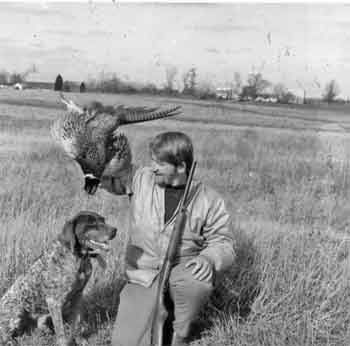
The author and Fritz on what was his last pheasant hunt in the early 1970s.


There is something very special that happens to your heart when a solid-as-Sears pointer slams to a stop, lifts a front foot, abd his stubby tail goes rigid as he locks up on a solid point. If I ponder on it long enough, it's easy to get all teary-eyed remembering certain points from 40 years ago.

It has happened many times to me, and I never fail to feel blessed by memories. I'd walk in behind a great pointer, shotgun at port arms, and look in front of and over the dog and five to 10 yards away. Too many people study the ground in front of the dog, and a pointer may be on a bird that is 10 yards ahead or to either side, and sometimes they are much further away. Fine field work is what endears good dogs to their owners.

The pleasures of owning a great dog died with my German shorthair, Fritz, who came with some truly great Royal bloodlines and who died many years ago. There were many reasons why no others have entered my life, and losing an old friend was the major one.

Most dog men live a long life and feel lucky to own one great dog. Fritz was mine.


Fritz, like many German short-hair pointers, was bullheaded and stubborn to a fault. He could get into more trouble than a 12-year-old kid with a new $20 bill, and he always thought he was hunting for himself. For two years, he didn't realize he was supposed to hunt with me in return for his daily meals and show some respect to the man who had brought him to this dance.

He was a terror, and his idea of hunting was to be a half-mile and three fallow fields ahead of me. I'd work him on a long leash, and he'd sit, heel and was steady to wing and shot as long as the rope snugged him in at about 25 yards. Take the lead off, and he attempted to set a new speed record for crossing three open fields and busting one pheasant after another along the way. Mind you, this was back in the day when pheasants were plentiful during the early 1960s.

Finally, in desperation, catching him after a long gut-busting sprint, I loosened his collar a bit, stuck one of this dark front paws through the collar, and turned him loose. He made one step and fell over whining. I got him back up on three legs, and he tried to run off again. He was scolded and told to hunt close.

An hour later, feeling sorry for my beloved pooch, I pulled his foot out and off he went like he had a booster rocket under his tail. Another long-winded sprint, and my feelings of regret changed to one of quickly solving this problem. The next two days he hunted on three legs, and wasn't happy about it but he stayed within 25 yards of me.

He worked the cover slow and cast from side to side, nosing into the wind, and we put up hens and roosters over his rather lop-sided points, and I'd praise him in person and to anyone who would listen, and after two days of punishment, we went out the third day.

He and I had a heart-to-heart chat about his past behavior, and more recent ways of staying close, and he seemed to pay attention. It was a gamble worth taking, and I slipped his foot from his collar. He looked at me, and I patted his head and said "Hunt close," and he began hunting into the wind. He cast back and forth, and never exceeded the 25-yard maximum. A soft "Whoa" was all I needed to steady him at his outer limits.

My face-to-face talk was a loving, full of meaning and veiled threat to shape up.


He locked onto point, and I whispered "Whoa" to him, lifted his tail, and he looked like a granite carving. I stepped in front, saying "Steady now," and he was rock solid. The ringneck pheasant lifted into the air with a raucous cackle, his long-barred tail streaming out behind, and I swung with the bird and down he came.

Fritz, after his introduction to a lead rope and the foot through the collar trick, never gave me another problem. He hunted grouse, pheasant and woodcock, and his expertise was superb. He would hunt with the neighbor kids, and there were only two rules: hunt safely and don't shoot at low-flying birds.

The last year of his life was a painful ordeal for us. His hips were shot from arthritis, and he always begged me to take him. We'd hunt near home, and he would gimp through the fields. His hips were bad but it didn't affect his hearing or nose.

He'd zero in on cackling roosters at dawn, and we'd move on them when shooting time opened. With luck we'd take two quick roosters, and then it was a slow and painful trek home for a dog in great pain. I'd pat his head, tell him I loved him, and he'd wag his bobbed tail. The vet had no words of encouragement. I didn't want to put him down.

His end was near, and it wasn't a pretty sight. I was sick to my stomach.


Our last hunt came a few days later. A magazine deadline was met, I grabbed my shotgun, got Fritz up and we headed out. He slowly worked two different birds, both roosters, and my shooting was better than average. Fritz pointed, and I shot both birds, and then he sat down. I kneeled beside my old friend as he whined and shivered with pain, and I picked him up and carried him home, knowing that he'd run has last race in prime pheasant habitat.

Two days later, during the second week in October as cold winds blew down from the north, Fritz left me and went to that area where all good bird dogs and close friends go when they die. He was buried along a fencerow that often produced a rooster, and on occasion I think I can hear him snuffling a big ringneck 10 feet in front of him.

It isn't, of course, but there is the deeply-seated memory of a bird dog that never knew the meaning of the word quit. He could out-hunt me, and it's the biggest reason I've never owned another hunting dog. A new dog could never measure up to Fritz, and it would be unfair to expect him to.

So I live with my deeply-held memories of Fritz. He was the finest bird dog I've owned, and I'll never see the likes of him again. There's a place tucked back in the corner of my mind where I go looking for lost friends and bird dogs, and when the memory machine registers a hit on man or dog, I reach up, dust off a fond reminder and trot it out for the world to think about whenever they hunt with a great pointer.

This has been just one of my favorites.

Monday, April 11, 2011

Turkeys in the fog

It was several years ago when I experienced what personally felt like a perfect turkey hunting day to me. I awoke with plenty of time to hike to my hunting spot, and stepped outside to see what the weather like.

I should have turned on the yard light first. Everything was a blur as thick tendrils of fog hovered like white gauze from ground level up to the tree-tops. It was impossible to see but I decided to leave early to walk to my hunting location. I’d need more time on this day to find my hotspot.

Turkeys often stay roosted until the fog clears off but these birds had been put to bed the night before. I knew where they were, and didn’t need any landmarks to find this spot. Just get on the north-south dirt road, and walk along the edge of it until i reached a narrow finger of woods that came down to the road. The almost one mile walk would take longer on this day, so I forsake a breakfast and hot coffee in favor of the early start.

A one-mile walk in the fog to reach the turkeys.


The fog was so thick it was literally impossible to see your hand in front of your face. My tiny penlight was shone on the road edge where weeds met the dirt, and I actually walked past the finger of woods in the dark and fog, and had to backtrack.

I eased off the road and into the trees, and knew I was within 200 yards of the roosted birds. There were three adult gobblers with long beards, two jakes and two hens ready for breeding. I had no clue what the day would provide but knew the birds would stay roosted even longer in the fog.

A narrow spot of farm land was separated by two woodlines. There seemed to be no need for a turkey decoy because the birds couldn’t see the ground. All I had to do was sit still near the clearing, wait with infinite patience for a roosted gobbler to call, and then try to sweet-talk him to within 35 yards while hoping all the birds didn’t approach at once.

A long hour passed, and there seemed to be a lightening of the fog but it was still impossible to see the trees on the other side of the clearing. The birds were roosted 100 yards deeper in the woods, and a small water puddle lay at the base of the roost trees.

Fog so thick I couldn’t see my hand in front of my face.


The second hour passed without hearing a bird. The fog seemed thick enough to cut, and it was lighter but the ground fog hung heavy over everything within sight. Eventually a lone crow flew over, cawed once, and a moment later a gobbler returned the greeting. Nothing happened for a few moments, and the bird gobbled again, and was joined by the others.

I sat there, knowing the birds probably wouldn’t fly down until it got a bit lighter so they could check for danger. I kept my silence, and so did they, and by nearly 9 a.m., the fog was thinning slightly but it still a long ways to go before I’d be able to see well enough to shoot.

Time seemed to drag by for another 30 minutes before the sound of flappint wings was heard. They hadn’t flown down but were getting restless on the roost. I coaxed out the faintest purr from my old Ben Lee box call, and the birds lit up. They double- and triple-gobbled, and the hens were making noise, and the tree-top-talking went on for another five minutes before they pitched down into the open spot in front of me.

The unseen gobblers called


All the gobblers, including the jakes, began ripping the air apart with their gobbles. Another faint yelp started another round of gobbling as the birds circled the clearing looking for the hen. On several occasions, the gobblers were right in front of me and their footsteps in the leaves could be heard, and they kept circling in a clockwise manner. The sounds still seemed a bit muffled by the fog but all the birds were within 25 yards of my shotgun, but the dense moisture-laden air was still too thick so see a thing.

Those birds circled around me, time after time, until about 10 a.m. when the fog began to clear. I called softly one more time, and the birds stopped moving. The biggest longbeard was 50 yards away, and I tried to appear to his male urges. One of the hens began calling to him, and I began a duel with the hen, and we verbally fought for 10 minutes before all the birds shut up and they moved off through the woods.

It had been a long morning of sitting with just a bit of calling, but the suspense of those birds circling in the fog right in front of me, has left an indelible imprint on my memory. I didn’t shoot that day, and it didn’t matter, because the symphony of turkey talk coming at me through the fog was enough to satisfy my hunting desire for one day.

Sunday, April 03, 2011

Practice turkey calling now … indoors


The author practices with a box call indoors.


It's one thing to choose a spot to ambush a gobbler when he walks by.  It's still something else to make a  longbeard come to you, one or two  tentative steps at a time; its head up and looking, the roar of a  return gobble, the sight of a snowball head moving slowly through the  woods toward the hen call.

Turkey hunting is fun. Calling a gobbler to the bow or shotgun is just  about as much fun as anyone can have while hunting. Is calling hard and must we be an expert caller to succeed?

Good questions. No, one doesn't have to be an expert and calling is not extremely hard. A diaphragm call is far more difficult to learn than an aluminum, glass or slate friction call. The wood box call is perfect because it is one of the easiest calls to master, and the easiest of all to is the push-button call that produces realistic sounds. So, what’s holding you back. Practice now, but not outside.

The most difficult turkey call of all to master is the wing-bone yelper. Anyone who can run a yelping sequence on a wing-bone or trumpet is a person who has my utmost admiration. It is extremely difficult to master this call, which is why few people use them in the northern states. Their use is slightly more common, but as a general rule, wingbone call are generally used by old-time turkey hunters.

There is one important thing to remember: turkeys, like humans, have different voices. They all sound slightly different.

I've listened to world champion callers, and once spent a week deer hunting with the late Dick Kirby of Quaker Boy Calls. He was prepping for the World Championship of turkey calling, and he could make truly realistic turkey sounds that were as clear and pure as the sound of a church bell on Sunday morning.

This longbeard was photographed coming to a turkey call.


"Championship calling is different than an in-the-field situation," Kirby told me years ago. "Hunters who can cluck, cutt, purr and yelp can call birds. Championship-type calling isn't required because no two turkeys sound alike. The key is more about the cadence and rhythm of a call than the quality of the sound. The biggest secret is knowing when to call, which call to make and not to call too much. A caller who calls too often will scare more birds than he attracts."

Using certain calls requires some skill but it’s not too hard to learn.


Box calls - Hold the call lightly in the palm of the hand. Many callers hold a box call horizontally, and draw the paddle across the top of the box. Some hunters, especially in southern states, hold the box vertically and hold the striker between index and middle fingers to strike the lip of the box. Both methods work well, and what it boils down to is using whichever method that feels the most comfortable.

A turkey show was on television recently, and the host was using a box call in a horizontal position, and would then hold the call in a vertical fashion. He didn't look very comfortable with either method. Use whichever feels most comfortable, and there's no need to switch back and forth from horizontal to vertical.

Make a cluck by popping the striker (handle) against the top of the box. It is a sharp one-note sound. To cutt, ake a series of sharp clucks in rapid fashion. Yelps are made by moving the handle across the lip of the box and cover the sound chamber to accomplish the two-note call. Purring is simple and works best early in the morning when birds are roosted; move the striker lightly and slowly across the lip of the box.

Diaphragm - Kirby could make astounding sounds with a diaphragm call but mine sound like a gobbler with a ruptured voice box. However, my diaphragm calls are effective. Remember, notes need not be competition perfect. Just understand the cadence of each call, and know when to make that particular call.

To cluck exhale air across the reed(s) and say "putt." Cutt by making three or four fast clucks quickly and sharply. They can be made loud or softly, and much depends on how far away the bird is and how he responds to the call. A soft cutt often excites birds when they are within 50 yards.

Master a purr, whine and yelp, and you can call gobblers.


A yelp begins high (and can be strung out) and falls off into a lower note. Yelps can be strung together quickly or done just once but jaw, mouth and tongue movement can affect volume and tone. Experiment until it sounds good. A purr is fairly difficult to do, but I find it easier than breaking off the high end of a yelp into the low tone. My yelps sound like a bird with tonsillitis but they come to it.

Aluminum, glass or slate calls are quite easy to use but require both hands. I favor these calls when a turkey is a good distance away, and as the bird comes closer, I switch to the diaphragm call so both hands are free to handle the shotgun.

All three materials require the use of a peg or striker. Strikers are made of glass, plastic or wood. To cluck, hold the striker like a ballpoint pen but turn the tip at an angle pointing toward your body and drag it toward you in a skipping motion. Press down harder to make a louder cluck. Cutting is done by making a series or fast and irregular clucks for five to seven seconds. Cutts can be soft or loud, and long or short in duration. Yelping is done by dragging the striker with some pressure in a circular motion or a straight line. The more pressure of striker against the call, the louder the sound. Purr by lightly dragging the striker across the call. This is one of my favorite calls early in the morning because it sounds like a contented bird.

A recording of these sounds make more sense for a beginner than me trying to put down what each sound is like. Hunters also can talk to an accomplished caller and learn these basic sounds.

Some gobblers are, by nature, downright call-shy, especially if some yoyo practices his calling outdoors. Gobblers often will call from the roost, and four or five Toms gobbling back and forth sends chills down my spine. As a general rule, don't call as often as a gobbler; let him wonder where the hen is and come looking for it. I often give one or two soft tree yelps after I hear the first crow calling at dawn. If there is no response, try again five minutes later. If a gobbler responds, sit still and say nothing. Wait for the gobbler to call again, and then softly cluck or purr for five seconds and shut up.

Hunters have up to four weeks to practice before their season opens.


A big limbwalker will probably boom back a return call but let him wait again. As he gobbles, birds in other areas may respond with a gobble so wait for a few minutes after silence is restored. Try another soft purr, and if it is full light, slap a turkey wing against a tree or your pant legs to imitate a bird flying down, and give one short and soft yelp to sound like a hen on the ground.

Muffle some calls like a hen moving around on the ground, and listen for the gobbler to fly down. Give him another yelp, and if he gobbles, let him come. If the bird stops 50 yards away, purr or softly cluck and scratch in the leaves with your fingers like a hen feeding. If the bird keeps coming, stay quiet and let him come. If the gobbler stops behind a tree within range, purr or cluck softly and shoot when he steps out and lifts his head.

If a gobbler hangs up, try a trick that has worked for me many times. Use two calls at once: yelp softly with a diaphragm and with a box or slate call to imitate two hens calling for Tommie. This trick has produced many gobblers for me and my friends. Or, try creeping backwards and turn and call softly to imitate a hen moving away.

Try to set up so the bird can come into a semi-open area to look for the hen. Gobblers will move through thick cover if necessary but they like to see what lays ahead and if it appears dangerous. Calling isn't particularly difficult but it requires some practice. Do it in the car, not out in the field. The first time you call outdoors is when you have a shotgun in hand.

The above are just some of the basics of calling a wild turkey within range, and it represents some of the tricks that work. Give 'em a try when the April-May turkey season is open, and work at learning something new every day. Studying turkey behavior and their calls- will pay off.

Sunday, January 30, 2011

I fish, hunt and enjoy watching birds


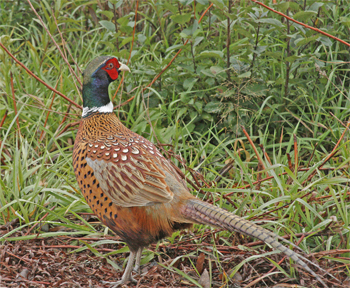
Pileated woodpecker on suet. Ringneck pheasant below.

Bird watching is something I do year ‘round. It’s been a longtime habit, and this is particularly so during the winter months when forage is tough to find under the snow and ice.

Each day, without fair, I measure the snow depth on my deck railing. So far, we are at about 110 inches of snow. We have two bird feeders out, and they are refilled every two days. I deliberately pay little attention to the cost. If I knew the cost was high, I’d stil do it because watching winter bird life keeps me tuned in with winter.

It also helps me give something back to the birds that provide me with so much enjoyment all year. Food plots were planted, and they feed deer and other animals and birds from the first green-up until the winter snow flies.

Winter birds add a bright spot to winters.

The birds feed every day at my place. There are sunflower seeds and thistle seed feeders. The woodpeckers get a big chunk of suet, and some of the other birds peck at it a bit.

Seventy-five yards behind my house is one of my food plots. There's not much to it now that deep snow has covered the ground although deer occasionally paw through the snow and nibble at the old clover and purple-top turnips. It becomes a major source of nutrition during the spring, summer and fall months.


It satisfies all the rules that pertain to winter feeding. I no longer can distribute carrots, corn and sugar beets over the once-prescribed 10 X 10-foot area, and each day when I went out, there would be deer tracks everywhere but adding some corn to the winter deer diet is now illegal. supposedly because of the Chronic Wasting Disease scare three years ago.

So far there is very little sign of wild turkeys near us, and I seldom see them until the winter weather turns harsh. Right now, our area seems to be inhabited by a few does and young fawns from last spring although it's possible a buck that has lost his antlers may be coming in, but in all honesty, since the no baiting, no-feeding law went into effect nearly three years ago, the deer have not been coming to my food plot with any regularity. It’s hard to compete with standing corn fields.

Mind you: before last night and today's snow and 15-degree temperatures, the snow has been too deep for easy deer travel. We seldom see deer once the snow gets knee-high to an adult human. The deer vacate such upland country and head for traditional low-lying deer yards where food usually isn’t any more plentiful.

In summer we have a bird bath and orange rinds nearby.

Frankly, I'm not 100 percent sure what comes to dine on the food plot behind the house. Deer are common in early and late winter, and so too are rabbit and squirrels. On a warm sunny day we occasionally see a 'possum or raccoon track in the melting snow.

Turkeys might really get hungry this winter. We get some ground-feeding birds, amd whenever I fill the feeders, I sprinkle some sunflower and thistle seed on the ground for those birds that seldom fly up to the feeders.

At times we’ve had some turkey roosting near the house, but they seldom do that any more. I think with the open food plots that the land is a bit too open for nightime roosting now.

I enjoy watching the birds all year, and the first several years we lived here, we tried to identify the differ birds that came to weed. Years agp, we had a pair of red-headed woodpecker but they eventually died out or moved on. We still have a passel of downy and hairy woodpeckers.

We see songbirds, game birds and even birds of prey.

The largest bird that visits our bird feeders (primarily the suet feeder) is an adult pileated woodpecker. We have both the male and female of that species, and see them almost every day. Flickers also visit, and they are a fairly large bird. We also get chickadees, goldfinches, grosbeaks, juncos, nuthatches, sparrows and a raft of the smaller downy and hairy woodpeckers. We quit counting the birds after we’d seen more than 100, but perhaps it’s time to start counting over again.

We feed to help give something back to the wildlife community. It can be a major expense, but I've found that it makes me feel good. And watching the birds as they feed is far more entertaining than watching television.

For more information, go to any book store or the National Geographic Online Bookstore. They have other bird books.

I recently received a copy of National Geographic’s Global Birding by Les Beletsky. It’s a big book, and perhaps more than most of us in Michigan need, but it’s an interesting read with wonderful color photos and great information.

Birds are a part of my life. While I may not go out with binoculars and a bird book in hand, I do enjoy my love affair with birds.