Showing posts with label talk. Show all posts

Saturday, April 14, 2012

Listening TO Only A Few Spring Gobblers

Jakes – shoot or let them walk by
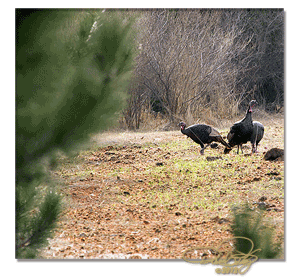
Wild turkey gobblers; listen to only a FEW spring gobblers.
Pick up on a FEW Spring Turkeys and listen closely
photo Dave Richey ©2012
It was a beautiful morning to be alive. I slipped out the door about 6:45 a.m. into 42-degree temperatures, and it felt wonderful.

The sun wasn't up yet but sharp spears of golden light shot upward from the eastern horizon, and my thoughts were on how beautiful the morning was. I stood there, a moment frozen in time, and waited for the sun to start bulging the horizon of the eastern sky.

It seems to start slow, and then the top surface of the ball of fire broke through, and up came the sun, growing more orange and red as it rose. It's a magic that I never tire of watching, and if there is a reason for rising before sun-up, it's to witness the rare beauty of dawn.

Watching a golden sunrise on opening day

I stood, transfixed by its beauty, and asked myself how anything could be any better. And then I learned how.

Off in the distance, so far away it could hardly be heard, came the very soft tree yelp of a hen turkey. She cutt once, just checking on the whereabouts of the other birds, and then a full-throated gobbler chimed in and the sound was loud even from a long distance away.

It's always amazing how loud a gobbler is when he roars as the sun comes up. The volume of sound is impossible to believe unless it is seen and heard up close.

He nailed that gobble with lusty exuberance for the day, and she gave another soft yelp. Big Daddy, still sitting in his roost tree, gobbled and then hit a double-gobble just to show everyone in the nearby trees who the Boss Gobbler in these parts happened to be.

Another Tom gobbled once, and again 10 seconds later, and then the Big Boss Man tuned up the woods again. The hen yelped a little bit more, just enough to keep the gobblers fired up, and then the Toms began gobbling back and forth at each other.

A gobble or double-gobble is pure Michigan excitement

Four individual gobblers were heard, and the fury of this sound was awesome. One or two small jakes tried to gobble but couldn't quite pull it off. Like adolescent boys, their voices were changing but they simply couldn't hit that low bass note and keep it going.

It was one of those days when I wished I could be sitting on the ground in my camo, a shotgun over my knees, and start lighting a real fire in their bellies. I love to listen to that low-pitched humming sound that gobblers make when they are close to a hen.

Many people have heard it, didn't know what it was, but if you are hunting and hear it, don't move because a gobbler is close. The sound doesn't carry far, and two or three years ago I was calling a gobbler for a buddy when I heard it.

"Don't move a muscle," I whispered. "There's a big gobbler behind us and he is very close. Don't move anything. We'll wait him out."

If you hear a gobbler spitting and drumming, sit still and don't move

That bird was within 15 feet of us, and I could hear him pacing back and forth in dry leaves, but he wouldn't circle around. We later learned that he had two big hens with him, and he was trying to lure my two hen decoys to follow along with him.

Unfortunately, I was too far away to hear this sound but I have no doubt that once the hens and gobblers flew down, that it would have been audible if the birds were close.

These birds on this delightful day serenaded the morning for 20 minutes while I stood and listened. And then, as if the switch had been thrown, they shut up and started moving.

I pulled the newspaper from the tube, walked back to the house, and stood on the back deck for another 10 minutes. The birds were indeed on the move, and I heard one gobbler rattle out his love song to the hens as they walked off in the opposite direction.

The turkeys, just like me, appeared happy to see the snow gone off the hillsides. All of winter's snow back in the hollows is gone, but I'll greet the dawn with the birds many times before the hunting season begins.

There's not much need for preseason scouting because I know the pattern of these birds and where they roost. I'll stay far away from them, hope they are not spooked out of the area, and each day they greet my distant presence with a gobble, is another memorable moment in my life.

Calling gobblers is more fun than shooting one

Somehow, I hope that's the way it may turn out but I have some doubts. It's been spring for five weeks, and I doubt many birds will be in the mood this spring. Some hen  birds have been seen on nests, and we're seeing very little gobbler activity if compared to past years.

But when my season open April 30, I'll be out there as usual, to greet the dawn with optimism. And I hope for just one lusty gobbler to call to me and my buddy. One chance may be it for this spring season, and we'll try to make the most of it.

Tuesday, February 14, 2012

When an unexpected man-bear encounter occurs

Getting this close to a bear is never a wise idea

bear
Bear hunting is a special brand of outdoor adventure where the hunted can become the hunter. It's where the tables can be rapidly turned on a sportsman, and where things can get very interesting very quickly.

It doesn't happen very often with black bears, but when one attacks, it's not good news. A grizzly will maul and bite a human, often inflicting horrific injuries, but the person often lives.

Black bear, even though they are the most common bruin of all, are perhaps the most dangerous. Their attack may continue until the victim is dead. It has happened many times across North America, and in many cases, the human doesn't survive such brutal maulings. In certain situation, the bruin makes a meal of its victim.

Someone in North America gets mauled by a black bear yearly. It's a matter of fact, and it has happened in Michigan several times over the years.

Anytime a bear is within 100 yards of you, there may be danger

I lay no claim to being a black bear expert, but have hunted bruins, photographed them, and have had them approach within three feet of me. Each experience is one to learn from, and to hope it never happens again. A human's best hope is he does everything right if a bear gets within three feet. One wrong move, and it can mean terrible trouble.

I've never been truly frightened of a black bear even when they've come within spitting distance on a dead run. Knowing some things about bears can help you cope with the animal when things turn sour, and an angry bear is only feet away. What you do may truly affect the outcome of the encounter.

This is not mean to frighten people, but the Michigan bear hunting seasons opens in September. However, during this mild winter, bruins can awaken in their den and now is about the time sow bears give birth to their cubs. Realize, first of all, black bears are unpredictable at any time, and a sow with little ones is something to steer clear of.

Whenever bears are baited or being run with hounds, and  humans may find themselves within close proximity of a bruin, and neither one knows it. Throw in the fact that the bear may be a sow with young cubs, and there is the potential for disaster.

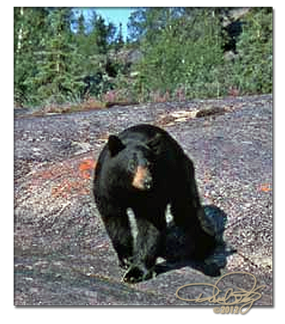
Once while photographing a black bear in Canada's Northwest Territories I was downwind of a foraging bruin. It turned, looked in my direction just as I took a photo with a flash. It startled the animal, and it came walking slowly toward me. It was straight upwind of me.

I talked to the animal in a fairly soft voice. I kept my voice level, and it approached close enough that I could have touched it on the head, which I knew would probably be a major mistake. The animal continued to circle me, and as it moved around me, I turned with it and continued to face it and talk. The bear got downwind of me, caught my scent, and circled back the same path as before and slowly walked away.

Talk to a bear in a soft, level tone. Don't scream or shout. Whatever you do, don't get silly or hysterical. This isn't Disney World.

If a bear is seen, make some noise, don’t walk closer and it may leave

One important thing in bear encounters is to keep a clear head. Don't scream at the animal, and realize that a wild bear can sense anxiety and fear. The same is also true of a junkyard dog. Running from a bear is the worst thing to do. Watch the animal, and read the messages it gives you.
Know this: bears, and especially sows with cubs, will often make a false charge toward a person. They can walk, trot or run, but you'll hear teeth clacking, deep growling, and then the bear will stop at 10 to 20 feet and assess the situation.
It is defending its turf and its cubs, and a slow dignified retreat with soft talk while facing the animal can put an end to the whole business. However, it doesn't always end that way.

Know what to do, and do it, in a bear-man confrontation

The trick is to stand your ground until she stops. Step backwards slowly for a step or two, and talk to the bear. If it does nothing, take two or three more slow steps backwards. This allows the animal some space, and gives it a chance to save face. Its enemy is retreating to avoid what could be a deadly confrontation. Just don't make any quick moves, and pay some attention to your footing. If you fall down, it could trigger an attack that would be difficult to defend against.

Watch the bear. Keep a level head, and don't crowd the animal. If it comes, turn with it, but watch its head because the body will follow the head. Study its actions intensely. A bear that becomes increasingly agitated is now a deadly animal and the risk of an attack escalates.

A bear that approaches within 15 to 20 feet and stops, its ears laid back against its skull, and is clacking its teeth and growling, is a dangerous animal. A bear that does that, and then begins slamming its front feet against the ground, has become truly dangerous. Back up and try to defuse the situation with a slow retreat and a soft voice Don't step toward a bear that is stomping its front feet.

Do not run. Never run from a bear because it's like running from a mean dog: the chances are it will trigger a charge. A full-blown charge with foot stomping, growls, ears laid back, and clacking of teeth is something that will stir your guts into soup and give your mouth a coppery taste. This is no time to lose your head and do stupid things.

Continue to face the animal but try a slow-moving retreat. Chances are the bear doesn't want to force the issue, but this posturing can be a prelude to a mauling and death or a close call. In many cases, the human's movements or lack of them may act as a catalyst that triggers an attack.

Allow bears to save face; Give it a way out but don’t run

Saving face is no different with a bear than with a bar-room bully. Sometimes the issue can be resolved without incident; other times, it can only be resolved with force. A man alone, unarmed, is not capable of fighting a faster and stronger bear. A few instances have been noted of a bear-man fight, including one here in Michigan, and they are the stuff of wild tales ... except some of them are absolutely  true.

Few people will ever face a false charge, and even fewer will come to grips with a full-blown charge. Those who face the latter (and it's difficult to determine one from the other until the attack occurs) and live to tell the story are a rare breed in today's society.

I've faced three, and all were defused after several troubling minutes, but the best advice is to stand tall, make yourself look as big as possible, talk (don't scream) to the animal, and give the bear a chance to save face without injury to it or you.

Backing away or stepping aside when a bruin is very close can leave you with a wildly beating heart, a dry mouth and your life, providing you do everything right. The chance of a bear attack anywhere is rather remote, but it pays to have some knowledge of what to do well before such a need is standing only 10 feet away with its ears back.

Especially if the bear has a surly attitude and you are wondering how you ever got into such a situation. Just remember: keep your head, don't lose control, and you may have a hair-raising tale to tell.

Make a mistake at this crucial point, and even the best Hollywood make-up artist won't be able to make you recognizable to your best friends and family at the funeral.

Monday, April 11, 2011

Turkeys in the fog

It was several years ago when I experienced what personally felt like a perfect turkey hunting day to me. I awoke with plenty of time to hike to my hunting spot, and stepped outside to see what the weather like.

I should have turned on the yard light first. Everything was a blur as thick tendrils of fog hovered like white gauze from ground level up to the tree-tops. It was impossible to see but I decided to leave early to walk to my hunting location. I’d need more time on this day to find my hotspot.

Turkeys often stay roosted until the fog clears off but these birds had been put to bed the night before. I knew where they were, and didn’t need any landmarks to find this spot. Just get on the north-south dirt road, and walk along the edge of it until i reached a narrow finger of woods that came down to the road. The almost one mile walk would take longer on this day, so I forsake a breakfast and hot coffee in favor of the early start.

A one-mile walk in the fog to reach the turkeys.


The fog was so thick it was literally impossible to see your hand in front of your face. My tiny penlight was shone on the road edge where weeds met the dirt, and I actually walked past the finger of woods in the dark and fog, and had to backtrack.

I eased off the road and into the trees, and knew I was within 200 yards of the roosted birds. There were three adult gobblers with long beards, two jakes and two hens ready for breeding. I had no clue what the day would provide but knew the birds would stay roosted even longer in the fog.

A narrow spot of farm land was separated by two woodlines. There seemed to be no need for a turkey decoy because the birds couldn’t see the ground. All I had to do was sit still near the clearing, wait with infinite patience for a roosted gobbler to call, and then try to sweet-talk him to within 35 yards while hoping all the birds didn’t approach at once.

A long hour passed, and there seemed to be a lightening of the fog but it was still impossible to see the trees on the other side of the clearing. The birds were roosted 100 yards deeper in the woods, and a small water puddle lay at the base of the roost trees.

Fog so thick I couldn’t see my hand in front of my face.


The second hour passed without hearing a bird. The fog seemed thick enough to cut, and it was lighter but the ground fog hung heavy over everything within sight. Eventually a lone crow flew over, cawed once, and a moment later a gobbler returned the greeting. Nothing happened for a few moments, and the bird gobbled again, and was joined by the others.

I sat there, knowing the birds probably wouldn’t fly down until it got a bit lighter so they could check for danger. I kept my silence, and so did they, and by nearly 9 a.m., the fog was thinning slightly but it still a long ways to go before I’d be able to see well enough to shoot.

Time seemed to drag by for another 30 minutes before the sound of flappint wings was heard. They hadn’t flown down but were getting restless on the roost. I coaxed out the faintest purr from my old Ben Lee box call, and the birds lit up. They double- and triple-gobbled, and the hens were making noise, and the tree-top-talking went on for another five minutes before they pitched down into the open spot in front of me.

The unseen gobblers called


All the gobblers, including the jakes, began ripping the air apart with their gobbles. Another faint yelp started another round of gobbling as the birds circled the clearing looking for the hen. On several occasions, the gobblers were right in front of me and their footsteps in the leaves could be heard, and they kept circling in a clockwise manner. The sounds still seemed a bit muffled by the fog but all the birds were within 25 yards of my shotgun, but the dense moisture-laden air was still too thick so see a thing.

Those birds circled around me, time after time, until about 10 a.m. when the fog began to clear. I called softly one more time, and the birds stopped moving. The biggest longbeard was 50 yards away, and I tried to appear to his male urges. One of the hens began calling to him, and I began a duel with the hen, and we verbally fought for 10 minutes before all the birds shut up and they moved off through the woods.

It had been a long morning of sitting with just a bit of calling, but the suspense of those birds circling in the fog right in front of me, has left an indelible imprint on my memory. I didn’t shoot that day, and it didn’t matter, because the symphony of turkey talk coming at me through the fog was enough to satisfy my hunting desire for one day.