Showing posts with label and. Show all posts

Friday, February 18, 2011

Make outdoor ethics count

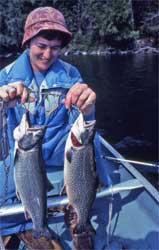
Kay landed two big brook trout  but stopped fishing then. She'd had enough.
Outdoor ethics are like dipping snuff. It doesn't agree with everyone, and for some, it leaves them feeling cold and sneezzy. Ethics, often unlike laws, are rules that rule our pitdppr conduct.

Ethics are more easily understood when explained in this manner. Ethics are those things you wouldn't do if you knew a conservation officer was watching from a distance.

They are those hard-to-explain things that keep sportsmen from breaking fish or game laws if we knew an officer was in the area. For most of us, ethics and knowledge of our fish and game laws run hand-in-hand. We won't break the law under any situation.

Ethics keep honest people honest in the woods and on the water.

That's fine, as far as it goes, but it's a gross oversimplification of a very complex personal outdoor issue that all sportsmen must think about. And, frankly, these issues baffle many sportsmen.

Outdoor ethics are those complex but unquestionable rules that sportsmen must adhere to whether other people are watching or not. They are those things we must endorse if fishing and hunting is to survive this century.

Want a few examples? Chew on these on these little tidbits:
  • I had six chances to arrow a big 10-point two years ago. He always showed up from two to five minutes after legal shooting time had ended. No one was within a half-mile of me, and no one would have known if I had cheated by shooting that buck a few minutes late.
No one, that is, except me. It would have ate at my guts like a malignant tumor until the taking of that big 10-point buck would have been reduced to a humiliating experience. It would have ruined my hunt as well as my perception of myself as a law abiding sportsman.
  • One night last fall I climbed into my bow stand, tried to remove my wallet from my back pocket, and discovered it wasn't there. My bow license was home on the dresser in my bill-fold. I had a valid deer-hunting license but it wasn't in my immediate possession so my bow was stowed away in its soft case and lowered to the ground.
That evening was spent watching deer through binoculars. It was a fun evening, even without a bow in my hands.

I wouldn't have been able to eat a tenderloin steak if  I'd shot late.

  • A big problem with outdoor ethics is they are impossible to legislate and difficult for many people to understand. Only one person – you or me – can deal with these ethical situations whenever a potential problem arises.
  • For instance: we shoot a rooster pheasant and it drifts across a fence on set wings and falls onto posted land. Does shooting that bird give us the legal right to pursue it without landowner permission? Nope! The ethical sportsman would determine who owned the property, and make every attempt to gain permission to cross the property line.
What happens when it's virtually impossible to track down the absentee landowner? No one wants to see the game go to waste. The next decision would be to contact the closest conservation officer. If he says you can't cross the line without permission, it still remains an ethical and legal question. Cross without permission means breaking the law. Do you go or stay? Laws and ethics. Right or wrong. It always pays to do the right thing.
  • We're fishing flies-only water for native brown trout and a stiff breeze puts down the mayfly hatch. Is it ethical to fish worms here? The answer, both ethically and legally, is no.
  • Or, as I mentioned earlier about the 10-point buck, could I have cheated in that instance and shot? Sure, but I would have had to deal with my emotions and my personal sense of right or wrong and any resulting guilt.
  • Mallards pinwheel down on a freshening breeze to spill into the bobbing decoys. It's a perfect morning, and it's five minutes before legal shooting time. Hunters in a nearby blind shoot and drop two hen mallards. Does that make it legal for me to shoot early?
We all know the obvious answer is “No” but some sportsmen would shoot any way, and be ticketed by a conservation officer. If they are not caught, they must still deal with their conscience as well as state and federal laws.

Ethics prevent us from doing illegal or quasi-illegal acts. Hunters don't shoot ducks on the water or grouse on the ground or off tree limbs. We don't snag fish, and we don't keep undersized fish or fish over our legal limit. We don't ignore slot limits wherever they exist. Such things are just not done. Buying a fishing or hunting license is no guarantee of a full game bag, a trophy buck, a hefty creel or a brace of pheasants. The license only grant us an opportunity to fish or hunt during the legal season. It offers sportsmen nothing more and nothing less than the opportunity to participate in these pastimes.

Ethical behavior is a topic as personal as the color of our morning toothbrush. It also serves as the bare-bones foundation on which our sports are built.

We are judged by our conduct, in and out of the field bu others, and those who wink at fish or game law violations or encourage any breach of ethical conduct, do themselves and others a great disservice.

If we can't fish or hunt ethically, and within the confines of the laws that pertain to these pastimes, we should not be considered sportsmen. If we have to worry about being caught by a conservation officer and ticketed, it may be necessary for some people to re-examine the reasons they fish or hunt.

Sunday, January 30, 2011

I fish, hunt and enjoy watching birds


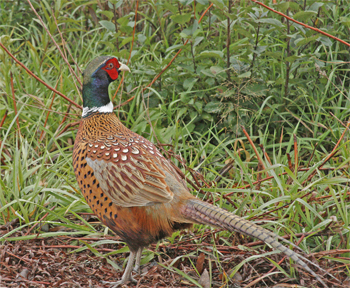
Pileated woodpecker on suet. Ringneck pheasant below.

Bird watching is something I do year ‘round. It’s been a longtime habit, and this is particularly so during the winter months when forage is tough to find under the snow and ice.

Each day, without fair, I measure the snow depth on my deck railing. So far, we are at about 110 inches of snow. We have two bird feeders out, and they are refilled every two days. I deliberately pay little attention to the cost. If I knew the cost was high, I’d stil do it because watching winter bird life keeps me tuned in with winter.

It also helps me give something back to the birds that provide me with so much enjoyment all year. Food plots were planted, and they feed deer and other animals and birds from the first green-up until the winter snow flies.

Winter birds add a bright spot to winters.

The birds feed every day at my place. There are sunflower seeds and thistle seed feeders. The woodpeckers get a big chunk of suet, and some of the other birds peck at it a bit.

Seventy-five yards behind my house is one of my food plots. There's not much to it now that deep snow has covered the ground although deer occasionally paw through the snow and nibble at the old clover and purple-top turnips. It becomes a major source of nutrition during the spring, summer and fall months.


It satisfies all the rules that pertain to winter feeding. I no longer can distribute carrots, corn and sugar beets over the once-prescribed 10 X 10-foot area, and each day when I went out, there would be deer tracks everywhere but adding some corn to the winter deer diet is now illegal. supposedly because of the Chronic Wasting Disease scare three years ago.

So far there is very little sign of wild turkeys near us, and I seldom see them until the winter weather turns harsh. Right now, our area seems to be inhabited by a few does and young fawns from last spring although it's possible a buck that has lost his antlers may be coming in, but in all honesty, since the no baiting, no-feeding law went into effect nearly three years ago, the deer have not been coming to my food plot with any regularity. It’s hard to compete with standing corn fields.

Mind you: before last night and today's snow and 15-degree temperatures, the snow has been too deep for easy deer travel. We seldom see deer once the snow gets knee-high to an adult human. The deer vacate such upland country and head for traditional low-lying deer yards where food usually isn’t any more plentiful.

In summer we have a bird bath and orange rinds nearby.

Frankly, I'm not 100 percent sure what comes to dine on the food plot behind the house. Deer are common in early and late winter, and so too are rabbit and squirrels. On a warm sunny day we occasionally see a 'possum or raccoon track in the melting snow.

Turkeys might really get hungry this winter. We get some ground-feeding birds, amd whenever I fill the feeders, I sprinkle some sunflower and thistle seed on the ground for those birds that seldom fly up to the feeders.

At times we’ve had some turkey roosting near the house, but they seldom do that any more. I think with the open food plots that the land is a bit too open for nightime roosting now.

I enjoy watching the birds all year, and the first several years we lived here, we tried to identify the differ birds that came to weed. Years agp, we had a pair of red-headed woodpecker but they eventually died out or moved on. We still have a passel of downy and hairy woodpeckers.

We see songbirds, game birds and even birds of prey.

The largest bird that visits our bird feeders (primarily the suet feeder) is an adult pileated woodpecker. We have both the male and female of that species, and see them almost every day. Flickers also visit, and they are a fairly large bird. We also get chickadees, goldfinches, grosbeaks, juncos, nuthatches, sparrows and a raft of the smaller downy and hairy woodpeckers. We quit counting the birds after we’d seen more than 100, but perhaps it’s time to start counting over again.

We feed to help give something back to the wildlife community. It can be a major expense, but I've found that it makes me feel good. And watching the birds as they feed is far more entertaining than watching television.

For more information, go to any book store or the National Geographic Online Bookstore. They have other bird books.

I recently received a copy of National Geographic’s Global Birding by Les Beletsky. It’s a big book, and perhaps more than most of us in Michigan need, but it’s an interesting read with wonderful color photos and great information.

Birds are a part of my life. While I may not go out with binoculars and a bird book in hand, I do enjoy my love affair with birds.

Friday, January 28, 2011

Are you a giver or taker?


Where wil bear and deer go when there are no more wild places?


Are you a giver or a taker? It's a very simple question that goes far beyond a one-word yes-no answer.

The bottom line here, in the event this question surprises you, is very simple. Do you take more from your fishing or hunting experiences than you give back?

The purchase of a fishing or hunting license grants us no more than a chance to legally fish or hunt or trap in season. It is a privilege but not a guaranteed God-given right.

It promises opportunities, not limit catches or a heavy game bag.


In days of old, when knights were bold, landowners also owned the fish and game. They owned the river water that flowed through their properly, and Heaven help any soft-headed peasant who poached one of the king's red deer stags, a brown trout or an Atlantic salmon.

The population 300 years ago was far less than today, and peasants were kept in their places and ruled with an iron fist. People caught poaching were severely punished, and any fish or game illegally taken was confiscated.

Things are much different these days. We have flowing springs, but bottled-water plants are tapping into the aquifers. They take our ground water but put nothing back. There are developers ready to quickly fill wetlands, and they operate on the premise that it's easier to apologize later, if caught, than seek permission first.

These are trying times, and everyone wants and needs some outdoor recreation. We need to smell the roses, but what will happen when the roses no longer bloom? What will happen when former trout streams become a turgid trickle before drying up because a bottling plant has shipped our water out of state for corporate profit, and the trout have disappeared because bottlers have drained and sold our water?

Stand up and speak for what you believe in.


How many people are speaking out? Are you standing up to face big business, and asking the hard questions: Is sale of our water a right and proper thing to do? What happens to Great Lakes water when Arizona, New Mexico and Texas want their share? What will we do then?

God help us if the Asian carp gain entrance to the Great Lakes. Out new Carp Czar says he doesn’t think it will happen, but while people stand around and wring their hands about the problem, some of those fish could be moving through Chicago’s canals and waterways. Are you following that problem and pushing for immediate action? I(f not, why not?

Who among us speaks out about urban sprawl in the Traverse City area? Or near Charlevoix and Gaylord areas? On the Petoskey-Harbor Springs region? If you haven’t looked lately, the northwestern corner of Lower Michigan is spreading out at a rapid pace, traffic is horrid, and it reminds me of Detroit.

How many people will take a few minutes from their busy lives to ask why this is happening and how can it be controlled? Why does state government allow this to occur? Why are cities like Detroit becoming an empty maze of cluttered and unsafe streets, boarded up crack houses, and why has 1.2 million people fled Detroit over the past 20 years? Why is the same thing happening in Flint and other once prosperous southern cities?

What will become of our open fields, marshlands, hardwoods and conifers that now provide cover for game and non-game animals and birds? Has anyone paid attention to the downsizing of Michigan's deer herd and our Department of Natural Resources? The marked decrease in snowshoe hares and various game birds such as ruffed grouse has become alarming?

What will happen to our environment and wild game if no one cares?


As alarming, what’s happening to the hoped-for increase in hunter numbers? Baiting died three years ago in the Lower Peninsula, and hunter numbers went with it. At the same time, baiting continued in the Upper Peninsula. Is this fair and equitable treatment to Lower Peninsula hunters?

Is it fair that private landowners get preferred treatment from the DNRE for spring turkey tags, but private landowners in the Northern Lower Peninsula cannot get such a permit. How fair is that?

The answer is simple. We're talking about habitat loss in most parts of the state. We're talking greedy businessmen. How, I wonder, can Exxon and other gas companies declare such huge profits for shareholders while the average motorist breaks his back trying to stay solvent in a credit-card society that is rife with foreclosures. We have Medicare programs that no one understands. It's bureaucracy at the worse possible level.

Granted, what has happened in the past several years to our deer herd is not easy to cope with or accept. But take a hard look at some of the problems.

Urban sprawl is eating away at the land needed for deer to thrive. People move north, buy five or 10 acres of paradise, and disrupt deer travel routes. Homes are built where deer once crossed roads. As more people move in, buy land and build homes, the terrain becomes fragmented. The deer soon disappear to another area that has yet to be exploited, but how long will that area be safe?

People are seeing bears where bruins have never been seen before. The animals need a place to live, but humans have taken over. My wife and I own 20 acres we bought 30 years ago, and admit that we added to the problem. However, we did it long before the big northern invasion began, and since then, plant food plots every year to help wildlife.

Deer numbers in our area are way down so we hunt elsewhere at times. Does this solve the problem? Of course not, it just puts a bit more hunting pressure on an area that hasn't yet felt the full force of land development like what has taken place around Traverse City and other northern cities.

Thirty years ago Traverse City was a quaint northern Michigan town with about 8,000 people. Look at it now. We have the same problems as southern cities have faced for many years. Drugs, embezzlement, robbery, murder. Such things now live on our doorstep, and paradise no longer glimmers.

Twenty or 30 years from now, when Traverse City has expanded southeast past Kingsley to Fife Lake, southwest to Copemish and Thompsonville, northwest to fill the entire Leelanau Peninsula and Benzie County, and northeast to meet Charlevoix and Gaylord that are expanding southward, we'll have the same problems that people fled when they moved north.

The difference is those who moved north brought their heavy baggage with them, and now they want this area to be like their home area once was. Folks, it doesn't happen that way.

When will many people learn to care for other things and not be selfish?


When will people look around, see the slow but sure decay and destruction of this area, and wonder how and why it has happened? Of course, the answer is easy: we are too busy raising our family, pinching pennies because half our pay is a view of the bay, and if we live long enough, we'll learn that if we aren't part of the solution, we must be part of the problem.

Meanwhile, paradise has been turned into another drug store, gas station, bank or a cement-carpeted parking lot. And one must look hard to find a rose to smell, a deer to see, or that wonderful silence at night when the northern lights dance and glow in the heavens and the coyotes howl at the moon.

The problem is we've taken what we feel is ours and given nothing back. How sad is that, and when will we learn? Sadly, I’m sure many people will be asking that question after it’s too late to change our ways.

Posted via email from Dave Richey Outdoors

Wednesday, December 08, 2010

Clean up television shows & videos


Tony Knight with a bear shot on Vancouver Island with TV host Jim Shockey.


I'm not a big television fan, and would rather read a book than watch dumb television shows. Many people apparently agree with this philosophy.

OK, folks, want an example. Most television hunting shows focus on turkeys or whitetails. Most of the show hosts are from down south. Now, I mean no disrespect to any one, but I'm tired of hearing deer antlers being called "horns." Call ‘em what they are, not what they aren’t.

Deer do not have  horns. They have antlers. Bison, goats, muskoxen and sheep around the world have horns. Horns on big-game animals continue to grow while antlers are shed every year. I even hear a few people from Michigan call a deer's rack "horns." Guess again, fella, and try to get the show terminology correct. It will give you and your television show a lot more credibility, at least North of the Mason-Dixon Line.

This is just one of the things that trouble me.


On occasion, and I mean that both figuratively and literally, I'll watch a television hunting show. I shy away from some because I have a major problem viewing many bloody, brain-dead, poorly-thought-out shows. I hate watching shows with the host walking around in his underwear. Not only is it stupid, but it’s rude to the viewing audience, regardless of age or gender.

Many hunts are filmed on a game ranch. I don't care if the deer they shoot are raised behind a fence as long as the host informs the viewing audience. Too many people view these shows, and consider the host a superb one-of-a-kind hunter. How many hunters do you personally know who kill a big buck every week and everywhere they go?

Some of these folks probably are excellent hunters, and great shots, and some may not be but the viewer is left out of touch with what is real and what is not. Most people think if they see it on television, this is reality. Guess again.

I won't name names, and I'm not out to bad-mouth anyone. But I see things on some shows that fly in the face of what I consider good form and good hunting ethics. Some set poor examples for their viewers. Some hunting shows are good, show vivid detail, and they are watching masters of the hunting art in action. Jim Shockey, who I’ve hunted with, falls in this category. He is the real deal.

Here is an example. A guy was sitting 25-30 feet up a tree, and along comes a buck walking directly at him. The bow comes back to full draw, the deer catches the movement and stops to look up, and our hero shoots the animal in front of the front shoulder near the brisket.

The deer was shot in full daylight, and suddenly it has turned extremely dark, and they find the deer pm;u 75 yards away after a perfect shot, or so they say. Does this mean that taking whatever shot the deer offers will make the viewer a better hunter? Not hardly, because they may assume that this was a good shot when in fact it was a horrible shot placement.

There are two high-percentage shots that hunters should take: broadside and quartering-away, and the latter is the best. The showing of this deer being shot in front of the front shoulder, coupled with the fact that it had apparently taken hours and perhaps more than one day to find the animal, is never explained. Again, a poor example is set for novice hunters. Sportsmen who know better won't watch these shows more than once because they have a great deal of respect for the game they hunt and shoot.

The hunt for most longtime sportsmen is much more important than the kill.


Another show I recently watched saw an arrow hit a deer in the front shoulder blade. There was hardly any penetration, and the animal ran off with the arrow dangling down. They later found a deer, and it shows the animal with a round hole behind the front shoulder. It appeared to be a different deer, one that may have been shot with a rifle to provide a dead animal for the show. Folks, you were suckered on that one.

Right, wrong, I'm not the hunting-show police. It's not up to me to act as an unpaid overseer of how they produce their shows. I made a vow to my readers many years ago that I wouldn't fib, lie, prevaricate or tell something which was not true. For 44 years I've kept that promise, and I’m very proud of the fact.

I write books, magazine articles, newspaper articles and columns, and now write for my personal daily website. I write a daily blog, and one must have countless experiences to continue to write a story every day, but what I write is what I've done. There's no need for exaggeration. I've hunted on a professional level for most of my life, and I want my professsional image to be squeaky clean.

Granted, this is just a personal observation about some television hunting shows. Each person has his or her own sense of personal ethics, but when I see someone shoot a buck in the shoulder, and when they "recover" the deer and it looks different, I have a problem accepting such things. It's just flat wrong! I just saw one show where a bear was shot in the water. That's not legal in the any of the places I hunt.

Image is all-important for television hosts or writers. Project a good one.


Many years ago, a hunter who had numerous whitetail bucks in the  record books (before they were disqualified) got into making videos. I bumped into him on a hunt, and he wanted me to watch his latest video.

I almost walked out before the video ended. He was proud of the live "kill" and "pass-through" shots. In one scene he shot a buck, it ran off, stumbled and fell in a tiny stream. The camera zeroed in on the downed buck, blood spurting into the air and turning the creek water red, and he asked what I thought of his latest masterpiece.

"That is the most disgusting video I've ever seen!" I said. "It makes me want to puke. How many "pass-through" shots are needed? I believe your sales will fall if you leave the buck-in-the-creek and spurting blood in that video. We all know an arrow-shot deer bleeds and dies, but is it necessary to video such a scene? It would be like videotaping one of your children or a parent dying. Some women will ask their husband not to view it when the children are around. Some women will just make the video disappear."

He left in the spurting blood portion of the buck kicking and thrashing in the creek, and the video didn't sell well. Then, other video producers started an attempt to clean up some of the gorier hunting videos.

He didn't speak to me again for several years, but later admitted that he and the video producer made an error in judgement. I am not the guy to say such things mustn't be shown. I'm just a guy who feels that some things don't deserve to be shown in all their blood-and-guts glory.

Some things are better left alone. The outdoor magazines long ago avoided bloody abdomens, blood around the nose and mouth, tongues sticking out and most outdoor writers take time to clean up the animal and stick its tongue back in before shooting photos. A live deer is majestic to look at but a dead deer just looks dead, even if it has been cleaned up. You can put lipstick on a pig to make it look better, but in the end, it is still a pig that has been tramped up a bit.

Sorry to natter on so long on such tasteless topics. I just saw one of the shows a few days ago, and felt I had to write about it. Journalists should report only that which is honest and true, and if it doesn't cause other people to get wild-eyed with horror when they see it.

Frankly, I'm tired of the fist pumps, the knuckle bumps, the thumb-grip handshakes, and the phoniness of some of these shows. The laughing and giggling when something dies leaves a very bad taste in my mouth.

Class will carry a television hunting show. A few television shows have class and many do not. It's my choice to choose which few outdoor shows I watch, and we never linger on the bad ones.

Posted via email from Dave Richey Outdoors

Monday, December 06, 2010

Dogging the deer tracks


This nice buck was watching a hunter that was following his back-trail.


Snow depths are getting deeper this year as one storm after another blows through the state. Whitetails are moving freely throughout the Lower Peninsula and parts of the Upper Peninsula but if heavy snows continue in the UP, the deer will soon all be yarded up, which makes for a long winter.

Many avid hunters want to learn more about deer. There's no better time to learn about deer, from deer, than taking a walk through a swamp or woods. It can provide great exercise, and can teach a sportsman a thing or two about these animals they hunt.

Wait for a fresh snow, and go for a hike. There will be no particular destination in mind, but walk until you find one big track traveling alone. Chances are good it will be a buck, and he may be with or without antlers. Many bucks lose their antlers in December, but some Michigan bucks will keep theirs into January or February.

Find a unique track, and get on it and track it for a mile or two.


This is a form of hunting without carrying a bow or firearm. Get on that track and note any particular characteristic about it. One hoof may be oddly shaped, or one leg may drag a bit, and anything different about a hoof print will make it easy to identify.

Stay on the track, and usually you will determine that the deer knows you are behind him within 30 minutes. You are not trying to stalk the deer; instead, you are trying to track that animal until you see it. It's a game of hide and week, and you'll soon learn the deer is better at staying out of sight than you are.

You'll soon come to where the deer is bedded down, and keep to the trail but continue to look ahead and to both sides. Eventually the deer will circle to check you out.

The deer will mosey along until he hears, sees or smells you on the trail, and then will start to meander. Ofter the deer will take you through some rugged terrain before it begins to circle.

The circle is your first clue that the deer knows you are back there, dogging his tracks. They often circle back to a point where they can watch their backtrail. They want to know what is coming up behind them.

Sometimes the deer, if badly spooked, will light out of there on a hard run and cover a quarter-mile or more before slowing. That's OK, just let him run and keep to the track.

Stay on the same track, and don’t be in a rush. Fast-moving hunters spook deer.


Deer that are being followed will often join up with other deer, mix with them, follow many of the same runways or trails they use, and that is when tracking a deer becomes more difficult. It's important to find a track that is noticeably different than those of other deer.

The animal may try to fool you this way, and if this doesn't shake you off the track, look for it to head for another area that holds many deer. Track the deer through that maze, and the animal will either get really spooked or develop a curiosity.

I should note that it isn't wise to do this when deer are yarded up. Deer pinned in a cedar swamp do not need to be spooked. They often will be living off fat reserves, and even though the animals may run away, it may later lead to their death. Track deer when they can freely move.

A deer may move with the wind, across wind, or try to circle to get downwind of your location. A circling deer is trying to see or smell you, and that is when it pays to look all around and slow down a bit.

Don't hurry. A slow-moving sportsman will move the deer where it wants to go, and a spooked deer will lead you on a long chase. Often, a deer will be spotted within a mile.

You may see it standing motionless in the tag alders ahead, crossing a snowy hill ahead, or heading into the next patch of thick cover. It's not necessary to follow a deer to the point of exhaustion.

The trick is to watch what deer do when they know something is after them. They are less frightened of a slow-moving person than one moving as fast as possible.

Watch and see how deer try to elude you. They will make sudden direction changes, stop, move off to one side or the other, but often will be back in thick cover. You may find yourself walking within 20 yards of a deer without seeing it.

Deer will try to elude you. Look for sudden direction changes or movements.

This is great exercise, but even more important, it gives a hunter a greater insight into how deer think and why they do some of the things they do. And best of all, it is fun.

Become extremely good at this tactic, and then start carrying a bow or firearm. Walk up a buck without overly spooking him, and you'll have acquired a talent that very few hunters possess.

Posted via email from Dave Richey Outdoors