Showing posts with label is. Show all posts

Friday, February 18, 2011

Make outdoor ethics count

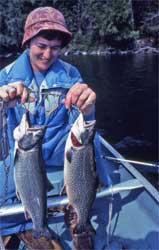
Kay landed two big brook trout  but stopped fishing then. She'd had enough.
Outdoor ethics are like dipping snuff. It doesn't agree with everyone, and for some, it leaves them feeling cold and sneezzy. Ethics, often unlike laws, are rules that rule our pitdppr conduct.

Ethics are more easily understood when explained in this manner. Ethics are those things you wouldn't do if you knew a conservation officer was watching from a distance.

They are those hard-to-explain things that keep sportsmen from breaking fish or game laws if we knew an officer was in the area. For most of us, ethics and knowledge of our fish and game laws run hand-in-hand. We won't break the law under any situation.

Ethics keep honest people honest in the woods and on the water.

That's fine, as far as it goes, but it's a gross oversimplification of a very complex personal outdoor issue that all sportsmen must think about. And, frankly, these issues baffle many sportsmen.

Outdoor ethics are those complex but unquestionable rules that sportsmen must adhere to whether other people are watching or not. They are those things we must endorse if fishing and hunting is to survive this century.

Want a few examples? Chew on these on these little tidbits:
  • I had six chances to arrow a big 10-point two years ago. He always showed up from two to five minutes after legal shooting time had ended. No one was within a half-mile of me, and no one would have known if I had cheated by shooting that buck a few minutes late.
No one, that is, except me. It would have ate at my guts like a malignant tumor until the taking of that big 10-point buck would have been reduced to a humiliating experience. It would have ruined my hunt as well as my perception of myself as a law abiding sportsman.
  • One night last fall I climbed into my bow stand, tried to remove my wallet from my back pocket, and discovered it wasn't there. My bow license was home on the dresser in my bill-fold. I had a valid deer-hunting license but it wasn't in my immediate possession so my bow was stowed away in its soft case and lowered to the ground.
That evening was spent watching deer through binoculars. It was a fun evening, even without a bow in my hands.

I wouldn't have been able to eat a tenderloin steak if  I'd shot late.

  • A big problem with outdoor ethics is they are impossible to legislate and difficult for many people to understand. Only one person – you or me – can deal with these ethical situations whenever a potential problem arises.
  • For instance: we shoot a rooster pheasant and it drifts across a fence on set wings and falls onto posted land. Does shooting that bird give us the legal right to pursue it without landowner permission? Nope! The ethical sportsman would determine who owned the property, and make every attempt to gain permission to cross the property line.
What happens when it's virtually impossible to track down the absentee landowner? No one wants to see the game go to waste. The next decision would be to contact the closest conservation officer. If he says you can't cross the line without permission, it still remains an ethical and legal question. Cross without permission means breaking the law. Do you go or stay? Laws and ethics. Right or wrong. It always pays to do the right thing.
  • We're fishing flies-only water for native brown trout and a stiff breeze puts down the mayfly hatch. Is it ethical to fish worms here? The answer, both ethically and legally, is no.
  • Or, as I mentioned earlier about the 10-point buck, could I have cheated in that instance and shot? Sure, but I would have had to deal with my emotions and my personal sense of right or wrong and any resulting guilt.
  • Mallards pinwheel down on a freshening breeze to spill into the bobbing decoys. It's a perfect morning, and it's five minutes before legal shooting time. Hunters in a nearby blind shoot and drop two hen mallards. Does that make it legal for me to shoot early?
We all know the obvious answer is “No” but some sportsmen would shoot any way, and be ticketed by a conservation officer. If they are not caught, they must still deal with their conscience as well as state and federal laws.

Ethics prevent us from doing illegal or quasi-illegal acts. Hunters don't shoot ducks on the water or grouse on the ground or off tree limbs. We don't snag fish, and we don't keep undersized fish or fish over our legal limit. We don't ignore slot limits wherever they exist. Such things are just not done. Buying a fishing or hunting license is no guarantee of a full game bag, a trophy buck, a hefty creel or a brace of pheasants. The license only grant us an opportunity to fish or hunt during the legal season. It offers sportsmen nothing more and nothing less than the opportunity to participate in these pastimes.

Ethical behavior is a topic as personal as the color of our morning toothbrush. It also serves as the bare-bones foundation on which our sports are built.

We are judged by our conduct, in and out of the field bu others, and those who wink at fish or game law violations or encourage any breach of ethical conduct, do themselves and others a great disservice.

If we can't fish or hunt ethically, and within the confines of the laws that pertain to these pastimes, we should not be considered sportsmen. If we have to worry about being caught by a conservation officer and ticketed, it may be necessary for some people to re-examine the reasons they fish or hunt.

Saturday, November 27, 2010

Trespass & resulting landowner problems


Trespassing on private land has become a major problem in Michigan.


The firearm season ends soon, and for some landowners, the 16-day season brought trespassers to their land. Tire tracks were as obvious as a train wreck on my woods road. I hadn’t made them so it meant someone was trespassing or poaching on my property.

I followed the vehicle tracks for 200 yards into my woods, and then they ended. A truck had come that far and left. It was easy to see where it had been parked, and nearby was an empty cigarette package, cigarette butts and a candy bar wrapper.

I continued down my two-track another 200 yards before stumbling over something in the leaf-covered trail. Leaves covered the trail, and I kicked around to remove what I’d tripped over and uncovered a mound of illegal sugar beets.


Trespassing is bad enough but using bait on my land angered me.


I felt like a detective searching for evidence. My gaze went to the nearby trees, and 20 yards away was a ladder stand. It wasn’t mine so I climbed the stand, unhooked it from the tree, and twisted it free. It was either a very cheap stand that bent easily or my anger made me stronger than I realized, but the ladder got twisted like a pretzel. Darn!

A note was left at the site. It said “If you want your ladder stand back, stop at the house next door at noon. Don’t be late!”

A truck pulled into my driveway in timely fashion, and I didn’t recognize it. A man got out, walked to the door, and I met him. He’d come to claim his stand.

He said he had put up the stand for his son who was living with other people nearby. I asked him why he used my two-track as a parking spot while he trespassed.

“I didn’t know it was private,” he whined. “I’m sorry.”

He was told that he had purposely driven past two No Trespassing signs near the road, but he claimed ignorance. He said he didn’t see them. I pointed out that it was impossible not to see them.

“Do you want your ladder stand back?” I asked. He said he did.

“Let me see your drivers license. I need some information, and once I have that information I’ll return the stand.”

I wanted his drivers license to obtain information about the dude.


“Why should I show you my license,” he asked.

“If you don’t, you won’t get your stand back. I’ll walk outside before you can back out of my driveway, and write down your license plate letters and numbers. Then I’ll call and let the police track you down. That will work fine for me. How does that flush for you?”

“C’mon, man, I don’t want any problem with the police.”

“Give me your drivers license, and don’t call me man. I’ll write down the information, and then give you your stand. But first, a no-nonsense warning: if you are caught on my land again, I will go to the police. If I find your truck on my land I’ll flatten all the the tires to keep you here until the police arrive. Do we understand each other? Is all of this clear enough for you?”

It was, and he complied with my request for his drivers license, and I returned his bent ladder stand. He asked me why it was bent and was told the he had made my very angry. I haven’t seen him since, and never want to.

Trespass is one of the most common problems that landowners face. People sneak onto private land, put up tree stands, screw in tree steps, and figure they can get away with it. It is illegal to trespass on another person’s property without permission.

The penalties for trespass are not strong enough to discourage its practice.


Sadly, trespass is a misdemeanor and few trespass cases ever wind up being prosecuted. The prosecuting attorney and staff is too busy dealing with armed robberies, burglaries, embezzlement, home invasion, murder, rape and other more serious crimes. They seldom handle a trespass case unless it is a part of a more serious crime.

Sadly, what seems an easy situation for the prosecuting attorney’s office to handle, can leave the landowner blowing in the wind. Is it fair? No, but it’s a fact. This leaves the landowner feeling helpless and used by the system and the trespasser. It’s difficult to get police to the scene of a trespass problem in time to take any immediate action. Often, the landowner must handle the problem alone, and this is not always a wise decision.

Trespass is only one problem. Two others often include littering and property damage.

Years ago several friends and I leased 640 acres near Harrison for deer and turkey hunting. On opening day of the firearm deer season we encountered a stranger in the woods. He wasn’t dressed in  blaze orange, and we asked what he was doing.

This gent was antagonistic and surly. He wanted to know who we were.

“We lease this land,” I told him. “You are trespassing and will have to leave.”

“I’ve hunted this land for 40 years and will continue to hunt it,” he said, with grit in his voice. “You can lease it but I plan to continue hunting here. If you call the police, I’ll set fire to the woods. You’ll never be able to prove I did it.”

He left, and we bumped into him again later. He threatened to fight all three of us, and the last thing we needed from a lease was to fight with a cranky neighbor. We finally gave up the lease for apparent reasons. The guy acted like he was half-crazy.

It’s really not wise to mess with trespassers but they need better manners.


A doctor who requests anonymity bought 400 acres of land in the northern Lower Peninsula, built a nice log cabin and barn, and began planting food plots for wildlife. He soon encountered a trespasser, and went to talk and politely asked him to leave.

“I’ll leave this time but I’ll be  back and there’s nothing you can do about it,” he said. “My daddy grew up in this area and so did I, and I’ve always hunted one specific spot on the border of your property and I’ll continue to hunt it whether you like it or not.

“Put the police on me and I’ll sugar up the gas tank of your brand-new tractor. If that doesn’t educate you, I’ll burn down your barn. If that doesn’t work I’ll burn down your fancy log cabin. However, I am a reasonable man.”

By now the doctor was terrified, and asked what “reasonable” meant.

“Give me written permission to hunt my one spot on the corner of your land, and I’ll be the best caretaker you’ll ever have. Poachers and other trespassers know who I am, and I’ll keep everyone else away from your house, barn and farm equipment. I won’t hunt if you have a bunch of company, but I won’t allow anyone to hunt my stand.”

“How do I know you’ll do as you say,” the doctor asked. “What guarantees do I have?”

“There are no guarantees. It’s a simple deal. Give me my one place to hunt, and I’ll keep everyone else off your land. You live up to your end of the deal and I’ll live up to mine. Trust me, you don’t need me as your enemy. I’m just a little bit goofy after Nam.”

So he cut a deal with the devil. He honored the agreement and has had no problems even though his cabin and land is in a remote part of the state, off a dirt road with no close neighbors except for his new caretaker. No one has broke into his cottage, sugared his gas tank or burned down his barn.

He made a deal with the devil that worked out for him.


Not many trespasser will work out such deals. They come and go until caught, and if anything happens, they get a naughty-boy slap on the wrist and are turned loose with a minor fine.  Some may retaliate. Most do not, but they may return to trespass again.

Land is getting tight in the Lower Peninsula, and as more farms are sold and subdivided, the acreage where people could once hunt has shrunk. It becomes a situation of the haves and have-nots. Those who own land worry about the have-nots trespassing on it.

There has been a few cases of physical violence over the years although most such actions have involved snowmobilers. It seldom comes to that with sportsmen.

However, the specter of trespass is never far away. What does the future hold?

It’s a question that is most difficult to answer. The most  obvious concern among landowners is the threat of increased trespass cases. That also brings to mind the possibility of retaliation.

Several people I know have made friends with the local Sheriffs Department deputies, and offer them a chance to hunt their land in return for them running  people off. Others invite Michigan State Police officers to fill the same role. It eliminates the need for the owners to physically confront  trespassers.

Should such actions be necessary? If we lived in a perfect world, it wouldn’t be but this is not a perfect world nor are all of our citizens nice people. The perfect world would allow for a jail sentence for repeat offenders and something far more substantial than a wrist slap and a small fine and court costs.

The perfect world would teach trespassers to stay on their own land or hunt federal or state land. That obviously doesn’t work in today’s society, and violence on behalf of the landowner only exacerbates the problem.

Solving this issue takes time, proper legislation, solid law enforcement, landowner cooperation and a court system that will address the issue properly while administering justice and punishment in a swift manner. One can only hope that day soon comes.

Posted via email from Dave Richey Outdoors

Tuesday, November 09, 2010

How much is too much?


This Cuddiback photo of a buck was taken at 15 yards, an average bow shot.


The man had a very serious problem. He no longer could draw his bow without severe arm, back and shoulder pain.

He is the son-in-law of a friend, and being young and strong and very competitive, he and some of his buddies decided to settle a macho bet of who could draw the most poundage. Testosterone was flowing, and they soon began by pulling 70 pounds.

Hey, no problem, they all thought. The next step was to crank each bow to 75 pounds of draw weight, and measure it on a scale. Only two  sucked the bow back to full draw, and then they raised the draw weight to 80 pounds.

How much draw weight is needed to kill a deer with a bow?


This was possible for both of them, but the others had already dropped out of this childish contest. It took considerably more effort than they were willing or able to give. This contest was finally going somewhere. The two guys kicked the draw weight up to 85 pounds, and with a great deal of posturing, each one reached that plateau but it was obvious it was becoming very difficult for both men.

We've come this far, one said, let's take it to 90 pounds. There was a great deal of grunting and groaning as each bow came back to their individual anchor points at that draw weight. Both were red in the face, and agreed now to take the contest upwards again, but now only one pound at a time.

One man made it to full draw at 91 pounds. The other man did not. We then had a winner and a loser, and both titles belonged to the same person.

The winner-loser felt something go as a muscle ripped in his shoulder while he took it up that one last pound, and his shoulder hurt all winter and was still sore in the spring. By now, he had cranked his bow down to his usual draw weight of 68 pounds.

But he couldn't pull that much weight now. He was then forced to travel in reverse, and tried again at 65 pounds, and then 60 pounds, and finally settled in at 55 pounds. It still hurt to draw his bow at that poundage, but over the spring and summer he settled in at that draw weight for good.

It's been about 15 years since the two strong men competed to be the top dog at pulling the heaviest draw weight. He is content now because he doesn't have to crank down his bow for the December bow season, and he has found that 55 pounds is plenty heavy and fast enough to kill a buck while hunting in Michigan's swamps and woods.

There seems to be an obsession with more and more arrow speed. Years ago, most bows couldn't shoot 150 feet per second (fps). Many thought an arrow speed of 200 fps would be impossible to attain. Ten years ago archers and bowhunters felt an arrow speed of 300 fps would never be reached, but it has.

Do most bow hunters require increased poundage and arrow speed?


The reality of shooting a bow is that if an arrow travels at 180 fps, and hits a deer at a distance of 20 yards or less, the arrow will hit the animal before it can hear the bow string twang and jump the string or duck under the approaching arrow. So ... is there a need to shoot an arrow any faster?

Of course there is, under certain circumstances. Faster arrow speed means a flatter arrow trajectory. An increase in arrow speed of only 20 fps will allow a person, with the proper skills and considerable practice, to easily kill deer at 30 yards instead of 20. Hunters who travel west to hunt for antelope, elk or mule deer with a bow often need to shoot at longer distances, and that is where a faster arrow speed is required to flatten out the arrow flight.

There are still some men who are into heavy poundage on their bows, and who want to reach out and set new personal arrow-speed records. They modify their bows, add an overdraw, shorten their arrow length, and crank up the poundage. They use carbon inserts and carbon arrow, and shoot continuously.

How far up the poundage ladder is it necessary to climb?


Hunters broke the 300 fps barrier years ago, but as time goes on, I see fewer people maxing out the poundage of their bow. And, to be honest with you, I'm seeing far fewer people with shoulder injuries caused by taking their body to a point where it was never meant to go.

I now advise people to shoot what feels comfortable to them. A test of strength and determination isn't required to be a successful deer hunter.

Most deer hunters are content to keep the poundage down to a comfortable level, and where drawing a bow is fun ... and never a painful exercise from which they may never recover.

Posted via email from Dave Richey Outdoors