Showing posts with label draw. Show all posts

Tuesday, April 26, 2011

Gobbler hunting with a bow


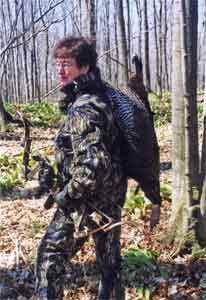
Kay Richey with a jake gobbler she shot with bow and arrow.


There are any number of ways to hunt these sharp-eyed birds, but one thing is a constant. Hunters must have some way of concealing the movements necessary when drawing a bow on a strutting gobbler.

Trust me, it's not easy. Turkeys see well, hear well, and there often is enough of them around a gobbler that coming to full draw isn't easy.

One way of doing it, and the most effective way, is to use a pop-up ground blind of camouflage material. These blinds take hardly any time to set up, and a bit of natural grasses or broken tree branches can allow a hunter and his blind to blend right in.

One way to do it is to locate a gobbler or two the night before, watch them fly up to roost, and return the next morning well before dawn. Set up the blind in the dark as quietly as possible, climb inside, sit down and stay quiet.

Sometimes gobblers will gobble first, but often small birds will be chirping and then the crows start to fly. The cawing of crows often triggers a spirited gobble.


Don't get impatient and hurry a bow shot before it's time.


I prefer to let the birds gobble two or three times before making a soft and short yelp. That's it, just one very soft call. Gobblers aren't deaf, and if they hear it and haven't been spooked, they will answer.

Just sit tight. It's not necessary to answer every gobble. In fact, let them gobble one or two more times, and make one more soft tree yelp. Listen for the birds to gobble from the roost, and then beat old turkey wing feathers against tree branches like a hen flying to the ground.

The gobblers will hear that, and often gobble again, and one more soft yelp is usually all it takes. If you are using decoys, there are different schools of thought on decoy placement.

I like to use two hen decoys and one jake decoy. I like the jake decoy facing the blind and the hens five or six yards farther out. When the gobblers come to the decoys, it's best to place the jake about 18 to 20 yards away and facing the pop-up blind. This will normally put the live gobbler between the jake decoy and you.

Gobblers almost always will head for the jake decoy, and I've watched adult gobblers jump up on the jake decoy, knock it over, and start putting the spurs to the decoy.

Shooting the gobbler is pretty easy with a shotgun, but it is much more difficult with a bow. Gobblers can stand still for long minutes, but when they come to the call and decoys, they are moving around.

Two certain shots are possible. A shot taken at a gobbler facing directly at the hunter is fairly easy but I know many people who wind up killing the bird but slicing off the beard in the process.

Wait for the bird to drop his wing-tips, spread his tail feathers, and prance around. Once the bird stops, aim for a spot just below where the beard comes out of the chest, lower the sight three or four inches, and try to hit just to one side or other of the beard. Done properly, this will kill the bird quickly.

The other way is to wait for the bird to start strutting, and let the gobbler turn all the way around to face the jake decoy. Aim for the center where all the tail-feather quills go into the back end of the turkey, and take a well-aimed shot.

Place the jake decoy in front of you and shoot when the gobbler goes to it.


A mortally wounded turkey will almost always shoot 10 to 12 feet straight up into the air, and fall back dead. I strongly suggest using a Game Tracker unit, because if the bird is not mortally wounded, it will fly or run off. The bird may not travel too far, but if it goes out of sight, they can become nearly impossible to find. A  string tracker can be a big help in recovering the bird.

Do not take side shots at a gobbler. The wing bones and feathers are heavy, and it's difficult to place an arrow through the wing feathers. I've talked to a few turkey hunters who say they shoot their bird at the juncture of the head and neck with an arrow, but it would be a difficult shot because a gobbler's head is always moving.

Of utmost importance is to position the blind so a shot can be taken sitting down. If the tent has horizontal and vertical windows, position a vertical window in front of you. Sit back, with full camouflage on, and wait for the bird to get into the proper position for a shot.

My wife has shot two gobblers with a bow.


My wife has shot two nice gobblers with her bow, and everything must into place in order to be successful. It is even more of a heart-pounder if a longbeard is taken with stick and string.

Turkey hunting with a bow is a major challenge. It's not easy with a bow, but when it works, it offers a surge of adrenaline that will be hard to forget.


Saturday, April 02, 2011

Shoot lower draw weights


An accurate shot with a lower-poundage bow can be deadly.


Even big bucks can be killed with sharp broadheads and low draw weight. Doubt that? Well, don't bet big money against it.

I've seen it thousands of times over the past 30 years as more hunters are drawn to bow hunting. The strongest looking guy on a 3-D course has muscles in his spit, and he delights in telling others how he pulls 92 pounds or some such thing.

He tells others he is dead-on at 60 yards, and his arrow speed is well over 340 feet-per-second. He usually insults other hunters by asking them how much weight they draw, as if it's any of his business.

Be more comfortable and accurate: shoot lower draw weight.


If they answer 55 pounds, 60 pounds or 65 pounds, he criticizes them for not shooting more poundage. Such jokers attend one or two 3-D shoots, and then wonder why no one wants to shoot with him. Such people can become intimidating bores. Shooting high draw weights can be dangerous to your health.

Other than because of a personal belief, there is very little need why any sane person should be pulling 90 pounds or more. It's not needed, and drawing so much weight doesn't make most people a better archer.

In fact, one could argue the case that too much draw weight can make them a worse shot. How so?

It's easy. Anyone who draws that much weight is an accident waiting for a place to happen. There used to be a guy I knew, and he had to retune his bow after every four or five shots. The vibration of the shot was so violent his bow would go out of tune. Watching it explore made some people want to take up croquet.

Once, the bow blew up when he shot an arrow much too light for his draw weight. The bow disintegrated in his hand, and only through sheer good fortune, did he escape serious injury. He was cut up some when things started flying off his bow.

Trust me -- shooting too much draw weight can be hazardous to your health.


A month later, as he cranked his bow up another two pounds, he drew it back with visible difficulty, and shot one arrow. It was on the second shot that he blew out a couple of shoulder muscles, and the last thing I knew he was pulling 55 pounds. His he-man days had painfully ended.
Heavy draw weight can cause lasting damage to back and shoulders.

He no longer razzs other hunters about their meek draw weight. He learned a lesson he'll never forget. Too much draw weight can cause long-lasting injuries.

The one thing such macho guys believe is that pulling heavy-duty weight helps them. Another guy I once knew cranked his bow up to 85 pounds, and he knew he was teetering on the ragged edge of too much draw weight. He gritted his teeth, and when he shot, he would miss the kill zone by a foot or more. He wounded too many dee that couldn't be recovered, and also wound up hurting himself. He no longer hunts with a bow.

Most of the deer shot in Michigan and other states are taken at 20 yards or less. It doesn't take a heavy draw weight to shoot a razor-sharp broadhead through a deer with 35-40 pounds.

One woman I know is extremely accurate. She has good eyes, good form, and has shot over 300 chipmunks and red squirrels around her home using a bow and arrow. She rarely misses, and if she draws on either one of the small rodents, it was dead but doesn't know it yet.

She gradually built up her strength to draw 40 pounds, and she shoots deer every year. She shoots arrows clean through the deer with a two-blade broadhead, and that points out the two things any bow hunter needs to be effective in the deer woods. They need to be able to be accurate, and must shoot arrows tipped with razor-like broadheads.

Shooting accurately with razor-sharp broadheads is important.


It's hard to over-emphasize what sharp broadheads mean.

Most factory broadheads are not razor sharp. If you shoot a replaceable blade broadhead, choose one with the sharpest possible blades. If you choose a fixed-blade broadhead, choose a two-blade head than can be sharpened by hand.

We use a flat file to get the broadhead reasonably sharp, and then we put the finishing touches on with a stone. The tiny burrs on the edge are removed on a leather strop like the ones barbers once used to shave with.

It doesn't require he-man strength to shoot a deer. It does require accurate shot placement, and very sharp broadheads. A bow shooting an arrow at 180 feet-per-second or faster, and an arrow tipped with a very sharp broadhead, is far more effective than a bad hit from an arrow traveling 300 feet-per-second. Too much draw weight can lead to target panic and flinching.

It's a matter of concentration and skill rather than one of brawn and bluster. A cool hand, under pressure, can place an arrow accurately, and the sharp broadhead does the rest.

Which of these two scenario do you think works the best?

Sunday, January 09, 2011

Draw your bow daily


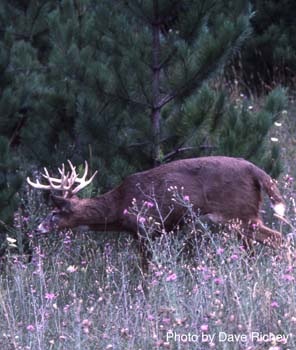
Practice now, and next fall when a buck like this shows up, you’ll be ready.


Many people from all over the state have told me they shoot in an archery league to stay sharp during the winter. Others  have developed some rather ingenious ways to conduct winter practice.

The primary function here is to shoot enough to pick up the bow, draw, aim and shoot without feeling any discomfort. Stay away from shooting of any kind for a month or more, and the bow often feels a bit uncomfortable in your hands. The trick is to stay comfortable with a bow in your hands all winter.

My basement has a 20-yard archery range in it. I can shoot every day if the mood moves me, which it often does.

Shooting a few arrows makes the bow feel five pounds heavier than it really is, and the back and shoulder muscles get sore easily. Shooting is the best cure for any of these problems, and it makes accurate shooting much easier.

Consistent practice, whether just drawing or shooting, is more comfortable.


If a person just has no place to shoot, they can still draw their bow and develop some strength training. Here are several examples of things one can do during winter months to stay comfortable drawing a bow.

A buddy does his shooting out in his cavernous garage. A target is set up at one end of the garage, and he can shoot at distances from 15 to 25 yards. Of course, on a bitter cold day, five or six shots is about all he can handle.

Another friend has a 17-yard archery range in his basement. He is talking about cutting a hole in the wall which would allow him to shoot at 25 yards, and it would more closely simulate shooting from an enclosed hunting blind.

He practices standing up and sitting down while shooting, and this is good. As a rule, he normally shoots while sitting. He can don some fairly heavy clothing similar to what he would wear for December hunts or he can wear lighter clothing to simulate shooting in October.

Still another gent I know does shoot some, but he walks around his house, comes to full draw, centers the sights on the nearest light bulb, telephone or drawer pull, and he finds it is excellent practice.

Just draw and aim at different household objects without shooting.


Most people when they draw on a deer have to fiddle around a bit to get their sight pin on target. All of that uses up time, and if the buck is walking away, it makes people hurry. When they hurry, they usually make a mistake and take a bad shot.

Not this guy. He practices all winter drawing an empty bow and concentrating on putting the sight where he wants the arrow to go. He works hard at it, and when he is shooting he will do the same thing with an arrow on the string. The bow comes up and back, and the arrow is on its way. This only comes from perfect practice.

Such practice makes target acquisition quick and easy. He always nails his anchor point, and if he is on his anchor point and the sight is on the target, a twitch of the finger on a release sends the arrow downrange to where he wants it to go.

Practice can take many forms, but it's important to become somewhat committed to handling your bow during the winter months. I shoot as often as possible, as I follow my no-nonsense method of drawing, achieving my anchor point, aiming and shooting.

How you practice is up to you, but practice is very important when shooting deer.


It gives me the daily practice that I want, and the result is that when it comes time to shoot a deer during bow season, I am ready. My muscles are tuned up, my eyes are sharp, and when I hit my anchor point, a slight adjustment tweaks my aim and the arrow is gone.

Many hunters wait until two or three weeks before the season opens, to start practicing. It's better than nothing, but the people who are the finest shots practice shooting on a regular basis.

Their muscles are all peaked out at a comfortable draw weight, and their eyes automatically center on the aiming point, and all it takes is to touch the trigger, and the arrow goes where it should. It's simple once you begin to practice on a regular basis.

Tuesday, November 09, 2010

How much is too much?


This Cuddiback photo of a buck was taken at 15 yards, an average bow shot.


The man had a very serious problem. He no longer could draw his bow without severe arm, back and shoulder pain.

He is the son-in-law of a friend, and being young and strong and very competitive, he and some of his buddies decided to settle a macho bet of who could draw the most poundage. Testosterone was flowing, and they soon began by pulling 70 pounds.

Hey, no problem, they all thought. The next step was to crank each bow to 75 pounds of draw weight, and measure it on a scale. Only two  sucked the bow back to full draw, and then they raised the draw weight to 80 pounds.

How much draw weight is needed to kill a deer with a bow?


This was possible for both of them, but the others had already dropped out of this childish contest. It took considerably more effort than they were willing or able to give. This contest was finally going somewhere. The two guys kicked the draw weight up to 85 pounds, and with a great deal of posturing, each one reached that plateau but it was obvious it was becoming very difficult for both men.

We've come this far, one said, let's take it to 90 pounds. There was a great deal of grunting and groaning as each bow came back to their individual anchor points at that draw weight. Both were red in the face, and agreed now to take the contest upwards again, but now only one pound at a time.

One man made it to full draw at 91 pounds. The other man did not. We then had a winner and a loser, and both titles belonged to the same person.

The winner-loser felt something go as a muscle ripped in his shoulder while he took it up that one last pound, and his shoulder hurt all winter and was still sore in the spring. By now, he had cranked his bow down to his usual draw weight of 68 pounds.

But he couldn't pull that much weight now. He was then forced to travel in reverse, and tried again at 65 pounds, and then 60 pounds, and finally settled in at 55 pounds. It still hurt to draw his bow at that poundage, but over the spring and summer he settled in at that draw weight for good.

It's been about 15 years since the two strong men competed to be the top dog at pulling the heaviest draw weight. He is content now because he doesn't have to crank down his bow for the December bow season, and he has found that 55 pounds is plenty heavy and fast enough to kill a buck while hunting in Michigan's swamps and woods.

There seems to be an obsession with more and more arrow speed. Years ago, most bows couldn't shoot 150 feet per second (fps). Many thought an arrow speed of 200 fps would be impossible to attain. Ten years ago archers and bowhunters felt an arrow speed of 300 fps would never be reached, but it has.

Do most bow hunters require increased poundage and arrow speed?


The reality of shooting a bow is that if an arrow travels at 180 fps, and hits a deer at a distance of 20 yards or less, the arrow will hit the animal before it can hear the bow string twang and jump the string or duck under the approaching arrow. So ... is there a need to shoot an arrow any faster?

Of course there is, under certain circumstances. Faster arrow speed means a flatter arrow trajectory. An increase in arrow speed of only 20 fps will allow a person, with the proper skills and considerable practice, to easily kill deer at 30 yards instead of 20. Hunters who travel west to hunt for antelope, elk or mule deer with a bow often need to shoot at longer distances, and that is where a faster arrow speed is required to flatten out the arrow flight.

There are still some men who are into heavy poundage on their bows, and who want to reach out and set new personal arrow-speed records. They modify their bows, add an overdraw, shorten their arrow length, and crank up the poundage. They use carbon inserts and carbon arrow, and shoot continuously.

How far up the poundage ladder is it necessary to climb?


Hunters broke the 300 fps barrier years ago, but as time goes on, I see fewer people maxing out the poundage of their bow. And, to be honest with you, I'm seeing far fewer people with shoulder injuries caused by taking their body to a point where it was never meant to go.

I now advise people to shoot what feels comfortable to them. A test of strength and determination isn't required to be a successful deer hunter.

Most deer hunters are content to keep the poundage down to a comfortable level, and where drawing a bow is fun ... and never a painful exercise from which they may never recover.

Posted via email from Dave Richey Outdoors