
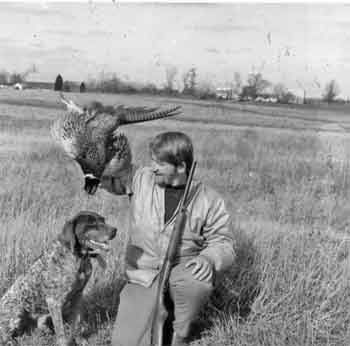
The author and Fritz on what was his last pheasant hunt in the early 1970s.
There is something very special that happens to your heart when a solid-as-Sears pointer slams to a stop, lifts a front foot, abd his stubby tail goes rigid as he locks up on a solid point. If I ponder on it long enough, it's easy to get all teary-eyed remembering certain points from 40 years ago.
It has happened many times to me, and I never fail to feel blessed by memories. I'd walk in behind a great pointer, shotgun at port arms, and look in front of and over the dog and five to 10 yards away. Too many people study the ground in front of the dog, and a pointer may be on a bird that is 10 yards ahead or to either side, and sometimes they are much further away. Fine field work is what endears good dogs to their owners.
The pleasures of owning a great dog died with my German shorthair, Fritz, who came with some truly great Royal bloodlines and who died many years ago. There were many reasons why no others have entered my life, and losing an old friend was the major one.
Most dog men live a long life and feel lucky to own one great dog. Fritz was mine.
Fritz, like many German short-hair pointers, was bullheaded and stubborn to a fault. He could get into more trouble than a 12-year-old kid with a new $20 bill, and he always thought he was hunting for himself. For two years, he didn't realize he was supposed to hunt with me in return for his daily meals and show some respect to the man who had brought him to this dance.
He was a terror, and his idea of hunting was to be a half-mile and three fallow fields ahead of me. I'd work him on a long leash, and he'd sit, heel and was steady to wing and shot as long as the rope snugged him in at about 25 yards. Take the lead off, and he attempted to set a new speed record for crossing three open fields and busting one pheasant after another along the way. Mind you, this was back in the day when pheasants were plentiful during the early 1960s.
Finally, in desperation, catching him after a long gut-busting sprint, I loosened his collar a bit, stuck one of this dark front paws through the collar, and turned him loose. He made one step and fell over whining. I got him back up on three legs, and he tried to run off again. He was scolded and told to hunt close.
An hour later, feeling sorry for my beloved pooch, I pulled his foot out and off he went like he had a booster rocket under his tail. Another long-winded sprint, and my feelings of regret changed to one of quickly solving this problem. The next two days he hunted on three legs, and wasn't happy about it but he stayed within 25 yards of me.
He worked the cover slow and cast from side to side, nosing into the wind, and we put up hens and roosters over his rather lop-sided points, and I'd praise him in person and to anyone who would listen, and after two days of punishment, we went out the third day.
He and I had a heart-to-heart chat about his past behavior, and more recent ways of staying close, and he seemed to pay attention. It was a gamble worth taking, and I slipped his foot from his collar. He looked at me, and I patted his head and said "Hunt close," and he began hunting into the wind. He cast back and forth, and never exceeded the 25-yard maximum. A soft "Whoa" was all I needed to steady him at his outer limits.
My face-to-face talk was a loving, full of meaning and veiled threat to shape up.
He locked onto point, and I whispered "Whoa" to him, lifted his tail, and he looked like a granite carving. I stepped in front, saying "Steady now," and he was rock solid. The ringneck pheasant lifted into the air with a raucous cackle, his long-barred tail streaming out behind, and I swung with the bird and down he came.
Fritz, after his introduction to a lead rope and the foot through the collar trick, never gave me another problem. He hunted grouse, pheasant and woodcock, and his expertise was superb. He would hunt with the neighbor kids, and there were only two rules: hunt safely and don't shoot at low-flying birds.
The last year of his life was a painful ordeal for us. His hips were shot from arthritis, and he always begged me to take him. We'd hunt near home, and he would gimp through the fields. His hips were bad but it didn't affect his hearing or nose.
He'd zero in on cackling roosters at dawn, and we'd move on them when shooting time opened. With luck we'd take two quick roosters, and then it was a slow and painful trek home for a dog in great pain. I'd pat his head, tell him I loved him, and he'd wag his bobbed tail. The vet had no words of encouragement. I didn't want to put him down.
His end was near, and it wasn't a pretty sight. I was sick to my stomach.
Our last hunt came a few days later. A magazine deadline was met, I grabbed my shotgun, got Fritz up and we headed out. He slowly worked two different birds, both roosters, and my shooting was better than average. Fritz pointed, and I shot both birds, and then he sat down. I kneeled beside my old friend as he whined and shivered with pain, and I picked him up and carried him home, knowing that he'd run has last race in prime pheasant habitat.
Two days later, during the second week in October as cold winds blew down from the north, Fritz left me and went to that area where all good bird dogs and close friends go when they die. He was buried along a fencerow that often produced a rooster, and on occasion I think I can hear him snuffling a big ringneck 10 feet in front of him.
It isn't, of course, but there is the deeply-seated memory of a bird dog that never knew the meaning of the word quit. He could out-hunt me, and it's the biggest reason I've never owned another hunting dog. A new dog could never measure up to Fritz, and it would be unfair to expect him to.
So I live with my deeply-held memories of Fritz. He was the finest bird dog I've owned, and I'll never see the likes of him again. There's a place tucked back in the corner of my mind where I go looking for lost friends and bird dogs, and when the memory machine registers a hit on man or dog, I reach up, dust off a fond reminder and trot it out for the world to think about whenever they hunt with a great pointer.
This has been just one of my favorites.


