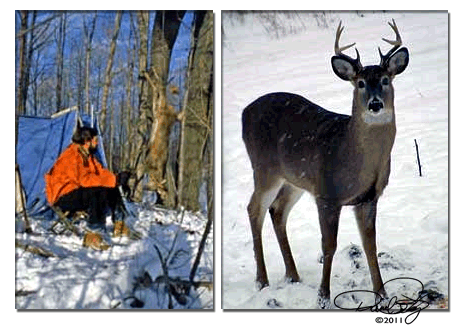
Some Thanksgiving Day hunters camp. The object of our attraction.
Thanksgiving Day is something special where we celebrate our good friends, the weather, and a fine chance to hunt with friends.
The weather was a bit blustery today, and it appears this nasty weather will continue into the weekend with possible snow. The first day of a winter storm arrived last week, and the whitetails moved well.
Tonight the deer didn't move as much as last night, but deer sense these upcoming weather changes and increased hunting activity. Weather can kill deer quite quickly if they don't have easy access to heavy cover and an available food supply.
Thanksgiving Day deer hunts with snow are better than without.
We are indeed fortunate that our whitetail herd has plenty of thick cover where they can take refuge against the cold and snow. We have low-lying swamps, huckleberry marshes, tag alder thickets and other areas of thick cedar cover. Many of these spots provide fair to excellent thermal cover against the cold, which is expected to arrive this weekend.
Deer in our area are never found very far from cover or food, but we still experience a certain amount of winter kill. Occasionally, it may be a big buck that succumbs to death after rutting hard, losing 25 percent of its body weight, and not being able to recover that lost weight before deep snow and cold weather sets in.
A few bucks are still chasing an occasional doe, but the rut has pretty much ended, and bucks are going to feed as often as possible. Storms such as last week are the early warning sign for post-rut bucks, and they are eating as often as possible to regain fat reserves to get them through the winter.
Much of any winter kill is attributed to late-born button-bucks and doe fawns that simply do not have the fat reserves needed to make it through a long winter, and I suspect we may have one of those this year. Some whitetail deer biologists feel that button-bucks die before a doe fawn for one very simple reason: button-bucks are more aggressive and always are the first to a feed station or bait site while doe fawns often were forced to forage more for food.
It doesn't make that much difference in this region because there is a continual food supply unlike what is found in many other more heavily hunted areas. I've seen years when button-bucks were dead from starvation by late November or early December when we get early and heavy snow storms. It's nature's way of making the strong stronger and the weaker ones die early of starvation or being pulled down by coyotes in the Lower Peninsula or wolves in the Upper.
Predation in late November and December increases with snow.
There is still a good bit of standing corn fields although my neighbor had his cut yesterday. Since baiting and winter feeding has returned, many people put out small amounts of food (two gallons) and deer with this handout and regular forage, can do fairly well providing we don't get severe ice storms.
Ice storms on top of deep snow is a major killer when combined with a low wind-chill factor and poor thermal cover. Last year, many corn fields were never cut and they provide fairly good winter cover.
Think about it. A big corn field offers continuous cover, an adequate winter food source, and snow melt and frost provide some moisture. An uncut corn field is a magnet for winter deer.
I didn't kill a buck today, but over the years I've managed to shoot a buck 45-50 percent of the time on this day. Driving deer is our major hunting method, and between my in-laws and neighbors, we have a number of people who will participate in a deer drive.
Just hunting on Thanksgiving Day is a treat for most hunters.
We prefer long and narrow strips of heavy cover, and two or three people will move slowly back and forth, with frequent pauses, to let our scent blow down to the deer. We try not to make much noise, and we have people stationed quietly and motionless at key spots along the edges and the downwind end. Drives are the most popular hunting method on Thanksgiving Day, and other than the first three days of the firearm season, Thanksgiving Day is the next best day of the hunting season.
Tonight wasn't a major hunting night except for family. We spent some time hunting, and more time indoors telling old deer stories. We do give thanks for our hunting land, the deer that live around here, and the opportunities we have to spend time afield with family and good friends.
For that, we are most grateful. Happy Thanksgiving!