Showing posts with label purple-top turnips. Show all posts

Monday, September 06, 2010

We really needed this rain


Rain is a necessary commodity. It has many uses other than messing up vacation plans.

The Great Lakes are still low, as are many inland lakes. The woods were bone dry, and when it's as dry as it has been, the chance of a wild fire (once called forest fires) goes up.

Farmers have been looking for rain, and what we've been given in the past several days has ended our drought conditions. A drought occurs when the ground is baked dry, and dust puffs up with every step. It's what we've had for several weeks.

Rain over the past 10 days may save our food plots. only time will tell.

The rain, including that which rumbled through the area about midnight last night, was a heavy downpour. The problem with that is it fell so hard and fast that little soaked into the ground. It's better to get a steady rain that slowly soaks the ground than a deluge.

My food plots were looking miserable, and I'm hoping the rain came in time to save this years crops. Two or three clover patches were looking very poor, especially during that spate of dry 90-degree weather.

If some rain continues, as is forecast, we may still have decent food plots. My Imperial Whitetail Clover, Brassic and Purple-Top turnips, plantings were almost burned up by the hot sun two and three weeks ago. and I'm keeping a close watch on it. Drought conditions just do not produce the quality of food plots that some people desire.

Many farmers are wondering if they will be getting a decent second-cutting of hay this year. Corn fields seem to be growing well but some feel a second cutting of hay may not be in the cards this year. It's much the same with clover and other things planted in food plots.

Some state areas have had plenty of rain while other locations, such as around Traverse City, had suffered. I'd counted on making three or four plantings.

I suspect my proposed fall plantings will be put off until spring.

I will hold off on ther plantings until next spring, and see how my plots make it. Instead, I'd been thinking of some winter wheat planted on some of my woods trails to give the deer some greenery to eat this fall, and it might come up and provide an early food source next spring when deer need a nourishing early source of easy-to-find nourishment. Such a planting this fall is now in doubt.

I've said this before, and will say it again, but I'm not well learned in planting and growing things. I discuss my food plots with people I trust, and then hope the weather conditions are suitable for producing good crops.

It's one of these late-in-life situations where I hope to put something back into the resources, provide better cover and food for the animals and birds. I'm learning that Mother Nature has a somewhat perverted sense of humor: she teases us with rain, and then sends it north or south. To add insult to injury, she often decides to send us more snow.

My eyes are peeled for my Imperial Whitetail Clover plantings. Some seems to be greening up a bit, but most of our crop was brown and down. We  did the soil tests, planted at the proper time, had a bit of rain early, and then the drought began just as it did in 2007.

Giving back to nature is my prime motivations for putting in food plots.

It's difficult watching a crop go downhill, but I now have a better understanding of what farmers go through on a year to year basis.  A drought serves no one, whether a farmer growing crops for market or a sportsman who plants crops for the wildlife.

Nature and the weather can be incredibly cruel at times. We invest our sweat equity into seed, fertilizer and lime, and hope for the best. The best this year can bring will be to have a mediocre crop, and it will only happen with even more rain, sunshine and warm weather.

I'm keeping my fingers crossed.

Posted via email from Dave Richey Outdoors

Wednesday, July 14, 2010

Give our food plots a drink


Crops were impossible to grow for a few years, and dust storms covered roads, seeped into houses, and some people with respiratory problems did not survive those years.

Things aren't that bad right now. It's not even close but people who have put in food plots or are trying to establish them are having a tough way to to go to make things grow.

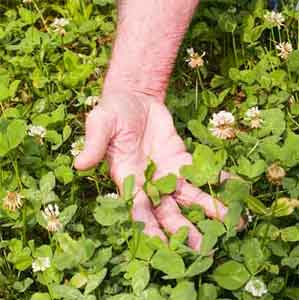
Clover, like shown above, is nutritional for deer.

Last year was a bad year for me with Purple-Top turnips," said a friend. "I planted after a  nice rain, but then the rains ended and the turnips weren't any good. They came up small and rather woody looking on the inside.

Anyone who plants a food plot is subject to all of the same problems as any farmer. Some years the weather turns against us.  Many people are getting ready to put in their fall crops, but the soil is hard, cracking, and lacks any moisture. A series of rains are needed, and we usually get some rain in August to jump-start our fall planting season."

One can only hope the weatherman cooperates. If not, some fields will be useless.

Two fields of mine will be ready to plant in early to late August, and we are hoping for a good rain between now and August 1, and some good rain storms after. That's what makes fall planting so tricky, and admittedly, this will be my third such planting. Two produced a lush crop and one could barely grow weeds.

Getting ready for fall food plots.

Many people like fall plantings or annual crops while others like some favorites when the soil conditions are conducive to growing a  crop of brassica such as Dwarf Essex Rape and Purple-Top turnips. Poor soil conditions can be built into good organic soil by planting buckwheat, oats and rye, and discing it into the ground for two or three years in a row.

"This is called 'green manure,'" an elderly farmer told me. "Two or three seasons of a green manure crop will usually build enough organic residue into your soil to produce a good high-protein crop such as alfalfa, clover or rape.

He did caution me to keep records of what is being planted every year. Keeping records of planting dates, crops planted, and what kind of a yield it produces is very important. He says a lack of records means that sportsmen have no way of knowing what they did right or did wrong.

He said the ideal plan is to provide for a year 'round food source for animals and birds. Proper planning means soil tests before anything is planted. Some soil is so poor that nothing but weeds will grow until the soil mineral content is built up.

Rain, and a good bit of it, is needed soon.

One should never consider a food plot as a replacement for baiting. One problem with food plots on large tracts of land is the land is heavily wooded in many cases, and it takes time to build a good soil content that is capable of growing high-protein crops. It just doesn't happen overnight.

Many  food plots that are planted to legumes (beans and peas) are literally destroyed by deer eating the crop as it begins to grow. A small food plot will be quickly annihilated by hungry deer.

One suggestion for sportsman is to mix other things that will grow in the fall and come back early in the spring. A mix of winter wheat offers good green food and cover in the fall, and it comes back up as soon as the snow melts. Rape and Purple-Top turnips, with some alfalfa and clover in other nearby fields, will produce good fall and early spring food for hungry deer.

If you see a man with a white beard standing outside about this time of year, and gazing skyward, it  probably means I'm either praying or scanning the skies for sign of rain clouds.

A bit of each may be needed late this summer and in the early fall. I know that my food plots are in bad need of a good drink, and the sooner it comes the better.

Posted via email from Dave Richey Outdoors