Showing posts with label rain. Show all posts

Tuesday, August 28, 2012

Rainy Day Whitetails

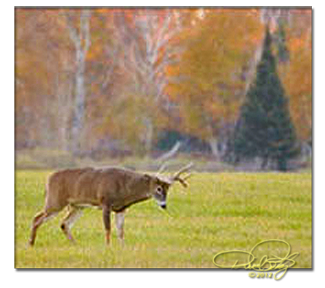
dro_big buck
A big buck posturing in a soft rain and far from any bow hunters
photo courtesy Dave Richey Outdoors©2012
There are times when a bow hunter can hear a whitetail coming for 100 yards. If the animal is upwind, and the leaves are as dry as corn flakes, the sound carries for a long distance.

Whitetails depend on their hearing for survival, and dry leaves advertise their presence. The opposite is true when it rains.

The leaves soak up the rainy weather, and a whitetail can ghost through the woods with barely a sound. This is an important reason for hunters to spend time in the woods when the rain is falling.

Fog, a light mist or a soft drizzle can cause bucks to move


I've written before that deer love to travel when a soft misty rain is falling. There is a soft pitter-patting sound under such conditions, but it doesn't seem to bother the deer. They seem to be able to separate that soft noise from a dangerous noise without a problem.

These soft rains seem to get deer moving earlier in the evening, and it appears that deer move with more confidence during a soft rain. They appear more comfortable moving between bedding and feeding areas, and they seem to eat and move without hesitation.

I've had people ask if I feel a soft rain will carry human scent downward. I believe, to a small degree, that it does. I also think that low-lying ground fog will hold human scent near the ground.

Soft rains and fog seem to go hand in hand during the autumn months, and I've seen some of my largest bucks under such conditions. The fog seems to offer big bucks a sense of security, and they seem to be on the move. This is most certainly true during the pre-rut, rut and post-rut, when buck and doe activity is high.

One thing about fog is it distorts the sense of sound. I don't know how many times I've listened to a buck grunting as he tends an estrus doe, and in the fog, my vision and hearing is limited. I've seen bucks appear and disappear in the rainy fog without ever seeing the doe, and there have been many times when the doe is visible but the tending buck cannot be seen.

Fog is the hardest to hunt in because it distorts hearing and vision


It's at times like this that a hunter must be alert. I remember one night several years ago just before the Nov. 15 firearm season opener, when I saw a half-dozen bucks appear and vanish into the fog. All were moving, all were grunting, and the antler and body size of each one indicated they were individual animals.

Judging distance in the fog can be difficult. I've talked with a number of people who know the far edge of their bait pile is 20 yards away, and if a doe or buck appears in heavy fog, they feel the animal is much farther away that it appears. They aim high to compensate for this imagined difference and shoot over the animal.

The best advice is to put out markers  if you are not using bait. A measured distance must be believed, even if the fog makes the animal appear much farther away than what it is.

I like rain on the roof, rain after my crops are planted, and rain (on occasion) when I'm hunting. I dislike a steady diet of it, and I compare that to eating steak every night. One soon grows tired of it.

I find it enjoyable to  hunt under these conditions


Hunting in the rain isn't too bad. It offers something a little different to a bow hunter, and that is fine by me. I enjoy a variety, a change of pace, in my hunting, and I can hunt in anything except a downpour or when the lightning is dancing in the sky.

Most of all, I like to hunt in those soft misty evening when the darkness comes early because of heavy rain clouds overhead, and when the whitetails seem to slip up on a guy. That is when a hunt really means something to me.

Wednesday, August 01, 2012

Praying for rain

DRO_drought blights deer as well as land
A buck walks through drought-ravaged fields in search of food
photo courtesy Dave Richey Outdoors ©2012
Rain is a necessary commodity. It has many uses other than messing up the vacation plans of tourists.

The Great Lakes are still low, as are many inland lakes. The woods were bone dry, and when it's as dry as it has been, the chance of a wild fire (once called a forest fire) goes up.

Farmers have been looking for rain, and what we've been given in the past several days hasn’t ended our drought conditions. A drought occurs when the ground is baked dry, and dust puffs up with every step. It's what we've dealt with for months.


Fields are dust-bowl dry


The rain, including that which rumbled through the area about midnight two nights ago, was a heavy downpour. The problem with that is it fell so hard and fast that little soaked into the ground. It's better to get a steady rain that slowly soaks the ground than a deluge.

My food plots look miserable, and I'm hoping rain comes in time to save this years crop. Two or three clover patches look awful, especially during our two-week spate of dry 90-degree weather.

If some rain comes in a few days, as is forecast, we may still have decent food plots. My Imperial Whitetail Clover, Brassica and Purple-Top turnip plantings were almost burned up by the hot sun two and three weeks ago. I'm keeping a close watch on it. Drought conditions just do not produce the quality of food plots that most of us desire.

Many farmers wonder if they will get a decent second-cutting of hay this year. Cornfields are not growing well but some feel a second cutting of hay isn’t in the cards this year either. It's much the same with clover and other things planted as food plots.

Some state areas have had plenty of rain while other locations, such as around Traverse City, has suffered. I'd counted on making three or four plantings but that didn’t work out.

I will hold off on other plantings until next spring, and see how my plots make it. I'd been thinking of some winter wheat planted on some of my woods trails to give the deer some greenery to eat this fall, and it could come up and provide an early source of easy-to-find nourishment. Such a planting this fall is now in doubt.


I’m not a farmer but do the best I can with my food plots


I've said this before, and will say it again, but I'm not well learned in planting and growing things. I discuss my food plots with people I trust, and then hope the weather conditions are suitable for producing good crops.

It's one of these late-in-life situations where I hope to put something back into the resources, provide better cover and food for the animals and birds. I'm learning that Mother Nature has a somewhat perverted sense of humor: she teases us with rain, and then sends it north or south. To add insult to injury, she often decides to send us more snow.

My eyes are peeled for my Imperial Whitetail Clover plantings. Some seems to be greening up a bit, but most of our crop was brown and down. We did the soil tests, planted at the proper time, had a bit of rain early, and then the drought began just as it did several years ago.

It's difficult watching a crop go downhill, but I now have a better understanding of what farmers go through on a yearly basis.  A drought serves no one, whether a farmer growing crops for market or a sportsman who plants crops for the wildlife.


Food plots from other years came up; Not this year


Nature and the weather can be incredibly cruel at times. We invest our sweat equity into seed, fertilizer and lime, and hope for the best, which would be to have a mediocre crop, and it will only happen with even more rain, sunshine and warm weather.

I'm keeping my fingers crossed for much more rain. I try to be optimistic in all things, but it’s very hard to think that way this year about food plots.

Time will soon tell whether we will give the land a good drink or if drought condition will continue.

Sunday, April 17, 2011

Forget the Weather: Go Hunting


If nothing else about turkey hunting holds true, there is one thing that does: wild turkeys are hard to hunt on windy days like the past two. My hunt doesn't begin for a week, but lots of first-season hunters hope tomorrow morning's wind is not gusty and strong.

There are days when it doesn't pay to dress in turkey hunting togs. Once, a few years ago, was a day when a guy really didn't want to spend all day hunting gobblers.

In fact, most people didn't want to spend one hour sitting outside in hopes a longbeard would come calling. The weather was just too cold and nasty.

I'm living proof that it's impossible to shoot gobblers from bed.


I got up in the dark, leaving a warm and comfortable bed, and could hear the wind whistling outside. My eyes were wide open, my ears cocked toward the bedroom window which I reached up and opened, and I began a private fight with myself.

One part was clamoring: "You fool, it's impossible to shoot a gobbler while laying in bed. Get up, and get out there into the woods. Your last days of the spring turkey hunting will soon end. Forget the weather and get with it."

The other part, the more logical side of my brain, argued the other side of this problem. "That may well be true, but tell me when have you had a good turkey hunting day in really windy weather? Huh?"

It seemed a standoff. Both sides of the problem made some valid points, and both sides had a strike or two against them. Both made sense, in a rather twisted kind of way, and the final decision had to be made by the guy laying in a warm and comfy bed.

Deal with the weather, get out in it and hunt up a gobbler.


Recognizing the problem, I made my decision. I rolled over, closed my eyes, dozed and dreamed of a fanned-tail gobbler marching to the call like a good little soldier. He came, head-up, wary and looking around, and I woke up again just as the Day-Glow bead was settling on his noggin.
It was still dark, but graying up toward dawn. My watch said 5:45 a.m., and I decided to let my ears do some work for a change. If I heard a bird gobble, I'll hit the floor moving, climb into my camo, grab the cased shotgun and my hunting vest, and head out.

I laid there for almost an hour, and heard some robins and other song birds outside, but not one gobble was heard. Up I come, jumped rather slowly into my pants and shirt, and went out for the morning paper. I'm listening with both ears cocked, hopefully in two different directions,  desparate to hear a gobbler beller from yonder woods.

No such luck today. The paper was eased out of the tube, and I stood there for 20 minutes in 40-degree windy weather and listened. I can hear a gobbler a mile away, and so I'm covering nearly four square miles with my ears.

There was nothing but the sound of wind whistling through the trees. I spotted a doe, her belly heavy with fawns, cross the road a quarter-mile upwind of me as I stood motionless and silent. The old girl moved rather sluggishly, and it was apparent this year's litter of fawns would be born very soon.

Michigan's weather often changes. Hunt and hope for the best.


In the house I go, my mind now on the next Detroit Red Wings play-off game. That line of thinking made me happy, and I began having turkey hunting thoughts again.

My mind conjured up many past turkey hunts, in my younger days when time was limited and I hunted regardless of the weather. Thinking back, I've shot a couple of gobblers in a heavy rain when they looked like giant two-legged, water-logged rats coming to the call.


There were days when the Toms roared, and days when they snuck in as silent as drifting fog. Some of those days I shot a gobbler, other times my wife did, and on many occasions, whoever was hunting with me popped a cap and took a grand longbeard as he raised his head to look things over.

I've also hunted enough to know that some of this turkey hunting business, and the weather conditions we encounter during the season, are rather meaningless. For every rule, there seems to be an exception.

The rule holds true with many things. Normally, I would have been out there looking for gobblers that don't gobble. It's mighty difficult to really get cranked up, but I donned my clothing, grabbed my venerable Model 870 Remington, stuffed three magnum loads of No. 5 copper-plated shot into the old cornshucker, and headed out into the cold morning air.

I moved often, called sparingly, covered a mile of terrain, and never saw or heard a gobbler or hen. Once, I thought I heard a hen mouthing off at my calls, and moved in that direction.

I gave it a few minutes of rest, and tried again, now about 200 yards closer to where I thought I heard the hen. I tried calling again, hoping for some word from a tired old gobbler who still had enough in him to want to breed one more young hen.

No such luck. It may have been the wind or just wishful thinking, but nothing came to the call in that morning's wind. However, there is always tomorrow and with luck the wind will die and the gobblers will gobbble like we expect them to.

Based on tonight's weather of cold temperatures, rain and snow, the prospect for tomorrow's hunt may not be everything we hope for. But, one can always hope. Right?

Thursday, December 30, 2010

Changing weather patterns


Will changing weather patterns affect a trophy buck’s patterns?


Anglers and hunters who yearn for spring need only step outside. Our winter weather is so mixed up that no one knows what to expect.

Here it is, the end of December and the snow is melting tonight in 38-degree evening temperatures. The forecast is for possible rain showers tonight and tomorrow.

Possible snow? The chance for snow flurries? Chances are like betting on the roll of a pair of dice. Maybe it will snow a bit later this week, but perhaps it won't. Where is our normal cold weather.

It seems the possibility of a culprit may be at hand. The weather service hints that El Nino is at fault. It seems that several years ago El Nino took the blame for something else. Something must be wrong.

Predicting weather is supposed to be scientific but forecasts often are wrong.


Folks, the changing weather patterns are goofy, and have been for many years. Is it the fault of greenhouse gas? Is carbon monoxide to blame? How about flatulence in cattle? Some years ago they were blaming the gas used in aerosol spray cans caused weather changes.

Our planet is no bigger now than it ever was but there are more people on Earth than ever before. They breathe in oxygen (and smog) and breathe out carbon dioxide. More people, more carbon dioxide, and more diesel and gasoline fumes. More smog in our cities, and more weather problems. And less we forget, remember the cows.

The problem will only get worse. I read where ice is melting at a faster rate in polar regions, and the earth is warming up. So, what does this mean for you and me?

Will New York and Los Angeles soon be under water as ocean levels rise? Will more people be moving inland away from the oceans, buy land on a mountain, and stay high and dry? Who knows? Will an earthquake topple the Pacific Rim into the ocean, resulting in a staggering loss of life and trigger tsunamis?

Every time one of the world's many volcanos blows its top, and spews tons of ash, debris and smoke into the air, the worse things become. Every time an earthquake rattles the ground, and some buildings and bridges topple, things get progressively worse.

Is the weather all wrong? Is it changing or are people just learning how to adapt?


Should we be like Chicken Little and run scared? No, I don't think so yet, but as mankind continues to overpopulate the earth in an ever increasing manner, more people must breathe and travel to work. Hydrocarbons are released into the atmosphere vy the gazillion, and as more gasses pollute the upper atmosphere, the warmer it wil get.

There will become a greater need for water, and the arid southwest would like some of our Great Lakes. We have water bottling plants that suck millions of gallons of state water from the earth so people can pay Coca-Cola, Pepsi and Nestle money for their bottled water. As the earth warms, and water becomes more precious, this demand will grow.

Much talk was made of making ethanol from corn some years ago. We have lots of corn, but if the atmosphere changes, and the tendency for warmer temperatures increases, will the rain and snow pattern we've seen the past month continue? Most likely it will dwindle, and it's hard to grow corn in a dust bowl but people back in the 1920s and 1930s faced that problem.

Then the weather changed around, rain began to fall again, and soon corn grew where years before the ground had been baked solid. Are we in for more troubling weather ahead?

I'm not an alarmist but I think things will continue to change, and some of these changes may be irreversible. Weather has become quite unpredictable. It may become even more so in the years to come.

I’m more curious about future weather patterns than anything else.


Will this affect me? At 71, I doubt seriously it will have a major impact on me except for how the weather will affect my fishing and hunting.

If the weather continues to gradually grow warmer, there will be a greater desire among some fast-buck artists to sell Great Lakes water. If we start selling our water, we will have jumped onto a slippery slope that will dramatically lower water levels. For every change we see, there will probably be a greater impact on our weather patterns.

If South America's rain forests continue to be eliminated at a rapid pace as trees are cut, what will happen then? What will happen if springs start to go dry because water bottlers are taking our water? How long will it take for every human being in this state and this country and this world to be impacted by the consequences of any mistakes made now?

Once the springs that feed our tiny trout streams are sucked dry, where will our trout go? Where will we go?

Man, left to its own greedy devices, will eventually be responsible for despoiling this planet until there is nothing useful left. I won't be around to see it, and perhaps my children will dodge this climatic bullet, but future generations will suffer for the mistakes made by past, present and future generations.

And just think: here we sit griping about the weather. The winds of change are blowing today, and those costly mistakes will one day be the cause of the death of this planet.

It's not a cheery thought but I'll be gone by then, and thankful for what this life has given me. Writing about changes has been a way of life for the past 44 years.

Someone once said: the more things change, the more they remain the same. It's up to people to protect what we have, and move forward in a positive manner, if Planet Earth is to prosper in the future.

Posted via email from Dave Richey Outdoors

Thursday, November 18, 2010

Forget the weather: get out & hunt


Some bucks are still trailing does as the rut winds down.


It's impossible for hockey players to play a game unless they are on the ice, and it's impossible for hunters to shoot a buck or doe if they are sitting indoors watching television.

So, that's settled, so what do we do when faced with inclement weather? You know: like some of what we've had so far this fall?

East winds, northeast and southeast winds, and rain. Some snow flurries today. Copious amount of rain two or three times. Strong blustery winds. Weather that even deer dislike.

Dress for it and get out in the weather. Hunt as often as possible.


If we were to set out every evening when inclement weather rears its ugly head, we may have been able to hunt only a few nights so far this season. The abundance of combined weather conditions has been noticeable to most hunters.

So, what can we do about it? The answer is to go hunting anyway. Some deer move even in bad weather although they may not move very much ir very far.

It only makes sense that if deer move for only 15 or 20 minutes, the closer one hunts to the bedding area should provide them with greater opportunity to be nearby when the animals do move.

Mild rain doesn't bother whitetails at all. They are out in it on a daily basis, and can't come inside out of the weather. If it is a soft rain, the deer often move well. They move less in a hard down-pouring rain.

Deer will move on an east wind, but most hunters have few locations set up where an east wind offers an advantage. A strong wind is much worse than a soft breeze.

There are good and bad hunting winds. All can be hunted.


Heavy winds put everything into motion. Trees, weeds, cattails and tall grasses move. Leaves (those that still remain on trees) shake violently on the trees, go blowing off the branches, and leaves are constantly in the wind at ground level and above. Deer detest such windy conditions because it removes their ability to see motion because everything within sight is moving.

Stands located closest to heavy cover offer hunters the best opportunity to see deer on these miserable days. The important thing is to get into a stand without being seen, smelled or heard.

Crow hunters say that these black birds can't count. I contend that deer can't count either, and that opens up one possibility to get into a stand even if the bedding area is downwind of the stand. A friend can drive you in by truck, park with the motor running while the hunter crawls into the stand, and then drive off.

Deer can’t count, and hunters working together can gain an edge.


A friend of mine and his wife leased land for many years, and each of them hunted a different parcel. My buddy would drive his wife 3/4 miles back off the road to her stand, walk with her to her ground blind while the four-wheeler idled nearby, and once she was in her blind, he would jump back on the machine and drive away.

She often saw deer while the sounds of the four-wheeler were still audible in the distance. The noise of the four-wheeler didn't bother the deer, and if anything, it gave them advance warning that people were coming. Two people get off, two walk to the blind, one walks back and drives away. Deer can't count, and this method works well.

The one thing to bear in mind is that deer are accustomed to seeing cars and trucks, tractors and other farm equipment in most areas. Deer will run from all motorized equipment heading in their direction, but they don't run far unless the hunters talk to each another. Human voices add another dimension to this equation.

Talking while dropping someone off at a blind or when picking them up should not be done. Deer also are accustomed to hearing people talk, but whether talking near a hunting stand is a good idea, I think it's best to drive up, drop off the hunter, and drive away without speaking.

One thing about weather: Any time there is a storm moving in, deer will usually move just ahead of the storm. If the weather forecasts a storm arriving about 4 o’clock, try to be in a good spot by 3 p.m. It can be a super time to be hunting.

Weather plays an important role in deer movements and travel. Rather than sitting indoors and not hunting, try to incorporate some other tactics into your hunting bag of tricks, and hunters may be pleasantly surprised at how well some of these will work.

Posted via email from Dave Richey Outdoors

Monday, September 13, 2010

Weather & deer movements


Michigan's weather is often considered the most unreliable in the nation. One reason is we are affected by weather fronts crossing the Great Lakes.

Depending on time of year, it can be raining near the shoreline and snowing 30 miles inland. My area is known for its lake-effect snow.

The wind crosses Lake Michigan, and if the water is warmer than the air, it gets sucked up into the atmosphere. As it reaches shore, the rain begins to fall but farther inland, away from the lake, it is snow that starts to dump on us.

Weather on the Great Lakes affect weather inland.

Studying the wildlife can offer major clues to upcoming weather. I'm often noted for my whitetail deer studies and observations, and deer are somewhat predictable.

I've watched birds and deer for many years, and they are early warning indicators of approaching bad weather. If a major winter storm is due to roll through, the deer are up and moving two or three hours before the storm hammers through.

Birds at the feeder make a major aerial assault on sunflower seeds. I've filled the feeder in the morning, and the birds will nearly empty it before the storm arrives. They seem aware of impending weather changes, and will feed heavily before it hits.

Deer always seem a bit anxious before a major storm. They are moving toward heavy cover, but are heading for areas closest to the nearest food supply. Sheer determination makes them stock up on as much as they can eat, and I've seen deer lay up in heavy cover for two or three days when blizzard-like conditions move through.

Deer hate heavy wind and aren't crazy about thunderstorms which often are accompanied by some high winds. Heavy winds upset a deer's ability to hear well, and their vision is affected as limbs and trees sway, grasses blow sideways, and their world becomes one of constant motion and noise. They dislike not being able to hear, see or smell potential danger.

Deer will move in fairly heavy rain if need be, but such times often are accompanied by wind. A soft, gentle rain is one of my favorite times to hunt because the constant pitter-patter of rain drops falling off trees and to the ground is much better than a silent evening.

Calm & still mornings and evening seldom produce good deer movements.

I'll hunt on a very calm and still night but it's not my favorite nor do deer react well to a dead calm. They seem jittery, knowing that every step they take is something that can be heard by hunters.

On a still night the deer move in fits and starts, and almost always move most just before shooting time ends. That pattern changes a little during the peak of the rut, but deer seem to sit tight until dark.

I've had mixed results in a ice or sleet storm. The worst is when this type of weather comes with either dead-calm conditions or a hefty wind. Deer seem reluctant to move much under such conditions.

If I had a favorite time to hunt it would be during the peak of the rut, with a soft breeze of about five miles-per-hour, and a light mist. The deer seem to move quite well under such conditions.

I pay attention to high and low barometric pressures as well. If the cows are standing up and moving around, and birds are flittering through the air, the chances are excellent that deer will be seen.

However, if cows are laying down, there is a good chance the deer will be doing the same. The same weather conditions that cause cows to stand up or lay down also seem to apply to game fish as well. The fish seem to bite best when the cows stand up.

Barometric pressure is a key factor in deer travel.

Most of this is relative to barometric pressure. A rising barometer often gets fish and game moving, and a slowly falling barometer doesn't hurt much. However, a rapidly falling barometer forecasts an impending storm, and the deer will move fast and feed hard, and be buried away in heavy cover before the storm hits.

I wrote some time ago about people who keep a daily diary of weather conditions and how it affects deer and their movements. Keep a diary of what you see as it pertains to changing weather patterns, and a hunter can often learn to predict what deer will do.

Posted via email from Dave Richey Outdoors

Wednesday, July 14, 2010

Give our food plots a drink


Crops were impossible to grow for a few years, and dust storms covered roads, seeped into houses, and some people with respiratory problems did not survive those years.

Things aren't that bad right now. It's not even close but people who have put in food plots or are trying to establish them are having a tough way to to go to make things grow.

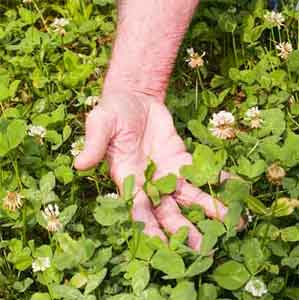
Clover, like shown above, is nutritional for deer.

Last year was a bad year for me with Purple-Top turnips," said a friend. "I planted after a  nice rain, but then the rains ended and the turnips weren't any good. They came up small and rather woody looking on the inside.

Anyone who plants a food plot is subject to all of the same problems as any farmer. Some years the weather turns against us.  Many people are getting ready to put in their fall crops, but the soil is hard, cracking, and lacks any moisture. A series of rains are needed, and we usually get some rain in August to jump-start our fall planting season."

One can only hope the weatherman cooperates. If not, some fields will be useless.

Two fields of mine will be ready to plant in early to late August, and we are hoping for a good rain between now and August 1, and some good rain storms after. That's what makes fall planting so tricky, and admittedly, this will be my third such planting. Two produced a lush crop and one could barely grow weeds.

Getting ready for fall food plots.

Many people like fall plantings or annual crops while others like some favorites when the soil conditions are conducive to growing a  crop of brassica such as Dwarf Essex Rape and Purple-Top turnips. Poor soil conditions can be built into good organic soil by planting buckwheat, oats and rye, and discing it into the ground for two or three years in a row.

"This is called 'green manure,'" an elderly farmer told me. "Two or three seasons of a green manure crop will usually build enough organic residue into your soil to produce a good high-protein crop such as alfalfa, clover or rape.

He did caution me to keep records of what is being planted every year. Keeping records of planting dates, crops planted, and what kind of a yield it produces is very important. He says a lack of records means that sportsmen have no way of knowing what they did right or did wrong.

He said the ideal plan is to provide for a year 'round food source for animals and birds. Proper planning means soil tests before anything is planted. Some soil is so poor that nothing but weeds will grow until the soil mineral content is built up.

Rain, and a good bit of it, is needed soon.

One should never consider a food plot as a replacement for baiting. One problem with food plots on large tracts of land is the land is heavily wooded in many cases, and it takes time to build a good soil content that is capable of growing high-protein crops. It just doesn't happen overnight.

Many  food plots that are planted to legumes (beans and peas) are literally destroyed by deer eating the crop as it begins to grow. A small food plot will be quickly annihilated by hungry deer.

One suggestion for sportsman is to mix other things that will grow in the fall and come back early in the spring. A mix of winter wheat offers good green food and cover in the fall, and it comes back up as soon as the snow melts. Rape and Purple-Top turnips, with some alfalfa and clover in other nearby fields, will produce good fall and early spring food for hungry deer.

If you see a man with a white beard standing outside about this time of year, and gazing skyward, it  probably means I'm either praying or scanning the skies for sign of rain clouds.

A bit of each may be needed late this summer and in the early fall. I know that my food plots are in bad need of a good drink, and the sooner it comes the better.

Posted via email from Dave Richey Outdoors

Friday, March 12, 2010

Spring has sprung and some gobblers are calling

A new metal roof was installed on our roof a few years ago. I was outside yesterday before last night's heavy rain, looking up at what little snow that remained, and watched the last of it come down.

Mind you, I understand fishing and hunting, but the mechanics of metal roofs isn't in my bag of tricks. I was standing there, looking up,  and heard a hen turkey nearby cut loose. She sounded as if she was scolding a gobbler that may have been pestering her.

There was a soft rumble, and about 10 pounds of snow landed out in front of my somewhat foolish head. Thankfully, the snow was loose and not loaded with ice as it was several days ago.

There is, I suspect, a short period of education about metal roofs as the thought dawned me. I'm not the sharpest knife in our drawer, and after scraping snow off my head a few times, pulling out my shirt-tail and shaking out the snow that snaked down my back, a light went off telling me that standing under the edge of the roof could be adangerous piece of business to my longtime health.

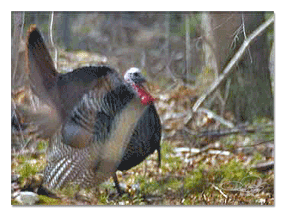
A flock of hens are kept in line by two gobblers.

I walked away from the roof, stood out of harm's way, and listened as a gobbler 100 yards away and out of sight, gobbled at the hen. It appeared on this bright, warm and sunny day, that he was trying his best to pull together a harem of hens.

It's probably still a bit too early for him to get very excited about breeding hens, but for me, spring fever has set in. I'm eager to go back outside after this is written, and soak up some of the warmth that has been missing from my life since early last fall.

It's about 50 degrees, and one must stretch their imagination a bit to say that 50 degrees is warm, but all things are relative. Fifty degrees is warm when compared to the teens and the 20s of a week ago.

It's a day for doing very little except trying to get accustomed to a bit of warmth in the air. I still had to shovel off the front deck to clean things up, but that is fine by me.

It is a trade-off. Warm weather makes snow slide off my roof. In places, it misses the deck and falls over the railing. In other places it lands with a dull thud on the deck, shakes the house, and just lays there making a mess of things. In open spot, there is a deck railing that was destroyed two weeks ago by falling ice and snow.

I could do, as I once did, and figure if the Good Lord wanted snow there, He put it there and could make it go away. It seems the going-away part gets lost in the translation of my thoughts, and it also means that it's time to go to work.

I'm no longer fond of snow.

Shoveling snow isn't one of my favorite winter chores, but it is a necessary evil. Last summer I reached the age of 70, and with the vision loss in one eye, meant crawling up on the roof to clean it off three or four times a year was foolhardy and stupid. I agreed with that.

My balance is bad on slanted surfaces, and even worse when those surfaces are snow and/or ice-covered. My depth perception is off a twitch or two, and my family could see me sliding off the roof. Even worse than falling to the deck would be to fall and spread-eagle myself on the deck railing. It would probably ruin not only a day but many days, and it seems an unnecessary risk I wouldn't take.

So ... the metal roof was installed. All I need to do now is get a hard hat to wear, start paying more attention when the roof snow starts to melt, and pay more attention to my roof than listening for turkeys gobbling.

Listening to gobbler music is more fun than almost anything.

Oops, there was another gobble. I must be learning, because I'd moved away from the edge of the roof in time to escape the last  little bit of wet snow.

I stood, listening to him rattle the woods and kept trying to spot him through the trees. I haven't seen a hen or gobbler today, but I'm about to start looking for birds.

Maybe a couple of birds will come to stand back in the woods and watch the foolish human as he listens to them. Those birds are smarter than me. They walk around, eat and I've yet to see one with a show shovel.

Whoever said turkeys are dumb have no clue. I know better.

Posted via email from Dave Richey Outdoors