Showing posts with label friends. Show all posts

Wednesday, June 27, 2012

Homer Circle: A Legend Among Legends

HOMER CIRCLE

I’ve been a member of the Outdoor Writer’s Association of American since 1968, a year after I began writing outdoor magazine articles for Sports Afield and other major outdoor magazines. I needed a member to sponsor me for OWAA membership, and since Homer Circle, angling editor of that magazine was one of my favorites, I asked if he’d do me that favor.

Uncle Homer, as he was known to millions of anglers, quickly agreed. A month or two later, I was accepted as a member. A year later I attended my first OWAA annual conference, which was held in Duluth, Minnesota.

I attended my first conference that year and met the great man in person. We chatted about fishing, and over many years we became good friends. That friendship continued until last Friday when Homer Circle passed away at the age of 97. Now, more than four decades later, I could Homer’s sponsorships as a major highlight in my life.
Meet My Friend, HOMER CIRCLE
photo courtesy Bass Research Foundation

He had fished in many places, and written many magazine articles, but I remember Homer for one specific talk we’d had at a later OWAA conference.

We had covered each other’s lives, and caught imaginary fish together, and he was a walking encyclopedia of fishing information…  and a joker. He was known for telling some pretty corny jokes, but then we settled into our conversation, and it was one most people never share with others, but one that often drifts my way.

Death was the topic that day, one that rarely is discussed, and over many years we happened to drift back to cover our tracks. I’ve had such chats with John Voelker (Robert Traver), Dale Earnheart, Homer Circle, and several others. Homer led the way on this day, and it soon became apparent that he had given this topic great thought.

“I’m getting old,” he said, “and will be in my early 80’s this years. I expect I’ll have some of the normal miseries that come with old age.”

“Like what,” I asked, thinking that he was as sharp as a carpet tack.
“Ah, the usual things like arthritis, forgetting things, aches and pains in my body … that sort of thing. The brain is still working fine.”

“Sounds to me like the normal process of growing older.”

“I guess, but I’ve got all my plans laid out. My old buddy Tom Mann, and I have chatted about the hereafter, and for me, I’ve decided to be cremated. It’s a big decision, and I wanted to make certain everything is set right and proper before the need arises.”

“How so,” I muttered half aloud, wondering how a living legend went about setting up plans for his own death and cremation.”

“Tom and I have worked out a plan. Once they toast me up nice and proper and turn me into five pounds of ashes, Tom is going to mix up some of that goo he uses to make plastic worms. He is in charge of tossing my ashes in and stirring them up.”

And that’s where his story got more than a little interesting.

“Tom will set up a special fishing lure campaign. It will be called the Uncle Homer Fishing Program, and once these special worms are all cooked up with my ashes mixed in, he will make a news release.

“It will be called Uncle Homer’s Bassin’ Worm, and they will be made in several colors. On the outside of the package will be a picture of me, a short write-up, and an invitation to Take Uncle Homer Bass Fishing Again by buying and using these special worms to catch bass.”

“Uh, yea, I guess that would work,” I said. “I’d bet lots of people would buy those Uncle Homer-dosed-up lures.”
And then, the topic slowed to a stop and we began talking about other things. The odd thing is over the years that followed, the topic never came up again.

That was his story, and now we must wait to see if such a magical plastic worm comes onto the market or whether Homer Circle, with his marvelous sense of humor, was just telling another story and using himself as the focal point.

So, until we meet again up yonder, I’m still on a high lope, and can only say: Go With God, Homer. Millions of your fans and I will miss you, and, if Tom Mann makes such a lure, I’ll buy one and take you bass fishing again.

HOMER CIRCLE (1915-2012)

Thursday, November 24, 2011

Happiness is a Thanksgiving Day deer hunt

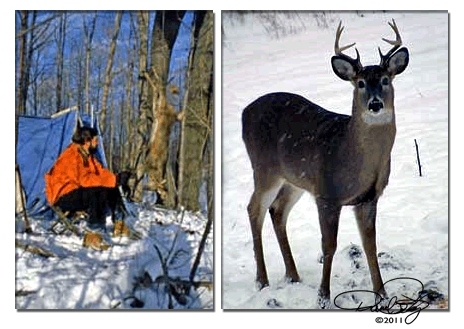
Some Thanksgiving Day hunters camp. The object of our attraction.


Thanksgiving Day is something special where we celebrate our good friends, the weather, and a fine chance to hunt with friends.

The weather was a bit blustery today, and it appears this nasty weather will continue into the weekend with possible snow. The first day of a winter storm arrived last week, and the whitetails moved well.

Tonight the deer didn't move as much as last night, but deer sense these upcoming weather changes and increased hunting activity. Weather can kill deer quite quickly if they don't have easy access to heavy cover and an available food supply.

Thanksgiving Day deer hunts with snow are better than without.


We are indeed fortunate that our whitetail herd has plenty of thick cover where they can take refuge against the cold and snow. We have low-lying swamps, huckleberry marshes, tag alder thickets and other areas of thick cedar cover. Many of these spots provide fair to excellent thermal cover against the cold, which is expected to arrive this weekend.

Deer in our area are never found very far from cover or food, but we still experience a certain amount of winter kill. Occasionally, it may be a big buck that succumbs to death after rutting hard, losing 25 percent of its body weight, and not being able to recover that lost weight before deep snow and cold weather sets in.

A few bucks are still chasing an occasional doe, but the rut has pretty much ended, and bucks are going to feed as often as possible. Storms such as last week are the early warning sign for post-rut bucks, and they are eating as often as possible to regain fat reserves to get them through the winter.

Much of any winter kill is attributed to late-born button-bucks and doe fawns that simply do not have the fat reserves needed to make it through a long winter, and I suspect we may have one of those this year. Some whitetail deer biologists feel that button-bucks die before a doe fawn for one very simple reason: button-bucks are more aggressive and always are the first to a feed station or bait site while doe fawns often were forced to forage more for food.

It doesn't make that much difference in this region because there is a continual food supply unlike what is found in many other more heavily hunted areas. I've seen years when button-bucks were dead from starvation by late November or early December when we get early and heavy snow storms. It's nature's way of making the strong stronger and the weaker ones die early of starvation or being pulled down by coyotes in the Lower Peninsula or wolves in the Upper.

Predation in late November and December increases with snow.


There is still a good bit of standing corn fields although my neighbor had his cut yesterday. Since baiting and winter feeding has returned, many people put out small amounts of food (two gallons) and deer with this handout and regular forage, can do fairly well providing we don't get severe ice storms.

Ice storms on top of deep snow is a major killer when combined with a low wind-chill factor and poor thermal cover. Last year, many corn fields were never cut and they provide fairly good winter cover.

Think about it. A big corn field offers continuous cover, an adequate winter food source, and snow melt and frost provide some moisture. An uncut corn field is a magnet for winter deer.

I didn't kill a buck today, but over the years I've managed to shoot a buck 45-50 percent of the time on this day. Driving deer is our major hunting method, and between my in-laws and neighbors, we have a number of people who will participate in a deer drive.

Just hunting on Thanksgiving Day is a treat for most hunters.


We prefer long and narrow strips of heavy cover, and two or three people will move slowly back and forth, with frequent pauses, to let our scent blow down to the deer. We try not to make much noise, and we have people stationed quietly and motionless at key spots along the edges and the downwind end. Drives are the most popular hunting method on Thanksgiving Day, and other than the first three days of the firearm season, Thanksgiving Day is the next best day of the hunting season.

Tonight wasn't a major hunting night except for family. We spent some time hunting, and more time indoors telling old deer stories. We do give thanks for our hunting land, the deer that live around here, and the opportunities we have to spend time afield with family and good friends.

For that, we are most grateful. Happy Thanksgiving!

Sunday, August 28, 2011

Love each day to its fullest and be happy


Walleye fishing was a joint adventure when we fished like this.


A number of people who have been near and dear to me may have taken life for granted at one time or another. Most of them, in the final days of their life, realized their mistake.

In other situations, some of us don't take things for granted, but life can still step up and blind-side us.

None of us are infallible, and none of us are invincible, no matter how strongly we believe it. Life can begin and end on a moment's notice.

My life has been blessed in many ways, and I took my vision for granted until I began losing it. Now, every day is a precious commodity to be wisely considered and lived with a fervent passion.
The problem is that none of us know how much time we have to live. My father, who died of old age, had prostate cancer for years. It didn't kill him but 94 years of life did.

Twin brother George lived life to its fullest. He did nearly everything in life he really wanted to, and learned on a Saturday that he had incurable cancer and he died the following Wednesday.

He didn't go to his Maker kicking and screaming. Hours before he passed away, he told me: "I have no regrets. I've lived a good life, and now I'm ready to go."

A good friend of mine died two days later in Oregon. He had made it through perhaps ten years in a wheelchair, and died after having lived a full life before a stroke kept him from walking.

Brother George had seven different kinds of cancer, and his pain levels were mild compared to that of others. Why does this happen? Why do so many people die of this disease in agonizing misery?

My aunt, who died years ago at the age of 84, was a very religious woman. She never smoked or drank, but battled cancer for many years. She attended church two or three times a week, and still the disease finally wore her down.

My first wife died at the age of 40 from cancer. She didn't visit the doctor as often as she should have, but no one should die such a painful and undignified death.

Three good friends died early. Two had families, but died of self-inflicted gun-shot wounds. Only one was physically ill, and he had inoperable cancer and chose his own time of death.

All of these people, with the exception of the two suicides, had cancer. It wreaked havoc on their bodies, and in the end, the pain and the debilitating effects of chemotherapy and radiation probably hastened their demise.

My good friend, Fred Houghton, a friend since childhood, died quietly. He loved to fish for walleyes and yellow perch on Saginaw Bay, was married the second time about four years ago, and kept himself in great shape.

Physical conditioning doesn't bar the way to cancer. It can come calling, as it did with him, and now my old friend is gone. I remember many fishing days from when we both went to Clio High School, and we spent many days over many years hunting ducks and geese.

He lived a good life, retired fairly early, and had everything going his way except for a cancer he didn't know he had until it required surgery. He was pronounced cancer-free, as he told me several months before his death, but the disease took him from us all too soon.

I attended a birthday party for a friend who just turned 90 years old. I've thought about him and another 90-year-old friend all day, remembering their contributions to my success as a photographer and writer.

I remember while duck hunting on Wigwam Bay near Standish in the late 1950s, when brother George and I were hunting from a sneak boat. My childhood buddy was hunting in the cattails, got cold and tried to climb into our boat.

It didn't work, and the boat finally sank beneath the waves as he tried to clamber aboard. I was the only one without waders (who knows why) but I went down with the ship, and got soaking wet and cold during an early November storm.

My buddy always had a much different version of that story, and we argued long and hard about the merits of his or my version. But the boat went down, and in a good-natured way, I always told him it was his fault. He blamed me, and we both had a good laugh about me getting wet.

That story, now that he is gone, was part of the glue that held us together as friends for over 60 years. As is so true with all of us, one day we will all have run our race.

Fred's race sadly ended early, and I shall cherish his memory and that of my brother and father. He was a good man, a kind and considerate friend, and cancer took him much too early.

I will miss my dear friends, family and relatives. They are gone, and those of us who remain, are stuck with memories. Enjoy them for memories are meant to be cherished, and leave the sadness behind where it belongs.

Saturday, December 25, 2010

A lazy Christmas for me


Some very nice bucks like this one are taken in late December.


There were thoughts of bow hunting this evening. They were very brief thoughts, and then the notion quickly passed.

I have hunted a good many Christmas days over the years, and there have been a few bucks taken. Not many though, and frankly, it's become more difficult of late to muster up much energy after chowing down on a big dinner.

Too much food makes me act a bit like an old bird dog curling up before the fire. I turn around in a circle two or three times, slump into an easy chair, and if the chatter isn't too loud and the mood suits me, I might study the insides of my eyelids for an hour or two.

Life is good when such luxuries exist in the afternoon.


Old dogs, especially those lean and long-legged pointers, hit the floor like a sack of old bones, and are about as noisy on a hardwood floor as anything could be. The dogs curl up, make little puppy-like sounds as they follow the heady scent of a grouse, pheasant or woodcock through their dreamy coverts.

The older I get, the more sense it makes to sleep off at least an hour after a big meal. It allows the grub to settle into all the nooks and crannies of my digestive system, but sadly, I didn't get a chance to doze today. Good chats about deer hunting got in the way.

Some basketball game was on, and two or three of the players acted as if they had eaten far too much before the game, but perhaps that was just my lazy attitude this afternoon. It would have been a decent bow-hunting day.

There was just enough people around to keep me indoors. A soft breeze may be fun to listen to but the deer do not move well in deep snow, and in my area, many deer have found the yarding areas already. Hunting such areas is not a wise decision this late in the season.

There is a lot of snow still on the ground, and somehow, heading out for an afternoon of bow hunting in too much deep  snow seemed pointless. It's not that I might not have seen a deer or two, perhaps even taken a shot, but it seemed a far wiser decision to spend time with my family.

Hunting in or near deer yarding areas puts too much pressure and stress on them.


I did kick back, put my feet up on a foot stool in the late afternoon, and remembered two or three past Christmases when I hunted. As I recall, all had snow on the ground and much colder temperatures. Our snow this year is deep, and where I live about 60 inches have fallen since it first arrived six weeks ago.

Years ago, the cold and snow made the deer move, and on one such day, a nice 8-point came walking by and offered an easy shot at 12 yards. The buck ran 45 yards, and fell with a two-bladed hole through his heart. It was an easy shot, and a wonderful Christmas gift.

Now, as a rule, hunting on holidays (especially Christmas) is something I seldom do. It doesn't bother me to hunt Thanksgiving Day or New Years Day, but I usually stay inside on Christmas.

My son-in-law was up early this morning, and as the sky began to lighten in the east, he spotted a 140-class buck bed down with a doe in an open field about 75 yards behind the house. He watched the buck for a half-hour, and as the light grew stronger, both deer got up and moved off into the pines. He felt that was his Christmas present from the deer in his hunting area

And, guess what for me? Missing out on hunting today didn't bother me one bit. I can still hunt through Jan. 1, and expect to do so. Some cold weather would certainly help, and then I'll hang up the bow for a month before starting to practice for next year's bow season and start dreaming about next year's spring turkey hunt.

Merry Christmas from my house and family to yours. May the best of the Christmas season bless and keep you, and while you're at it, say a prayer for the men and women in our Armed Forces, who make such Christmas events possible for us. God bless one and all.

Posted via email from Dave Richey Outdoors

Sunday, November 01, 2009

Choose Hunting Friends Wisely

A friend leased some hunting land years ago, put up some tree stands and ground blinds. As soon as people who knew him learned he had some decent property, his list of newest best friends grew overnight.
Two came to hunt from another part of the state where deer were few, and seeing any buck was great cause for celebration. He did all the work, built blinds, did the preseason scouting and they just came to shoot deer.
He assumed they were hunters. That assumption led him to believe they knew when and where to shoot a deer. That assumption was incorrect.

Running shots at bucks are risky

Each one hunted the first weekend with my buddy. At the end of two days, four deer -- two bucks and two does -- had been wounded and lost. They didn't have Game Trackers on their bows, and all four deer eventually fed the neighborhood coyotes.
They came the next weekend, and my friend presented each with a Game Tracker unit and helped them install it on their bow. You guessed it: they shot and lost four more deer because they wouldn't tie the string behind the broadhead so they could easily recover wounded animals.
"No more," he screamed. "You've lost eight deer in four days of hunting over a two-week period. Either learn when and where to shoot or don't bother to come back. And ... you won't hunt one more day here without using a Game Tracker."
The following weekend he explained the facts of life to them again. He told them that where they once hunted, and where they seldom saw a deer, was a thing of the past. If they were to hunt more than this one last day with him, they would know when and where to shoot deer.

Take only high-percentage shots.

He explained the necessity of taking only high percentage shots, and never taking low percentage opportunities. He told them the only shots they could take were standing broadside or standing quartering-away shots at 20 yards of less. There would be no exceptions to these new rules.
Any deer hit anywhere else would buy them a one-way ticket off his hunting land. And, he stressed, friends or not, he was done messing with them. They would do it right or they wouldn't do it at all.
He used a deer target and positioned it at all different angles. He offered them broadside, quartering-away, quartering-toward, dead-on and dead-away shots. He made them shoot countless arrows at the target when it was properly positioned, and they finally realized what they had been doing wrong.
They had been flinging arrows in hopes that a lucky hit would kill the deer. No doubt the first eight "lucky" hits killed the deer but none were recovered even after several hours of blood trailing long after dark.
They soon became excellent shots, and knowing which shots to take and when to take them came next. He had to teach them how and when to draw, and he didn't want them shooting at moving deer.
"A deer that is feeding is occupied," he said. "Watch that animal and any other nearby deer, and make your draw slow and noiselessly. Take careful aim at the heart-lung area, and don't shoot at anything else. Neck, frontal or rear shots are strictly forbidden. Quartering-away bow shots are the best of all."
He told them that patience is a virtue, especially when trying to arrow a deer. Wait until the deer offers you the ideal shot. Often deer will move around and never offer a shot, so he told them not to shoot. You be the judge of when to shoot: don't let the deer decide for you.

Quartering-away bow shots like this are the best bow shots of all.

"You control when you shoot," he preached. "Don't raise the bow until a deer turns sideways or offers a quartering-away shot. If the deer is within range, but other deer have their heads up and are looking around, wait.
"Don't be in a big rush to shoot. Cherish the moment. Make it last. Drag out the final outcome as long as possible. When you decide to shoot, make certain the buck is properly positioned within range. Check to make sure no other deer have their heads up or are looking in your direction.
"You'll know when the right moment comes. Pick a spot, come to full draw, aim at that precise spot, and make a smooth release. Don't lift your head up until the Game Tracker line starts going out after arrow impact."
That night both of them shot bucks. Nothing big, but bucks nonetheless. They waited, and true enough, when the right time arrived for a shot and the deer were perfectly positioned, they eased back to full draw and killed their bucks.

Everything in life must be learned, and proper hunting methods are no different. Do it right or don't do it.

Learning periods like this are very important. Beginning bow hunters have the urge to shoot something, and they invariably take shots that offer little hope of recovering the wounded animal.
Bow hunters must perfect the art of patience. Don't try to rush things. If and when the time is right to shoot, the deer will be motionless and looking away or at another deer, and you'll have plenty of time to shoot. Learn how to wait, and if a deer doesn't offer a good shot that day, let the animal go and try again the next day.
Shooting and wounding deer is stupid. Practice constantly, and know when to draw, how to aim and where to shoot. Refine each of these skills. They are not difficult to learn, and once hunters understand these principles, shooting a buck become much easier.