Showing posts with label bass. Show all posts

Friday, July 27, 2012

Max, the smallmouth bass

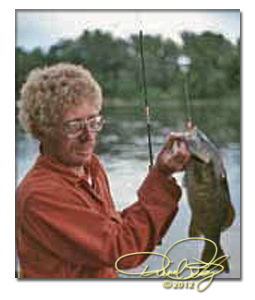
DRO-MaxBass-Dave
Me and Max years ago;  I no longer lip-lift or gill-lift fish to avoid possible injury
photo courtesy Dave Richey Outdoors ©2012
TUSCOLA, Mich. – Tucked down deep in a smooth run near a tangle of tree roots on the Cass River was a smallmouth bass – a special fish, because he was an old friend.

Mind you, when we first met, the fish was just a feisty one-pounder. He was all a’glitter with greenish-brown scales, a hint of red in his eye and the built-in temperament of a barroom bully with a belly full of bad brew.

He liked to scrap, and, like some fighters, he always seemed to lose. After two years of striking a variety of lures that hung from his lip when belly-lifted from the water, I named him Max, which seemed the proper name for a born fighter.

We had numerous dust-ups over a few years.


We were buddies years ago, and it’s been a long time since I thought about him.  This year’s bass opener brought him to mind, the same way we recall other old friends.

Max had a split in his dorsal fin, and was easily recognized/ He would come out and play each time I floated the Cass River, and once we finished our little fight, I would release him back to his favorite haunt. A little tired, perhaps, but losing a fight never seemed to bother the bronze-back – he’d be there, ready and eager to scrap each tune I  came into his life.

Max would come out to play whenever I canoed that section of river. I returned him each time he was landed, knowing he’d be there again whenever I returned. Few people ever fished that stretch of river because of all the uprooted trees across the river. One had to work hard to get through that section of river, but I always returned for another fight and he was most accommodating.

Max lived under a submerged root-wad in the Cass River


An old weathered maple had toppled into the river where he lived. The submerged root-wad offered him the security any fish needed to survive. The river poured over the roots, and the bass grabbed any lure, minnow or other morsel.

His only failing was that he was too easy. I never caught another smallie in that location, just my old buddy.
Three summers passed, and with two or three trips each summer on the river. I guess he was whipped by me a dozen times. Each time we tested the others’ mettle, and Max was getting bigger and more pugnacious.

I soon gave up lip-lifting him because I was concerned that such a method may break his mouth, and prevent him from eating, even though he could easily swim away. (See drawing.)

It was during the fourth season that I felt Max had become a solid four-pounder, but I couldn’t find him.. The canoe was eased into a small back-eddy of moving water, and I arched a cast into the new spot and the Beetle Spin came back without a strike.

The lure was changed, and several more casts were made without a strike.. He just wasn’t there.

It came time to analyze the situation. The area where Max had called home had changed during spring’s high water. Sand and silt had built up in the spot he’d called home, and either he left for another location or he had been caught and kept.

My spirits soared as the canoe was eased downstream 20 yards to another hole that was not sand and silted in. The canoe was tethered again to an overhanging tree limb. Ah, just right for an easy cast to his suspected new home.

The lure twinkled downstream with the current, bumping against some bottom debris, and stopped with a sudden jolt. A fish had sucker punched the lure, and I snapped the rod tip up to set the hook. A bundle of fishy dynamite known as a smallmouth bass, brook the river current with an explosive leap.

The bass cleared four feet of water in a head-to-tail jump


The split dorsal fin was easily seen, and Max now was red-eyed and wild as he surged downstream before skippering into the air again with another jump. He dove for bottom and tried to drive his way back into the submerged debris.

The six-pound monofilament hummed under the strain, and judging from his appearance, he had wintered well. He was a robust four pounds, and any stream smallie that size is a genuine trophy.

We settled into a bare-knuckle scrap. I’d give a bit; Max would take line and then falter slightly, and I’d press the advantage.

It was give-and-take as the battle seesawed for five minutes before Max began fining slowly, just out of reach. He was tired, and he knew he was whipped as I belly lifted him from the water.

He seemed to glare balefully as the hook was worried from his jaw. I held him for an instant, and briefly admired his sleek form. Then planted a smooch on his nose before lowering him into the river.

“Goodbye, old friend, and good luck,” I said as I gave him his freedom.  He whirled in the water, splashed a final salute with his tail and was gone.

I never saw Max again. I heard later that summer that a local kid had caught a five-pound smallie from the river. Was it Max? Who knows, but I never saw that bass with the split dorsal fin again.

I floated the river again a few years ago, and caught a two-pounder, which was belly-lifted while supported in the water and released. I named him Max, Jr.

Maybe I’ll try for him again this summer. He may like to come out and play.
-----
Read: Lip Grip is OUT! , an informative article from the O'fieldstream Journal about the dangers of the old-time Lip Grip. Plus, O'fieldstream provides solid advice to insure the bass you release has a far greater chance of surviving to live and fight again.

Wednesday, June 27, 2012

Homer Circle: A Legend Among Legends

HOMER CIRCLE

I’ve been a member of the Outdoor Writer’s Association of American since 1968, a year after I began writing outdoor magazine articles for Sports Afield and other major outdoor magazines. I needed a member to sponsor me for OWAA membership, and since Homer Circle, angling editor of that magazine was one of my favorites, I asked if he’d do me that favor.

Uncle Homer, as he was known to millions of anglers, quickly agreed. A month or two later, I was accepted as a member. A year later I attended my first OWAA annual conference, which was held in Duluth, Minnesota.

I attended my first conference that year and met the great man in person. We chatted about fishing, and over many years we became good friends. That friendship continued until last Friday when Homer Circle passed away at the age of 97. Now, more than four decades later, I could Homer’s sponsorships as a major highlight in my life.
Meet My Friend, HOMER CIRCLE
photo courtesy Bass Research Foundation

He had fished in many places, and written many magazine articles, but I remember Homer for one specific talk we’d had at a later OWAA conference.

We had covered each other’s lives, and caught imaginary fish together, and he was a walking encyclopedia of fishing information…  and a joker. He was known for telling some pretty corny jokes, but then we settled into our conversation, and it was one most people never share with others, but one that often drifts my way.

Death was the topic that day, one that rarely is discussed, and over many years we happened to drift back to cover our tracks. I’ve had such chats with John Voelker (Robert Traver), Dale Earnheart, Homer Circle, and several others. Homer led the way on this day, and it soon became apparent that he had given this topic great thought.

“I’m getting old,” he said, “and will be in my early 80’s this years. I expect I’ll have some of the normal miseries that come with old age.”

“Like what,” I asked, thinking that he was as sharp as a carpet tack.
“Ah, the usual things like arthritis, forgetting things, aches and pains in my body … that sort of thing. The brain is still working fine.”

“Sounds to me like the normal process of growing older.”

“I guess, but I’ve got all my plans laid out. My old buddy Tom Mann, and I have chatted about the hereafter, and for me, I’ve decided to be cremated. It’s a big decision, and I wanted to make certain everything is set right and proper before the need arises.”

“How so,” I muttered half aloud, wondering how a living legend went about setting up plans for his own death and cremation.”

“Tom and I have worked out a plan. Once they toast me up nice and proper and turn me into five pounds of ashes, Tom is going to mix up some of that goo he uses to make plastic worms. He is in charge of tossing my ashes in and stirring them up.”

And that’s where his story got more than a little interesting.

“Tom will set up a special fishing lure campaign. It will be called the Uncle Homer Fishing Program, and once these special worms are all cooked up with my ashes mixed in, he will make a news release.

“It will be called Uncle Homer’s Bassin’ Worm, and they will be made in several colors. On the outside of the package will be a picture of me, a short write-up, and an invitation to Take Uncle Homer Bass Fishing Again by buying and using these special worms to catch bass.”

“Uh, yea, I guess that would work,” I said. “I’d bet lots of people would buy those Uncle Homer-dosed-up lures.”
And then, the topic slowed to a stop and we began talking about other things. The odd thing is over the years that followed, the topic never came up again.

That was his story, and now we must wait to see if such a magical plastic worm comes onto the market or whether Homer Circle, with his marvelous sense of humor, was just telling another story and using himself as the focal point.

So, until we meet again up yonder, I’m still on a high lope, and can only say: Go With God, Homer. Millions of your fans and I will miss you, and, if Tom Mann makes such a lure, I’ll buy one and take you bass fishing again.

HOMER CIRCLE (1915-2012)

Thursday, July 29, 2010

Fish the hot, muggy nights


There is a certain excitement about fishing after dark that isn't experienced with other angling methods. Gone is our sense of vision, of seeing a strike, and our ears become what helps guide our casts.

It tells us how far away the fish is, gives us a sense of its size based on the commotion it makes, and we know that accurate casting based on what our ears tell us is all the help our body can deliver.

Night fishing for bass and walleyes is a great way to spend time on the water.

Years ago there were a number of lakes I'd prowl with a small row boat. The oars were evenly matched, which is always good, because it helps us row quietly and lets us ghost up on feeding fish. The same can be done with an electric motor  but rowing provides some exercise.

My bass lures came in two basic varieties, and both were top-water models. I liked a black Jitterbug because it was easily silhouetted against the night sky. A frog-colored Hula Popper was the other.

The boat would glide along smoothly with less noise than a stalking cat, and I'd ship the oars onto rubber pads (to muffle that noise), and I liked the Jitterbug best. It could be cast near docks, swimming rafts, lily pads and it was a very productive lure.

The lure would hit the water on a tight line, and I'd let it sit for a minute before taking one or two slow turns of the reel handle. That would make the lure gurgle along on the surface for a foot or so, and then another pause. If a largemouth bass didn't hit after the second pause, I retrieved it just fast enough for it to chuckle all the way back to the boat.

However, strikes often came after the first or second pause, and I wouldn't strike at the splash but once the fish was felt, and then, as they say in the great state of Texas, I'd cross their eyes on the hook-set.

Fish key locations hard.

Probing into likely areas was always fun because night fishing for bass is a bit problematic. One fishes all the normal hotspots, and hopefully one or two fish will produce the desired results. At times, a fish can be heard actively feeding, and an angler could concentrate on that fish until repeated casting put it down or the bass struct the gurgling lure.

Walleyes have always figured highly in my night-fishing escapades. I preferred to cast for them rather than troll because even though trolling allows an angler to cover more water faster, casting allow us to cover the water more thoroughly. An important point, to my way of thinking.

My casting lure of choice for these game fish was a Heddon River Runt Spook in the black-and-white shore minnow pattern. It came in floaters and sinkers, and the floaters usually produced the best action for me.

Walleyes, on drowned river mouth lakes that are connected to the Great Lakes, fed on alewives after dark along a drop-off, point, gravel or sand bar, shallow bar with nearby deep water, or around and over old slab docks left behind after the timbering era ended. Hitting  walleyes is a matter of good timing; missing them means bad timing.

Blind casting with a lure off points and other key locations can produce although night-time feeding walleyes often herd alewives up close to shore, and slash through the bait fish like a school of piranha. One can prospect by motoring to key spots and casting. If you fish a lake often enough to know where walleyes beat up on the alewives, go there to wait.

Sit and wait for feeding fish to move your way.

Sitting silently and waiting in an anchored boat makes sense. A dark quiet night, and the hot muggy air will wrap you up like a hot dish rag, and anglers wonder why they sit there feeding mosquitoes.

Suddenly, out in front, small splashes are heard as alewives leap from the water as walleyes move up from below and start shredding and gobbling the hapless bait fish. The trick is to be able to cast accurately without seeing. Turn on a light, and the walleye school will vanish.

Pitch the lure tight to shore, and reel just fast enough to bring out the lure action. The floating model River Runt will dive on a steady retrieve, and if the lure is close to a fish, it will hit and start tugging for bottom.

I always used 8-pound line, and I never broke off on a big walleye, and landed many fish to 12 pounds. Keep the line tight, keep the fish coming, net it, grab another rod rigged up with the same lure, and cast again. I've landed as many as three big walleyes before the school breaks up or moves off.

Most of the big fish are released. If the school holds 18-inch fish, allow the first hooked fish to lay in the bottom while you get another lure in the water.

Night fishing for bass and walleyes can produce great action but it's important to work them hard and fast while a school hangs around because once it moves on, the chances of finding it again are slim.

For me, fishing at night means dealing with the unexpected. Sometimes the fishing is great, and often it is poor. Do it often enough, and fish enough nights, and the good-bad times seem to average out.

And that is one of the nice things about after-dark fishing. It is great fun, and at times, will produce fast action.

Posted via email from Dave Richey Outdoors