Showing posts with label hearing. Show all posts

Saturday, January 28, 2012

Winter and the Five Senses

A wonderful day on the river can stroke your five senses
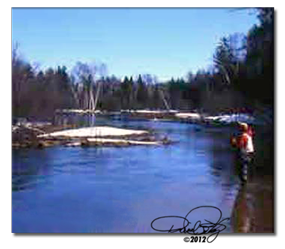
steelhead
Cultivating my five senses is easy during the winter months. Hearing, seeing, smelling, tasting and touching are what enables sportsmen to fully enjoy the entire package of being in the wintry outdoors.

Winter ice fishing turns me on but there isn't much safe ice yet except on a few small lakes and ponds, and so I have to forgo watching the lowering of my rod tip as a pug-nosed bluegill sucks my bait down. Though I may not see that sight right now, or at least until we get more ice, there are countless other things for me and you to watch.

Saw a mature bald eagle soaring on the thermals yesterday, gliding first one way and then another, and their vision doesn't miss a thing. Stand still next to a tree, and they will drift through the sky, but if they spot a human, they will head elsewhere.

Your five senses, when used on an outdoor trip, improves the outing

Well, that’s not always true. An adult bald eagle made his living on the ice of Green Lake at Interlochen several years ago. This bold eagle would swoop down and grab a perch off the ice with an angler only 20 yards away.

Seeing a cold lemon-colored sunrise with frost sparkles in the air and the glint of weak light off ice- or snow-coated branches provides a kaleidoscope of colors. Ever notice how much sharper your vision seems on a very cold day?

Hearing is another of the senses I rely heavily on because my vision is so poor. Put me in a room filled with people talking, and I can't hear a thing, but put me in a tree stand and I can hear a mouse or chipmunk run through dry leaves 50 yards away.

Many times I've heard black bear or deer approach from behind long before I saw them, and it offers ample time to slowly prepare for a shot. The clamor of Canada geese in flight can be heard for long distances, and like a fog horn in pea-soup fog, it is a lonely and haunting sound. It's a fact that a black bear can be as stealthy as a hunting house cat, but I've heard every bear I've shot long before I saw the animal.

Is there anything than smells better to an ardent hunter than the crisp and nose-tingling odor of wood smoke on the wind as we make our way home to the wood stove of a hunting camp. A close second is the smell of fresh-brewed coffee or the crackling sizzle of bacon frying. The latter tantalizes the ears and the nose and triggers the need to taste.

We're short right now of prowling skunks on the snow, but I can smell foxes at a good distance if downwind of the animal. I also can smell changes in the wind, and that is something some people question. The smell of an approaching rain is something many people have come to recognize, but the air takes on a faint change as a new snow storms begins to build nearby.

Think each day about what you can hear, see, smell, taste, & touch

Walk into a grouse cover near an abandoned apple orchard or a wild grape arbor, and if you are downwind from either one, the winter odor is unmistakable. That smell is one that ruffed grouse seek out, and I’ve seen a pair of grouse lately near a winter frozen grape arbor. The birds are still hustling their vittles based on their autumn feeding frenzies of tart grapes.

Taste is normally associated with eating but years ago before there was a problem of beaver fever there were a few springs and tiny inland ponds that had the sweetest tasting water in the world. To dip and sip from those ponds or springs now is not only foolhardy, but a bout of beaver fever would always be a constant reminder of how our world has changed over 50 years.

Taste is an enjoyable sensation, and for me, pan frying a brace of lovely and winter-caught bluegills or perch is something I gladly apply a stamp of approval to, and it’s something I do often during the winter. I gut and gill them, pan-fry them, and pick them up like an ear of corn and slowly strip the  flesh from the rib bones. It is a tempting treat that will be long remembered.

Touching the knobby bases of a buck's antlers at the tail end of the archery season always provides me with a sense of wonder. How and why can antlers turn out in so many different ways is just one part of God's handiwork. All antlers seem as individual as finger prints.

These five senses bring an added bonus to the day - Try it!

The magic of the outdoors is best enjoyed when outside. Learn to test your five senses on a daily basis. Listen hard for the jackhammer rattle of a pileated woodpecker; watch for the slow and cautious approach of a nice buck; listen to the clarion call of geese as they circle and look for open water or grain still laying in a farm field; taste the delightful flavor of a cup of good coffee on a bitter cold day on the ice as the cold and wind tries to suck the warmth from your body; and never forget to reverently touch the buck, bluegill, perch or walleye while fishing or the soft fur of a cottontail taken ahead of a brace of yodeling beagles trailing a hot bunny track.

Our five senses add a special bonus to every outdoor trip, and it becomes especially true on a winter day when bright sunlight glistens off newly fallen snow. These senses magnify the outdoor pleasures if we just remember to use them at every opportunity.

A proper winter day means more than fish or game. Drink deeply of your five senses, and we find a new thrill in giving our five senses a good workout.

Thursday, July 29, 2010

Fish the hot, muggy nights


There is a certain excitement about fishing after dark that isn't experienced with other angling methods. Gone is our sense of vision, of seeing a strike, and our ears become what helps guide our casts.

It tells us how far away the fish is, gives us a sense of its size based on the commotion it makes, and we know that accurate casting based on what our ears tell us is all the help our body can deliver.

Night fishing for bass and walleyes is a great way to spend time on the water.

Years ago there were a number of lakes I'd prowl with a small row boat. The oars were evenly matched, which is always good, because it helps us row quietly and lets us ghost up on feeding fish. The same can be done with an electric motor  but rowing provides some exercise.

My bass lures came in two basic varieties, and both were top-water models. I liked a black Jitterbug because it was easily silhouetted against the night sky. A frog-colored Hula Popper was the other.

The boat would glide along smoothly with less noise than a stalking cat, and I'd ship the oars onto rubber pads (to muffle that noise), and I liked the Jitterbug best. It could be cast near docks, swimming rafts, lily pads and it was a very productive lure.

The lure would hit the water on a tight line, and I'd let it sit for a minute before taking one or two slow turns of the reel handle. That would make the lure gurgle along on the surface for a foot or so, and then another pause. If a largemouth bass didn't hit after the second pause, I retrieved it just fast enough for it to chuckle all the way back to the boat.

However, strikes often came after the first or second pause, and I wouldn't strike at the splash but once the fish was felt, and then, as they say in the great state of Texas, I'd cross their eyes on the hook-set.

Fish key locations hard.

Probing into likely areas was always fun because night fishing for bass is a bit problematic. One fishes all the normal hotspots, and hopefully one or two fish will produce the desired results. At times, a fish can be heard actively feeding, and an angler could concentrate on that fish until repeated casting put it down or the bass struct the gurgling lure.

Walleyes have always figured highly in my night-fishing escapades. I preferred to cast for them rather than troll because even though trolling allows an angler to cover more water faster, casting allow us to cover the water more thoroughly. An important point, to my way of thinking.

My casting lure of choice for these game fish was a Heddon River Runt Spook in the black-and-white shore minnow pattern. It came in floaters and sinkers, and the floaters usually produced the best action for me.

Walleyes, on drowned river mouth lakes that are connected to the Great Lakes, fed on alewives after dark along a drop-off, point, gravel or sand bar, shallow bar with nearby deep water, or around and over old slab docks left behind after the timbering era ended. Hitting  walleyes is a matter of good timing; missing them means bad timing.

Blind casting with a lure off points and other key locations can produce although night-time feeding walleyes often herd alewives up close to shore, and slash through the bait fish like a school of piranha. One can prospect by motoring to key spots and casting. If you fish a lake often enough to know where walleyes beat up on the alewives, go there to wait.

Sit and wait for feeding fish to move your way.

Sitting silently and waiting in an anchored boat makes sense. A dark quiet night, and the hot muggy air will wrap you up like a hot dish rag, and anglers wonder why they sit there feeding mosquitoes.

Suddenly, out in front, small splashes are heard as alewives leap from the water as walleyes move up from below and start shredding and gobbling the hapless bait fish. The trick is to be able to cast accurately without seeing. Turn on a light, and the walleye school will vanish.

Pitch the lure tight to shore, and reel just fast enough to bring out the lure action. The floating model River Runt will dive on a steady retrieve, and if the lure is close to a fish, it will hit and start tugging for bottom.

I always used 8-pound line, and I never broke off on a big walleye, and landed many fish to 12 pounds. Keep the line tight, keep the fish coming, net it, grab another rod rigged up with the same lure, and cast again. I've landed as many as three big walleyes before the school breaks up or moves off.

Most of the big fish are released. If the school holds 18-inch fish, allow the first hooked fish to lay in the bottom while you get another lure in the water.

Night fishing for bass and walleyes can produce great action but it's important to work them hard and fast while a school hangs around because once it moves on, the chances of finding it again are slim.

For me, fishing at night means dealing with the unexpected. Sometimes the fishing is great, and often it is poor. Do it often enough, and fish enough nights, and the good-bad times seem to average out.

And that is one of the nice things about after-dark fishing. It is great fun, and at times, will produce fast action.

Posted via email from Dave Richey Outdoors