Showing posts with label lures. Show all posts

Friday, July 27, 2012

Max, the smallmouth bass

DRO-MaxBass-Dave
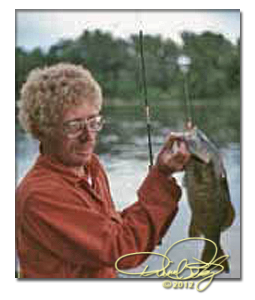
Me and Max years ago;  I no longer lip-lift or gill-lift fish to avoid possible injury
photo courtesy Dave Richey Outdoors ©2012
TUSCOLA, Mich. – Tucked down deep in a smooth run near a tangle of tree roots on the Cass River was a smallmouth bass – a special fish, because he was an old friend.

Mind you, when we first met, the fish was just a feisty one-pounder. He was all a’glitter with greenish-brown scales, a hint of red in his eye and the built-in temperament of a barroom bully with a belly full of bad brew.

He liked to scrap, and, like some fighters, he always seemed to lose. After two years of striking a variety of lures that hung from his lip when belly-lifted from the water, I named him Max, which seemed the proper name for a born fighter.

We had numerous dust-ups over a few years.


We were buddies years ago, and it’s been a long time since I thought about him.  This year’s bass opener brought him to mind, the same way we recall other old friends.

Max had a split in his dorsal fin, and was easily recognized/ He would come out and play each time I floated the Cass River, and once we finished our little fight, I would release him back to his favorite haunt. A little tired, perhaps, but losing a fight never seemed to bother the bronze-back – he’d be there, ready and eager to scrap each tune I  came into his life.

Max would come out to play whenever I canoed that section of river. I returned him each time he was landed, knowing he’d be there again whenever I returned. Few people ever fished that stretch of river because of all the uprooted trees across the river. One had to work hard to get through that section of river, but I always returned for another fight and he was most accommodating.

Max lived under a submerged root-wad in the Cass River


An old weathered maple had toppled into the river where he lived. The submerged root-wad offered him the security any fish needed to survive. The river poured over the roots, and the bass grabbed any lure, minnow or other morsel.

His only failing was that he was too easy. I never caught another smallie in that location, just my old buddy.
Three summers passed, and with two or three trips each summer on the river. I guess he was whipped by me a dozen times. Each time we tested the others’ mettle, and Max was getting bigger and more pugnacious.

I soon gave up lip-lifting him because I was concerned that such a method may break his mouth, and prevent him from eating, even though he could easily swim away. (See drawing.)

It was during the fourth season that I felt Max had become a solid four-pounder, but I couldn’t find him.. The canoe was eased into a small back-eddy of moving water, and I arched a cast into the new spot and the Beetle Spin came back without a strike.

The lure was changed, and several more casts were made without a strike.. He just wasn’t there.

It came time to analyze the situation. The area where Max had called home had changed during spring’s high water. Sand and silt had built up in the spot he’d called home, and either he left for another location or he had been caught and kept.

My spirits soared as the canoe was eased downstream 20 yards to another hole that was not sand and silted in. The canoe was tethered again to an overhanging tree limb. Ah, just right for an easy cast to his suspected new home.

The lure twinkled downstream with the current, bumping against some bottom debris, and stopped with a sudden jolt. A fish had sucker punched the lure, and I snapped the rod tip up to set the hook. A bundle of fishy dynamite known as a smallmouth bass, brook the river current with an explosive leap.

The bass cleared four feet of water in a head-to-tail jump


The split dorsal fin was easily seen, and Max now was red-eyed and wild as he surged downstream before skippering into the air again with another jump. He dove for bottom and tried to drive his way back into the submerged debris.

The six-pound monofilament hummed under the strain, and judging from his appearance, he had wintered well. He was a robust four pounds, and any stream smallie that size is a genuine trophy.

We settled into a bare-knuckle scrap. I’d give a bit; Max would take line and then falter slightly, and I’d press the advantage.

It was give-and-take as the battle seesawed for five minutes before Max began fining slowly, just out of reach. He was tired, and he knew he was whipped as I belly lifted him from the water.

He seemed to glare balefully as the hook was worried from his jaw. I held him for an instant, and briefly admired his sleek form. Then planted a smooch on his nose before lowering him into the river.

“Goodbye, old friend, and good luck,” I said as I gave him his freedom.  He whirled in the water, splashed a final salute with his tail and was gone.

I never saw Max again. I heard later that summer that a local kid had caught a five-pound smallie from the river. Was it Max? Who knows, but I never saw that bass with the split dorsal fin again.

I floated the river again a few years ago, and caught a two-pounder, which was belly-lifted while supported in the water and released. I named him Max, Jr.

Maybe I’ll try for him again this summer. He may like to come out and play.
-----
Read: Lip Grip is OUT! , an informative article from the O'fieldstream Journal about the dangers of the old-time Lip Grip. Plus, O'fieldstream provides solid advice to insure the bass you release has a far greater chance of surviving to live and fight again.

Thursday, June 23, 2011

Honey, Just A Few More Lures?


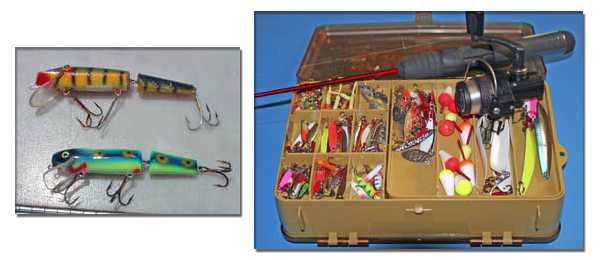
A pair of big muskie plugs plus a small tackle box of ice fishing lures.


There are more tackle boxes in my basement storeroom than any sane man needs. Every one is almost overflowing with fishing lures, so why should I need more?

It's a bit like fishing and hunting books. A man can never have too many good books, and I'm as guilty of buying more than I will probably ever need or read. Much the same is true with lures.

There are four huge tackle boxes filled just with muskie plugs, and a smaller one that holds some smaller muskie lures. I've got some 10-inch muskie plugs and great huge spinnerbaits in the big boxes. However, every year I see someone with a Bobbie or Eddie bait or a Suick or Brunner Runner in a hot new color.


I’m over-run with fishing lures and tackle boxes.


It doesn't mean that the other guy's oddly colored Suick hasn't worked for him. It could, and there I'd be without one painted in that strange color that every muskie fishermen needs to own. Sadly, seldom do they produce fish, but against all odds, they could produce if we just believe in them and cast them often enough.

There are two more beastly huge tackle boxes filled with nothing but salmon spoons and big salmon plugs. I own most colors of J-Plugs, Dardevles, Silver Streaks and other fishing spoons, but I keep bumping into newer sizes with different paint and  tape patterns that seem to beckon to me with eyes that look deep into mine and seem to whisper "Buy me and take me home!" It's the old siren song that we all know.

The eyes have it. I've been adding stick-on eyes to my lures for many years, and now more and more lures are being made with prominent and well-colored eyes. I think eyes make lures more appealing to fish but wonder if they really produce more often. One can only hope.

OK, how about Herring Dodgers? I have two smaller boxes filled with them. There are red ones, white and yellow ones, chrome plated, some home-painted a dull black color (don't laugh because they work ... sometimes), half silver-half bronze, chartreuse models, and some with dazzling tape and some without. There are small ones, large ones, those of normal size, and Hoochie Mamas. Got me some of them too.


Herring Dodgers and Hootchie Mamas. Gotta have ‘em.


If we're going after lake trout I tote 50-60 different sizes, shapes and colors of cowbells and perhaps half that many different colors of P-nuts. Another tackle box is filled with various trolling weights for inland trout lakes, and some stainless steel needles to sew shiners onto my hook.

One tackle box is loaded with more Dardevles in a variety of colors although my best pike fishing comes with two color combinations -- red with a white stripe and silver back or yellow with five red diamonds and a brass back. There are other pike spoons and plugs in the box, and although most of my largest pike come on the two colors noted above, there are another two dozen other patterns for when the pike get picky. And then there is a box of spinnerbaits in several sizes that work for muskies and pike.

Oh my, I nearly forgot. One box is filled with body baits like Rapalas, Rebels, FasTracs, Long A Bombers and other similar lures. They too are in an infinite variety of great colors, and some have never been in the water but boy, do they look pretty.

Still another box is filled with wood FlatFish and Tadpollys from my guiding days when I used the dropback method on the Manistee River below Tippy Dam or when trolling Manistee, Pentwater or Pere Marquette lakes for late-fall steelhead. The FlatFish come in two varieties: those with the tiny treble gang hooks or with two larger hooks. In that box are extra hook hangers for the small treble hooks that I prefer to use.


A hundred pounds of leadhead jigs in a dazzling display of colors.


I'm a big fan of vertical jigging on the Detroit, Kalamazoo, Saginaw and Tittabawassee rivers, and there are two heavy tackle boxes filled with jigs weighing from 1/8 to 1 ounce, depending on the depth of water and current speed at each location. Half of one box is filled with oodles of grub bodies and twister-tail bodies in a rainbow of colors.

And as nice as freshly painted jigs look in their trays, I often scrape the paint off and use just the bare lead and a lip-hooked minnow. It works!
One small box holds nothing but Mepps spinners, and another holds nothing but weight-forward spinners like Erie Dearies. Another small box is nothing special except it contains lures purchased when I was 15-17 years of age from the Wanigas Fly Shop near Saginaw, Michigan. The shop was owned by Art Neumann, a co-founder of Trout Unlimited, and it holds a bunch of small trout-size spoons that are rarely seen these days except in a lure collection.

Then there are some collectible Heddon lures that I normally leave home, and other scarce Creek Chub Pikie minnows, etc. And did I mention two small boxes of ice fishing lures?


C’mon, Honey, I just need a few more for this season.


So, do I really need several more lures? Probably not, but once one or two new lures wink at me and catch my eye, I go into a feeding frenzy until I have them. Many times, after such a cabin-fever purchase, I try the lure once and take an active dislike to its action, color or lack of fishing-catching abilities.

Someone once told me that fishing lures catch more anglers than fish, and I suspect that is quite true. However, gazing upon tray after tray of various colors and sizes of lures makes me feel good.

So, why not, honey? All I need is two or three more $20 muskie plugs. There are still a few Suick colors I don't have. You never know when one of these odd-ball color combinations will tempt a trophy muskie. And I’ll even put up storm windows when I can find the time.

Tuesday, March 09, 2010

Testing river waters for steelhead

Steelhead fishing has been my addictive passion for more than 55 years. Give me four or five days of snow-melt temperatures, and a forecast of two or more days of rain, and there's only one thought that goes through my head at this time of year.

It's time to think strongly about hitting the river. One might ask where. Pick any stream, but those larger rivers with a dam and a constant stream flow, may be the best of all. Some good bets this week and over the weekend could be on rivers such as the AuSable, Betsie, Boardman, Manistee, Muskegon and St. Joseph. Many anglers concentrate their efforts in those river stretches just below the dam.

Why? Easy answer. Any steelhead that entered the rivers last fall or earlier this winter have been in the river for varying lengths of time. A run-off caused by melting snow and rain will move downstream, and fish that are holding out in the lake waiting for the water to warm. A temperature rise of only a few degrees will send fish migrating upstream before their spring spawn.

My strategy would be to fish close to the dam. That's where many of the fish will eventually be, and it can be a wise decision. Or start at the dam and begin fishing the holes and runs and an angler works downstream. There is still a good bit of snow in the woods, which can make gaining access to good spots more difficult. It's also a good reason to start fishing near the day because the  angler traffic has made it a bit easier to get around.

Learn to see spawning male steelhead.

Make no mistake about it. The river water is still cold, and fish can be lethargic and slow to move to bait, fliesm plugs or spinners. The trick is to cove every inch of holding water from as many possible position as wading conditions will allow. Anglers must be aware of the possibility of shelf ice extending out from shore, and use caution when wading. Any appreciable run-off can raise the water level, and each spring holes and runs change as sand or other timber debris moves downstream. I've seen holes change completely during a heavy spring run-off.

One key piece of fishing advice is to fish deep, and allow bait, flies or lures to bounce downstream with the current. Make several casts from one location, and then move downstream a few steps and go through the same routine again. Work the holding water thoroughly, and if you aren't getting hung up on bottom debris occasionally, you are not fishing properly. Your offering must be bouncing downstream along the bottom, and at the same speed as the current.

When it comes to bait, spawnbags are the eternal favorite of most anglers. However, keep this in mind: when the water is extremely cold (33-35 degrees) was worms or wigglers occasionally out-produce the tradition spawnbag. Two major fishing methods work for bait, and can be equally successful.

Many fishermen prefer rolling the bait along bottom. Cast across the river and allow the bait to sink to bottom. Splitshot is preferred, and use just enough weight to allow it to bounce downstream. Use too much weight about a foot above the baited hook, and the bait remains in one place. Keep adjusting the weight until you achieve the proper drift. Too little weight will mean a faster drift but the bait will up off bottom, and drifting over the fish's head. Spring steelhead rarely move up in the water column to take bait.

Bobber fishing or rolling spawnbags along bottom?

The second way to effectively fish bait is to estimate the depth of the water being fished, and attach a bobber (float) above the baited hook. Use just enough weight about 10-12 inches above the hook so it causes the bobber to stand upright in the water. Cast as outlined above, and watch the bobber as it drifts downstream. If you are unfamiliar with the river, keep adjusting the bottom. If the bobber lays on its side and doesn't move, slide the bobber down toward  the hook. It can take several adjustments to make the drift carry the bait along and just off bottom.

Years ago, many of us use small leadhead jigs and we'd bait them with a wax worm or wiggler. We used small jigs weighing  1/16 or even 1/32-ounce, and the brightly colored jigs, when combined with bait, seemed to make your offering more appealing to fish.The key to success, with or without a tiny jig, is to use just enough weight to make the bobber stand upright in the water. Watch the bobber at all times, and if it goes down just a little bit, it could have picked up a leaf or twig or a fish could be mouthing the bait. The best indication of a strike is the swift disappearance as the bobber is sucked under the surface. Lift the rod tip with a bit of force, and set the hook.

Late winter streams often feature very clear water. Long 10-12-foot rods work well, and my favorite is four-pound monofilament. If the river rises suddenly with heavy run-off, bait anglers should consider using six or even eight-pound line. Sometimes a fish will clean you (take all the line on your spool), and just keep going. Again, trial, error and experience can be the best teacher on how heavy line can be used. Bait fishing is finesse fishing, and more fish are hooked on light line than heavy line.

Catching fresh-run steelhead on a fly is fun!

Heavier line can be used when fishing with plugs or spinners. Most spring steelhead strikes when using hardware are sure and hard. There's no mistaking a strike, and some fish slam the lure so hard that it can produce a sore wrist. The key thing when pitching plugs, spinners or spoons, is to stay alert. Even though the strike can be a wrist wrenching affair, if you are daydreaming and don't set the hook promptly, the fish can get away.

Great lures for this type of fishing would include plugs like the FlatFish, Tadpolly or Hotshot. I favor the Mepps Aglia spinner for smaller waters if I'm going to use this type of gear, and a No. 2, 3 or 4 Mepps Aglia spinner (without the bucktail) is a favorite.

Back me into a corner, and demand to know my favorite steelhead fishing method, and I'd readily say fly fishing. There's something magical about catch a mint-silver hen or a red-cheeked buck steelie on a fly. Sight fishing works well for those anglers who have enough brains to stay out of the water until the spot a fish. The best action takes place during the spawning period, and when fly fishing to bedded fish, re,e,ber that it's most important to fish for only the male fish. Often a soon-to-spawn steelhead may have three, four or five males line up behind her, and the pecking order places the biggest and most aggressive male closest to the hen.

Fly-fishing for steelhead is the best fun of all.

Watch the fish long enough to spot the silvery hen rolling up on her side. The male moves in close, and together the release a cloud of eggs and milt. The males usually are darker than the female, and they move around more as they chase other smaller fish away. Pick a fish, and fish directly to it. I spent 10 years guiding steelhead fishermen from 1967 through 1976, and pioneered fly fishing on Michigan's tributary streams for browns, salmon and steelhead. Many of the methods my twin brother George and I devised are still in use today.

One steelhead caught on a fly is just about as much fun as a person can have while wearing waders. Watch the weather, and fish at every opportunity. This warm-up has come early, and I've seen years when the run has ended by April 1. The only way to avoid disappoint is to fish as often as possible. Follow some of these tips, and this may be the year you'll hit the run just right. Good luck!

Posted via email from Dave Richey Outdoors