Showing posts with label caribou. Show all posts

Saturday, April 21, 2012

Caribou in the snow

Caribou moving in the snow
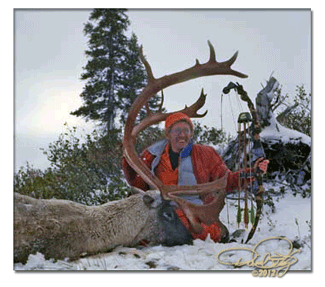
Caribou hunting, a most enjoyable outting into Quebec and a world away of eduction.
I'll never forget my first caribou bull with a bow, in that remote snow-covered land of northern Quebec.
photo Dave Richey ©2012
One of the most fascinating things about northern Quebec is how many lakes and rivers there are, and how few people inhabit the region. Some Montaignais Indians and a small group of Inuit from the sub-Arctic coast, and that's it for thousands of square miles of bush country.

My first Quebec-Labrador caribou hunt took place in 1971, and it left much to be desired. I saw two caribou, dropped the only bull with one shot, and that was it.

My next hunt was in 1974, and it was far different than my first outing. It was on the George River, north of Schefferville, Quebec, and near the Torngat Mountains. My Montaignais Indian guide, Peter Wanish, spoke very little pidgin English, a bit of French, but we managed to communicate with hand signals and a few spoken words.

Sign language proved useful between my guide and I

As all hunters can do, we learned to communicate.

We headed upstream through a series of rapids above Wedge Hills Lodge, and the sky was the color of soft putty. A cold wind blew out of the north, and we came to an area where the mighty river narrowed. My compound bow was ready, and we took up a position 10 feet uphill from the river bank as we kneeled behind some low-growing trees. We were near the edge of the tree-line, and our meager cover would have to do.

The weather turned colder, and then it began to snow. An hour later there was 12 inches of snow on the ground, and my Bushnell spotting scope was trained on the opposite shore a quarter-mile away. It wasn't needed.

Wanish muttered a guttural "Caribou!" and lifted his finger just off his lap and pointed. Caribou were filtering down toward the river, and stood there looking across. We didn't move, and the caribou stood at the waters edge, and more caribou began to pile up behind them.

The snow gained in intensity, and much of the time the animals could not be seen. And then, a stray gust of wind would flatten out the snow, and through the gauze-like haze of huge snow flakes, we would see them increasing in numbers on the opposite shore. I lifted my Bushnell  binoculars, and when next the snow cleared, there was a steady string of 'bou filtering down through the few trees off the hillside, and the animals just kept coming.

The heavy snow caused thousands of caribou to cross near us. This was an age-old migration route, and trails had been cut deep in the shorelines where generations of Quebec-Labrador caribou had traveled.

Now, after many such caribou hunts, and having taken 28 big ‘bou with double-shovels, I'm convinced that only three things make caribou move: Cold temperatures, heavy snow fall and because the animals decide they want to do so. Cold and snow is what hunters can depend on if the weather cooperates. Migration routs like this can be a hit or miss situation in this country in August and September, if the animals decide to move. It is with eagerness and a madly beating heart when they do.

His whispered warning: “Get ready, they’re coming. No move.”

We watched the animals pile up on the opposite side of the river, and then Wanish grunted again. "Caribou. In water. Swimming!"

He looked at me, signaled for me to get up on one knee and get ready for a close shot. He motioned me to stay behind our skimpy shoreline cover.

I looked across the river, and at least 1,000 caribou were in the river, swimming our way. Their heads were sweeping our shoreline with their eyes, their antlers interlocking with those of other bulls, and on they came as we remained motionless. We were where the animals wanted to go.

They would disappear from sight through the thick snow, and then we'd see them again. The current was swift but the caribou are strong swimmers, and their hollow hair serves as insulation and they seem to bob like a cork on the water.

I singled out a bull with a good rack and a white mane and waited

Once they were within 100 yards of us, they became more visible. A big white-main bull with long main beams, good mass on top, good bez tines and a double shovel was clearly the largest one that would make landfall near us. The other caribou was allowed to swim ashore and leave.

My attention remained riveted on that bull, and as he reached shallow water, he lurched slowly up near shore. Dozens of caribou had already walked past us, and we were just downwind of them. They climbed the hill behind us and disappeared.

The bull stepped ashore, stood on the sand and rocks, shook himself like a Labrador retriever shaking himself off after retrieving a duck, turned broadside to me, and I came to a full draw. Aiming, I had to wait for a cow to pass in front of me, and then made a smooth release on the bull.

The arrow disappeared behind the near-side front shoulder, and the animal stood there for several moments, and started up the hill and fell. From shot placement to death took less than five seconds. It didn't bother the other 'bou, and they just passed by his position on either side, and for 15 minutes it was a steady parade of caribou walking past.

That bull was mounted but his rack was never scored, and years later, I had another bull scored that was slightly smaller, and it made it into the Boone & Crockett record books. This animal is a bit wider, a bit higher, and has more scoreable points. One day I may have it mounted but it’s not necessary.

One day, that caribou may get scored but each time I look at him, all I see in my mind's eye is a huge snow fall, strong winds, and a massive caribou migration that put 2,000 to 3,000 animals past us that day. Believe it or now, hitting the caribou migration isn't easy.

Memories of other hunts may be come or go, or may be forgotten, but I'll never forget my first caribou bull with a bow, on a lonely northern Quebec rive shoreline, when the snow fell and the caribou just kept coming. It was a wilderness spectacle that  has stayed with me for many years, and will never go away.

Monday, November 21, 2011

Choose quality optics and spend more glassing for game

My vision is only fair at best but when snow covers the tag alders, and a deer stands motionless back in this heavy cover, they are tough for me to see.

Quality optics means everything to a deer hunter. The difference between good and bad optics is like the difference between a good apple and a worm-filled one.
I've always believed in good optics, and also believe that a person gets what they are willing to pay for.

I have a pair of Swarovski binoculars, and I'd rather leave home without my bow release (I do bow hunt during the firearm season at times) than without my binoculars. I know that I can still shoot with my fingers and make a killing shot, but I don't have the same confidence in my vision without quality glass around my neck.

Hunting skills are only as good as your quality optics.


A friend of mine returned to Michigan many years ago from a hunt in southern Alabama. He and his wife were hunting with some Louisiana Cajun shrimpers from the Mississippi River delta country, and they all carried big, heavy binoculars and scopes."What's up with the big binoculars," he asked the Cajun hunters. He was quickly given a demonstration of the difference between his and theirs. That difference was simply amazing.

"Our binoculars and rifle scopes give us another 15 minutes of quality hunting time once your binoculars no longer work," he said, once shooting time had ended. "Look yonder. Can you see that deer standing 10 yards inside the cover by that lightning-blasted pine stump?"

My buddy couldn't see the animal and could just barely make out the fuzzy image of the stump. The Cajun offered his Swarovski binoculars, and he quickly spotted the buck. That short demonstration offered him more light-gathering qualities, greater magnification and a much greater ability to see deeper into the thick brush. Had it still been legal to shoot, it would have been and easy shot on that buck.

Alabama is wrapped up in deer, but once they get into thick cover along the edge of the green fields, they are virtually invisible without great optics.

My ability to see deer enables me to better plan on how to hunt them. In some cases, it means allowing the bucks to come to you; in other situations, it may allow the hunter to make tactical changes in how he hunts that particular animal.

It goes without saying that seeing deer before they see you is of paramount importance. Quality optics can help make that happen. For instance, a few years ago I saw some snow fall off a tag alder.

I wondered why that happened. I studied the area from my stand, and it took several minutes but then the beam of one antler came into focus. I kept studying the spot, and the buck was bedded down inside the alders where he thought he was invisible.

He wasn't, and he came my way and offered an easy shot. I didn't shoot because I was waiting for a bigger buck. He didn't show up, and I proved to myself again why I shelled out a big chunk of money for those high-quality binoculars, rifle scopes and spotting scopes.

Quality binoculars are important. Without them, there is much you won't be able to see. Binoculars aren't only for deer hunting. I always carry a good pair of binocs when wild turkey hunting. If I catch a glimpse of a gobbler heading into the woods, my binoculars come up and I can keep and eye on the longbeard's travel direction. It's amazing just how easy it can be to pick a hole through the brush as the bird approaches the call.

Glassing for game is more of the same. My optics come in handy on elk and mule deer hunts, and I've separated a Boone and Crockett bull from grey-colored rocks in northern Quebec and elk from the alpine ridges of Arizona, Colorado, Idaho and New Mexico.

Spot the animals, and your hunt can be made much easier. It's possible to cover and help point the way to move to intercept a big bull without being winded in the prospect.

I do much of my spring turkey scouting from my car while driving back roads. Stop often, and glass open woodlots and pasture land. Often, about 10 a.m., gobblers head for their strut zones to impress the hens.

Find the birds, keep them in sight, and move carefully into position to call. Hunters will soon learn that quality optics can make hunting a little easier, and believe me, there are times when you'll need all the help you can find to be successful.

Saturday, November 19, 2011

Dreams of big Quebec char


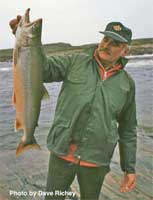
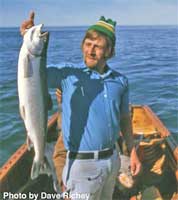
Doug Knight (left) and the author with a lightly colored & silvery char


The dream began sometime late last night. Many of my better dreams are remembered, and some are savored and occasionally one will haunt me for a day or two. This one was weird but true, as are most tales of fishing or hunting dreams from the far north.

My dreams often deal with fishing or hunting, and the odd thing is that many are dreams about things I’ve experienced sometime in the past. Last night’s dream was from 30 years ago and it's as vivid as it had just happened. It was my first trip where Arctic char were available, and it was a wonderful week spent catching the occasional Atlantic salmon, brook trout and char.

There was Ed Murphy from Sports Afield magazine, a man I'd sold many magazine articles to. He and the late Doug Knight, a freelance writer, and I were fishing at Bobby Snowball's camp at the mouth of Quebec's Tunulik River. Mind you, the Tunulik literally throws itself over a waterfall about 300 yards up-river from salt water, and the stream gradient from the falls to the salt is steep with haystacks of standing white water.

Getting to this area of Quebec’s Ungava Bay is a long plane ride.


I was accustomed to sight-fishing for visible fish, and Arctic char were our quarry. A few Atlantic salmon were mixed in with the char, and it took a heavy Dardevle to get down to the char holding at the edge of the fast water.

Bobby Snowball, an Inuit from Quebec's Ungava Bay region spoke fluent English as he met the plane. I'd made all the arrangements for the three of us on this trip, and he escorted me up the dock to the cabins where we would sleep. Children were throwing balls, and one of the balls bounced off a dead Inuit woman laying on the ground beside my tent.

"Uh, Bobby," I asked, trying not to be offensive but needing to know, "what's up with the dead woman?"

"Oh, that's my mother," he said. "She died three days ago and we're waiting for an airplane to come in and take her back to town. Hopefully, she will go out tomorrow."

The dead lady was a bit troubling but the feeling soon passed.

The fishing was nothing short of sensational. Large orange- or silvery-flanked fish held below the falls in the rushing white water, and by casting into the falling water and feeding six feet of slack line into the cast, the Dardevle was soon wobbling past their noses. Every tenth cast or so, a char would peel out of the group and savagely maul the lure.

These fish are uncommonly strong, and when swimming downstream, it took them 20 seconds to peel off line and make it to salt water. On the hook-up, I jumped from rock to rock (some as big as a single-story house), and to say I was leaping like a gazelle would be wrong. I felt more like a young hippo, and it had to have been a roller coaster ride for the fish.

Of all the char we caught only one jumped and it was at best a feeble attempt. However, the fight on 10-pound line was as tough a struggle as any angler could hope to experience. If a 12-pound char and a 15-pound Chinook salmon were tied tail to tail, the char would drag the salmon to its death. There is no quit in their fight, and once we reached salt water, the fish were still full of energy and every fight turned my wrist into a weary joint that became more weakened by the day.

The Inuit were a quiet but fun-loving group, and when we stopped for shore lunch, I soon learned to cook my own lunch of Arctic char. Bobby and his friends and neighbors would fare well at today's sushi bars. Their fish, wrapped in tin foil and tossed into the fire, weren't even warm in the middle when they began eating. We decided to cook our own fish, and the red flesh was delightful when cooked until done but not overcooked.

Fresh fish cooked on the rocky shoreline were tasty.


One fish would feed Knight, Murphy and me, and once we began cooking our own, we were soon hooked on the delicate flavor.

One sea-run brook trout was caught and I tangled with and landed two Atlantic salmon on spoons but they were returned. The Inuit told me they were legal to keep, but legal only for the Native People and not for visitors. For us, if one could be caught on a fly, it would have been a legal catch.

This particular trip was recalled in its entirety last night, and relayed here. The fishing was next-door to the best I've ever seen, and there is something haunting about watching herds of caribou migrate by within 50 yards while we battled fish with flanks the color of orange-pineapple ice cream.

And, best of all, the elderly dead lady vanished from outside my tent wall late the second day and I mentally wished her a safe journey, and I slept like a baby that night while dreaming of crimson-sided wilderness fish.

Saturday, October 09, 2010

Remembering some very long shots


Granted, we are already in the archery deer season, not the firearm season, but one recurring thought today kept running through my head like a needle stuck in the groove of an old 45 rpm record.

I got to thinking of several of my long shots. Long shots made with a rifle on caribou, mule deer and whitetails. The ones that tell you that you've practiced long-range shots, know how the rifle shoots, and are capable of taking and making such shots.

A long shot means different things to different hunters. There is a television show that specializes in one-shot long-range kills. I've watched it several times in the past, and they've stretched things out a bit farther that I have but not by much.

Long shots requires lots of practice and a flat-shooting rifle.

I own a Winchester pre-1964 Model 70 in .264 Winchester Magnum, and my first scope was a 1.5X8-power Weaver with fine crosshairs. It hit the market, if memory serves me right in 1961 and I bought the rifle and scope  in 1962 and 48 years later it still shoots better than I can hold it.

Back in those days I did all my own reloading of ammunition for that cartridge, and I played with loads ranging from a 77-grain Norma to a 165-grain Hornaday. Each bullet weight would shoot to the same point of impact, and my vision was keen back then, and I could shoot.

One year, while hunting the Sleeping Bear National Lakeshore sand dunes, I had my son David with me. I told him where to lay on the ice-cold dunes, and where to watch, and that if a buck came out on a deer drive, it would almost run over top of him.

I saw the buck come out, and just as straight as a string, it ran at my son. No shots, and it went past him on a dead run, only to stop between 325 and 350 yards away on another dune. I took a quick sitting position, locked in on that buck and sent a 140-grain airmail package at him. He dropped, and that was it.

Another year, while hunting near the Platte River, I spotted one of the biggest does I'd ever seen walking on the far bank of the river. It was an honest 300 yards away, and when the rifle cracked, the deer fell to a well-placed shot.

A few years ago, while hunting the Kaibab along the north rim of the Grand Canyon, a good mule deer jumped up at 200 yards, went bounding off in that bouncing pace of theirs. Contrary to popular belief, mule deer bucks don't always stop to look back. This one never stopped.

He ran down a valley that led down into a side canyon. My guide and I ran just below the rim on one side, and we could see the buck and a doe running across the opposite side of the canyon. The buck and doe finally stopped when they felt it was safe, and started browsing.

We worked as close as possible, and this was the last day of my hunt, and the guide said: "That buck is 400 yards away. Can you hit and kill him at that distance? We can't get any closer."

Could I hit that muley buck that far away?

I found a scrub tree nearby, scraped some pointed rocks away so I could sit down to hold the rifle steady. I cranked up that Swarovski  scope to 12 power, studied the buck with a firm rest. I settled the crosshair at the top of his back (my rifle was sighted in to be three inches high at 100 yards), took a deep breath and shot downhill at the buck. A second passed before I heard the bullet hit that mulie buck, and down he went. It was a clean one-shot kill.

The longest shot I ever made was in Canada's Northwest Territories a dozen years ago. I was hunting Central Canada Barren Ground caribou, and the guide and I found a huge herd of 3,000 to 4,000 animals down in a big mountainous bowl. There was no cover for a stalk.

My guide held my ankles as I leaned over a steep cliff, and I shot free-hand at the largest bull that was bedded down directly below us. I had no support, and it was a dumb thing to do but I hit that huge bull.

The caribou -- every last one of them -- left that bowl, climbed a ridge across from us, and finally my bull stopped. We went down into the bowl, made our way across it, and eventuall we ran out of cover, and the bull was staring at us.

"I say 500 yards," was my guess while the guide thought it was farther. I took a firm rest after laying my backpack on the last big boulder of the right height, and I studied that great stag. I'd be shooting into a stiff cross-wind at a wounded animal at least 500 yards away.

I know my rifle, know what it can do, and in my early 20s when the rifle was purchased, I shot crows at 300-350 yards in an open field. I felt this shot was possible, and with great patience, I leaned into the stock, settled the crosshairs for where I thought I should hold, and squeezed.

Two second later came the sound of the bullet hitting that bull and down he went. I paced off the distance, and I was doing my best to take 36-inch steps, and 535 steps later, I walked up to that great bull.

It was the longest shot of my life at a wounded animal.

That animal was big, but I had no clue just how big he was until we later put a tape measure to him. He wound up the first year in the No. 9 position in Boone & Crockett. The last I looked he was down to about 100, and I could care less. Whenever I look at him, and the great long rear points, I relive the long-range shot of my lifetime.

Long-range shooting isn't something I encourage. There is too much risk of missing, but if a hunter shoots often and knows his rifle and where it will hit at 250 yards, making a 350-400-yard shot is fairly simple. Luck was riding on my shoulder on the 535-yard shot even though I was confident I could make it.

In the end, people don't ask "Can you?" Instead, they ask "Did you?" And I did.

Posted via email from Dave Richey Outdoors