Saturday, October 23, 2010

Choosing when to shoot


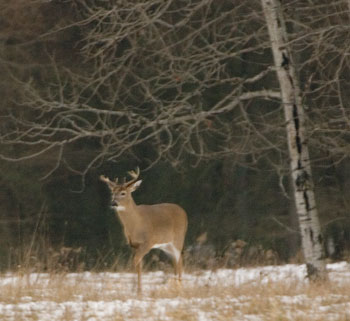
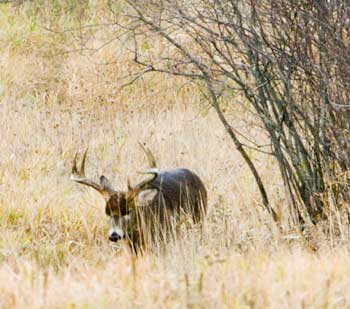
The buck was a nice animal. It was an adult 2 ½-year-old with eight points, the beginning of a really nice rack, and he wasn't rut-crazed just yet. This rack, while still thin and spindly, had an inside spread of 16 inches with good brow points.

The buck came to me early in the evening with plenty of shooting light, and stopped at 18 yards and stood at an extreme quartering-away angle for long minutes. It was a tempting shot possibility.

Questioning my desire

Did I want to shoot that buck? You know, I really can't answer that question. Undecided, I did as I often do, and came back to full draw. The tiny sight settled low behind the front shoulder, but the shot would have to be precise and I tweaked my aim a bit more.

It's too shallow of an angle, I thought. Too much margin for error. I held the bow back longer, waiting for him to turn. Finally the bow was eased down, and that buck stood in that position for several more minutes before shifting just a bit to turn directly away from me.

I continued to watch him, all the while asking myself: do you really want to shoot this buck? He is nice, but he isn't that nice. Another year of life would make this a really fine animal if someone else didn’t shoot him this fall.

The result was that my inner self talked me out of that buck until five minutes later when he turned slightly to watch another deer. I raised the bow, put the sight on the proper spot, and held it there.

That animal had no clue I was anywhere in the area. For me, much of my deer-hunting enjoyment comes from fooling the animals. I don’t need to kill a buck to have had a good hunt. But … this guy was very tempting.

If I touched the trigger of my release this would be a dead 8-point. I laid my index finger on the trigger, refined my aim just a tad and didn't pull it. Deep down, I really didn’t want to shoot this deer.

No shot and my reason

The bottom line was the buck wasn’t  exactly what I wanted. It was nice, to be sure, but not that nice. Besides, it was too early in the season for me to shoot a buck. I had time to wait for something bigger.

The buck walked away minutes later, completely unaware of how close he had come to getting shot. It was turned just right so I wasn't looking into its eye, and it wasn't fidgety. It was completely unaware of my predatory presence, and I let that buck walk.

Thirty minutes later an even larger 8-point walked down the wooded trail. This guy stood broadside, and offered an easy 17-yard shot. I aimed, held the red-dot on the vitals for 30 seconds and eased up.

Shoot or don’t shoot?

It was useless. I knew, in my heart, that I had no intention of shooting this animal that evening. He was a nice buck, but still didn't have quite what I wanted.

It occurred to me that I was having a problem identifying what it was I did want. Trophy hunting doesn't appeal to me, but after a half-century of deer hunting and shooting many basket-rack bucks and some other really nice animals, shooting what suits me is very important. Some years I don’t shoot a buck, and that is my choice. I certainly see enough antlered bucks within range that I can afford to be a bit picky with my choice.

I then agonized over trying to identify what it was I wanted, and got no further down that trail before I realized that a buck was important but it was nearly impossible to identify what unique requirements were needed to satisfy my need to release an arrow at the animal.

A lesson from the past

It reminded me of a conversation I'd had 30 years earlier with a magazine editor as we discussed his magazine’s photographic needs and how I could help him reach those goals. He said: "I don't know what I want but I'll recognize it when I see it."

My buck-shooting problem is similar to his photo problems: I probably won't recognize what it is I’m looking for until I see it, and then all of my motor skills will allow me to come to a full draw, aim with precision, and let loose a killing arrow providing the animal is within my clear and well defined shooting range.

Once, some years ago, I could see a big buck easing along the edge of an oak ridge. His position in relation to mine made it impossible to see both sides of this rack.

The buck sneaked along an overgrown fence line at the edge of the woods, and he would lift his head on occasion to look ahead for danger before lowering his head again. I heard a soft grunt coming from his direction, and I knew he was scent-trailing a hot doe.

He would come within easy bow range of my tree stand, but still the right side of his antlers wasn’t visible. He was a shooter, no doubt, if the right side was as good as the left.

Here he came, walking gently as if he was stepping through broken glass, and he paused 20 yards away. It was just a bit too far to shoot with unfailing accuracy. His head was down and out of sight, and he would be at 15 yards when both sides of his rack would be visible. Just wait, suck a bit more air, and settle down. The bottom line in all such cases is he will come closer or he won’t. Wishful thinking doesn’t work at placing deer at the preferred location.

He eventually took a few more steps toward me, stepped out into the open, and stood with his head held high. I looked at the right and left side as I drew and prepared to  aim. I soon let off on my draw, and knew I wouldn’t shoot this buck.

The right side had three antler tines broken off as a result of scrapping with another buck. His rack had been damaged in a fight, and if I am to shoot a big buck, his antlers will go on the wall. This old boy got a break on this day although another person shot him on the opening day of the firearm deer season.

A mental crossroads

My problem is I'm at some type of mental crossroads. I'm well past the point where I must shoot another buck. I'm not out looking for massive antlers although I'd probably shoot if that kind of buck walked in front of me at my preferred shooting range, but more than anything, outwitting a good buck seems much more of a personal challenge than just shooting a nice animal.

And I suspect it's one of the reasons I didn't shoot either one of those bucks. The time wasn't right, and whatever it is I seek in a whitetail buck, just wasn't there. Perhaps, both shots would have been too easy or perhaps the reason is the challenge just wasn't intense enough to excite me.

That said, the opportunity is out there. I know of a big 10-pointer in one of my hunting areas. Being there at the right time, with the right temperament, and within easy bow range might tempt me into taking a shot.

Will I take it? Only time will tell, because for me, the hunt is far more important than antler or skull size. Something must challenge my personal skills, and mental moods, and if the challenge isn’t there, neither is the need to shoot.

Many people think hunting is easy. This simply proves that for some people, hunting is far more difficult than one might believe.

Posted via email from Dave Richey Outdoors

Friday, October 22, 2010

Being still as a statue


There is an art to sitting still. It means much more than being  motionless; it means being still without making a sound.

This may sound easy but it is a very difficult thing to accomplish for more than 10 minutes. Everyone who bow hunts for deer will fidget at times, moving around, easing that tree stub that pokes you in the back, and swatting at pesky, whining mosquitoes.

Think about this: we watch a musical and our foot taps to the music. We think, and our fingers and head moves. The trick to sitting still this fall during deer seasons means learning how to remain motionless without noise.

To acquire such needed skills it’s important to start practice them.

Trust me, sitting still is an acquired and learned art. Not everyone can do it, and I can still set as motionless as a statue at the age of 71, but it’s nothing like I could do 20 years ago. Age brings with it knowledge for those willing to learn. It also brings more aches and pains that can affect our ability to remain still … if we let them.

The knowledge of how to do it is what allows me to tune out the sore back, hips, legs and other aches and pains in body parts that were injured years ago. Knowledge is the key to becoming a successful deer hunter, and sitting still is just one part of learning.

Many years ago my back was broken, and a  full-body cast was placed on me. Any body movement took time to accomplish, and the exaggeration movements were like waving a red flag at a bull.  It did make me learn to sit still because I couldn’t move my body easily. Accepting that part of this philosophy was the first step to my success, and once I got out of it, I continued to practice sitting still.

Don’t think that my sitting-still philosophy means going out and breaking your back. That’s no fun. If you can follow this anecdote and understand why I couldn’t move, it may  help.

Anyone who has ever studied deer should have learned at least two things very quickly. Stay downwind of the animals, and  learn how to sit still.

Sitting still is not easy. Those who think they are being motionless and silent are, in most cases, moving far too much and making some noise in the process. Camouflage clothing is not a cure-all for your hunting ills.  Deer spot movement regardless of whether you are wearing camo or blaze orange.

Learn how to relax mind and body.

Don’t move, eh? A person’s nose itches so they scratch it. A tree stub pokes them in the back, butt or legs, and they move to ease that discomfort. A leafy branch blocks their view so they move their head to see more clearly. A rustle in dry leaves sets their head in motion to see what created the sound. Boredom sets in, and bored people become twitchy. Their movements increase.

Many hunters think they are motionless, but in fact, all parts of their body is in motion. The slightest movement can catch the eye of a deer, and if that happens, the deer will stand in cover until they positively identify what they saw. If they determine it was caused by a human, that hunting spot may be blown for the rest of the hunting season.

How do you sit still while bow hunting? The best way to learn is to go where deer live and are plentiful, and sit in a tree or a ground blind. See how long it takes before a deer is spooked by hunter movement. Pay attention to what triggers fear in deer.

Many sportsmen seem to feel that only spooked deer snort. Lots of antsy deer simply disappear into heavy cover, and slowly leave the area silently. They are spooked but do not snort.

Study deer and see just how still one can be.

Watch deer, and see how often they stop and look around for possible danger. I've watched large numbers of deer over the years stand motionless for 30 minutes to an hour after detecting the presence of a hunter in a tree stand. Not a muscle, ear, eye tail or anything on that animal will move it they've  been alerted to a nearby human  presence.

One of my hunting friends used to hunt a funnel leading out of a cedar swamp and into open hardwoods. The swamp was full of water, and it was easy to tell where the deer were coming from. Those animals that were wet up to their belly were coming through the swamp. Those deer could be heard coming for 15 minutes as the water sloshed around as they moved. Those deer attracted the attention of any nearby hunter.

Once he spotted a buck moving slowly, and then it stopped. It was 200 yards away but there was an open spot he could see through with binoculars, and he knew there was a hunter upwind of the deer. That animal stood  in cold November water for over an hour without moving a muscle. Dusk came and went, and the buck still stood in the water, as motionless as an anchored statue.

This begs the obvious question: how do you sit still? Part of it comes through continual practice but much of it comes from a total state of mental relaxation. Put your mind at ease, forget about aches and pains, and that stiff little stub that continues to poke into your rump.

Relax your brain and your body will follow suit.

Tune everything out of your mind. The more you think about an ache or pain, the more it will bother you. Forget it! The same is true of mosquitoes early in the bow season; forget about them, and the less you move the less they will pester you.

Think good thoughts about good friends and loved ones. Remember past hunting friends who have traveled around their last turn in the trail. Leave business problems at the office, and dismiss them from your mind while hunting. The same goes for home or other business problems. If they could be solved, you’d have handled the problem earlier.

Mentally put all of your thought into something calming and pleasant. Put your mind in a relaxed state. Forget about missed phone calls or upcoming doctor appointments. Clear your mind of anything and everything, relax and simply do not think.

Purge your mind of all thoughts, and picture yourself somewhere lovely. A spot where you feel a gentle sense of peace and security, and where nothing can bother you.

One of my friends imagines himself on a calm pond where no wind is felt, no sound is heard, and he mentally lays his back against a boat seat, stares up at the drifting clouds overhead, and his breathing slows down. He keeps seeing that gentle pond in his mind's eye, and he sits quietly and without movement.

Time seems to pass slowly, and almost as if from a haze, out steps a calm buck. The animal is upwind, sniffing and looking for danger. Sensing none, he steps forward two or three more paces, and stops to check his surroundings once again.

Relaxed, the deer turns around and watches his back trail. As the deer looks away, the hunter slowly and quietly comes to full draw, aims and kills that animal. It really can be that simple.

It was easy because the hunter was totally relaxed. A laid-back sportsman, at peace with body and soul, doesn't move and never makes a sound while on stand.

It takes a great deal of practice but so do many other things in our lives. Sit in the woods during the summer months, and practice the art of sitting motionless and silent, but realize you do need practice.

Sitting still is all in your head.

And just remember: sitting still while not making a sound is all in your mind. Think it, practice it, and you’ll conquer the involuntary sense of being startled when a doe snorts  or when a buck starts slamming into a nearby small tree with his antlers.

Mind control is an amazing thing if you practice it. Use your mind, learn how to slowly ease your eyes toward an oncoming buck, and practice coming to full draw without making that herky-jerky movement that is bound to attract a deer’s attention.

Trust me, it works for me and for many people who have adopted these mind-over-matter things. It can be productive for anyone but it requires constant practice.

Just remember this: an object that doesn’t move, makes no noise and is positioned so he cannot be winded, poses no threat to a deer… at least not until it is too late for the animal to react.

Posted via email from Dave Richey Outdoors

Thursday, October 21, 2010

Getting the shot ... photos


Many people visit my blog on a daily basis, and those who do know that killing a deer isn't the most important part of my hunting life. There have been too many deer taken over 55 years to shoot a small buck.

So, I sit patiently in a ground blind, elevated coop or tree stand, and wait. I bought a new Canon digital camera with two lens, and it set me back more than $3,000, but I can now reach out and get some of the deer photos that were impossible to get in the past.

My new hobby is taking more and more deer photos. You see, besides getting more photos to illustrate my daily weblogs, it offers one more reason to study deer.

Shooting deer photos teaches hunters about whitetails.


I carry my bow while photographing, but have yet to see a shooter buck this year. So, if there are no good bucks around just yet, I'm content to kick back and watch the passing movements of these animals. Time, as it passes, is working in my favor.

So far, in three weeks, I've passed up three small bucks within easy bow range. I've seen an 8-pointer, a spike and a tiny 4-pointer. I saw one animal on the archery opener that looked like a nice buck with its head down, but it was back in the dark timber, and I just couldn't grow antlers on it. I think it was a buck but couldn't tell.

Taking photos is good practice for a bow hunter. A classic example. Last night I clicked off several shots of a nice 8-point, and he illustrated my blog. The breeze was in my face and he was upwind of me, and most photos came while the wind was blowing. It stopped blowing just as I clicked the last photo, and he heard the shutter noise. You can't shoot photos of deer without that happening on occasion. Often, the deer run off but sometimes the noise doesn't both them.

Even more important than shooting a deer, with bow or camera, is to enjoy the outing. Each day is counted as a blessing, and I look at the bright side of every day.

Yesterday we had 15 minutes of sunlight when the deer moved, and today was windy until sundown. I look for the unusual things, and that satisfies my artistic bent. A beautiful sunrise or sunset is perfect, but so too is the cobalt blue skies that often grace us during October. I enjoy framing deer with natural objects when photos are taken, but it's not always possible, but I seek unusual shots.

For all intents and purposes, our leaf drop has ended. Today's harsh wind and last night's short-lived rain, combined to encourage what few leaves that were left to drop. The woodlots are mostly open now, and seeing deer will become a bit easier from now on.

The chasing phase of the rut will kick off any day now.


The first stage of the rut -- the chasing phase, which is my favorite -- is due to kick off within the next week. With luck, spotting other bucks will be much easier providing they decide to move before sundown. My hint to most sportsmen is to hunt the mid-day hours whenever possible.

I study deer every day I'm in the field, and it's that constant study and attention to minute detail, that allow me to be a good deer hunter. Sure, I study wind currents, stay downwind of the deer, and put myself into situations where the deer will move my way.

These are things learned through constant deer studies. A tail flick can mean one thing to most people, but to me it means that animal may be getting ready to move out of the area. Reading a doe or buck's body language is important because it tells me what is going on around me.

Head-up and alert deer means something can be heard but not seen. Is it another deer or danger? The head-down approach of one buck to another means one of two things: the approaching buck is spoiling for a fight or he is intimidating a subordinate buck.

Posturing is a big part of a deer's world, and watching them pull their ears back and make the neck hairs rise is a cue that something nasty could happen. Often, other deer read these signs accurately, and bail out of the situation before it turns ugly.

Buck fights during the rut can be painful or deadly.


It's been my pleasure to have watched a knock-down, drag-out fight between two evenly matched bucks, and those who believe deer live in a Bambi-like world haven't spent any time in the field during the rut. A serious buck fight is nasty, and often one buck or the other is seriously injured and sometimes killed.

I've seen bucks gored, eyes poked out by an antler tine, skin ripped off their skull, animals with dangling ears or tine holes in their rump, and it's not pretty but it's part of the real world. And I count myself fortunate to be able to watch some of these whitetail pre-rut actions, and hopefully will be able to photograph a major buck fight this fall.

So, if you'll excuse me, I've rambled on long enough. It's time to see what images I've got, and those photos do nothing but whet my appetite for more deer-watching tomorrow.

Posted via email from Dave Richey Outdoors

Wednesday, October 20, 2010

Fritz, my best bird dog


Today marked the opener of the 2010 pheasant season, but it was one I missed. Many reasons kept me closer to home: one-eyed vision, no dog, far fewer birds now than back in the 1960’s, and a lack of enthusiasm for what once was my favorite field sport.

Now, although there are still some roosters, their numbers are far fewer than back in the 1950s and 1960s. In those halcyon days, pheasant numbers had peaked, and a short one-day hunt would feature more flying roosters in a day than a hunter could see now in a season of hunting.

For me, it was never about shooting a two-bird limit. It was about hunting the fallow and weed fields with a fine dog.  Here’s a few things about my old pointer and my hunts back in those good old days.

Fritz, the wonder dog


Know this: There is really something very special that happens to your heart when a solid-as-Sears pointer slams to a stop, lifts a front foot and his stubby tail goes rigid.

It has happened to me many times. I’d walk in behind a great point, shotgun at port arms, and look in front of and over the dog and 10 yards away.  Too many people study the ground  immediately in front of the dog, and a pointer may be on a bird that is 10-20 yards ahead or to either side. Fine field work is what endears good dogs to their owner.

The pleasures of owning a dog died with my German shorthair, Fritz, who came with some truly great bloodlines and who died many years ago at 13 years. There were many reasons why no others have entered my life, and losing my old friend was the major one.

Fritz, like many shorthairs, was bullheaded and stubborn to a fault. He could get into more trouble than a fox in a hen-house, and in his early years he always seemed to think he was hunting for himself. He didn’t realize that he was supposed to hunt with me in return for his daily meals and in respect to the man who brought him to the dance.

He was a terror, and his idea of hunting was to be a half-mile and three fallow fields ahead of me. I’d work him on a long leash, and he’d sit, heel and was steady to wing and shot as long as the rope snugged him in at about 25 yards. Take the lead off, and he attempted to set a new speed record for crossing three open fields and blindly busting one pheasant after another along the way.

Finally, in dark desperation after finally catching him after a long sprint, I loosened his collar a bit, stuck one of this dark front paws through the collar, and turned him loose. He made one step and fell over whining. I got him back up on three legs, and he tried to run off again. He was scolded and told to hunt close.

Training Fritz to hunt close was a humbling experience


An hour later, feeling sorry for the dog, I pulled his foot out and off he went like he had a booster rocket under his tail. Another long-winded sprint, and my feelings of regret changed to one of quickly solving this problem. The next two days he hunted on three legs, and wasn’t happy about it but he stayed within 25 yards of me.

He worked the cover slow and cast from side to side, and we put up hens and roosters over his rather lop-sided points, and I’d praise him in person and to anyone who would listen, and after two days of punishment, we went out the third day.

We had a heart-to-heart chat about his past behavior, and more recent ways of staying close, and he seemed to pay attention. It was a gamble worth taking, and I slipped his foot from his collar. He looked at me, and I patted his head and said “Hunt close,” and he began hunting into the wind. He cast back and forth, and never exceeded the 25-yard maximum. A soft “Whoa” was all I needed to steady him.

He locked onto point, and I whispered Whoa to him, lifted his tail, and he looked like a granite carving. I stepped in front, saying “Steady now,” and he was rock solid. The ringneck pheasant lifted into the air with a raucous cackle, his long-barred tail streaming out behind, and I swung with the bird and down he came.

Fritz, after his introduction to a lead rope and the foot through the collar, never gave me another problem. He hunted grouse, pheasant and woodcock, and his expertise was superb. He would hunt with the neighbor kids, and there were only two rules for the kids who hunted him: hunt safely and don’t shoot at low-flying birds.

Nothing a vet could do would cure mt beloved friend


The last year of his life was a painful ordeal. His hips were shot from arthritis, and he always begged me to take him. We’d hunt near home, and he would gimp through the fields. His hips were bad but it didn’t affect his hearing or nose.

He’d zero in on cackling roosters at dawn, and we’d move on them when shooting time opened. With luck we’d take two quick roosters, and then it was a slow and painful walk home for a dog in great pain. I’d pat his head, tell him I loved him, and he’d wag his bobbed tail enthusiastically.

Our last hunt came a few days later. A magazine deadline was met, I grabbed my shotgun, got Fritz up and headed out. He slowly worked two different birds, both were roosters, and my shooting was better than what I deserved. Fritz pointed, and I shot both birds, and then he sat down. I kneeled beside my old friend as he whined and shivered with pain, and I picked him up and carried him home, knowing that he’d  run has last bird through thick pheasant cover.

Two days later, in late-October as cold winds blew down from the north, Fritz left me and went to that area where  all good bird dogs go when they die. He was buried along a fencerow that often produced ringnecks, and on occasion I still think I hear him snuffling the scent of a big rooster 10 feet in front of his nose.

It isn’t, of course, but there is the memory of a bird dog that never knew the meaning of the word quit. He could out-hunt me in his prime, and it’s the biggest reason  I’ve never owned another hunting dog. A new bird dog could never measure up to Fritz, and it would be unfair to expect him to.

So I live with my many fond memories of Fritz. He was the finest bird  dog I’ve owned, and I’ll never see the likes of him again. There’s a place tucked back in the corner of my mind where lost friends and bird dogs go, and whenever the memory machine registers a hit on man or dog, I reach up, dust off a fond memory and trot it for the world to see.

You’ve just read one of my favorites.

Posted via email from Dave Richey Outdoors

Tuesday, October 19, 2010

Hunt deer where it’s tough going


The hunter who pays attention to deer movements will soon find some out-of-the-way spots where big bucks like to live. Some of those locations are easily hunted and some are not.

Some of these out-of-the-way spots are found while hunting other species. Some of the little hidey-holes where bucks lay up are so small that one wonders if there is enough cover for a cottontail rabbit to hide. Take it from me: it doesn't take much cover to hide a big buck.

Some of my friends hunt in widely scattered locations. Many also hunt upland game birds, cottontail rabbits and snowshoe hares, wild turkeys and other game. The observant ones find hard-to-hunt buck hideaways.

Be alert to possible buck hotspots.


A friend pays attention to such things, and as he walked past an overgrown apple orchard after a hard rain, he spotted a big deer track going over the fence. He'd tried to get his pointer to work into it in search of birds, and the dog refused to go.

Being a patient fellow, he walked his pooch around the orchard, and found the way the buck left that orchard. He also noticed that the tracks went past a big pine tree. Two days later he scaled that tree in the late afternoon after putting the dog in the truck kennel, and took his bow with him. Thirty minutes before the end of shooting time a buck that grossed 152 points jumped the fence and walked past his tree.

He's no stranger to seeing big bucks. This one passed the tree at 22 yards, and my friend shot him. It is still his largest buck, but it points out the reasons why hunters should be attentive to deer sign.

Another guy was out chasing ruffed grouse, and walked past a sumac patch on top of a hill with a good view in all directions. The man stopped to re-tie his boot laces, and was 20 feet from the sumac patch, and out busted a big buck. He was laying up there because most people walked past the sumac without stopping, thinking the cover was much too sparse to hold a deer.

Hunt cover that other sportsmen won’t.


A friend tells the story of hunting ringneck pheasants near Montrose, Michigan, years ago. He was hunting along the edge of the Flint River. A rooster flushed wild at 30 yards ahead of the dog, and he swung and winged the bird.

It caught its balance in mid-air, cocked its wings and soared part-way across the river and landed on a tiny island of marsh grass and a few stunted trees. He checked the water depth, and it was only shin deep, and he crossed. His dog caught some scent, pointed, and as he approached the dog, a big buck jumped up and bolted across the river. He watched the buck splash across, crisscrossed the tiny island, and kicked up the pheasant and downed the bird.

He kept that oddball sighting in mind, and once the firearm season opened, he and friend waded across to the island. One went to the upstream end while the other walked through, and sure enough, they jumped the buck and killed it with one shot.

Talk to some farmers, and they all have tales of bucks laying up in tall weeds along their line fences or next to a barn. They push deer out of swampy little tangles perhaps 20 feet across. These bucks hold in such tiny bits of cover because few people think to look there.

The thing is that bow hunters can dare to be different. They don't have to follow the doctrine everyone throws at them. They can walk through an area so small that it takes less than 10 seconds to get through, and often they find the home of a big trophy buck that no one knows about.

If it’s tough going, and hard to walk through, it may be just right for deer.


Cattail marshes hold bucks, and I remember a nice buck that a friend shot as it came out of the cattails. He knew that buck was there, and when he shot it, the buck wheeled and dove back into the cattails and died there.

Don't stick with the status quo. Check things out. Know where the tiny patches of heavy cover are in your hunting area, look for those little nooks and crannies, and try to figure where a buck will come from or go to when leaving. That information is knowledge you can put to good use this fall.

Try it this year. It may produce a nice buck that you've probably overlooked for years.

Posted via email from Dave Richey Outdoors

Monday, October 18, 2010

Cause & Effect


This is about a topic first learned in school. It may not have been devised with whitetail deer in mind, but it certainly does apply.

It states that for every action, there is an opposite or opposing reaction. We've all heard this before, and it applies in many and varied ways to deer hunting.

Take an ill-advised shot at a buck or doe and miss, and the action of shooting causes an opposing reaction. The deer runs off, alarmed but unharmed. It also snorts and alerts other deer in the area to hunter presence.

There’s no mistaking a bad reaction to an unwise human decision.


This action-reaction plays out on a daily basis in the deer woods. Set up in the wrong place, place yourself upwind of deer, and once they catch your scent, off they go without a bow-shot being taken.

The same action-reaction could be called cause-and-effect. Your ill-advised hunting actions cause you to take a shot and miss, and the deer runs off, allowing for its escape.

Many bow hunters fail to heed the good advice of credible hunters. They seem to think they are invisible because they are dressed in camo. Well-worn camo can be ruined by wearing clothing washed in detergent with whitening agents. The deer spook from whitened clothing that just doesn't look natural.

Thousands of hunters believe they are quiet and motionless. They should have a buddy sit 50 yards away with a video camera to tape all the movements that are made.

We've all seen television hunting shows where the cameraman tapes the host pointing and loudly whispering "it’s a buck" four or five times in a row. These are called "cutaways," and are usually taken long after or before the buck has walked into range and caught an arrow through the heart and lungs.

Be cautious about what you think is learned from a TV hunting show.


Hunters who try such nonsense merely are seen, heard or both by the deer, and the animals run off snorting. Cause and effect or action and reaction.

Television hunting shows are expensive to produce, and the competition for advertising dollars is fierce as people compete for money to do next year’s shows. If they make noise at the wrong time, and the buck vamooses, the chance of getting future ad dollars from that company go down the tube. Again, a classic case of action and reaction.

Bow hunters are well advised to consider cause and effect, action and reaction, every time they go hunting. For every possible action, there is a possible reaction, and they may be damaging to your body or harmful to your hunting efforts.

Hang stands early. Insure that everything is safe. Wear a safety harness. Learn how to sit still and don't make noise. There are countless things to think about, but consider every action far in advance and think about any possible reactions.

Give live deer the credit they deserve.


Deer live in the fields, swamps and woods every day. We live there a few hours a day or a week. Give deer a great amount of credit for being instinctive, savvy and alert to changes within their home range.

One way to consider your actions while deer hunting is to consider your bed. If the head of your bed faces west, and you prepare to retire for the night and find the head of the bed facing east, you will quickly notice it. Deer always notice changes in their world.

Consider every change made while hunting, and give serious consideration to the reactions. This is such a basic concept that any bow hunter should learn it early in their hunting career. Alas, too many don’t learn it until it’s too late.

Just remember: for ever action, there is an opposite reaction. Anything you do can and will backfire if you don't think the problem through long before committing to it.

Conquer this basic thought, engage the brain before the body, think things through, and it's very possible that your hunting success ratio with climb.

Posted via email from Dave Richey Outdoors

Sunday, October 17, 2010

Find hidden travel trails


Reading deer sign is something that has always made sense to me. It gives me more knowledge of the animals, where they feed, where they travel, and in the end, it's this knowledge that makes hunters more successful.

I'm so mindful of a big buck from several years ago. I'd seen him on two or three occasions but didn't know where he lived. It took me a week of reading October deer sign to pin down his whereabouts.

The area was in fairly heavy cover. I knew the buck had an exceptional 8-point spread, and reasoned he would be working over some big trees to strengthen his neck muscles before the rut began.

Big bucks make big rubs on trees.
I'd moved slowly through the heavy cover without seeing much buck sign except for a few small rubs on some tag alders. I came out the other side of the tag alders, and entered a 25-yard by 25-yard stand of cedars and pines. That is when I worked out this whitetail puzzle.

One cedar was scarred by a pre-rutting buck. Lower limbs were broken off, and the trunk was scrubbed hard from a foot above ground to four feet off the ground. Mind you, I couldn't circle my hands around the tree trunk. This big rub was truly made by a big buck.

Checking around was a faint trail that ran toward another cedar, and it too was rubbed by the same buck. Three trees within 25 yards formed a minor rub line, and the trail exited the cover I had just walked through. This buck was leaving the tag alder to rub the cedar and pine trees, and most likely, the deer was moving out just before dark.

A nearby tree was perfect for a stand. There would be no clattering and banging required to erect a tree stand here. I'd attached a rope to my bow and my belt loop, lay the bow down flat, climbed 10 feet up the tree and stand on too thick parallel limbs that grew close together. Another limb came out at waist level, and I could stand on two limbs and lean back against the other one.

A precarious perch but good enough for one night.

Two nights later as the sun was sinking into the western sky I caught the glint of sunlight hitting brownish-white antlers. The buck went to the first tree, thrashed it hard for several minutes, looked around, and went to the second tree and repeated the process. Fifteen minutes later it arrived at the tree just 15 yards upwind of me.

It took a minute for the buck to rake the tree to a pile of fuzzy bark curlings at the base. He nosed his handiwork, lifted his head, moved around the tree to work on the opposite side. The deer was quartering-away at 15 yards, and it was an easy shot.

I don’t advise anyone to stand on cedar or pine boughs and lean against another one, and I don't suggest you follow my lead. However, I knew the limbs would support me for one evening of hunting. I was certain it would lead to a shot at the big buck on the first night, and it did.

That buck was a creature of habit, and such habits can put a deer in trouble. Once the buck stopped rubbing and visiting the nearby scrape, this idea wouldn't have worked. My adventure with that big buck was timed perfectly, and that is where knowing something about the rutting activity comes in handy. From the end of October through mid-November, that tree might not have paid off as the buck hazed does through open fields and thick cover.

Hunting one buck is an adventure, a matter of going after them one on one. It means knowing as much about the area as is possible, and being able to translate that knowledge into an action plan.

There are countless other ways of reading deer sign that will pay off in a big way, and we'll cover some other examples in the weeks to come. The important thing to realize is that studying deer sign is as much a part of deer hunting as carrying a bow into the woods.

Be alert to deer sign, read what it says, and you'll be on your way to becoming a better deer hunter.

Posted via email from Dave Richey Outdoors