
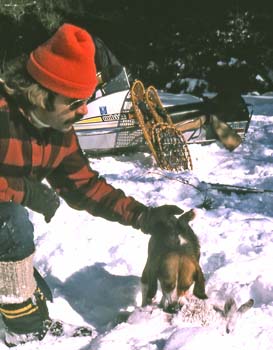
This beagle just retrieved a snowshoe hare for the hunter.
Hunting snowshoe hares is a hoot. What's not to like about it?
Well, we get to stand in thick cedars, Christmas tree plantations, juniper thickets or pines, and try to guess when and where the satchel-footed ghost hare will appear next.
All we need is some snow, We got another seven or eight inches of snow between yesterday afternoon and last night. We have more than enough snow for hunting the white hares. Sometimes, as has been true for several years, hares are conspicuous by their absense. They can be hard to find.
We can have snow fall off tree boughs and find its way down our neck, and when the snow gets deep, we get to wander around in this heavy cover and hope we don't fall down. Going down is easy, but climbing back to a vertical position can be difficult in deep powdery snow.
Hares are no longer plentiful in the northern Lower Peninsula.
There is the added bonus of listening to a some deep-throated beagles in full cry as they weave their way through heavy cover. Sometimes the hounds are sight trailing the swamp ghost, but most often the dogs are 100 yards or farther behind the hare.
Mind you, I've stalked snowshoe hared and run them with hounds, and there is one major requirement. I've even hunted them with a bow. All one needs a fresh hare track to follow.
Those tracks seem to be getting far less common in many areas. Twenty to 25 years ago, all we had to do was look for the thickest cover in northern counties and there would be tracks everywhere.
That's not so anymore. Some of my buddies have gone looking for hare tracks in all the right places, and if they find tracks, most of them are cottontails. It's a proven fact that cottontails are moving farther north every year.
We can blame the hare scarcity on new housing developments. We can blame it on clearing some land and planting bushes and shrubs around our house. There is predation by bobcats, coyotes, fox, hawks, and owls. People and our inroads into what once was ideal hare habitat must assume some blame, and the other cause is snowies are cyclic by nature.
Folks, if snowshoe hares are cyclic, then their cycle is close to hitting rock bottom, especially in the northern Lower Peninsula. There are still more hares in the U.P., but their numbers are slowly dropping as well.
Hares are cyclic, and heavily preyed upon by avian and land predators.
Yeah, I know,air and land predators take some of the the white animals but there is nothing sportsmen can do about that. The Fish & Wildlife Service has protected birds of prey for many years, and those who kill one of these birds and get caught, are severely punished.
So, what's a hare hunter to do? Well, they can easily find cottontail rabbits in most Lower Peninsula areas. Or ... they can do as some guys I know do.
They go hunting snowshoe hares. They scout for habitat that still holds some hares and go hunting. Unlike conventional wisdom dictates, they either go for the enjoyment of listening to hound music and leave the firearms home or they forget to load the shotgun.
They give the running hares a free pass. They give the dogs a good workout as the hare runs an egg-shaped oval before returning to the area where he was initially jumped. The hunters may let the white hare make two or three circles, catch up the hounds, and head for another location.
This way they have the thrill of listening to bawls, bellers, chattering, chops, howls, yelps and other words used to describe the voice of each individual hound.
Hunt the hares but limit the kill to keep hound interest high.
You see, hunting snowshoe hares is a good bit like hunting spring wild turkeys. The kill of a gobbler or a hare is anticlimactic. It's the sounds of the hunt, the dogs trailing the scent in full cry or the gobbler roaring back at the hen-talking hunter. Seeing the hare or a turkey is a major part of the hunt, and since hares are getting to the point of low numbers, taking the pooch out for a run may have to be enough fun.
Sure, the hound owner wants to kill the occasional hare to keep his dogs interest at a high level, but it doesn't have to happen on every hunt. If turkey hunters killed every turkey they saw, there soon wouldn't be any gobblers left to hunt or the birds would stop coming to the call.
It's much the same way with snowshoe hares. Maybe we'll just have to be content to listen to hound music. On many days, standing knee-deep in snow in a cedar swamp and drinking in the sounds of hounds on a hot track, has to be good enough.


