Showing posts with label flies. Show all posts

Sunday, March 13, 2011

The saga of Frenchman's Pond

John Voelker (Robert Traver) signs a copy of one of his trout fishing books.

Snow-covered trees and gusty breezes greeted the dawn, and sporadic flakes fell as the John Deere snow blower threw the snow into a nearby field. Cleaning my driveway of five inches of mushy snow gave me nearly three hours of uninterrupted time to think.

One thought came to mind. It was from a 1984 trip to the Upper Peninsula to fish the legendary Frenchman's Pond with famous author John Voelker who wrote under the pseudonym of Robert Traver. I was eager to get to the pond, and had realized a personal dream that had been gnawing at me for many years.

Fishing "Frenchman's Pond"; with Johnny Voelker was a longtime wish.

"The more you want something, the more you anticipate it," Voelker said, sensing my impatience as we stopped to pick blueberries, chantrelle mushrooms and black raspberries. "That means Frenchman's Pond will be a bigger thrill once we finally get there."

We eventually slid down what passes for a trail to his secluded cabin on the pond. The two-track leading into it was a mix of boulders, corduroy trails, rocks and sand. His battered old fish car was bouncing from side to side as he tried to keep it between the trees.

Frenchman's Pond glittered like a rare jewel amid a sea of cedar and spruce. Here and there a brook trout rose to an unseen insect, and my dream of visiting this hallowed water had become a reality.

It was like coming home after a long absence. I was speechless with the pond's beauty, and Voelker wisely stood by quietly and allowed me to absorb the rare mood of the moment without interruption.

Frenchman's Pond was Voelker's private retreat. He had owned it for over 30 years when I first visited it over 25 years ago. It's location is a closely-guarded secret, and the brookies are as shy and reclusive as the owner is to many people. We had traded letters, and I had interviewed him on several occasions, and it took a few years before the fishing invitation came.
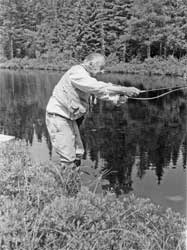
John Voelker, a/k/a Robert Traver, delicately drops a dry fly on Frenchman's Pond.

He knew I wanted to fish it, but by nature, he didn't trust many people that lived below the bridge, and like it or not, I had to measure up. What his standards were for admittance to the pond were unspoken. Therefore the invitation to fish came as a huge and unexpected surprise.

"Why don't you c'mon up and fish Frenchman's Pond with me?" he asked one day. "The trout are notoriously camera-shy, but we may be able to hook one or two."

An invite to fish the pond was like a special request to dine with the Pope or Queen Mum. It wasn't something to ignore or refuse. To do so would have sealed my fate and kept me away for all time.

One didn't ignore an invitation to Traver's famous wild brook trout pond.

I was full of questions. Would the trout rise? Which flies and sizes produced best? Any tips on fishing the pond?

"Chances are good we won't catch a fish," he said. "And if we do get lucky or skillful, as you fishing writers are wont to say, the brookies will probably be small and take only tiny dry flies.

"Fish a long leader tapered down to 5X or 6X, and try No. 18, 20 or 22 flies. We don't land many fish on such light tackle, but it sure is fun when we do."

We fished from casting platforms built around the pond, and I changed flies frequently. Brookies rose whenever the sun went behind a cloud but only one came to my fly. It missed or I missed, and that was that. I figured the old Judge had educated most of them.

Voelker had several rises to his tiny flies but failed to hook up. We crouched low on the platforms to reduce our silhouette, made adequate presentations but the trout weren't impressed.

"That's what I like about brook trout," Voelker said over a ritualistic sundowner of bourbon Manhattans during our U.P. cribbage championship game. "Brook trout are not impressed with who or what you are, or how much money you have, but they are responsive at times to a gentle and quiet approach."

All of this happened many years ago but our time spent together is permanently etched in my brain.

It's been well over 25 years since that trip, and it's been many years since his death, but I returned two more times by written invitation to fish with the old master. I would never go back even though I know where the pond nestles like a rare diamond in a green forest.

John Voelker fished around his last bend many years ago, and one day I may report what he told me about the frailties of old age and death's looming presence.

For now, on a warmer and snowy day, I'm satisfied with remembering this man of letters, writer of vibrant books on trout fishing, and masterful novels such as Anatomy Of A Murder. He taught me a valuable lesson that day, and it's one I occasionally pass on to others.

"There is more to fishing than catching fish," he said. "Learn to savor each day like a fine wine, listen to good music, fish often and keep few fish. Learn about life from brook trout because they are found only in cold, clean waters, and when brook trout disappear from our wild places, mankind won't be far behind."

Those are words worth remembering, and that the old Judge uttered them with a hitch is his voice, meant they came from his heart. The Bard of Frenchman's Pond had spoken, I had listened, and took his heartfelt advice with me when we drove away.

I remember Johnny Voelker (Robert Traver).. I remember the man, his little sayings, his attitudes about brook trout and the waters where they are found, and I'l never forget the old-timer, his Parodi cigars, his lively method of writing, and the waters he most loved to fish.

He was a one-of-a-kind man, and one I'll never forget. He still stirs my imagination.

Posted via email from Dave Richey Outdoors

Friday, March 04, 2011

Searching for the Shack Diary

The Shack building and some of the members of the Traverse City Fly Club.

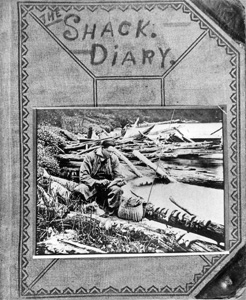
An important piece of local angling history has gone missing, and it disappeared several years ago. Where it is or who has the original book called “The Shack Diary” remains a complete mystery.

The Diary was more like a ledger than a real diary. Several Xerox copies exist, in whole or in part, but the original last owned by Jeanne Winnie Ball of Traverse City appears to have done a runner or someone put the five-finger discount on it.

This piece of legendary lore was kept by the late Art Winnie, a Traverse City barber and famous fly tier. Winnie’s daughter, Jeanne, found the Diary among some of his scrapbooks years ago.

It was a gentleman’s fishing-hunting club near Traverse City on the Boardman River.

The Shack, located on the Boardman River near Keystone and about five miles from Traverse City, seems to have sprung up from the logged-over land in the early spring of 1913. There were 10 founding members:

  • Charles Alley
  • John Corcoran
  • David Core
  • Carl Erickson
  • Ed Gilbert
  • Pat Hastings
  • Charles Longnecker
  • Charles Quick
  • Bert Ward
  • Art Winnie

The purpose of the Traverse City Fly Club, who owned the Shack, was to provide a place where the men could go to fish, and during the fall months, do some duck hunting, especially for mergansers that threatened to eat the river trout.

Bert Winnier (above) with a nice catch. Second fish from right was a grayling.

The Shack, as one observed noted, was “held together with chewing gum and cardboard.” Actually, based on photos I have, the Shack looked rather substantial although its location lacks any degree of beauty or aesthetics. Pine stumps, slashings and woody debris on land and in the water made foot travel a bit risky.

It seemed that fishing in those days was quite similar to what we experience today. Fishing can be wonderful today and rotten tomorrow, as the Diary so eloquently stated on many handwritten pages.

It seemed the Shack founders enjoyed their company, and a lengthy roster of guests were noted amid jotted observations that so-and-so left dirty dishes and others didn’t clean up after themselves. In that respect, some things never change … some people work and others do not.

Winnie cleans fish in the Boardman River in this photo of the Shack Diary. It has disappeared and an Important link to the past is gone.

It’s certain that most of the lengthy list of guests hailed from Traverse City but some came from many points around the country, including one visitor from Washington, DC. Guests include:

R. Anderson
Toots Armstrong
Mr. and Mrs. J. Bechtel
Harold Brown
Dr. A.W. Bruley
Walter Chase
David Core
Mark Craw; legendary conservation officer
John Farwell
Bill Foot
Walter Hanson
Remington Kellogg
Ray Lather
Dick Lawson
Charles Luick
D.J. McMeechan
Art Moore
J.B Moore
Theron Morgan
Donald Roxbury
Gus Ruff
Clayt Sardie
Jay Smith
Walt Thirlby
Harold Titus
George Winnie

If any names are misspelled, let’s blame it on faded handwriting and poor Xerox pages.

The record keeping was rather shoddy, and it seems that many dates were ignored or no one wanted to keep records that year. Some pages stated that fishing was bad while others boasted of large catches.

Members and guests of The Traverse City Fly Club also spent some of their time planting trout at various points near The Shack, and other nearby creeks as well as the Boardman River. Getting to The Shack was apparently an adventure in itself.

Getting to the Shack was an adventure. Most of the trees along the river had been cut during the timbering era.

The trail in was a corduroy trail of small tree trunks laid across the muck. One step off the trail, and it was a cold, stinky, wet walk into camp.

The Shack Diary continued, in fits and starts, until 1933 when the Traverse City Fly Club dismantled The Shack and relocated it to Rugg Pond in Kalkaska County. The photo on the cover of The Shack Diary was an original photo of  Art Winnie as he cleaned some fish.

The story doesn’t end there. A number of people borrowed The Shack Diary from his grand-daughter Judy Weber [ (231) 275-5654 ],  and all of them returned it except for one. My twin brother George had the Diary for a short time, and I saw, handled and read it, and then it was returned by him.

The late outdoor writer for The Record Eagle -- Gordie Charles – graciously turned over his notes about this and hundreds of other local stories that he wrote  for the newspaper and various magazines to me upon his death. By giving me these files, he asked me to appeal to my readers concerning the whereabouts of The Shack Diary.

If anyone knows anything about the whereabouts of the original Shack Diary, kindly contact me at:

Dave Richey
PO Box 192
Grawn, MI 49637
eMail me dave@daverichey.com

Or call Judy Weber at (231) 275-5654.

The Shack Diary needs to come home to rest.


Posted via email from Dave Richey Outdoors

Thursday, December 23, 2010

Toys of my lifetime


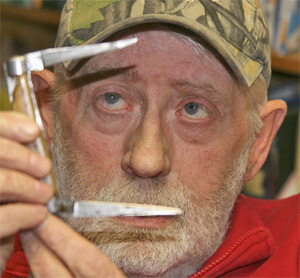
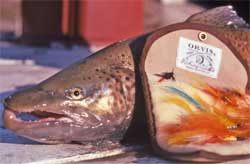
One of my favorite pocket knives & an old Orvis fly pouch with brown trout.


OK, so I’m a packrat. I come by it naturally. My mother and father saved all kinds of weird things, and I must have picked up this habit from them.

My baseball card collection disappeared when I was 18 years old. My mother decided that we (twin brother George and I) were quasi-adults now. What did we need with 5,000 or more baseball cards from the 1940s and 1950s.

Out went Al Kaline rookie cards. Gone too were Joe DiMaggio, Ted Williams, and others. We had them all, and in some cases, a dozen of each one.

The baseball cards were gone, and it was time to move on.


We lamented our lost cards then, and miss them now, but what's past is over and done with. I moved on, and over a period of many years, began picking up outdoorsy things that I like. Fishing and hunting books topped my list (and still does), but there were other items for a packrat to collect.

Much of my "stuff" was stored in cardboard boxes for safekeeping, and much of it has now been gone through and some marvels were found. Imagine finding my old Marble Boy Scout Knife. The handle is wrapped in rawhide, and the blade is big enough to slay bison with a single blow.

And tight to it was an old Marble compass from the late 1950s, It still works, and has been put away in a safe place. I was thinking I hit the jackpot until I laid my hands on a Winchester Model 61 .22 rimfire magnum pump rifle.

After high school, back in 1957, I worked for two years at Water Wonderland Sporting Goods, at the junction of Dort Highway and North Saginaw Road, about three miles north of Mt. Morris.

It was legal in those days to hunt whitetails (very few lived in our area near Flint) with a .22 rimfire magnum. They also came in handy for shooting red foxes, and some of my old fox-hunting buddies like Max Donovan, G.V. Langley and others carried one on hunts.

I saved my money, and bought the rifle. I was now ready to go out and run with the big dogs. The rifle was purchased during the winter, and about three months before the firearm deer season would open, the Department of Conservation outlawed the use of a .22 rimfire magnum for deer hunting.

I bought a Model 61 Winchester but it became illegal to use for deer.


My baseball cards may have been lost but I still have that rifle. I potted a few red foxes, a coyote or two and an abundance of woodchucks with it over the years. I still shoot it on occasion, but looking at it now brings back memories of buying it to hunt deer only to have it made illegal for that purpose.

In another box was my shotgun shell reloading equipment with all the powder and shot bars, crimping tools to seal paper and plastic shells. I found a great, huge box of Winchester AA plastic cases. Some had been reloaded two or three times, and many had been fired only once.

Five years ago I was visiting with my late friend, Fred Houghton, formerly of Clio, and he mentioned he still had that rod and reel I'd loaned him 50 years before. The rod was an ultra-light Wanigas fiberglass rod made by famous Trout Unlimited co-founder Art Neumann of Saginaw, and a Cargem Mignon ultra-light spinning reel. This rod and reel had been a favorite, and thanks to Fred's honesty, I now have it back.

I've always had a love affair with pocket knives, or jack knives as we called them. Brother George gave me a Remington two-blade pocket knife almost 50 years ago. I'd lost track of it, and then found it and now it's back in my pocket where it belongs. The blades have been sharpened so many times, and the steel is so good, that I often use it to fillet bluegills. It was a treasure that had been lost and found again.

Deep in the box was a round metal tin of Mucilin that we used years ago when fly fishing. There also were a dozen No. 1 traps that I used 55 years ago when running two trap lines. They brought back fond memories of days when prime muskrat pelts sold for $5-8 each, and we'd often catch five or six 'rats a day. Some years we made more money in a week of trapping than our father made in a week of cutting hair.

There was an old Jones-type hat that had traveled North America with me. It was half rotted, and I thought it had been thrown away, but there it was -- as ugly as ever -- and it brought back grand memories of far-flung fishing trips. Am p;d Ptvos fly pouch held flies I used when guiding brown trout river fishermen.

Browns of this size were common in the late 1960s and early 1970s.


Then I found a small pocket knife with the likeness of the Royal Canadian Mounted Police on the handle. Next to it were two rusted knives I'd found sticking in logs where some hunter had probably field dressed his deer, drug the animal out of the woods and forgot the knife. They are useless but I keep them anyway

There were a matched pair of old wooden duck decoys I'd found in the Saginaw Bay cattails while jump-shooting ducks in my youth. Their decoy anchor lines had broken, and they;d drifted off during rough water. George and I found 50-100 old wood dekes many years ago, but these were all that remain.

One might think this was a collection of junk, but not me. I looked at all these things, and counted them as wonderful memories from a bygone era when hunters knew enough to keep their paper shotgun shells dry. If they didn't, they would swell up and it was nearly impossible to get them to fire or get the swollen shells out of the shotgun.

Those were the days, my friends, we though they'd never end. And they haven't because fishing and hunting is still my way of life, and some of the old tools of the trade are still functional and remind me of the good old days when almost everyone in town turned out for the opening of the deer and pheasant seasons.

It’s not quite the same anymore, but my memories still bring joy. And, at this point in my life, that’s still very important to me.

Posted via email from Dave Richey Outdoors

Wednesday, August 25, 2010

River dancing with big salmon


Years ago we had an early cool snap, a cold rain fell, and suddenly the Betsie River was awash with fresh-run Chinook salmon. Everywhere one looked were fish moving upstream, their backs creasing the surface.

Brother George and I were fishing two small holes 30 yards apart, and he was casting a wet fly while I was pitching a copper No. 2 Mepps Aglia spinner. It was midweek, and we seemed to have the river to ourselves.

George hooked a fish on a pattern he devised for dark-water, and it was called The Crick. It was basically a black fly with a bit of color, and he was bouncing it along bottom when it stopped and the line switched sideways, There is nothing delicate about setting the hook on a big river salmon. It is a happening!

Hooking a big river Chinook salmon like like hooking the caboose of a down-bound freight train.

I could hear him grunt as he muscled back to pound the hook home. I took two turns on the reel handle, and a king salmon tried mightily to wrench the rod out of my hands. I urged him into a fighting mood with a hard double hook-set, and there we stood, 20 yards apart, the Richey twins, each one tight to an angry king salmon.

My fish started downstream, and jumped almost into his back pocket, and George spun around, glared at the fish heading out into midstream as his fish ran upstream away from the splash. His fish jumped out in front of me, and we both had to get moving to avoid tangling our lines.

He shuffled upstream while I moved down, and we had the two fish separated by 20 yards when his big king swapped ends, and headed downstream behind me as I scrapped with my fish in the deep hole. I stepped backwards, stepping over his line, and then we stood there, our backs almost touching, as we tried to beat up on those fish.

"Having fun yet?" he asked, knowing I was.

"Nothing better than a 25-pound king trying to rip the rod from your hands," I replied. "Waited a year to do this again."

The silence of the moment was hushed by splashing fish, and then George's fish headed upstream, and our two fish were as close together as we were, and both were struggling upstream, fighting the river current and our heavy rod pressure.

"Could get a bit tricky soon," he noted. "If both of them come down together, it will be interesting to see if we can get out of the way while keeping them separated."

The Chinook salmon apparently read his mind or heard his voice, and like two submarines heading for two troop ships, here they came. One fish stayed deep and mine was near the surface, and I pulled from one side to upset his travel pattern. George and I always seemed to read each other's mind, and he did the same except he pulled in the opposite direction.

Two big fish, two anglers -- all in a huddle -- in the middle of fast water.

The fish hit the air, both in half-hearted jumps, and it was as if we were in a ballet on water. We reacted in unison without discussing it, and his move and mine complemented the other. The kings, reacting in a somewhat predictable manner, responded in kind. This was a battle of two twin men, working on two adult Chinook salmon of equal size, and it couldn't have been choreographed any better.

My fish cut between me and shore, spinning me around as it charged downstream. George's fish peeled around him in midstream, and now both fish were wallowing on the surface.

My fish was just half-a-shade lighter in coloration than his but it played out faster on the spinning tackle. I led the fish to shore, grabbed it by the caudal peduncle (the wrist-like narrowing just ahead of the tail), lifted it out, reached for my long-nose pliers, and twisted the treble free and released the fish.

I grabbed my camera and began clicking photos of George as he landed his 25-pounder. There was a bit of color in the background, and he held his fish aloft for two or three photos.

He bent over, released the fish with the dignity it deserved after putting up a valiant fight, and we were off looking for another adventure.

Those were the days when George and I lived our lives to the fullest, guided fishermen, and traveled Michigan's rivers together as we did everything else ... together, and as a team.

Such days were common-place for George and I, and we lived for them.

Today I was on the Betsie River again, and my thoughts of George were wonderful as i looked for fish below the old Homestead Dam. I found a few fish but they weren't hitting. The river water is still warm, and oddly enough, there were no people where I was at.

I cast to several fish but the fish were really spooky. One cast, and they would head into a timber-lined hole. The last thing they seemed interested in was flies or spinner, but it was a good day for remembering my twin brother.

I still think of him daily after almost seven years since his premature death, and although we hunted together as well, it was on those early salmon and steelhead trips that we became almost welded together, inseparable as two peas in a pod. I miss him, and just remembered this story today as I tried to recreate that day, and it's one of my favorites.

Hope you enjoyed it as much as I did.

Posted via email from Dave Richey Outdoors

Wednesday, March 10, 2010

Steelhead fishing from another era

It was April 1, 1968, and my second year of guiding fly fishermen to brown trout, salmon and steelhead fishermen. My twin brother, George, and I was scouting the Little Manistee River between 6 Mile and 9 Mile bridges, for clients who would arrive to fish the next twp days.

The river was rain-swollen and murky, and in another hour of heavy rain, it would be a foot higher and the color of chocolate milk. I thought a big buck steelie was on a shallow gravel bar an easy cast from shore, and George shinnied up a shoreline tree and stood on a big branch to check things out.

"That fish is huge," George muttered to me. "It's bigger than any steelhead I've ever seen, and his cheeks and gill covers are a bright orangish-red color. This is an awesome fish.

"You know about where he is. Cast a copper spinner upstream and reel hard when I tell you."

The author admires a Betsie River steelhead.

I cast, and George said to cast another six feet farther upstream in hopes of getting the spinner down in the heavy current. My next cast, he said, was on target.

"That's the spot," he said. "Keep casting to it. Reel hard now!"

I reeled, and nothing happened. Cast after cast went into the right spot, and I'd reel fast enough to make the spinner blade turn over in the current, and after 40 or 50 casts, George yelled "Hit him!"

The hooks were slammed home as I felt the strike, and nothing happened, so I pounded the rod tip back to set the hooks again. The huge steelhead rolled to the surface, his cheeks and gill covers glowing like evening campfire embers, and the fish started swimming upstream, his dorsal fin creasing the surface like a shark. He didn't move fast but seem possessed with tremendous power.

I moved along the bank but stayed downstream from the fish. The trick was to make the giant steelhead fight the rod pressure and the river current. We duked it out in the soggy rain for 10 minutes before the fish swapped ends and headed downstream into a deep hole. I was reeling while running but still the fish tangled the line in underwater brush and quickly broke me off.

"How big," I asked George. He'd caught steelhead to almost 20 pounds, and he guessed this ponderous male was at least 25 pound, perhaps more.

Big steelhead were more common back then and there were fewer anglers.

Wow, you say. That's what I said, and of the thousands of steelhead I've caught before and since, it remains the largest one I've hooked or seen.

My point with this anecdote is that incident occurred back in the days of very few steelhead fishermen and lots of big fish. The Little Manistee River at that time had a huge run of spawning steelhead that averaged, according to the DNR, between 11 and 12 pounds. A 15-pounder wasn't anything special, and it took a 17- or 18-pounder to raise any eyebrows.

That same year, also on the Little Manistee River, I found a 30-yard stretch of gravel that was wall-to-wall fish. The river bottom was honeycombed with spawning redds, and 15 or 20 feet away would be another redd, and every one held a female and one to four males. We fished only for the male fish because a hooked hen would take all the boys with her.

On that day I set a record of sorts. I hooked 30 steelhead in eight hours, and am proud to announce that I made a professional release on every fish. If you're unfamiliar with the term, a professional release means I lost every fish, one way or another.

There were far more steelhead in those days than now. There are far more fishermen today than back then. It's easy to do the basic math; fewer fish are being caught by more fishermen.

Brother George casts a fly to a steelhead.

There are still some rather exciting days if anglers can find a spot where fishing pressure is minimal. Two years ago me and another man hooked 30 steelhead in a morning. We landed about half of them, and released each and every one. Those days seldom occur these days.

Low Lake Michigan water levels in the past haven't helped. The Betsie River mouth has been so low in recent years that very few fish made it upstream. Rivers like the Manistee below Tippy Dam can be good at times, but the fishing pressure is just too heavy to suit me. I can take two or three hours of fishing in a crowd, and then get turned off by the whole thing.

That doesn't mean that you should, but it's easy for me to remember way back when to those special days where a steelhead fisherman would consider himself unlucky to see two other anglers all day. And, back in the day, people didn't crowd you or wade down through a spawning bed.

They had some class and good manners. The fish were larger and more plentiful back then, and the rivers weren't swarming with anglers. It was a different era, and the steelhead fishing now remains fairly good, but remembering what it was like 40-45 years ago is enough to make a grown man cry.

Personally, it's my thought that we'll probably never see the likes of those days again but remembering them is still a thrill for an old goat like me.

Posted via email from Dave Richey Outdoors

Tuesday, March 09, 2010

Testing river waters for steelhead

Steelhead fishing has been my addictive passion for more than 55 years. Give me four or five days of snow-melt temperatures, and a forecast of two or more days of rain, and there's only one thought that goes through my head at this time of year.

It's time to think strongly about hitting the river. One might ask where. Pick any stream, but those larger rivers with a dam and a constant stream flow, may be the best of all. Some good bets this week and over the weekend could be on rivers such as the AuSable, Betsie, Boardman, Manistee, Muskegon and St. Joseph. Many anglers concentrate their efforts in those river stretches just below the dam.

Why? Easy answer. Any steelhead that entered the rivers last fall or earlier this winter have been in the river for varying lengths of time. A run-off caused by melting snow and rain will move downstream, and fish that are holding out in the lake waiting for the water to warm. A temperature rise of only a few degrees will send fish migrating upstream before their spring spawn.

My strategy would be to fish close to the dam. That's where many of the fish will eventually be, and it can be a wise decision. Or start at the dam and begin fishing the holes and runs and an angler works downstream. There is still a good bit of snow in the woods, which can make gaining access to good spots more difficult. It's also a good reason to start fishing near the day because the  angler traffic has made it a bit easier to get around.

Learn to see spawning male steelhead.

Make no mistake about it. The river water is still cold, and fish can be lethargic and slow to move to bait, fliesm plugs or spinners. The trick is to cove every inch of holding water from as many possible position as wading conditions will allow. Anglers must be aware of the possibility of shelf ice extending out from shore, and use caution when wading. Any appreciable run-off can raise the water level, and each spring holes and runs change as sand or other timber debris moves downstream. I've seen holes change completely during a heavy spring run-off.

One key piece of fishing advice is to fish deep, and allow bait, flies or lures to bounce downstream with the current. Make several casts from one location, and then move downstream a few steps and go through the same routine again. Work the holding water thoroughly, and if you aren't getting hung up on bottom debris occasionally, you are not fishing properly. Your offering must be bouncing downstream along the bottom, and at the same speed as the current.

When it comes to bait, spawnbags are the eternal favorite of most anglers. However, keep this in mind: when the water is extremely cold (33-35 degrees) was worms or wigglers occasionally out-produce the tradition spawnbag. Two major fishing methods work for bait, and can be equally successful.

Many fishermen prefer rolling the bait along bottom. Cast across the river and allow the bait to sink to bottom. Splitshot is preferred, and use just enough weight to allow it to bounce downstream. Use too much weight about a foot above the baited hook, and the bait remains in one place. Keep adjusting the weight until you achieve the proper drift. Too little weight will mean a faster drift but the bait will up off bottom, and drifting over the fish's head. Spring steelhead rarely move up in the water column to take bait.

Bobber fishing or rolling spawnbags along bottom?

The second way to effectively fish bait is to estimate the depth of the water being fished, and attach a bobber (float) above the baited hook. Use just enough weight about 10-12 inches above the hook so it causes the bobber to stand upright in the water. Cast as outlined above, and watch the bobber as it drifts downstream. If you are unfamiliar with the river, keep adjusting the bottom. If the bobber lays on its side and doesn't move, slide the bobber down toward  the hook. It can take several adjustments to make the drift carry the bait along and just off bottom.

Years ago, many of us use small leadhead jigs and we'd bait them with a wax worm or wiggler. We used small jigs weighing  1/16 or even 1/32-ounce, and the brightly colored jigs, when combined with bait, seemed to make your offering more appealing to fish.The key to success, with or without a tiny jig, is to use just enough weight to make the bobber stand upright in the water. Watch the bobber at all times, and if it goes down just a little bit, it could have picked up a leaf or twig or a fish could be mouthing the bait. The best indication of a strike is the swift disappearance as the bobber is sucked under the surface. Lift the rod tip with a bit of force, and set the hook.

Late winter streams often feature very clear water. Long 10-12-foot rods work well, and my favorite is four-pound monofilament. If the river rises suddenly with heavy run-off, bait anglers should consider using six or even eight-pound line. Sometimes a fish will clean you (take all the line on your spool), and just keep going. Again, trial, error and experience can be the best teacher on how heavy line can be used. Bait fishing is finesse fishing, and more fish are hooked on light line than heavy line.

Catching fresh-run steelhead on a fly is fun!

Heavier line can be used when fishing with plugs or spinners. Most spring steelhead strikes when using hardware are sure and hard. There's no mistaking a strike, and some fish slam the lure so hard that it can produce a sore wrist. The key thing when pitching plugs, spinners or spoons, is to stay alert. Even though the strike can be a wrist wrenching affair, if you are daydreaming and don't set the hook promptly, the fish can get away.

Great lures for this type of fishing would include plugs like the FlatFish, Tadpolly or Hotshot. I favor the Mepps Aglia spinner for smaller waters if I'm going to use this type of gear, and a No. 2, 3 or 4 Mepps Aglia spinner (without the bucktail) is a favorite.

Back me into a corner, and demand to know my favorite steelhead fishing method, and I'd readily say fly fishing. There's something magical about catch a mint-silver hen or a red-cheeked buck steelie on a fly. Sight fishing works well for those anglers who have enough brains to stay out of the water until the spot a fish. The best action takes place during the spawning period, and when fly fishing to bedded fish, re,e,ber that it's most important to fish for only the male fish. Often a soon-to-spawn steelhead may have three, four or five males line up behind her, and the pecking order places the biggest and most aggressive male closest to the hen.

Fly-fishing for steelhead is the best fun of all.

Watch the fish long enough to spot the silvery hen rolling up on her side. The male moves in close, and together the release a cloud of eggs and milt. The males usually are darker than the female, and they move around more as they chase other smaller fish away. Pick a fish, and fish directly to it. I spent 10 years guiding steelhead fishermen from 1967 through 1976, and pioneered fly fishing on Michigan's tributary streams for browns, salmon and steelhead. Many of the methods my twin brother George and I devised are still in use today.

One steelhead caught on a fly is just about as much fun as a person can have while wearing waders. Watch the weather, and fish at every opportunity. This warm-up has come early, and I've seen years when the run has ended by April 1. The only way to avoid disappoint is to fish as often as possible. Follow some of these tips, and this may be the year you'll hit the run just right. Good luck!

Posted via email from Dave Richey Outdoors