Showing posts with label spinners. Show all posts

Thursday, June 23, 2011

Honey, Just A Few More Lures?


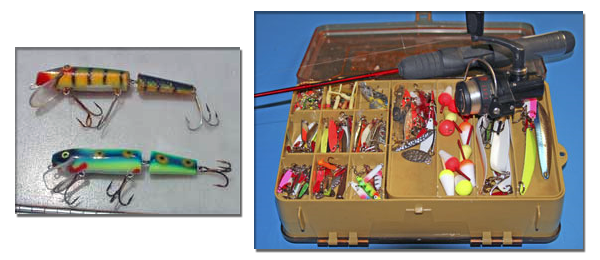
A pair of big muskie plugs plus a small tackle box of ice fishing lures.


There are more tackle boxes in my basement storeroom than any sane man needs. Every one is almost overflowing with fishing lures, so why should I need more?

It's a bit like fishing and hunting books. A man can never have too many good books, and I'm as guilty of buying more than I will probably ever need or read. Much the same is true with lures.

There are four huge tackle boxes filled just with muskie plugs, and a smaller one that holds some smaller muskie lures. I've got some 10-inch muskie plugs and great huge spinnerbaits in the big boxes. However, every year I see someone with a Bobbie or Eddie bait or a Suick or Brunner Runner in a hot new color.


I’m over-run with fishing lures and tackle boxes.


It doesn't mean that the other guy's oddly colored Suick hasn't worked for him. It could, and there I'd be without one painted in that strange color that every muskie fishermen needs to own. Sadly, seldom do they produce fish, but against all odds, they could produce if we just believe in them and cast them often enough.

There are two more beastly huge tackle boxes filled with nothing but salmon spoons and big salmon plugs. I own most colors of J-Plugs, Dardevles, Silver Streaks and other fishing spoons, but I keep bumping into newer sizes with different paint and  tape patterns that seem to beckon to me with eyes that look deep into mine and seem to whisper "Buy me and take me home!" It's the old siren song that we all know.

The eyes have it. I've been adding stick-on eyes to my lures for many years, and now more and more lures are being made with prominent and well-colored eyes. I think eyes make lures more appealing to fish but wonder if they really produce more often. One can only hope.

OK, how about Herring Dodgers? I have two smaller boxes filled with them. There are red ones, white and yellow ones, chrome plated, some home-painted a dull black color (don't laugh because they work ... sometimes), half silver-half bronze, chartreuse models, and some with dazzling tape and some without. There are small ones, large ones, those of normal size, and Hoochie Mamas. Got me some of them too.


Herring Dodgers and Hootchie Mamas. Gotta have ‘em.


If we're going after lake trout I tote 50-60 different sizes, shapes and colors of cowbells and perhaps half that many different colors of P-nuts. Another tackle box is filled with various trolling weights for inland trout lakes, and some stainless steel needles to sew shiners onto my hook.

One tackle box is loaded with more Dardevles in a variety of colors although my best pike fishing comes with two color combinations -- red with a white stripe and silver back or yellow with five red diamonds and a brass back. There are other pike spoons and plugs in the box, and although most of my largest pike come on the two colors noted above, there are another two dozen other patterns for when the pike get picky. And then there is a box of spinnerbaits in several sizes that work for muskies and pike.

Oh my, I nearly forgot. One box is filled with body baits like Rapalas, Rebels, FasTracs, Long A Bombers and other similar lures. They too are in an infinite variety of great colors, and some have never been in the water but boy, do they look pretty.

Still another box is filled with wood FlatFish and Tadpollys from my guiding days when I used the dropback method on the Manistee River below Tippy Dam or when trolling Manistee, Pentwater or Pere Marquette lakes for late-fall steelhead. The FlatFish come in two varieties: those with the tiny treble gang hooks or with two larger hooks. In that box are extra hook hangers for the small treble hooks that I prefer to use.


A hundred pounds of leadhead jigs in a dazzling display of colors.


I'm a big fan of vertical jigging on the Detroit, Kalamazoo, Saginaw and Tittabawassee rivers, and there are two heavy tackle boxes filled with jigs weighing from 1/8 to 1 ounce, depending on the depth of water and current speed at each location. Half of one box is filled with oodles of grub bodies and twister-tail bodies in a rainbow of colors.

And as nice as freshly painted jigs look in their trays, I often scrape the paint off and use just the bare lead and a lip-hooked minnow. It works!
One small box holds nothing but Mepps spinners, and another holds nothing but weight-forward spinners like Erie Dearies. Another small box is nothing special except it contains lures purchased when I was 15-17 years of age from the Wanigas Fly Shop near Saginaw, Michigan. The shop was owned by Art Neumann, a co-founder of Trout Unlimited, and it holds a bunch of small trout-size spoons that are rarely seen these days except in a lure collection.

Then there are some collectible Heddon lures that I normally leave home, and other scarce Creek Chub Pikie minnows, etc. And did I mention two small boxes of ice fishing lures?


C’mon, Honey, I just need a few more for this season.


So, do I really need several more lures? Probably not, but once one or two new lures wink at me and catch my eye, I go into a feeding frenzy until I have them. Many times, after such a cabin-fever purchase, I try the lure once and take an active dislike to its action, color or lack of fishing-catching abilities.

Someone once told me that fishing lures catch more anglers than fish, and I suspect that is quite true. However, gazing upon tray after tray of various colors and sizes of lures makes me feel good.

So, why not, honey? All I need is two or three more $20 muskie plugs. There are still a few Suick colors I don't have. You never know when one of these odd-ball color combinations will tempt a trophy muskie. And I’ll even put up storm windows when I can find the time.

Wednesday, August 25, 2010

River dancing with big salmon


Years ago we had an early cool snap, a cold rain fell, and suddenly the Betsie River was awash with fresh-run Chinook salmon. Everywhere one looked were fish moving upstream, their backs creasing the surface.

Brother George and I were fishing two small holes 30 yards apart, and he was casting a wet fly while I was pitching a copper No. 2 Mepps Aglia spinner. It was midweek, and we seemed to have the river to ourselves.

George hooked a fish on a pattern he devised for dark-water, and it was called The Crick. It was basically a black fly with a bit of color, and he was bouncing it along bottom when it stopped and the line switched sideways, There is nothing delicate about setting the hook on a big river salmon. It is a happening!

Hooking a big river Chinook salmon like like hooking the caboose of a down-bound freight train.

I could hear him grunt as he muscled back to pound the hook home. I took two turns on the reel handle, and a king salmon tried mightily to wrench the rod out of my hands. I urged him into a fighting mood with a hard double hook-set, and there we stood, 20 yards apart, the Richey twins, each one tight to an angry king salmon.

My fish started downstream, and jumped almost into his back pocket, and George spun around, glared at the fish heading out into midstream as his fish ran upstream away from the splash. His fish jumped out in front of me, and we both had to get moving to avoid tangling our lines.

He shuffled upstream while I moved down, and we had the two fish separated by 20 yards when his big king swapped ends, and headed downstream behind me as I scrapped with my fish in the deep hole. I stepped backwards, stepping over his line, and then we stood there, our backs almost touching, as we tried to beat up on those fish.

"Having fun yet?" he asked, knowing I was.

"Nothing better than a 25-pound king trying to rip the rod from your hands," I replied. "Waited a year to do this again."

The silence of the moment was hushed by splashing fish, and then George's fish headed upstream, and our two fish were as close together as we were, and both were struggling upstream, fighting the river current and our heavy rod pressure.

"Could get a bit tricky soon," he noted. "If both of them come down together, it will be interesting to see if we can get out of the way while keeping them separated."

The Chinook salmon apparently read his mind or heard his voice, and like two submarines heading for two troop ships, here they came. One fish stayed deep and mine was near the surface, and I pulled from one side to upset his travel pattern. George and I always seemed to read each other's mind, and he did the same except he pulled in the opposite direction.

Two big fish, two anglers -- all in a huddle -- in the middle of fast water.

The fish hit the air, both in half-hearted jumps, and it was as if we were in a ballet on water. We reacted in unison without discussing it, and his move and mine complemented the other. The kings, reacting in a somewhat predictable manner, responded in kind. This was a battle of two twin men, working on two adult Chinook salmon of equal size, and it couldn't have been choreographed any better.

My fish cut between me and shore, spinning me around as it charged downstream. George's fish peeled around him in midstream, and now both fish were wallowing on the surface.

My fish was just half-a-shade lighter in coloration than his but it played out faster on the spinning tackle. I led the fish to shore, grabbed it by the caudal peduncle (the wrist-like narrowing just ahead of the tail), lifted it out, reached for my long-nose pliers, and twisted the treble free and released the fish.

I grabbed my camera and began clicking photos of George as he landed his 25-pounder. There was a bit of color in the background, and he held his fish aloft for two or three photos.

He bent over, released the fish with the dignity it deserved after putting up a valiant fight, and we were off looking for another adventure.

Those were the days when George and I lived our lives to the fullest, guided fishermen, and traveled Michigan's rivers together as we did everything else ... together, and as a team.

Such days were common-place for George and I, and we lived for them.

Today I was on the Betsie River again, and my thoughts of George were wonderful as i looked for fish below the old Homestead Dam. I found a few fish but they weren't hitting. The river water is still warm, and oddly enough, there were no people where I was at.

I cast to several fish but the fish were really spooky. One cast, and they would head into a timber-lined hole. The last thing they seemed interested in was flies or spinner, but it was a good day for remembering my twin brother.

I still think of him daily after almost seven years since his premature death, and although we hunted together as well, it was on those early salmon and steelhead trips that we became almost welded together, inseparable as two peas in a pod. I miss him, and just remembered this story today as I tried to recreate that day, and it's one of my favorites.

Hope you enjoyed it as much as I did.

Posted via email from Dave Richey Outdoors

Wednesday, March 10, 2010

Steelhead fishing from another era

It was April 1, 1968, and my second year of guiding fly fishermen to brown trout, salmon and steelhead fishermen. My twin brother, George, and I was scouting the Little Manistee River between 6 Mile and 9 Mile bridges, for clients who would arrive to fish the next twp days.

The river was rain-swollen and murky, and in another hour of heavy rain, it would be a foot higher and the color of chocolate milk. I thought a big buck steelie was on a shallow gravel bar an easy cast from shore, and George shinnied up a shoreline tree and stood on a big branch to check things out.

"That fish is huge," George muttered to me. "It's bigger than any steelhead I've ever seen, and his cheeks and gill covers are a bright orangish-red color. This is an awesome fish.

"You know about where he is. Cast a copper spinner upstream and reel hard when I tell you."

The author admires a Betsie River steelhead.

I cast, and George said to cast another six feet farther upstream in hopes of getting the spinner down in the heavy current. My next cast, he said, was on target.

"That's the spot," he said. "Keep casting to it. Reel hard now!"

I reeled, and nothing happened. Cast after cast went into the right spot, and I'd reel fast enough to make the spinner blade turn over in the current, and after 40 or 50 casts, George yelled "Hit him!"

The hooks were slammed home as I felt the strike, and nothing happened, so I pounded the rod tip back to set the hooks again. The huge steelhead rolled to the surface, his cheeks and gill covers glowing like evening campfire embers, and the fish started swimming upstream, his dorsal fin creasing the surface like a shark. He didn't move fast but seem possessed with tremendous power.

I moved along the bank but stayed downstream from the fish. The trick was to make the giant steelhead fight the rod pressure and the river current. We duked it out in the soggy rain for 10 minutes before the fish swapped ends and headed downstream into a deep hole. I was reeling while running but still the fish tangled the line in underwater brush and quickly broke me off.

"How big," I asked George. He'd caught steelhead to almost 20 pounds, and he guessed this ponderous male was at least 25 pound, perhaps more.

Big steelhead were more common back then and there were fewer anglers.

Wow, you say. That's what I said, and of the thousands of steelhead I've caught before and since, it remains the largest one I've hooked or seen.

My point with this anecdote is that incident occurred back in the days of very few steelhead fishermen and lots of big fish. The Little Manistee River at that time had a huge run of spawning steelhead that averaged, according to the DNR, between 11 and 12 pounds. A 15-pounder wasn't anything special, and it took a 17- or 18-pounder to raise any eyebrows.

That same year, also on the Little Manistee River, I found a 30-yard stretch of gravel that was wall-to-wall fish. The river bottom was honeycombed with spawning redds, and 15 or 20 feet away would be another redd, and every one held a female and one to four males. We fished only for the male fish because a hooked hen would take all the boys with her.

On that day I set a record of sorts. I hooked 30 steelhead in eight hours, and am proud to announce that I made a professional release on every fish. If you're unfamiliar with the term, a professional release means I lost every fish, one way or another.

There were far more steelhead in those days than now. There are far more fishermen today than back then. It's easy to do the basic math; fewer fish are being caught by more fishermen.

Brother George casts a fly to a steelhead.

There are still some rather exciting days if anglers can find a spot where fishing pressure is minimal. Two years ago me and another man hooked 30 steelhead in a morning. We landed about half of them, and released each and every one. Those days seldom occur these days.

Low Lake Michigan water levels in the past haven't helped. The Betsie River mouth has been so low in recent years that very few fish made it upstream. Rivers like the Manistee below Tippy Dam can be good at times, but the fishing pressure is just too heavy to suit me. I can take two or three hours of fishing in a crowd, and then get turned off by the whole thing.

That doesn't mean that you should, but it's easy for me to remember way back when to those special days where a steelhead fisherman would consider himself unlucky to see two other anglers all day. And, back in the day, people didn't crowd you or wade down through a spawning bed.

They had some class and good manners. The fish were larger and more plentiful back then, and the rivers weren't swarming with anglers. It was a different era, and the steelhead fishing now remains fairly good, but remembering what it was like 40-45 years ago is enough to make a grown man cry.

Personally, it's my thought that we'll probably never see the likes of those days again but remembering them is still a thrill for an old goat like me.

Posted via email from Dave Richey Outdoors