Friday, April 27, 2012

Buying old turkey hunting books

Scoop's Books sells antique, rare and hard-to-find sporting literature
Unique, Rare and Hard-to-Find books are what Scoop’s Books deals in: looking for and For Sale. Contact us today to Buy or Sell.
photos by Dave Richey
I spent just enough time outdoors today to go to the doctor, say hello to my neighbor and bask in the warming breezes. I’m trying to work some nasty knots out of my back, and it’s not working very well.

At 45 degrees, the weather seems almost balmy. I spent some time arranging and rearranging books that will be for sale on my Scoop’s Books website. Some titles are once-in-a-lifetime acquisitions for any sportsmen and some are moderately priced. I may have a new address for my new book website soon. I hope to have 1,000 or more fishing and hunting books up very soon.

These fishing and hunting books are meant to provide two specific things for book buyers: education and information.

I also am placing some books on eBay for auction purposes. Feel free to check them out.

I want to buy your old turkey hunting & duck decoy books

It's obvious that not all sportsmen like to read books, and that is OK. They just don't know what they are missing. There are so many fine fishing and hunting books available and listed on Scoop's Books. Find a book cover that interests you, and email me at the above email address to see if the book is still available.

A hunter might ask: why buy a book on deer hunting? I already know how to deer hunt. Good question but a poor answer. Anyone who doesn't study deer regularly will know something about hunting these animals, but won't know enough about how to hunt them when the going gets tough.

It's the same with turkey hunting books. I buy as money as I can afford for my collection, and still need some others. If you have any turkey titles, and might consider selling them, send me a list of the book titles and the author's name, and I'll get with you soon.

Lots of people can cast a fly, but there are countless books available that can help with casting more accurately but also can teach us how to read the river, determine which insect is hatching, and which patterns will help fool the fish. Nothing is ever guaranteed except paying taxes until you die, but reading can broaden your horizons and help people learn new skills.

I'm constantly looking for fishing or hunting books to buy. I need to buy books in order to sell books, and I'm picky about condition but pay fair prices. So just what am I looking for and hope to buy from you?

I'm primarily interested in turkey hunting titles now. The scarcer they are, the better. Common turkey hunting books I don't need.
The easiest answer is for you to tell me the author's name, the title of the book, and whether it is a paperback or hard-bound book with a dust jacket. From that tiny bit of information, I can usually determine whether I may be or am not interested in buying that title.

Contrary to popular belief, all fishing and hunting books are not scarce. Most also are not worth big money. Many books I turn down are not worth $5, and I have no need for them. But for you, the potential seller, I will pay within reason what it takes to buy books in good shape that I want for resale.

Books with damaged covers, childish scribbles, underlined passages, highlighted sentences, damp-stained covers or those with other faults are not worth offering. I never buy musty, mildewed or ex-library books because they usually aren't worth owning.

Anything noted immediately above is what I don't want

So, c'mon Richey, what exactly are you interested in? I seldom buy new titles. I never buy Readers Digest or condensed books. I prefer books that state 1st edition or 1st printing on the copyright page. I absolutely will not buy print-on-demand books.

Topics of interest to me include Atlantic salmon, muskie, brook trout, tarpon, fly tying, bamboo rod building and other types of fishing books work for me. I crave good books on hunting ruffed grouse, deer, ducks, geese, upland game, wild turkey, woodcock and other hunting books. I have a mild interest in African hunting books but am picky about what I buy. I do pick up books on duck decoys.

Some hunting authors that I'm collecting. Please save this list. There are certain authors I collect.

Robert Austin Fred Bear Havilah Babcock Larry Benoit Wayne Bledsoe
Stewart Bristol Bob Brunner Nash Buckingham Doug Camp Thomas C. Chubback Burns
Peter Hathaway Capstick
(first editions only)
Russell Chatham Wally Chodak Thomas C. Chubb Malcomb Commer
Wingbone Cryer Eugene Connett Ralf Coykendall Paul Dalke Henry Davis
Jack Dudley John Duff George Bird Evans J. Wayne Fears Bill Harper
William Harnden Foster Percy Haver Marv Heeler Vic Jansen John Knapp
Dana Lamb Homer LeBlanc J. Stockley Ligon Doyle Loadholtz John Lowther
Thomas McGuane John Minor Art Moraski Richard Nissley Jack O'Connor
Hoffman Phiilip W. H. Purser John Pusztay Larry Ramsell George Richey
Robert Ruark Ernest Schwiebert Louie Spray Bob Swineheart Robert Traver
Jack L. Turner Ted Vogel Alfred Weed

and many more.

I'm always interested in any books written by Michigan turkey hunters like Denny Geurink. State published turkey hunting, management, ecology, roosting habits, food habits, etc. are needed.

People have nothing invested in offering me books for possible purchase. If I can't or won't buy your books, I'll be happy to explain why. If I do buy, know that I will give you the highest possible price, and hope then to be able to resell the books for a modest profit but that doesn't always happen.

I've never cheated anyone, and don't plan on starting now. My reputation is excellent, and I sell books off my website and some by mail order sales. It's in my best interest to pay the highest possible price, and still realize a potential profit.

I grade books fairly, charge a fair price and pay a fair price when I buy. I've been buying and selling books for 43 years, and one doesn't stay in this kind of business for long by cheating people.

Give me a try. The nasty winter weather is behind us, but late spring rains may stall your outdoor activities.  Take a bit of that time to dig through that pile of fishing and hunting books stashed in the attic, barn, basement, cellar, closet, garage or wherever, write down the author's name, the book title, and whether paperback or hardcover with dust jacket. If you can read this, you can certainly email me and tell me what you have for sale.

It's that easy. And who knows? The book you sell could be valuable or not, but the payment may allow you to purchase some fishing or hunting equipment. Try me and let's see what happens.

Sunday, April 22, 2012

A kill is not always needed

To shoot or not to shoot? That was the major question at the moment

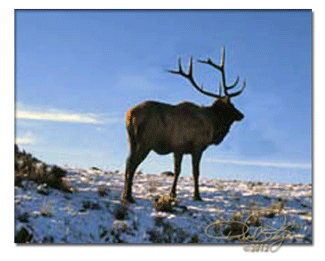
Colorado Elk
Perhaps, because I greatly enjoy the hunt, there is no longer a feeling of the need to kill. Maturity?
photo David Richey ©2012
I was in Colorado 15 or 20 years ago on an elk hunt. My buddy and I had seen several bull elk so far and our hunt still had a few days to go. We spotted a small elk herd from a distance, glassed them to see what they looked like.

"The bull on the far right is a nice 6X5," he whispered. "The middle bull is just a spike, and the left one is partly hidden. I can't see his rack."

The bull then eased from the black timber and offered a us  a long  look

"Wait. He's stepping out, and he's a dandy 5X5 with good ivory tips," the guide said. The right and left bulls are shooters. We have the wind in our favor, and if we can get 75-100 yards closer we can sneak in close for a good shot if cows don't get in our way."

To shoot or not to shoot? Shakespeare never had this problem. For me, it was easily solved. I chose not to make the stalk and take the shot. The bulls were decent racks but not what I'd hoped for. I offered them to my buddy from Michigan.

This hunt took place in September. I was looking for something big; I'm not a trophy hunter, but had fond hopes of getting a big bull. Besides, I wasn't keen on shooting a nice bull elk so early in the hunt.

"Want him?" my buddy asked our guide who also had an elk tag. "The best bull is on the right, and most hunters would be tickled to take him. He's broadside, and after a short stalk it would be an easy bow shot at 40 yards."

He knew I could kill a  bull elk at 40 yards, but I didn't want to shoot the animal
I shook my head no, and the three of us moved quietly from the area to look for a bigger bull. The guide and my friend kept looking sideways at me, probably thinking I was nuts for not shooting.

Sometimes elk hunting should be a solitary sport

The next day we drove as far as possible to get near a water-hole up an old mountainous two-track. We left the truck behind, and then climbed uphill within easy reach of the water-hole. Two hours later, we were there and had scouted the entire area. An elk bugled briefly and we shifted our attention to the sound.

"Here comes a nice bull," the guide said. "He looks great: heavy antler beams, long tines and a 5X5 rack. I'll try calling to see if he's interested."

My neck hairs lifted at the sound of elk music drifting through the mountains, and the bull responded by moving closer. The call had him interested, and for good reason: The bull wanted water from the water-hole, and figured he may have to get past the other bull. He closed to within 100 yards, turned broadside and challenged the unseen bull.

I again shook my head no to the unasked question. My friend couldn't understand my apparent reluctance to shoot a bull. Neither could the guide.

"I shot a beauty here two years ago, and since I have a choice in the matter, I'll wait for something bigger," I told him. "If I see an elk larger than what I've already taken, I'll shoot. Until then, I'll hold off and shoot a deer when I get home."

Many elk were seen but we never fired an arrow at any of them

We saw 16 antlered bull elk on that Colorado hunt, and I passed on each one. My buddy wound up shooting a nice 5X5, and was very pleased with his choice. It was his first elk with a bow, and a wonderful accomplishment.

I shot nothing, and wasn't disappointed. He, a first-time elk hunter was ecstatic, but still couldn't figure out why I wouldn't shoot. He didn't realize that I'd been here before, and had shot my share of bulls, and didn't need to do so again.

I assured him that he'd been a great hunting partner but the simple fact was I hadn't seen an animal I wanted. The hunt offered thrills and many opportunities, and no one could have asked for anything more. I had numerous chances to shoot in a sport where one lost opportunity may be all a hunter ever gets.

A successful hunt doesn't always mean returning home with game. I had many chances to shoot, but there was no need unless I saw an elk I really wanted. The animal I had hoped to take never materialized, but that didn't diminish my time afield.

If anything, it enhanced my hunt, which is difficult for other hunters to understand. My time was well spent, and seeing game in beautiful hunting country was a plus, but I've never regretted my decision.

A kill isn't always needed to produce a meaningful hunting experience. On this and three other elk hunts I passed up nearly 40 bulls. I was happy and proud to see my hometown friend connect on a fine bull.  But he wasn’t sure about my choice.

I hunt for what I please, and what is legal, and if I don't shoot, it's because of one of three reasons: the bulls were too young to shoot or I simply couldn't catch up with them. Perhaps a third choice is possible.

Perhaps because I greatly enjoy the hunt, that when it comes time to shoot, the urge to kill the bull has gone away.

In any respect, the guide and other hunter had a choice and decided, this time, not to shoot either.

For us, the hunt had been enough.

Saturday, April 21, 2012

Caribou in the snow

Caribou moving in the snow

Caribou hunting, a most enjoyable outting into Quebec and a world away of eduction.
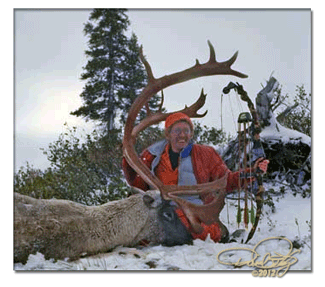
I'll never forget my first caribou bull with a bow, in that remote snow-covered land of northern Quebec.
photo Dave Richey ©2012
One of the most fascinating things about northern Quebec is how many lakes and rivers there are, and how few people inhabit the region. Some Montaignais Indians and a small group of Inuit from the sub-Arctic coast, and that's it for thousands of square miles of bush country.

My first Quebec-Labrador caribou hunt took place in 1971, and it left much to be desired. I saw two caribou, dropped the only bull with one shot, and that was it.

My next hunt was in 1974, and it was far different than my first outing. It was on the George River, north of Schefferville, Quebec, and near the Torngat Mountains. My Montaignais Indian guide, Peter Wanish, spoke very little pidgin English, a bit of French, but we managed to communicate with hand signals and a few spoken words.

Sign language proved useful between my guide and I

As all hunters can do, we learned to communicate.

We headed upstream through a series of rapids above Wedge Hills Lodge, and the sky was the color of soft putty. A cold wind blew out of the north, and we came to an area where the mighty river narrowed. My compound bow was ready, and we took up a position 10 feet uphill from the river bank as we kneeled behind some low-growing trees. We were near the edge of the tree-line, and our meager cover would have to do.

The weather turned colder, and then it began to snow. An hour later there was 12 inches of snow on the ground, and my Bushnell spotting scope was trained on the opposite shore a quarter-mile away. It wasn't needed.

Wanish muttered a guttural "Caribou!" and lifted his finger just off his lap and pointed. Caribou were filtering down toward the river, and stood there looking across. We didn't move, and the caribou stood at the waters edge, and more caribou began to pile up behind them.

The snow gained in intensity, and much of the time the animals could not be seen. And then, a stray gust of wind would flatten out the snow, and through the gauze-like haze of huge snow flakes, we would see them increasing in numbers on the opposite shore. I lifted my Bushnell  binoculars, and when next the snow cleared, there was a steady string of 'bou filtering down through the few trees off the hillside, and the animals just kept coming.

The heavy snow caused thousands of caribou to cross near us. This was an age-old migration route, and trails had been cut deep in the shorelines where generations of Quebec-Labrador caribou had traveled.

Now, after many such caribou hunts, and having taken 28 big ‘bou with double-shovels, I'm convinced that only three things make caribou move: Cold temperatures, heavy snow fall and because the animals decide they want to do so. Cold and snow is what hunters can depend on if the weather cooperates. Migration routs like this can be a hit or miss situation in this country in August and September, if the animals decide to move. It is with eagerness and a madly beating heart when they do.

His whispered warning: “Get ready, they’re coming. No move.”

We watched the animals pile up on the opposite side of the river, and then Wanish grunted again. "Caribou. In water. Swimming!"

He looked at me, signaled for me to get up on one knee and get ready for a close shot. He motioned me to stay behind our skimpy shoreline cover.

I looked across the river, and at least 1,000 caribou were in the river, swimming our way. Their heads were sweeping our shoreline with their eyes, their antlers interlocking with those of other bulls, and on they came as we remained motionless. We were where the animals wanted to go.

They would disappear from sight through the thick snow, and then we'd see them again. The current was swift but the caribou are strong swimmers, and their hollow hair serves as insulation and they seem to bob like a cork on the water.

I singled out a bull with a good rack and a white mane and waited

Once they were within 100 yards of us, they became more visible. A big white-main bull with long main beams, good mass on top, good bez tines and a double shovel was clearly the largest one that would make landfall near us. The other caribou was allowed to swim ashore and leave.

My attention remained riveted on that bull, and as he reached shallow water, he lurched slowly up near shore. Dozens of caribou had already walked past us, and we were just downwind of them. They climbed the hill behind us and disappeared.

The bull stepped ashore, stood on the sand and rocks, shook himself like a Labrador retriever shaking himself off after retrieving a duck, turned broadside to me, and I came to a full draw. Aiming, I had to wait for a cow to pass in front of me, and then made a smooth release on the bull.

The arrow disappeared behind the near-side front shoulder, and the animal stood there for several moments, and started up the hill and fell. From shot placement to death took less than five seconds. It didn't bother the other 'bou, and they just passed by his position on either side, and for 15 minutes it was a steady parade of caribou walking past.

That bull was mounted but his rack was never scored, and years later, I had another bull scored that was slightly smaller, and it made it into the Boone & Crockett record books. This animal is a bit wider, a bit higher, and has more scoreable points. One day I may have it mounted but it’s not necessary.

One day, that caribou may get scored but each time I look at him, all I see in my mind's eye is a huge snow fall, strong winds, and a massive caribou migration that put 2,000 to 3,000 animals past us that day. Believe it or now, hitting the caribou migration isn't easy.

Memories of other hunts may be come or go, or may be forgotten, but I'll never forget my first caribou bull with a bow, on a lonely northern Quebec rive shoreline, when the snow fell and the caribou just kept coming. It was a wilderness spectacle that  has stayed with me for many years, and will never go away.

Friday, April 20, 2012

Michigan wolves are increasing

Wolves are becoming more common in the midwest

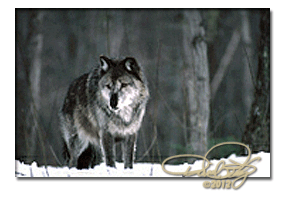
Wolves are increasing in Michigan
Wolves have been steadily increasing across the Upper Penninsula of Michigan. Protected for the latter half of the 20th century, they are now slated for culling once again.
photo Dave Richey ©2012
You love 'em or hate them. Wolves have few people who could care less about these apex predators.

Discussing Michigan wolves means people are either "for them" or "against them." Wolves, somewhat like black bear numbers, have a certain human acceptance or tolerance level.

Sadly, wolves kill other animals for dinner. Sometimes they kill things just to kill them, and it becomes a "sport." It's just what wolves are very good at doing.

Wolves have spread through the U.P. and parts of Lower Michigan

When predatory animal numbers exceed the social carrying capacity in that area, the local human residents find themselves quickly switch sides from "for" to "against." So, managing bears or wolves is as much about managing people as it is about managing wild animal populations.

It appears there are somewhere between 500-600 grey wolves in the Upper Peninsula, which includes Isle Royale, and best-guess scenarios have the animals well distributed from north to south and east to west. The number climbs in the spring when wolf pups are born, and drops slightly during winter months as some wolves perish for a variety of reasons.

Wolves are fascinating creatures, and here are some facts about Michigan's gray wolves that may be of interest to readers.

  • Key dates from 1838 to the present include: 1838 is when Michigan's legislature enacted a wolf bounty; 1840 was when wolves disappeared from the southern Lower Peninsula; 1910 was when wolves disappeared from the northern Lower Peninsula; 1954-1956 was when the last original verified wolf pup was produced in the Upper Peninsula; and 1965 was when wolves were legally protected.
  • Other dates of interest was 1974 when four wolves were trans-located to the Huron Mountain Area in the U.P. All four wolves were killed within a year; 1991 was the first year when documentation of the first wolf pup was produced in the U.P. in nearly 40 years; 1996 was when wolves were believed to be present in all U.P. counties; 1997 was when Michigan adopted the Michigan Gray Wolf Recovery & Management Plan; 2002 saw Michigan reclassifying its gray wolf population from endangered to threatened under the Michigan State Endangered Species Act; 2003 saw the Federal government reclassifying Michigan wolves from federally endangered to federally threatened; and 2004 saw the first documented return of the gray wolf to the northern Lower Peninsula where one was accidentally trapped and shot by a person who thought it was a coyote.
  • As of last year, Michigan's gray wolf population was about 500-550 animals. The breakdown since 1989 is as follows: 1989 showed a state mainland total of two wolves; 1991 saw 17 wolves; 1992 saw 21 wolves; 1993 had 30 wolves; 1994 showed 57 wolves in eight packs; 1995 found 80 wolves in 12 packs; 1996 showed 116 wolves in 16 packs; 1997 showed 112 wolves in 20+ packs; 1998 had 140-150 wolves in 20+ packs; 1999 showed 174 wolves in 30+ packs; 2000 had 216 wolves in 30+ packs; 2001 had 249 wolves in 30-50 packs; 2002 showed 278 wolves in 60 packs; 2003 had 321 wolves in 68 packs; 2004 found 360 wolves in 77+ packs and 2005 found 405 wolves in 86+ packs. It's unknown exactly how many wolves are present this year as pups were born earlier in the year.

Wolf numbers are steadily increase as deer numbers go down

One thing that holds true is some increase in Upper Peninsula wolf numbers is being seen, and the animals occasionally prey on farm animals. We're seeing the tip of the ice berg on wolf predation on cattle, sheep. etc., but wolves are preying heavily on whitetail deer, and to a much lesser degree, on U.P. and Isle Royale moose.

  • It's estimated that each gray wolf can consume 17-20 whitetail deer annually, states the Timber Wolf Alliance, a program of the Sigurd Olson Environmental Institute of Northland College in Ashland, Wisconsin.
  • Gray wolves (Canis lupus) are the largest member of the Canidae family. This family also includes coyotes and foxes.
  • Wolves do not necessarily require deep wilderness to survive. They can live anywhere there is an adequate food supply, enough suitable forest land to roam and, most importantly, human acceptance. Studying human acceptance is not easy, and many people who rather see them all dead.
  • Wolves are carnivores or meat-eating mammals that feed primarily on  beaver and deer, but also add to this diet some birds, small mammals and snowshoe hares. There has minor depredation complaints from farmers, and all complaints are investigated by the DNR and/or Federal officials.
  • A pack of wolves will cover at least 100 square miles or about three geographical townships. They can travel long distances quickly for short periods, but maintain a dog-like trot for 20 hours without resting.
  • In 2004, wolves killed 17 domestic animals including five dogs in the Upper Peninsula. Many bobcat, coyote and snowshoe hare hunters are lost each winter. If the dogs get too far from humans, and too close to wolves, Fido and his buddies get eaten.
  • Wolves survive as families in a pack system with a strong hierarchical structure of members that include: the alpha or apex male and female leaders of the pack, juveniles from previous litters, individual wolves that may not be genetically related plus pups from the present year. They work together to maintain the survival of the pack which leads to the survival of the individual animal. Packs are very dynamic, developing and breaking apart depending upon circumstances such as the death of an alpha male or female. The average number of wolves in a Michigan wolf pack is four to five animals, on average.
  • Isle Royale, in northern Lake Superior, belongs to Michigan. It has held wolves for many years, and in 2005, 30 wolves lived on the island where their primary food source are beavers and moose. The entire island is a National Park, and no hunting is allowed. The numbers of wolves on the Island has gone up and down for many years.

Wolves will go where their food is found but try to avoid humans

Wolves are survivors, and deadly predators. Killing other animals is what they do, and a pack is very efficient. Personally, would like to see some wolves in this state and throughout the upper Midwest states of Minnesota and Wisconsin.

Much thought is needed to determine the social carrying capacity of wolves in this and other states. However, if wolves prey too much on farm animals or deer in small areas, they will no longer be accepted by local residents.

The trick now is to determine that carrying capacity, and control wolf numbers before an all-out war breaks out as has happened in western states. Breaking laws to illegally remove wolves is not the answer.

Wednesday, April 18, 2012

Apathy describes many anglers and hunters

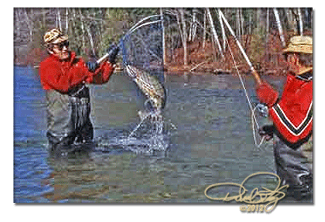
What would spring fishing be like without steelhead?

Apathy is killing our outdoor heritage activities. Speak UP for hunting and angling activities. If we don't we'll loose them.
photo Dave Richey ©2012
Does apathy adequately describe many of Michigan's anglers and hunters? I think it does. For those who haven't visited a dictionary, apathy means a lack of emotion or feeling or a sense of indifference.

An election in 2006 proved that most hunters didn't care much about a Michigan dove hunt. The measure got whipped in a bad way, and few hunters seemed very upset about it. No one seemed to care.

Folks, believe it or not, but that vote for a Michigan dove season went much deeper than keeping state sportsmen from shooting mourning doves. It was the first big step in a long parade of other items that can and one day will be stuck on the ballot. The next one might directly affect something you feel strongly about.

Would apathy keep people from fighting for their country?

How would you feel if it was put to a vote to end archery hunting. Or,  the next vote may be to prohibit firearm hunting for deer and/or other game species. It might come to a vote to outlaw dogs while hunting which would affect most bird hunters and bear, bobcat, coyote and fox hunting. Don't think so? Dream on!

Does anyone out there understand that the anti-hunters whupped us on the dove issue? Why, because many hunters are apathetic. They don't care enough to get involved. They wait for others to fight their battles for them. Read again the definition of apathy. It's present here.

I know a guy who whined about the dove season being defeated. The man has never voted for anything (including presidential elections) in his life, never discussed hunting issues with anyone other than his buddies, and he was most upset when I told him he didn't deserve the opportunity to whine and gripe. That behavior is reserved for those who have enough courage and gumption to vote.

People who don't vote on issues of importance to anglers and hunters should have no say in how a democracy is run. And trust me on this: anti-hunters know that sportsmen are unwilling to take a stand, and many folks claim to be too busy to vote. Say what?

Who among these unenlightened sportsmen is willing to wake up and see what goes on around them. They gripe and complain about a possible raise in license fees, but when the sporting segment of this country needs help to fight anti-hunting measures, where are these folks? They are too busy to care. Apathy reigns supreme.

Many avoid the voting booth as if the curtains were coated with asbestos. The day of letting others fight our battles is over. People who want to hunt, now and in the future, had best realize that forces are underway to eliminate all types of hunting. Wake up!

The deer kill was down last year. It also was down the year before last, and likely will be down again this year. Do you care? As a hunter, aren't you concerned about a declining deer herd? You should be

Will the same people who are against legalized hunting want to ban ownership of firearms? What will happen to our wildlife if the DNR has no money to manage it, which has already happened. Will the United States become neutered like Australia and Great Britain? Does anyone care? People need to get a grip on reality soon.

An out-of-control deer herd is entirely possible. The state has worked hard for years to reduce the herd size, and in many areas, they did their job too well and the deer numbers are way down. We saw the results of this problem the last two years. Each person can make a difference but they must get off their backside, learn what the really important issues are and get involved.

Michigan United Conservation Clubs, the state's largest conservation organization, is trying to fight the good fight. They keep people posted on what is happening, but MUCC membership rolls have shrunk dramatically from their highs of 20-30 years ago.

Why? The short and ugly answer is public apathy. Sportsmen no longer care about joining groups. They often say they don't have time or money to be a member. And for some that is probably true.

Others have different priorities. Where fishing and hunting was once their good time, bowling and golf may have replaced some of the leisure time activities. Others simply are not joiners, and care little about joining Delta Waterfowl, Ducks Unlimited, National Rifle Association, Trout Unlimited and many other excellent organizations that are trying to fight for all sportsmen.

Where do we go from here? I'm one man, preaching to the choir and to those who enjoy reading about the outdoors and who has nothing against hunting, but I'm only one man. I'm not a one-man army.

Speak up and show some true American spirit

Others must stand up and be heard. They must stand and fight the good fight. Are you willing to step up to the plate for our fishing and hunting and wise management of those resources?

I've heard it many times at a conservation club, Kiwanis meetings, or in other places. People actually ask me to fight their battles for them. I'm just one man with one voice, but they must make their voices heard. Sportsmen must become involved before it is too late.

Hunters of all stripes, whether bird hunters or a bear and deer hunter, must unite under one common banner to endorse all forms of legal hunting and be prepared to vote on critical issues. If one method of hunting is lost, as happened on the dove issue, anti-hunters will go after the next least defensible hunting method. Will it be bow hunting as many believe?

It could be dog ownership which would hurt hunters who use a pooch for their sport. If they don't support bear and deer hunting, and treeing coons with a hound or chasing bunnies with a beagle, than it is quite likely their lack of action will help future anti-hunters win.

The past issue was supposedly about dove hunting. That's nonsense. It was simply the first nail in the coffin of legalized hunting in this state, and hundreds of thousands of hunters stood by and watched it happen.

How sad. And who will feel sorry for you when your favorite fishing or hunting sport comes up on a ballot, and one by one, our outdoor pleasures and heritage are taken away from us because apathetic sportsmen don't care enough to become involved?

Or because they are too lazy, and cannot comprehend what is happening to them. It's time for many people to wake up, smell the coffee brewing, pull on their boots and fight for our hunting heritage.

It really is worth fighting for. Grow up, wake up, and fight. And if we lose part of outdoor heritage because of apathy, don't come whining to me to fight even harder. I've fought this battle for more than 50 years.

What exactly have you done?

Tuesday, April 17, 2012

Looking forward to the trout opener

Sometimes I enjoy big-water fishing off the beach

Michigan trout opener, harbinger of new fishing season
Michigan's trout opener hits the waterways the last Saturday in April. Grear up for another great year of fishing.
photo Dave Richey ©2012
My memories of the general-season trout opener are strung out now over 60 years, back to those days when my late twin brother George and I would have a visual race. It was to see who would be the first to spot the Sturgeon River glinting through the late-April sunlight.

Spotting the river first was as much fun as hooking a fish. We would count down the days to the opener, and in those days, a desperate anticipation overcame us. We were ready, and had been primed for the opener for many lean months.

It became a visceral thing. We could feel it coming, and each check mark on the calendar brought us one day closer to when we could fish our beloved Sturgeon River between Wolverine and Indian River in Cheboygan County.

We could sense the thrill and excitement deep in our guts

We could easily remember the first cold chill of the river current gripping our skinny little legs. We'd pick the brain of George Yontz, the steelhead guru of Hillside Camp, three miles north of Wolverine on old M-27.

We had fresh six-pound line on our reel, sharp No. 6 or 8 Eagle Claw gold hooks, and carried our treasured jars of Atlas salmon eggs. They sold for a buck a jar in those days, but salmon eggs produced better than worms or other bait.

Those early days meant a limit catch of 10 trout per day, and the Wolverine Hatchery and its hatchery truck planted fish just before the opener. It took years of catching lots of small trout in Phase 1 of our trout-fishing education before we arrived at Phase 2. That was when we'd had enough of the tiddlers and wanted more than a flip-flopping small trout.

We were primed and ready. It was an adventure for us

We wanted bigger fish, and it wasn't long before we were catching our fair share of steelhead. That phase of catching big fish stuck with us for many years before we graduated to accepting the challenge of meeting and greeting our trout in tough places where catching any trout -- large or small -- was a difficult challenge.

Many opening days have passed with the speed of an old man racing headlong through life, each year passing even faster than the previous one. To think that 60 years have gone by, and I've been out there for every opener to capture the moment with fly rod, spinning rod of camera, is a testament to my devotion to these grand game fish.

There have been a few openers where the Blue Wing Olives and Hendrickson's hatched well, but more often, the opener produced high winds, rain, and very often snow, and the fishing wasn't worth beans.

Art Neumann of Saginaw always handled the countdown

However, trout fishing isn't all about catching fish. It means meeting old friends, discussing past openers, learning who had fished around their last bend, who was ill and couldn't fish, and where the hot-spots might be later in the day.

For 23 years I covered the opener for the newspaper, and that usually meant very little fishing. Sometimes, if the action was good, I could shoot photos and write my copy, and still have time to fish for an hour or two.

Trout fishing also was George's love, and we shared so many wonderful days together on so many Michigan streams, and each one brought both of us a sense of peace and tranquility. We often didn't talk because twins know what the other is thinking. It's true in many cases, and especially for us. We didn't need to speak.

George and I could always communicate without talking

Many times I'd nod my head, George would spot the Hendrickson lift off the surface, and we both marveled at this transformation from a nymph to a flying insect. Sometimes a grunt and a look would indicate a mink running the bank or the flash of a trout under a sweeper.

We spent so many years greeting the dawn somewhere on a trout stream. We both loved the Holy Waters of the AuSable and Manistee rivers, but sometimes we would be on a steelhead stream or fishing a back-of-beyond beaver pond. Tiny cedar-shrouded jump-across creeks and brook trout were on the agenda at times, and occasionally we would fly-fish trout lakes.

Trout fishing, unlike a sport where a score is kept, was much closer to being a deeply religious experience to us. It was something we felt strongly about, and although in George's later years he would rather fly fish for bluegills than trout, he never lost his love of trout, trout fishing and the places where these game fish live.

It's up to me to carry on that tradition alone or perhaps with my son, David. But even that is out of the question this year as he heads for Florida to fish for tarpon.

I still enjoy fishing alone, do so often

It's OK, because sometimes fishing alone puts a person in a much different mood. We become more humble, easily satisfied, and we thrill to the magic of a rise, and we always are blessed to just be there for one more trout opener.

And just think, we have less than two weeks before the state-wide season opens on the last Saturday in April. I don't know where I'll be, but it will be on trout water, somewhere. Bet on it!

Monday, April 16, 2012

Ever taken a gobbler with a muzzleloading shotgun?

A nice beard on a very nice spring gobbler

Nice bearded tom turkey
Blackpowder and spring turkey hunting are like soup and sandwich; they go together - just keep the moisture out of the mix.
photo Dave Richey ©2012
Several years ago I killed a 24 1/2-pound long-beard gobbler while hunting in Iowa. My firearm of choice was a Knight muzzleloading shotgun with 150 grains of Pyrodex and two ounces of copper-plated No. 5 shot.

My first day of hunting with Tony Knight saw us spook a pair of roosted gobblers while opening a rusted and squeaky farm gate. Later, as we proceeded to look for unspooked birds, we stopped and began to call.

A nearby gobbler answered, walked right down the edge of an open field in broad daylight, gobbling his brains out, and one shot at 40 yards took care of him.

An easy shot with a muzzleloading shotgun

Mind you, 150 grains of Pyrodex and a two-ounce load of shot, produces a good bit of felt recoil. It wasn't excessive, but 100 grains of powder suits my moods much better.

The load isn't the issue here. I'm trying to decide in advance of April 30 whether to try with a muzzleloader this spring during my hunting period. It worked well for me three years ago, and it was great fun, and the Knight muzzleloading shotgun is very tightly choked, and it works like a dream when shooting at 40-50 yards.

Mind you, I don't like to shoot gobblers that far out unless I can boost the downrange velocity without scattering bird-shot all over the place. I have no qualms with shooting a 50-caliber front-loader with an extra-full choke  and two ounces of shot and three Pyrodex 50 grain at that range.

Five years ago, I sat down, and began calling an hour after daybreak, as rain and snow fell in a deluge. Fifteen hens and gobblers filed past me at 20 yards. The two big gobblers in the bunch had several hens between me and them.

Moisture in the barrel turned to sludge when mixed with snow

They disappeared from sight, and I waited another 30 minutes for those birds to move off, yelped once, and here comes a single gobbler running across an open field. He ran every step of the way until he was 30 yards out, and then he stopped, raised his head and began looking around.

I had a red-dot sight on my muzzleloading shotgun, and put the dot where his head and neck meet, and pulled the trigger. A sharp pop sounded, and the gobbler ran off like the hounds of hell were eating at his tail feathers.

The old adage of "Keep Your Powder Dry" came to mind, and I walked out to the car and drove 10 miles home. The muzzleloader was taken apart, the saboted shot cup and shot, and the black gooey stuff that used to be Pyrodex pellets, was pushed out the barrel. I had forgotten to put a latex thumb from a rubber glove over the muzzle to keep the rain out while i quickly set up my one-man tent blind.

What works is patterning a regular or muzzleloading shotgun

I really wanted to take another gobbler with the muzzleloading shotgun, but I have a Remington Model 870 pump 3-inch magnum 12 gauge shotgun that looks as it has been used to sink fence posts, but the shotgun is over 30 years old, and it shoots copper-plated No. 5 shot very well.

It comes with a sling, as does my muzzleloader, and it has produced gobblers from Alabama to Michigan. When the trigger is pulled, the bird dies. With it, my choice is to shoot birds at 30-35 yards. It has a full choke, but not the extra-full turkey choke found on many muzzleloading shotguns.

It is like an old friend. The stock fits well against my cheek, and nestles comfortably against my shoulder, and my good right eye lines up easily with the fiber optic sight.

The 12 gauge is a bit lighter than a muzzleloading shotgun to carry, and on a cross-country hike to find gobblers after the initial dawn action, that regular shotgun can be a big point in its favor. However, the muzzleloader has an extra-tight choke, and can easily kill birds at 50 yards if I choose to take a shot at that distance (which I've only done once). Make a decision which one to use and pattern it well.

Either firearm is fine by me, and in all honesty, shooting a gobbler isn't what tugs me gently into the turkey woods before dawn. It is the opportunity to attempt calling another bird within easy shotgun range. Sometimes it works and sometimes it doesn't, but for me, being there and having a gobbler circle me at dawn is what my hunt is all about.

Pulling the trigger and killing the gobbler is nothing more than a heavy layer of frosting on my turkey-hunting cake.