Showing posts with label follow. Show all posts

Tuesday, February 22, 2011

Write me a story

Dave Richey invites readers to submit a story for possible publication.


C'mon. Admit it. You've always had a hankering to write an outdoor story. One on fishing or hunting, and have it published.

Well, boys and girls, this is your golden opportunity. Here's the chance you've been waiting for. Let's get a bit of business out of the way first before I fill you in on what I need.

Right up front comes the bad news. I am not willing to pay anything for your masterpiece. No one pays me so I'm not going to pay you. However, I won't accept just any story. I want you to write me a query letter first, and send it to me, dave@daverichey.com. The query should be no more than 500 words, and it should tell me exactly what your story is about. If you have good, high quality color photos, tell me what you have.

Follow the explicit directions. I've mentored many great writers.


The story itself:

  • should run 750 words
  • I'll give you 50 words to work with
  • send it in a .doc format document
  • end it with a brief cover letter
    • NAME
    • ADDRESS
    • CITY, STATE, ZIP
    • PHONE NUMBER [ (area code) xxx-xxxx ]


Do not send a story until you've sent me the query letter, and I have returned your note with permission to send the story. Unsolicited stories will be rejected out of hand. People who write for magazines have all these hoops to jump through so I'm treating my space on my blog like they treat their magazine space.


I am soliciting your query letter on a topic of your choice, and hopefully with good photos. if your query letter is accepted, and I assign you the story, you have a month (30 days) deadline to write and send the story. I retain the right to accept or reject any story for any reason.


Stories must be
  • in good taste
  • feature no profanity
  • and not be filled with "fluff" words to build up the word count
  • stories of libelous nature will not be returned

I've edited four magazines during my career, and it's up to you to do it right the first time.


The story must be
  • typed,
  • double-spaced, and
  • written in 14-point bold (Geneva, Times or a similar font)

My vision is bad, and whatever you can do to help me read your manuscript is a point in your favor. It often pays off when trying to convince an editor to look at your story.


Some helpful hints for any beginning writer.

  • Write on a topic that you know very well. Only typed stories will be considered.
  • Write on things I write about. Search the archives of my site to gain a better idea of what I want. For example: stories on bear hunting, deer hunting, grouse hunting, turkey hunting, steelhead fishing, salmon fishing, catching bedded bluegills, bass fishing, etc. Treat fish and game with respect.
  • In your query letter, define exactly what the story will contain. A story needs a lead, a middle and an end. The lead is the first two paragraphs of the story. Use them wisely to capture my attention, and make me want to read the entire story rather than write a short rejection note.
  • If you don't know how to spell, use a dictionary or spell-check feature on your computer.
  • The two most overworked words are "the" and "that". Avoid them whenever possible.
  • Paragraphs should be no more than two or three sentences. Don't send me sentences that take up half a page. Plan your story with the lead, and then transition into the body of the story, and when you are done, stop writing. Most first-time writers fill a story with nonsense or b.s., and I've been at this business for 44 years. Write the truth in as few words as possible. Go back and read some stories I've written on your choice of topics and see how I handled it. Do not copy what I have written because to use something very similar to my copy is to copy me. Plagiarism is an ugly word among writers, and it tends to upset people. Be you, not me.
  • I retain the right to edit at will, and I will edit. I don't edit just to change things; I edit to make your story better. That's why they call people like me editors.


This is my challenge to you -- write a 750-word fishing-hunting story for me.


So pull yourself away from the television set, give it two or three days of thought,, and tell me a story that you think me and my many thousands of readers will want to read. I don't expect a Pulitzer piece for your first story, but I'd like to see a nice story on a fishing or hunting topic that pleases you, and I'd like to see you work hard on it.

Write it from beginning to end, set it aside for a day or two, go back through and read it again. One of the best editing tools is to read it aloud. Do this, and you'll stumble over a poorly written sentence. Figure out what needs to be done to avoid that bump in the road.

Your reward will find your story published on my website. It ain't much, but who knows, perhaps this is the kick in the pants you need to get started. One day you might find your name on a story in a big magazine that will reward you with a hefty check.

This is your chance. Let's see how many gutsy people we have out there.

Friday, February 18, 2011

Make outdoor ethics count

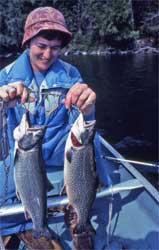
Kay landed two big brook trout  but stopped fishing then. She'd had enough.
Outdoor ethics are like dipping snuff. It doesn't agree with everyone, and for some, it leaves them feeling cold and sneezzy. Ethics, often unlike laws, are rules that rule our pitdppr conduct.

Ethics are more easily understood when explained in this manner. Ethics are those things you wouldn't do if you knew a conservation officer was watching from a distance.

They are those hard-to-explain things that keep sportsmen from breaking fish or game laws if we knew an officer was in the area. For most of us, ethics and knowledge of our fish and game laws run hand-in-hand. We won't break the law under any situation.

Ethics keep honest people honest in the woods and on the water.

That's fine, as far as it goes, but it's a gross oversimplification of a very complex personal outdoor issue that all sportsmen must think about. And, frankly, these issues baffle many sportsmen.

Outdoor ethics are those complex but unquestionable rules that sportsmen must adhere to whether other people are watching or not. They are those things we must endorse if fishing and hunting is to survive this century.

Want a few examples? Chew on these on these little tidbits:
  • I had six chances to arrow a big 10-point two years ago. He always showed up from two to five minutes after legal shooting time had ended. No one was within a half-mile of me, and no one would have known if I had cheated by shooting that buck a few minutes late.
No one, that is, except me. It would have ate at my guts like a malignant tumor until the taking of that big 10-point buck would have been reduced to a humiliating experience. It would have ruined my hunt as well as my perception of myself as a law abiding sportsman.
  • One night last fall I climbed into my bow stand, tried to remove my wallet from my back pocket, and discovered it wasn't there. My bow license was home on the dresser in my bill-fold. I had a valid deer-hunting license but it wasn't in my immediate possession so my bow was stowed away in its soft case and lowered to the ground.
That evening was spent watching deer through binoculars. It was a fun evening, even without a bow in my hands.

I wouldn't have been able to eat a tenderloin steak if  I'd shot late.

  • A big problem with outdoor ethics is they are impossible to legislate and difficult for many people to understand. Only one person – you or me – can deal with these ethical situations whenever a potential problem arises.
  • For instance: we shoot a rooster pheasant and it drifts across a fence on set wings and falls onto posted land. Does shooting that bird give us the legal right to pursue it without landowner permission? Nope! The ethical sportsman would determine who owned the property, and make every attempt to gain permission to cross the property line.
What happens when it's virtually impossible to track down the absentee landowner? No one wants to see the game go to waste. The next decision would be to contact the closest conservation officer. If he says you can't cross the line without permission, it still remains an ethical and legal question. Cross without permission means breaking the law. Do you go or stay? Laws and ethics. Right or wrong. It always pays to do the right thing.
  • We're fishing flies-only water for native brown trout and a stiff breeze puts down the mayfly hatch. Is it ethical to fish worms here? The answer, both ethically and legally, is no.
  • Or, as I mentioned earlier about the 10-point buck, could I have cheated in that instance and shot? Sure, but I would have had to deal with my emotions and my personal sense of right or wrong and any resulting guilt.
  • Mallards pinwheel down on a freshening breeze to spill into the bobbing decoys. It's a perfect morning, and it's five minutes before legal shooting time. Hunters in a nearby blind shoot and drop two hen mallards. Does that make it legal for me to shoot early?
We all know the obvious answer is “No” but some sportsmen would shoot any way, and be ticketed by a conservation officer. If they are not caught, they must still deal with their conscience as well as state and federal laws.

Ethics prevent us from doing illegal or quasi-illegal acts. Hunters don't shoot ducks on the water or grouse on the ground or off tree limbs. We don't snag fish, and we don't keep undersized fish or fish over our legal limit. We don't ignore slot limits wherever they exist. Such things are just not done. Buying a fishing or hunting license is no guarantee of a full game bag, a trophy buck, a hefty creel or a brace of pheasants. The license only grant us an opportunity to fish or hunt during the legal season. It offers sportsmen nothing more and nothing less than the opportunity to participate in these pastimes.

Ethical behavior is a topic as personal as the color of our morning toothbrush. It also serves as the bare-bones foundation on which our sports are built.

We are judged by our conduct, in and out of the field bu others, and those who wink at fish or game law violations or encourage any breach of ethical conduct, do themselves and others a great disservice.

If we can't fish or hunt ethically, and within the confines of the laws that pertain to these pastimes, we should not be considered sportsmen. If we have to worry about being caught by a conservation officer and ticketed, it may be necessary for some people to re-examine the reasons they fish or hunt.

Wednesday, January 05, 2011

Doggin’ the fox


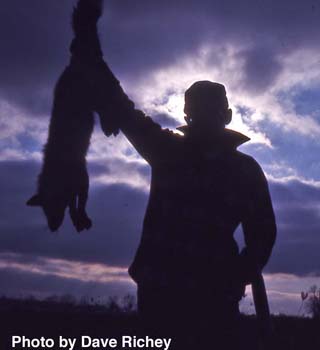
Brother George with a nice red fox he shot while doggin’ the tracks.


Many years ago there were far more red foxes than coyotes, and one of the things almost every winter day was to cut a fresh red fox track, and take off cross-country on foot along the straight-as-a-string trail.

Once I was driving to brother George's house, and spotted a fresh track that crossed the road a quarter-mile from his place. I stopped, got out of the car, and studied it. The track was smoking hot.

George and I put our heads together, and he felt the fox would probably skirt behind the barn, head off across the open field, hunt those fields for mice, and then settle down for a nap atop a clump of uprooted trees a half-mile from his house.

Two people working together is always a good plan.


We took turns dogging the tracks, and it was his turn. I'd lag behind, check ahead through binoculars, and try to make certain we didn't accidentally bump the critter. We headed out on the hot track, and the fox did cut behind the barn, moved down a hill, and crossed the field.

I glassed the track from cover, and lost them near a patch of sumac this side of a fence row 300 yards away, and on the other side of the fence was the tree-tops that would provide a sunny hiding place for a napping fox.

We eased through the field, spotted several areas where the fox had tried for a mouse, but the tracks stay straight until it came to a small knoll, and we bellied up to the edge of the knoll. More fox stalks are blown when people rush to see what is on the other side, and blunder into the fox. Once spooked, the animal will run for a long distance.

My head just eased over the top, and I glassed everything within view. The fox was nowhere to be seen, but its tracks cut through the field, into a cluster of sumac bushes near the hill-top, and we couldn't see the tracks past there.

We huddled, and whispered back and forth, and felt if the fox wasn't in the sumac, which we didn't believe possible, we'd have a reasonably clear look at the tree-tops. Perhaps the fox was already sunning himself.

I studied the sumac until my eyes were watering, and couldn't see tracks coming out. We had to keep going while we were fairly close to the animal. Stalling now could ruin the hunt.

We crossed the open field and approached the sumacs with caution. We could then see the fox tracks heading toward the fence line and the nasty mass of tree-tops scattered about like jackstraws.

Be ready to move but make sure the fox isn’t in sight before moving.


"I can see his tracks down to the fence," George whispered. "Check the tree-tops, and see if you can spot him. We'll stick out like two sore thumbs while crossing the field to the fence row."

Long minutes were spent glassing the tree-tops before I spotted the reddish-russet color of the bedded fox. He was facing away, directly into the wind, and we formulated plans. I would give George hand signals, and a palm raised upright meant for him to stop.

He watched a minute or two longer, saw the fox raise his head and check his back trail. We waited until he checked his back trail the second time, and we had five minutes. As soon as his head went down, George stayed low and ran for the fence only 40 yards from the fox.

He eased into place just as the fox's head came up to look around, and when it went down, I moved out. We met at the fence, and George pointed to a hole in the fence that would put him only 25 yards from the fox but he couldn't make a sound getting into position.

The fox looked around again, and when his head went down, George crawled to the hole, and snaked through. He had to depend on me now to tell him when the fox raised his head again.

Don’t shoot until the animal presents a clear shot.


Two minutes later the fox raised his head, and I made one small hand movement to George. He raised his 12 gauge 3-inch magnum, started to aim and the fox stood up when it caught the movement, and with one shot this fox hunt was over.

Stalking fox is no different than stalking bedded coyotes. Work into the wind, check closely before making a move, and when the stalk leads to a close shot, make it count. It's an exciting way to spend part of a mid-winter day, especially this time of year when foxes and coyotes are in the mating season, but not with each other.

The two species are deadly enemies, and a coyote will kill every fox they can catch. One rule hunters can count on: if fox are abundant, there aren't many coyotes around. However, if coyotes are thick, very few fox exist in the area.

Are you reading for the challenge of dogging a fox track to the animal's resting place. There's little margin for error.

Drove around square-mile sections until you find a coyote or fox track. Check the other roads to make certain the animal didn't cross out, and if it is still within the section, take up the track if you have permission to hunt someone else's land.

Move slowly with all possible haste, check ahead for the animal, don't move until the coast is clear, and always stay downwind if possible. It a great way to spend a snowy winter afternoon.

Posted via email from Dave Richey Outdoors