Sunday, May 08, 2011

Light line, small spinners & big spring crappies

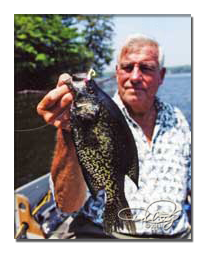
John Cartier holds a nice black crappie


The late John Cartier with a big crappie from Michigan's Hamlin Lake.


Very few things about fishing are really new. Granted, new reels, lines and lures may be new and different, but when it comes to catching fish, new techniques are slow to be developed. Most of what we really know is isn't really new, but  occasionally an angler may find it new to them,

I'm so mindful of a day I spent several years ago with the late John Cartier of Ludington, Mich. He was the long-time regional field editor for Outdoor Life magazine, and he was writing a book on cooking fish. My wife Kay was doing the lay-out for his self-published book, and we were visiting. A mix of business and pleasure.

“Feel like catching a bunch of crappies?” he asked. “It's mid-May, and I've got a sure-fire method for locating these tasty game fish, and once we've found them we can anchor and cast to the fish. Pere Marquette Lake has an excellent population of them.

The hope of learning a new fishing method was good news to me.


I'm almost always game for catching fish, and was more than a little curious about his method. It turned out that his method was a take-off on an old method of slow trolling a No. 0 Mepps Aglia spinner with a silver or gold blade. He tied a short leader to the hooks, tied in a No. 12 treble hook, draped part of a nightcrawler on the treble hook, and began trolling it slowly over eight feet of water.

“The trick,” he said, as we began letting out our lines on both sides of the boat, “is to troll this rig about 40-feet behind a slow-moving boat. Set your drag fairly light because crappies have a paper-thin mouth. A tight drag will tear the hooks out and you'll lose the fish.”

We'd covered perhaps 30 feet, when my ultra-light rod with 6-pound line jerked back toward the stern of the boat, and no hook-set was needed. I saluted the fish softly, and the black-and-white speckled crappie rose to the surface behind the boat. In he came, and the first of many crappies went into our live basket.

“Seen this method before?” Cartier asked. “I've been using it for many years, and it's a quick and easy way to find crappie concentrations in the spring. We'll keep trolling, and see if we can find a bunch of them. There are several fish shelters of old Christmas trees up ahead that a neighbor placed on the ice several years ago, and they are weighted down with cement blocks. The fish like to suspend around those brushpiles.”

We headed that way, and less than a minute later, just as Cartier told me we were going past the brush, we had a strike at the same time. Both of us were soon lost in the delight of hooking slab crappies on light line. He netted mine and then his, and held up both fish for inspection.

These crappies were big fish and hard fighters.

They were about 14 inches long with a big mouth, and when laid in Cartier's palm, they covered his hand and wrist. They followed their cousin into the wire mesh live well.

I told Cartier the only difference between my method and his was I used a small willow-leaf spinner with a single long-shank No. 10 gold hook. The method meant keeping the lure down about four feet, zigzagging a little one way or the other, and never getting into too deep water this early in the season. The fish like the lures presented slow, a good distance behind the boat, and the spinner blade barely turning over. Using a small electric trolling motor allows a slow and quiet approach when these fish are in the shallows.

“What I like about this particular method is that it's quite easy to survey a small lake or to section off various areas on a larger body of water, and it seldom takes long to find the fish. I usually start fishing in shallow back bays with a black marl bottom and some vegetation, brush or weeds. The water warms faster here, and that gets spring fish going.

This little bay was near his lakeside home. and it wasn't hardly big enough to be called a bay but it produced some nice fish. We head on down the lake, and finally found a spot where we caught several fish. We anchored, and began casting the same rig.

The crappies were there, and apparently hungry. We caught one fish after another, and soon had caught a limit  each of these tasty fish.

We each caught a limit of fine-eating game fish.


“It's time to quit,” he said. “We can head in, clean the fish and there's nothing better than a passel of spring crappies deep fried to a golden brown. Cartier's fish cook book has numerous recipes that can be used for cooking crappies, and he had a captive audience of hungry people.

He deep-fried some of the fish, and grilled some with another of his recipes, and along with some fried potatoes and baked beans, it was a fitting end to a fine day with an old friend. His fish recipes are interchangeable, and just a recipie and try it. Cartier been gone for a few years now, but this hard-boiled outdoor writer was a good and kind friend, an excellent writer and very knowledgeable about fishing and hunting. And I miss him.

Note: I have a few copies of his book, Best Fish Ever.
  • Only a few copies remain
  • If interested send a check for $15.95; postpaid to

David Richey
c/o Scoop's Books
PO Box 192
Grawn, MI 49637

Saturday, May 07, 2011

Forget all the arguments & just go deer hunting.


Hunters will never see a buck tasting the air if they don't hunt.


Millions of deer hunters are found across this great nation, and we all seem to have different philosophies on hunting. We seldom agree on wildly varying topics.

Some hunters refuse to hunt various wind directions. Anything from the east is bad. For years, October featured south and southwest winds and then west and northwest, and by December we were hunting northwest, north and northeasterly winds.

My philosophy is that a deer hunter won't get much hunting in if they sit out every day with a bad wind. I hunt but switch from an open tree stand to an elevated and enclosed coop on such days. A few stands are set up primarily for an east wind, and they are in demand when the wind goes sour.

The best hunting option is to hunt as often as possible.


Many are the deer hunters who believe they should only hunt during the dark of the moon. Others only hunt the week before the full moon, and others never hunt during a full moon.

There are those who believe in hunting around the Harvest Moon, the Hunters Moon, the Rutting Moon, and some who will only hunt just before the second full moon after the autumnal equinox. The nice thing about living in a free society is each of us can indulge ourselves in such personal pleasures.

I personally don't care which day of the week it may be, which way the wind blows, what the moon phase happens to be, or anything else. I find it difficult to kill deer while sitting in the house rather than being out hunting.

There are others who place great emphasis on hunting the rut. Little do they know that the 10 days before the full rut begins, deer go through the chasing stage or the pre-rut. It is a wonderful time to be hunting, regardless of the moon phase or wind direction.

Many feel the rut begins Oct. 20-25, and that is the beginning of the chasing stage, and it will last for about 10 days before the full rut begins. It's possible to find many people who would disagree on when the rut actually begins.

The peak of the rut in my hunting area will occur on or about Nov. 3-4, and it is winding down before the Nov. 15 firearm season kicks off.

Weather patterns have a major influence on deer travel.


There are variations, depending on where you hunt. Weather conditions and people pressure can alter these dates a bit.

Some hunters are addicted to the Solunar Tables. These tables, first invented by John Alden Knight many years ago, are based on the sun and moon and their effect on tides and the earth. They contend there are normally two minor and two major periods each day when fish bite, and when wild game move about.

Some sportsmen hunt according to the Solunar Tables and kill deer, and I know other folks who hunt whenever they can, and they also have good hunting success while hunting outside of these major and minor periods.

Forget most of this and just go hunting and watch the wind.


I've hunted many years with great success. Good hunting habits bring wonderful hunting success, and simply being afield whenever possible is a good reason for being more successful.

I forget about all this other business, and go on doing what works best for me. That means that I hunt whenever possible, and try to hunt every day of the season.

Take the normal precautions with the wind, stay downwind of the deer, and it becomes fairly easy to build a reputation of being a successful deer hunter.

Friday, May 06, 2011

Spring is big brown-trout time


Casey Richey (left) and his son Shane, with his former state-record brown.


All things are relative. A trophy brown when I was a kid was the 11-pounder that George Yontz of Wolverine caught from the Sturgeon River in the late 1950s.

Frankly, over many years of trolling Lake Huron and Lake Michigan for brown trout, I've landed many that were big enough to put a hefty strain on my rod, and would tilt the scales to weights from 11 to 19 pounds.

The brown trout is a mystery fish to many anglers. A five-pound brown on the Holy Waters of the upper AuSable and Manistee rivers is a trophy fish. Fish one of those back-of-beyond jump-across creeks, and catch a brown trout measuring 12 inches, and it too is a trophy.

Brown trout numbers have dwindled somewhat in recent years around the Great Lakes. Previously, browns of 20 to 25 pounds were common catches, and the current state record fish was caught two years ago from the Manistee River below Tippy Dam. It weighed in at 41 pounds, 7.2 ounces.

Big brown trout are around but they are difficult to hook and harder to land.


Big browns are where you find them. Most harbors on Lakes Huron and Michigan produce some big fish. For many years, Thunder Bay at Alpena was home to some of the state's biggest browns and the area continue to produce some big fish.

Some very nice fish have been caught trolling in Hammond Bay north of Rogers City, and the area near AuGres off Whitestone Point has produced some very nice fish as well.

Huron Bay at Baraga and L'Anse on Lake Superior also produce good numbers of brown trout in the past. Another Upper Peninsula hotspot for years has been along the Michigan's shoreline from Escanaba and Little Bay de Noc south to Menominee. Ten-pound fish were common catches here, and I've caught some 11 and 12-pounders near Escanaba.

Lake Michigan's Grand Traverse Bay, including both arms of the bay, have produced some huge browns. My son David hooked a huge fish on a Rapala years ago, played it with a gentle hand, and lost it when the lure broke apart. Three of us saw that fish, and our closest estimate to its weight was 25 pounds. In higher waters of yesteryear, the Acme Reel along US-31 was a real hotspot.

Harbors at Frankfort, Onekama, Manistee and Ludington also produce big brown trout on occasion. Even some of the southerly ports such as Saugatuck and South Haven have delivered good numbers of browns.

Some key fishing methods for Great Lakes brown trout.


It's possible to cast spoons off breakwalls or piers at these harbors, and a blue-silver, green-silver, orange-silver, all silver, copper, brass, pearl or other color 1/4 or 1/3-oz. Devle Dog spoons work well. Experiment with sinking time, retrieval speeds and vary between casting straight out off the pier or casting parallel to the pier if no one is in the way.

Trolling produces very well, and the trick is to work in and out of shallow water during the spring months. Years ago, Jack Duffy pioneered this offshore fishery, brought me in on it, and between us, we pounded the big browns for many years. The methods that follow worked for us, and they continue to produce.

We always used 6-pound line, and trolled two types of lures: wobbling plugs (X-4, X-5 and U-20 FlatFish to be exact) or minnow-imitating plugs like the Rapala, Rebel, Long-A Bomber or FasTrac. Hot colors were silver, silver-black, chartreuse-orange and gold-black in the latter category. FlatFish colors were silver, silver with red spots or pearl.

FlatFish required a very slow trolling speed, and we'd test lures next to the boat to see if they tracked straight. If so, slowly release line until the lures at least 100 yards behind the boat, and put them into rodholders. Some anglers prefer trolling off in-line planer boards.

Minnow-imitating lures can be trolled faster than FlatFish, but tie a loop knot to the lure's line tie to open up its wiggle. Again, let two lures out at the same time and speed for about 100 yards, and put the rods in rod holders. Adjust reel drags so a brown can take line on the strike.

Big browns almost always rip off an additional 50-75 yards of line on the strike. Reel the other line in to get them out of the way, and play the fish gently. Often, browns will strike and run toward the boat. Reel fast and hard, and you may be pleasantly surprised when you catch up to the fish when it is about 25 yards behind the boat.

Great Lakes browns grow to be the largest but some big ones come from rivers.


Browns occasionally jump, and most often will roll on the surface. Once they get close to the boat, be prepared for one or more last-ditch efforts by the fish. Watch its head, and if the head cocks to one side or the other, he is planning another run. Let the fish go, and don't try to pressure them on 6-pound line. A big fish will break the line like sewing thread.

Try trolling near the edges and tips of piers, along the mud line where river water meets lake water, and off a river mouth. Gravel or rocky bars in six to 15 feet of water can be good spots, and the key to good brown trout fishing is an abundance of alewives or smelt.

Catching big browns these days is not easy but my nephew, Casey Richey of Frankfort, set a new state record a few years ago. His record was broken last year with a massive fish from the Manistee River. The big fish are around, but scoring means putting in a lot of time.

Fish smart, play big fish with a soft hand and good luck!

Thursday, May 05, 2011

Slow down, drive defensively, save money, fuel & a deer's life

A tag is needed to keep a car-killed deer.


A buddy called today, and his spring deer report wasn't good. He was shocked by the carnage on Michigan's highways.

He'd driven from near Cadillac down highway M-115 to US-10, and then east to Bay City, down I-75 to Flint and back, all in one day. What he saw over 300 round-trip miles was sad.

He saw deer. Dead dead. Lots and lots of dead deer & other animals.


"There were dead animals everywhere," he said. "Leaving Cadillac, I began counting carcasses and major bloody pieces of pavement where deer and other critters had been hit. There were an incredible number of flattened deer.

"I saw 67 dead deer, coons, possums, and other critters between Cadillac and the US-10 expressway. Many were nothing but bloody lumps of hair and large blood stains. Some deer were hit, and bounced off to the side of the road, and I'd wager there were more deer and other animals that I didn't see."

He said it was equally bad between the M-115 and the US-10 freeway junction, and I-75 at Bay City. He counted well over 60 deer in that stretch. Some were so destroyed by an impact with an 18-wheeler and other vehicles as to be near unrecognizable except for their size.

"There were deer in the median, dead deer on the shoulders, and in two or three places I had to swerve to avoid dead deer in the road. It seems such a tragic waste, but no one appears to be slowing down.

And therein is the problem. The past several nights have been reasonably warm, and deer come up to graze on grasses and weeds growing alongside the highways. People, in their perpetual rush to go somewhere and get there fast, slam into them without much warning.

Most car-deer crashes come without any warning. One must stay alert.


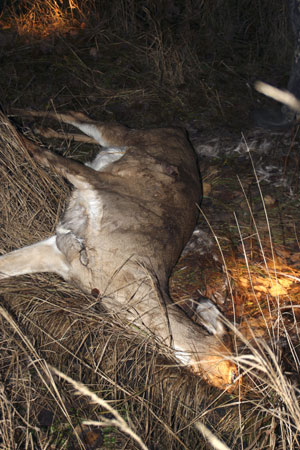
Car-killed deer often litter road-sides.


A friend that lives in the north delivers newspapers after midnight, seven days a week. He killed three deer during the winter months, and had several near misses. Speed in this case was not the cause. The deer often run down driveways in the dark, and bang into his car.

Normally, the deer die in this uneven contest an easily moved animal being hit by a speeding vehicle. Occasionally, deer hurtle up over the hood and through the front windshield. Every year thousands of car-deer accidents occur, and in some cases, humans get injured or killed in these wrecks.

Spring months are almost as deadly as the autumn when rut-crazed deer cross roads without stopping. There are some basic rules for safe driving if only people will heed this advice.

Gas is too costly to waste by driving fast, and speed kills deer & some people.


  • Slow down. Besides saving gasoline, which when last I looked, was $4.15 per gallon, and increasing the miles-per-gallon ratio, also would allow more braking time if a deer jumps in front of the vehicle.
  • Those "deer crossing" signs erected along state highways serve a greater purpose than as road ornaments to amuse bored drivers. They are placed in certain locations because it is a well-used deer crossing site. Such areas funnel deer movements, and the animals can quickly jump out in front of a vehicle without warning.
  • Newly growing grasses and weeds attract feeding deer. Areas where salt has been used also attract deer to road edges. Does, soon to drop this year's fawns, frequent roadsides at night.
  • Speed Kills means more than running head-on into another vehicle. Too much speed, and a collision with a deer, is due cause for many accidents and injuries every year. In some cases, the vehicle doesn't have to hit the deer. The driver swerves, misses the animal, and loses control, rolls over, hits a tree or nose-dives into a ditch. All can be hazardous to your health.
  • Driving defensively applies as much to deer as it does to watching for stupid drivers who drive too fast, swerve in and out of traffic, and who pay little attention to traffic and road signs. To drive defensively in deer country (which now covers the entire state including the Detroit area) means slowing down, using caution, looking ahead and to both sides of the road for deer eyes that are reflected in the headlights. If one deer crosses the road in front of you, slow down because there often are others coming behind, and beware of the deer that stands transfixed in the headlights. That deer is confused, and may run in any direction.
  • Dawn and dusk are key times for high deer movement. However, many deer are hit in broad daylight as well. The defensive driving suggestion applies to daylight hours as well as during the evening.
  • Some drivers believe in those little deer whistles that mount on the vehicle's grille. Do they work? It depends on who you talk to, but I don't use them but that doesn't mean you shouldn't.

Follow these tips when driving in deer country.


Car-deer accidents are a fact of life in this and many other states with high deer numbers. Not only is killing the deer a terrible waste (except for feeding crows, eagles and other scavengers), it is very costly. Car insurance rates are high enough without smashing up a vehicle by hitting a deer.

Highway carnage is a problem every year when one or two tons of vehicle meets 100 or more pounds of deer. The impact is predictable in most cases: the deer dies, the vehicle gets busted up, insurance companies whine and raise their rates, and if humans are lucky, no one gets injured or dies in the crash.

Slow down and take it easy in deer country. The life you save may be your own.

Wednesday, May 04, 2011

Become a doer rather than a procrastinator


Hey! If this buck keeps coming closer, are you going to shoot or think about it?


Those who have taken a Dale Carnegie course come out of it with an attitude. This 'tude is what some bow and turkey hunters need. They must think positively and act.

Some people develop a false hunting attitude where they think they can shoot a buck or gobbler. Those with the right mindset don't think they can; they know that when a shot is imminent, they will kill that critter.

There is a huge difference between thinking you can and knowing you can. Thinkers are doing just that. They think too much, and by the time their mind solves the issue, the deer is gone or offers only a low-percentage shot. They miss an opportunity by thinking too much.

Shooting game means doing so without thinking. Just develop an attitude.


How can a bow hunter go from being a thinker to a doer. It's really pretty easy.

They practice constantly on targets at distances consistent with their skill levels. They have confidence in their ability to shoot straight without having to think things out before drawing their bow.

They size up the opportunity, and have enough confidence in themselves and their arrow shooting ability to come to full draw at the right time and deliver a killing shot.

Confidence is the key word in this whole discussion. Confidence comes from knowing you can do it and then do it right. Any questionable thoughts just eat away at your confidence and a shot is usually missed. Good hunters, if faced with a questionable situation, won't shoot.

Good hunters know that a familiarity with deer or turkeys, and especially bucks or gobblers, is important. A sizable whitetail buck steps out within easy shooting distance, and the decision is made and the arrow is released in much less time than it takes to read this sentence.

Establish a buck has antler big enough to suit you and shoot at the right time.


The thinker, if he were sitting side-by-side with the confident doer, would still be evaluating the situation while the hunter has shot the animal. Thinkers deliberate and procrastinate, and doers shoot.

This doesn't mean the doers don't think. They size up the animal, raise the bow, aim and shoot in one fluid movement. Their mind, because they have a large amount of self confidence, instantly knows this is a shooter. The doer, if the animal switches positions, also can stop and wait if necessary.

This type of positive thinking comes from looking at a great many deer, learning to size them up, and being able to draw, aim and shoot without consciously thinking about it. Shooting becomes second nature.

Some people have enormous amounts of self confidence and some do not. Those who lack this confidence building skill must spend more time outdoors, and spend more time in close proximity to game.

Think of it this way. The wind is your greatest enemy because it allows deer to smell you. Your next worst enemy is the inability to sit still. Learn to conquer both items, and you'll have gained a large measure of self confidence.

The next step is to have a buck or gobbler within easy shooting range. Things change dramatically from when the deer is 100 yards away to when it is within 15 yards. The closer a buck gets, the more a thinker starts concentrating on the antlers than where the arrow must go.

A lack of concentration is the hallmark of the thinker. The doer is five steps ahead in his ability to draw, aim and shoot in a second or two.

The thinker also procrastinates. Learn deer body language, and a hunter can often tell if a deer is about to walk or run off or stay in the area. The longer a deer stands nearby, the longer the thinker studies the antlers, and the longer it takes to shoot.

Let's go back to high school exams. It's easy to tell the right answers, but some questions are more difficult. Often, studies show, the person's first instinct is right in a yes-no or multiple-choice question. It's when students begin to second-guess themselves, deny their original instinct and thought, that they often provide the incorrect answer.

Develop an attitude that allows an instant decision to be made and act on it.


Bow hunting is similar in many respects. Dawdle or think too much, and the opportunity walks off into thick cover while you dither about. This doesn't mean that hunters must rush their shot, because in most cases, they have more time to draw, aim and shoot than they think.

The doer recognizes that ideal moment, and instinctively reacts to it without conscious thought. Ninety-nine percent of the time, when the bow comes back to full draw, a shot quickly follows. The entire shooting experience becomes instinctive.

Deer act on instinct as well. There is no reason a hunter can't develop the same style of instinctive reaction to a quality shot opportunity. Shooting a deer with a bow should become instinctive, and mind you, learning how to do it doesn't come overnight.

Only consistent quality practice, being near deer or gobblers, being able to read a buck or gobbler's 's body language, and doing these things often, will lead to becoming a better hunter.

An old friend had a saying that seems to sum up this hunting philosophy: "They don't ask 'can you?'; they ask 'did you?"

The doers can, all the time, and the thinkers can, only on occasion. The summer months are a great time to work at becoming a doer rather than a thinker. In the long run it will pay off.

Tuesday, May 03, 2011

Working on our tree stands


An open tree stand like this means a hunter can't move a muscle. I prefer more cover, especially on both side and above me.


I've hunted from wide-open tree stands and from stands that have just enough room through which to shoot. Which do I like best?

The answer, for me at least, is obvious. It's easy for me to sit still, and I'm always positioned so a buck will never wind me, but the truth is, either tree stand will work if the hunter is downwind from deer and can sit still.

My preference leans heavily in favor of cover. I love cedar and pine trees, and have been known to fill in a few holey spots with boughs cut elsewhere on my property. I don't want to be entirely screened by brush in a tree, but my idea is to have enough limbs and branches nearby to provide what I need for enough cover to break up my silhouette.

Work to mute the light from dawn or dusk to create shadows.


I like a mix of shadows and light, and an unbroken dark blob can be as revealing to a deer as a wide-open area with a big blob in the middle. The trick is to achieve some sense of shadowy balance; not too much and not too little.

The hunter needs enough room to draw, aim and shoot with a bow. The hunter doesn't need to be worrying about bumping limbs or hitting them while taking a shot. It's possible to be so concealed you can't shoot.

On the other hand, it helps to have some background foliage behind you. A good stand needs some cover to the right and left sides, and some cover from cedar or pine boughs overhead will add to the shadowed effect that we need.

What a deer sees is what is most important to hunters. All trees, even thick cedars and pines, have gaps where light shows through. I just don't want too much light shining through where I'm sitting. I want the area to be shadowed but not completely blacked out.

Create your stands now & brush them in early for deer season.


One trick some hunters use is to prepare their stand now. Hopefully they know where deer will travel, where they come from and where they go, and then have one person stand on the ground at the ideal location for a shot.

Study the area like an artist studies a landscape, and determine what needs some help in the way of pine boughs and what doesn't. Be careful when adding boughs so the fresh-cut limb ends will not be visible by deer. Heavy twine can be used to tie the boughs in place.

Have a buddy climb into the stand and you hunker down in a squatting position at the height of a deer's head, and study it. Pay close attention to what looks like the proper blend of shadows and softer but lighter areas. Limbs placed horizontally three or four feet overhead will add to the shadowed effect, and sometimes it is just a matter of putting a clump of pine needles in the right spot to make it work.

My reason for loving cedar and pine trees is there is year 'round foliage plus the natural scent of the trees. One hour of work on a tree stand can improve its effectiveness.

Of special importance is to complete this job as soon as possible. Don't wait until mid-September to do it or you are liable to spook deer from this stand location.

Do it right & ways in and ways out & it can be a good stand for years.


A buddy of mine had a similar set-up, and hunted the same tree for 10 years until someone sneaked in and started hunting it when he was elsewhere or not hunting that day. They rearranged pine boughs to suit themselves, and soon the stand was worthless.

Should you decide to do this, treat the area like it is your private morel mushroom patch or your favorite ruffed grouse or woodcock covert. Don't breathe a word of it to anyone, and hunt it by yourself.

Good stands remain good only as long as no one else can climb into them when the hunter isn't looking. Trespass on private land is a major problem, and hunters who brag about shooting a big buck from a particular area are simply offering others an unwelcome invitation.

Keep quiet, don't tell anyone where it is, and have two or three ways to get into it and out of it after hunting. Sometimes it's worth hiking an extra half-mile to avoid detection. All's fair in love, war and hunting whitetails from a tree stand.

Sunday, May 01, 2011

Returning to an old, favorite steelhead stream


A nice steelhead for the Old Man. One is enough for me these days.


Decades ago, there was a place on the Little Manistee River that was almost like home. It had many shallow gravel bars where steelhead spawned, and rather than charging off elsewhere, my son David and I chose to returned to my hotspot from the late 1960s.

"If that's where you want to fish," I'm happy to tag along. "Show me a place you haven't showed me before." He and I had fished a good many spots but there were a bunch he had yet to see.

So I did, and it was like going back in time. And he fell in love with it just as I did 45 years ago. No, sorry, but I'm not revealing its exact location although I can get you fairly close.

Taking a big step back in time brought us to the Little Manistee River.


The river, between the 9 Mile and 6 Mile bridge, was running low, fast and clear that day as we stepped into the river. Strongly felt was the old familiar tightening of water pressure against my legs as we began wading slowly upstream in hopes of finding a leftover steelhead or two.

We poked along slowly, easing into the current, checking out gravel bars for the dish-shaped white overturned gravel from the fanning of a hen steelhead's tail. The bed is slightly upstream from the white gravel at the tail-end of the bed. Some people wonder why these beds are white, and the quick and easy answer is this gravel has been turned over as a hen digs her spawning redd.

David, much younger than the old man, has speed to burn. I nodded for him to charge off in his personal quest for a lively steelhead while I walked slowly, stopped often, and looked for the near-invisible shadow of a fresh hen or the darker and blockier shape of a male.

I covered 200 yards, and stood motionless, looking near a fallen log that had toppled into the river. My vision, at best, is poor but I know what to look for and quickly found it.

First came the dark shadowy shape of a male holding in slightly deeper water along the edge of the redd. The water was four feet deep here, and I studied it for 10 minutes. The trick is to locate both fish before starting to cast to them.

I just fish for male steelhead. Hooking a female can ruin the fishing.


Make a mistake at this point, and hook the female, and she is gone and the males will vanish with her. I studied the bed, both sides of it, and finally found her holding next to a log 10 feet downstream from the redd. The female was bright silver in the sunshine, and she was very close to being invisible. At first I couldn't see her, but then I spotted her shadow, and then she became instantly visible. It's a matter of knowing what to look for, and any skill at spotting these fish comes from many years of experience.

She was in an impossible spot to fish, even if I was stupid enough to try for her. The male held alongside the redd, and in a perfect location. My line was lengthened, and reading the current speed and depth gave me the ideal spot to cast. My orange yarn fly drifted downstream along bottom, and the fish moved away from it.

The fly was lifted out, cast again, and again the male moved aside and allowed the fly to drift past. Time after time I cast, and each time the male slid away, but he was becoming agitated, and on the 20th or 30th cast, he grabbed the fly and the hook was pounded home.

That fish ripped off on a downstream run, ran past the hen, went between two fallen logs, and wheeled in midstream, splashed out of the water in a corkscrewing jump, and ran back upstream. He took 10 yards of line upstream from me, rolled on the surface, and headed back down and turned. He bulldozed into a submerged brush pile in front of me, and in less than a second tangled my line and broke off.

I moved back up to shore, sat down, tied on another orange yarn fly, and rested the spot. It took 30 minutes before the hen moved back into her holding position, and 15 minutes later, the male reappeared. This time there was something different: an orange yarn fly was firmly embedded in the corner of his mouth.

Hooking and losing a nice buck steelhead was exciting.


It took at least an hour for both fish to settle down, and I admired the day and the scenic beauty of this portion of the river. It seemed a great day to be alive. Upstream, I heard David talking to himself as a fish splashed. He was into a steelhead, and was telling the world about it.

My male with the lip decoration lay beside the female, and she let loose a jet of yellow eggs as both fish rolled on their sides, mouth agape, and he fertilized the eggs. I got a good look at the hen, and she was flat-bellied and had successfully spawned.

She headed into a log jam and disappeared from sight. She would now rest, and I had no problem casting again to the solitary male. This time he was more eager, and grabbed the orange fly on the second drift but he'd learned his previous lesson well. He darted into the brush, twisted around, and the hook pulled free.

Minutes later David came back downstream. He had landed a nice male and released it, and said he had covered over a mile of river and saw just those two fish.

Was it a perfect day? The weather was wonderful though a bit windy, and we each found a male fish to cast to. David hooked and landed his and released the big 12-pound buck, and I hooked and lost the same fish twice. Did  we have a good time?

The answer was an emphatic "yes!" We fished several other areas that day, and never saw another steelhead. But, finding two males and hooking both of them, was just part of a perfect day. Fishing a spot I hadn't fished in 30 years was a bonus, and it was nice to know that fish still hold in the same locations as they did more than 40 years ago.

David will soon be in Alaska running his fishing boat, and I'm here and lacking company. Perhaps I'll return to that spot, but it's more likely I'll try another spot I haven't fished in years. Going it alone doesn't bother me, and sometimes I count myself lucky to still be able to fish for steelhead.

I'll soon be 72 years old, but fly fishing is much like shooting pool. Once you learn how, it only takes a bit of practice to become proficient. I'll never be as good at this type of fishing I was 40 years ago, but that's just fine. One fish is enough to make me fall in love with steelhead all over again.