Showing posts with label little. Show all posts

Monday, August 01, 2011

Litte things can change a hunt

Little things count. Wait for the right time to shoot and hit the vitals.

Many hunters think of bow hunting as a huge-antlered buck standing motionless at 20 yard with nothing between you except a few low-growing weeds and empty air.

This so-called calendar pose is what many short-term bow hunters expect to see while hunting. They've been conditioned over many years to expect such a big-as-life pose, no matter how unrealistic such thoughts may be.

The same hunters seldom think of spotting a nice buck, his head held low, as it ghosts through a cedar swamp or tag alder tangle. The truth is that while an occasional shot is taken at a broadside, head-in-the-air buck, the reality is much different than what our imagination tells us to expect. Wishful thinking seldom aids bow hunters in the field.

No matter how insignificant things may seem, the truth is deer rely on instinct.


The little things about bow hunting should tell us that a buck seldom offers an easy, open shot. Often, the animal is partially screened by brush or is standing in thick cover. Deer often stop when their vitals are screened by thick brush, not on purpose but by instinct.

One of the little things hunters must learn, and practice faithfully, is ro develop an extraordinary amount of patience. Hunters who get strung out by a motionless buck that doesn't move are usually unprepared for a shot when the deer does come within range.

Patience is something all of us must believe in. It's always better to sit motionless, and if the buck doesn't move before shooting time ends, chalk it up to another night when the deer outsmarted the hunter. Such things happen far more often than most of us care to admit.

Sitting motionless and silent is far preferable than trying a Hail Mary shot that may make it through the brush to the buck's vitals, but for whatever reason, it rarely does. Taking a low-percentage shot only educates or wounds deer.


There have been countless times when I've spent 30 minutes to one hour waiting for a good buck to move that last 10 feet to offer an open shot. More often than not, they refuse to budge and shooting time ends with the animal still standing motionless in thick cover, still looking around.

Another little thing to remember is to stay in your stand until the buck moves off by himself. Start crawling down out of a tree, and you'll have ruined that stand for the rest of the year. Just hang tight, remain silent, and let him move when the mood strikes him. Wait for someone to come looking for you, and let them spook the deer rather than you doing so.

Building your patience level doesn't occurs overnight. It takes time and a great deal of practice, and blowing some possible shot opportunities, before you acquire the necessary skills to wait out a slow-moving deer.

Don't do something stupid if the buck is slowly making his way to you. Perhaps you are in his travel route, and if you sit patiently, the buck may move to you. If you haven't been calling, and suddenly start calling to a nearby deer, the animal may turn away. It may or may not spook, but if the deer keeps coming to silence, don't introduce something new into the equation because it could backfire.

Keep a clear head, and think about what you are doing.


Be very cautious about dropping things. I've seen bucks and does stop 50 yards away because they saw something they don't like. I once watched a buck come a long ways only to stop just out of easy bow range.

Why the buck stopped was beyond me, but stop he did, and he kept looking on the ground along the edge of a tag alder run between us. I studied him through binoculars, and tried to see what he was looking at, and it remained a big mystery.

He left without coming the 20 yards necessary to provide me with a clean shot within my established shooting distance. He walked off and soon disappeared, and as shooting time fell, I eased from the stand and walked over to that spot.

It took a moment of looking around but I found what had spooked the deer. A hunter had moved through that area while hunting grouse and woodcock near the alders, and apparently had shot at a bird.

Little things can spook a wary buck. Police your hunting area.


I found an empty 12 gauge shotshell, and it was laying somewhat in the open where the setting sun would glint off the brass. It wasn't much, but from where the buck had stood, there was still a tiny glint of sunlight there. The buck knew something was different, and turned and traveled another route.

It's some of these little things that can make or break a bow hunt. Always be aware of what is going on around you during a hunt because it can affect how deer react.

Sunday, May 01, 2011

Returning to an old, favorite steelhead stream


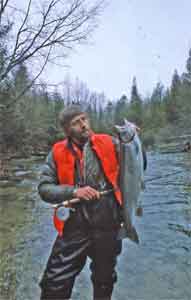
A nice steelhead for the Old Man. One is enough for me these days.


Decades ago, there was a place on the Little Manistee River that was almost like home. It had many shallow gravel bars where steelhead spawned, and rather than charging off elsewhere, my son David and I chose to returned to my hotspot from the late 1960s.

"If that's where you want to fish," I'm happy to tag along. "Show me a place you haven't showed me before." He and I had fished a good many spots but there were a bunch he had yet to see.

So I did, and it was like going back in time. And he fell in love with it just as I did 45 years ago. No, sorry, but I'm not revealing its exact location although I can get you fairly close.

Taking a big step back in time brought us to the Little Manistee River.


The river, between the 9 Mile and 6 Mile bridge, was running low, fast and clear that day as we stepped into the river. Strongly felt was the old familiar tightening of water pressure against my legs as we began wading slowly upstream in hopes of finding a leftover steelhead or two.

We poked along slowly, easing into the current, checking out gravel bars for the dish-shaped white overturned gravel from the fanning of a hen steelhead's tail. The bed is slightly upstream from the white gravel at the tail-end of the bed. Some people wonder why these beds are white, and the quick and easy answer is this gravel has been turned over as a hen digs her spawning redd.

David, much younger than the old man, has speed to burn. I nodded for him to charge off in his personal quest for a lively steelhead while I walked slowly, stopped often, and looked for the near-invisible shadow of a fresh hen or the darker and blockier shape of a male.

I covered 200 yards, and stood motionless, looking near a fallen log that had toppled into the river. My vision, at best, is poor but I know what to look for and quickly found it.

First came the dark shadowy shape of a male holding in slightly deeper water along the edge of the redd. The water was four feet deep here, and I studied it for 10 minutes. The trick is to locate both fish before starting to cast to them.

I just fish for male steelhead. Hooking a female can ruin the fishing.


Make a mistake at this point, and hook the female, and she is gone and the males will vanish with her. I studied the bed, both sides of it, and finally found her holding next to a log 10 feet downstream from the redd. The female was bright silver in the sunshine, and she was very close to being invisible. At first I couldn't see her, but then I spotted her shadow, and then she became instantly visible. It's a matter of knowing what to look for, and any skill at spotting these fish comes from many years of experience.

She was in an impossible spot to fish, even if I was stupid enough to try for her. The male held alongside the redd, and in a perfect location. My line was lengthened, and reading the current speed and depth gave me the ideal spot to cast. My orange yarn fly drifted downstream along bottom, and the fish moved away from it.

The fly was lifted out, cast again, and again the male moved aside and allowed the fly to drift past. Time after time I cast, and each time the male slid away, but he was becoming agitated, and on the 20th or 30th cast, he grabbed the fly and the hook was pounded home.

That fish ripped off on a downstream run, ran past the hen, went between two fallen logs, and wheeled in midstream, splashed out of the water in a corkscrewing jump, and ran back upstream. He took 10 yards of line upstream from me, rolled on the surface, and headed back down and turned. He bulldozed into a submerged brush pile in front of me, and in less than a second tangled my line and broke off.

I moved back up to shore, sat down, tied on another orange yarn fly, and rested the spot. It took 30 minutes before the hen moved back into her holding position, and 15 minutes later, the male reappeared. This time there was something different: an orange yarn fly was firmly embedded in the corner of his mouth.

Hooking and losing a nice buck steelhead was exciting.


It took at least an hour for both fish to settle down, and I admired the day and the scenic beauty of this portion of the river. It seemed a great day to be alive. Upstream, I heard David talking to himself as a fish splashed. He was into a steelhead, and was telling the world about it.

My male with the lip decoration lay beside the female, and she let loose a jet of yellow eggs as both fish rolled on their sides, mouth agape, and he fertilized the eggs. I got a good look at the hen, and she was flat-bellied and had successfully spawned.

She headed into a log jam and disappeared from sight. She would now rest, and I had no problem casting again to the solitary male. This time he was more eager, and grabbed the orange fly on the second drift but he'd learned his previous lesson well. He darted into the brush, twisted around, and the hook pulled free.

Minutes later David came back downstream. He had landed a nice male and released it, and said he had covered over a mile of river and saw just those two fish.

Was it a perfect day? The weather was wonderful though a bit windy, and we each found a male fish to cast to. David hooked and landed his and released the big 12-pound buck, and I hooked and lost the same fish twice. Did  we have a good time?

The answer was an emphatic "yes!" We fished several other areas that day, and never saw another steelhead. But, finding two males and hooking both of them, was just part of a perfect day. Fishing a spot I hadn't fished in 30 years was a bonus, and it was nice to know that fish still hold in the same locations as they did more than 40 years ago.

David will soon be in Alaska running his fishing boat, and I'm here and lacking company. Perhaps I'll return to that spot, but it's more likely I'll try another spot I haven't fished in years. Going it alone doesn't bother me, and sometimes I count myself lucky to still be able to fish for steelhead.

I'll soon be 72 years old, but fly fishing is much like shooting pool. Once you learn how, it only takes a bit of practice to become proficient. I'll never be as good at this type of fishing I was 40 years ago, but that's just fine. One fish is enough to make me fall in love with steelhead all over again.

Tuesday, April 19, 2011

Little things can affect a hunt’s success


Patience and avoiding those little things that may go wrong can lead to success.

Many hunters think of bow hunting as a huge-antlered buck standing motionless at 20 yard with nothing but a few low-growing weeds and air between them and the deer.

This so-called calendar pose is what many short-term bow hunters expect to see while hunting. They've been conditioned over many years to expect such a shot, no matter how unrealistic it may be.

The same hunters seldom think of spotting a nice buck, his head held low, as it ghosts through a cedar swamp or tag alder tangle. The truth is that while an occasional shot is taken at a broadside, head-in-the-air buck, the reality is much different than what our imagination delivers.

It's often the little things than determine success or failure while bow hunting.


The little things about bow hunting reveal that more often than not a buck seldom offers easy, open shots. Often, the animal is partially screened by brush or is standing in thick cover. Deer often stop when their vitals are screened by thick brush.

One of the little things that hunters must learn, and practice faithfully, is patience. Hunters who get strung out by a motionless buck that doesn't move are usually unprepared for a shot when the deer does.

Patience is something all of us must believe in. It's always better to sit motionless, and if the buck doesn't move before shooting time ends, chalk it up to another night when the deer outsmarted the hunter. Such things happen far more often than we care to think about.

Sitting motionless and silent is the best alternative to trying a Hail Mary shot that may make it through the brush to the buck's vitals, but for whatever reason, it never does. Taking a low-percentage shot only educates or wounds the deer.

There have been countless times when I've spent 30 minutes to one hour waiting for a buck to move that last 10 feet to offer an open shot. More often than not, they refuse to budge and shooting time ends with the animal still standing motionless in thick cover.

Patience is a virtue when bow hunting for whitetail bucks.


Another little thing to remember is to stay in your stand until the buck moves off by himself. Start crawling down out of a tree, and you'll have ruined that stand for the rest of the year. Just hang tight, remain silent, and let him move when the mood strikes him.

Building your patience seldom happens overnight. It takes time and a great deal of practice, and blowing many possible opportunities, before you acquire the necessary skills to wait out the deer.

Don't do something stupid if the buck is slowly making his way to you. Perhaps you are in his travel route, and if you sit patiently, the buck will move to you. If you haven't been calling, and suddenly start calling to a nearby deer, the animal may turn away. It may or may not spook, but if the deer keeps coming to silence, don't introduce something new into the situation because things could backfire.

Be very cautious about dropping things. I've seen bucks and does stop 50 yards away because they have seen something they don't like. I once watched a buck come a long ways only to stop just out of easy bow range.

Why the buck stopped was beyond me, but stop he did, and he kept looking on the ground along the edge of a tag alder run between him and me. I studied him through binoculars, and tried to see what he was looking at, and it remained a big mystery.

Pay attention to the little things in your hunting area.


He left without coming the final 20 yards necessary to provide me with a clean shot within my established shooting distance. He walked off and soon disappear, and as shooting time fell, I eased from the stand and walked over to that spot.

It took a moment of looking around but I found what had spooked the deer. A hunter had moved through that area while hunting grouse and woodcock near the alders, and apparently had shot at a bird.

I found an empty 12 gauge shotshell, and it was laying somewhat in the open where the setting sun would glint off the brass. It wasn't much, but from where the buck had stood, there was still a tiny glint of sunlight there. The buck knew something was different, and turned and traveled another route.

It's the little things that can make or break a bow hunt. Always be aware of what is going on around you during a hunt because if can affect how deer react.