Sunday, November 20, 2011

What will it be, Mister?

Dave Richey checks carbon (left) and aluminum Robin Hoods.


Archery shop owners invariably ask the same question when hunters come in to buy arrow. What will it be, Mister?

There is very little discussion these days about arrow shaft construction. There are only three basic choices, and from there, several secondary choices to be made.

Aluminum, carbon or wood? Only some long bow and recurve bow shooters still shoot wood arrows although many have switched to either one of the other two choices. The secondary choices are manufacturer, size, weight and length.

Choose which shaft is best for your archery use.


Compound bow hunters are locked into a choice between aluminum and carbon, and there is little to discuss. Very few compound shooters still shoot aluminum shafts these days.

I still like aluminum shafts for bow hunting but much of the time carbon arrows are in my bow quiver. There was a time 15-20 years ago when aluminum arrows had a death grip on the  arrow market but times have changed.

In most archery shops, at least 90 percent of arrow sales are now carbon. Some other shops report 95 percent carbon over aluminum arrows.
Years ago there were plenty of arguments against carbon shafts, and many were unfounded. Some of the early carbon arrows were too skinny, some had ugly out-serts that attached to the shaft, and the broadhead screwed into the out-sert. Another argument that has passed by the boards was that carbon arrows would shatter inside a deer.

Believe me on this: some people resented carbon arrows and resisted using them. I told a friend he'd lose arrow sales if he didn't stock carbon, and soon I noticed that people were passing up his aluminum shafts and going elsewhere to buy carbon arrows. He soon learned he was losing money.

It took some time but he eventually began to stock carbon, and began shooting these new shafts. They flew extremely well, and that settled the argument for me. He now stocks and sells carbon arrows.

Carbon shafts, in testing, out-perform arrow shafts of other materials.


Why shoot carbon? One excellent reason is the arrows are extremely straight, and tolerance levels are much tighter (less than half of one percent) than with aluminum, in most cases. Several years ago Archery Business magazine found carbon arrows were more perfectly formed, more precise, and in most cases, stronger than aluminum.

The magazine said that Carbon Express shafts, and especially their Maxima and other shafts, had the tightest tolerances in the arrow industry. It means, that with practice, a hunter or target archer can become a better shot with these arrows.

Carbon arrow companies have relegated the skinny carbon shafts of yesteryear to the back shelf, and are producing shafts with much the same diameters as aluminum.

The bigger shafts help increase down-range energy, and this allows the arrow to hit with greater force. The down-range force produces better penetration, and with increased accuracy, this means a  chance for more killing shots.

Carbon arrows require a properly maintained and tuned bow. A bow that is out of whack won't shoot any arrow well.

This means the hunter needs a well-tuned bow, a quality bow rest, and a good mechanical release. They will help produce far more accurate shots than most people ever felt possible.

Most quality archery shops can do a fine job of tuning your bow, and it's common for people to bring their bows to any high quality archery shop for an annual tune-up.

A properly tuned compound bow and carbon arrow should be paper tuned. A properly tuned arrow will cut a perfect hole when shot through paper. Out-of-tune bows will cut or tear ragged holes with feathers or vanes cutting high, low, right or left when they go through the paper.

I've shot Carbon Express for years. No reason to change.


This requires further tuning, and when the rest, nocking point and other factors jell, there is a perfectly round hole. And, with the great line-up of bows which are now available, the straight-nock travel produced by these bows make for the most accurate compound bows on the market.

Some people continue to fight the trend toward carbon arrows. Some folks simply resist change.

A well-tuned bow, quality carbon shafts, a good rest, and a broadhead suited for that shaft, will make any bow hunter a much better shot at deer and targets.

Tough? A buddy of mine shot a black bear, Quebec-Labrador caribou and whitetail deer with one arrow. That's right -- one carbon arrow. He re-sharpened the broadhead after each kill, and the arrow was still straight after killing three big-game animals in one year.

One thing is that people who shoot carbon, or any other arrow shaft for that matter, must avoid shooting an arrow that has be dented or dinged by another arrow during practice. They could shatter. Check any arrow before shooting, and then shoot with confidence.

My belief in carbon shafts, with the proviso noted immediately above, puts a capital T and A on the two words -- Tough Arrows.

Saturday, November 19, 2011

Dreams of big Quebec char


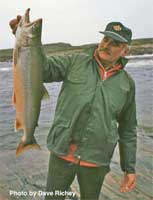
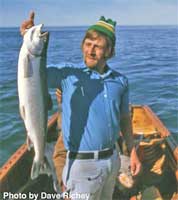
Doug Knight (left) and the author with a lightly colored & silvery char


The dream began sometime late last night. Many of my better dreams are remembered, and some are savored and occasionally one will haunt me for a day or two. This one was weird but true, as are most tales of fishing or hunting dreams from the far north.

My dreams often deal with fishing or hunting, and the odd thing is that many are dreams about things I’ve experienced sometime in the past. Last night’s dream was from 30 years ago and it's as vivid as it had just happened. It was my first trip where Arctic char were available, and it was a wonderful week spent catching the occasional Atlantic salmon, brook trout and char.

There was Ed Murphy from Sports Afield magazine, a man I'd sold many magazine articles to. He and the late Doug Knight, a freelance writer, and I were fishing at Bobby Snowball's camp at the mouth of Quebec's Tunulik River. Mind you, the Tunulik literally throws itself over a waterfall about 300 yards up-river from salt water, and the stream gradient from the falls to the salt is steep with haystacks of standing white water.

Getting to this area of Quebec’s Ungava Bay is a long plane ride.


I was accustomed to sight-fishing for visible fish, and Arctic char were our quarry. A few Atlantic salmon were mixed in with the char, and it took a heavy Dardevle to get down to the char holding at the edge of the fast water.

Bobby Snowball, an Inuit from Quebec's Ungava Bay region spoke fluent English as he met the plane. I'd made all the arrangements for the three of us on this trip, and he escorted me up the dock to the cabins where we would sleep. Children were throwing balls, and one of the balls bounced off a dead Inuit woman laying on the ground beside my tent.

"Uh, Bobby," I asked, trying not to be offensive but needing to know, "what's up with the dead woman?"

"Oh, that's my mother," he said. "She died three days ago and we're waiting for an airplane to come in and take her back to town. Hopefully, she will go out tomorrow."

The dead lady was a bit troubling but the feeling soon passed.

The fishing was nothing short of sensational. Large orange- or silvery-flanked fish held below the falls in the rushing white water, and by casting into the falling water and feeding six feet of slack line into the cast, the Dardevle was soon wobbling past their noses. Every tenth cast or so, a char would peel out of the group and savagely maul the lure.

These fish are uncommonly strong, and when swimming downstream, it took them 20 seconds to peel off line and make it to salt water. On the hook-up, I jumped from rock to rock (some as big as a single-story house), and to say I was leaping like a gazelle would be wrong. I felt more like a young hippo, and it had to have been a roller coaster ride for the fish.

Of all the char we caught only one jumped and it was at best a feeble attempt. However, the fight on 10-pound line was as tough a struggle as any angler could hope to experience. If a 12-pound char and a 15-pound Chinook salmon were tied tail to tail, the char would drag the salmon to its death. There is no quit in their fight, and once we reached salt water, the fish were still full of energy and every fight turned my wrist into a weary joint that became more weakened by the day.

The Inuit were a quiet but fun-loving group, and when we stopped for shore lunch, I soon learned to cook my own lunch of Arctic char. Bobby and his friends and neighbors would fare well at today's sushi bars. Their fish, wrapped in tin foil and tossed into the fire, weren't even warm in the middle when they began eating. We decided to cook our own fish, and the red flesh was delightful when cooked until done but not overcooked.

Fresh fish cooked on the rocky shoreline were tasty.


One fish would feed Knight, Murphy and me, and once we began cooking our own, we were soon hooked on the delicate flavor.

One sea-run brook trout was caught and I tangled with and landed two Atlantic salmon on spoons but they were returned. The Inuit told me they were legal to keep, but legal only for the Native People and not for visitors. For us, if one could be caught on a fly, it would have been a legal catch.

This particular trip was recalled in its entirety last night, and relayed here. The fishing was next-door to the best I've ever seen, and there is something haunting about watching herds of caribou migrate by within 50 yards while we battled fish with flanks the color of orange-pineapple ice cream.

And, best of all, the elderly dead lady vanished from outside my tent wall late the second day and I mentally wished her a safe journey, and I slept like a baby that night while dreaming of crimson-sided wilderness fish.

Friday, November 18, 2011

Big buck but no shot

Big bucks often catch a break 
by veering away from a hunter.


The big buck appeared like a ghost from a bad dream. One minute there was nothing nearby, and the next found me looking at a 140-class whitetail buck.

He was 75 yards away, moving in my general direction through the fringe of a swampy wooded area. He moved slowly and cautiously, the way big bucks do once they've been shot at.

This big boy was an old buck, and I saw him once the year before but such thoughts often leave something to the imagination. My guess was that he was 5 1/2 years old, and had survived this long by being smarter than the average buck.

Instincts play a major role in keeping big bucks safe.


He tested the wind constantly, stood for long minutes checking things out before committing to a move, and I knew where he was heading. A nearby corn field had been half picked, and the owner hoped to get all of the field harvested before the predicted weekend rain fell.

The buck nosed the ground, following the track made by an unseen deer for 10 yards before turning back on his course toward the corn. At this pace, it would reach the dinner table just after dark.

The question was whether he would reach me or pass out of range through marsh grass and scrub brush before shooting time ended. A doe came squirting out of the marsh grass, moving away from the buck. The rut was in full-drive, but she was nervous but he didn't pursue her.
His intentions seemed quite clear: reach the corn field right at dark, feed, terrorize the younger bucks and young does, and be back bedded down before daylight broke across the land.

He kept coming, and was soon 60 yards away. I've shot many bucks over the years, but this one was too grand an animal to try such an unwarranted shot in fairly thick cover. I never shoot at a buck that I'm not 100 percent confident of killing.

My bow was in my hand, and this was the largest buck I'd seen lately, but he would either come close enough for a slam-dunk easy shot or he'd continue on about his business.

He eventually reached the edge of thick cover, and would move through more open upland woods ... if he stayed his course. He would move out of the heavy cover and into the open, and then duck back in the cover, zigzagging ever closer to me.

He minced along like he had sore feet, and stopped every few steps. He was now 35 yards away, but still in heavy cover when his heavy white antlers could be seen. In fact, it was one glimpse of white antlers going up and down as he rubbed a tree that first caught my attention.

The wind was swinging a bit from north to northwest, and then he turned and seemed to move closer toward me. That turned out to be an illusion as he walked around a wind-toppled tree.

Sometimes bucks offer shots but are too far away. I don't take them.


My watch showed there was but 10 minutes of shooting time left, and he was now at 30 yards but still five yards inside thick cover. The suspense continued to build with each step he took, and the big question was whether he would start sliding toward the more open part of the funnel or stay back where it was thick.

I'd shot a number of bucks from this spot before, and all of them had walked into the thin part of the cover. One spot offered a 20-yard open shot but he was still 25 yards from it.

The clock was ticking, and even though I've shot bucks at this distance over many years, each one is a new adventure. Honestly, the wait is an adrenalin-filled rush. He stepped forward, almost to the edge of the thin cover, and I'm glancing at my watch.

There was five minutes left, and two more steps would put him into the opening where I'd have an easy broadside shot. He put his head down, rocked on his feet, but didn't move forward.

My bow was up, and I was ready to draw, but still he stood, rooted in one spot. And he was still standing there, two steps from a clean shot, when shooting time ran out.

Legal shooting time had ended without me shooting.


He was so close, and yet so far away, and he stood there for 10 more minutes before moving on toward the corn field. It was a wonderful hunt, filled with heart-pounding excitement right up until the end, and after he moved off, I headed home.

Knowing that buck is there is important. I may or may not shoot him, but I will hunt him again. He is too big to ignore but one wonders. Bucks in this area are like circuit-riding preachers from the Old West, and there is always the troubling thought of never seeing him again.
Time will tell. If I never see him again, I'll feel blessed to have seen him once on a snowy November day.

Thursday, November 17, 2011

Hay-bale blinds, where legal, are the warmest winter blinds

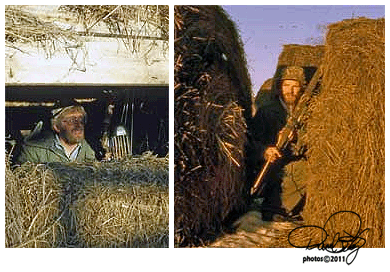
Two types of hay bale blinds. Sit back away from shooting area


The deadliest, most unconventional and warmest blind in the deer hunting woods has escaped many hunters. At first guess, many December hunters feel a heated on-the-ground or elevated stand is best.

Not me. For my money, a hay bale blind beats whatever else might come in second. It has many advantages, and only one disadvantage. Hunters afflicted with hay fever shouldn't hunt from a hay bale blind.

However, in Michigan where baiting rules exist, a hay bale blind could be considered illegal unless it is in a hay field with other hay bales, Even then, people who think they'd like to hunt from one should personally contact the conservation officer in their hunting area for advice.

Assume responsibility to learn if such blinds are legal


A group of retired conservation officers I am friends with say they feel it would be up to the individual officer to determine its legality.

Personally, I hunted from them many years ago before Michigan adopted laws and rules on baiting. However, that was then and this is now. I loved a hay bale blind years ago, and would jump at the chance to hunt from one again providing it was deemed legal. It may be legal in other states, and it's up to each hunter to determine whether the method is legal or not.

The solid points in favor of them are many and all are valid. Here are some good reasons to use such a blind in late November and December.

  • Hay bale blinds can be constructed from big round bales or the smaller and more manageable rectangular bales.
  • A round bale blind is made by putting two round bales together at an angle to form a capital "V". Put a sheet of one-inch marine plywood over the top, and stack six or eight rectangular bales on top to provide a warm roof over your head.
  • A rectangular blind requires quite a few rectangular bales. Pile as many bales up on the left and right sides, and behind you, and put a chair inside to sit on. Stack the bales at least two high in the front, and leave just enough room to shoot. Cover the top with plywood and more bales, and you are set. The disadvantage of this blind is if one or two bales get bumped, the blind could fall like a house of cards.
  • Of the two, my favorite is made from round bales. Five minutes with a tractor to move the two round bales together, laying a sheet of plywood on top and several rectangular bales on top of that and in front to form a shooting window will complete the blind.

It's possible to hunt from behind or between hay bales


  • Any hay blind placed before October in a key location will pay off when December rolls around. The deer get used to it, and by the time the winter archery season rolls around, it will entice deer to your area.
  • Key spots for a hay-bale set is near the edge of a cornfield, in an open field where two or more trails converge, or in a hay field that has abundant deer traffic.
  • This blind is warm. Unless the shooting window faces directly into the wind, this is the warmest blind there is. Wet hay builds a certain amount of heat, and hunters can stay warm in the most bitter weather.
  • Human odor isn't a problem with hay blinds. The heavier odor of hay serves to cover any human scent inside the blind.
  • It would be difficult to consider a hay-bale blind as a bait site although deer could occasionally eat some of it while a hunter is inside.
  • Of major importance to me, and to others who use such blinds, is they offer straight-out, horizontal shots at whitetails. There is none of the problems of shooting downward while sitting or standing in a cold tree stand or elevated coop, and deer often walk within six feet of a hay-bale blind. The shots can be impossibly easy to make unless the hunter suffers from buck fever.

Many things favor such blinds if regulations are not against them


  • The hay absorbs almost any noise. I've coughed, sneezed, and done other noisy things in a hay-bale blind in the past without having nearby deer hear me. Of course, any movement visible through the narrow shooting window can be spotted.
  • Is it too late to build a hay-bale blind? It depends on deer numbers in your area, the available food supply, whether you bait or don't bait, and how quickly the blind can be constructed. Deer often take three or four days, and sometimes as much as a week, to become accustomed to the blind.
If I were a hunter with a new hay blind, I would not sit in it for a week. The one exception to that would be if a major winter storm was due to hit that evening. Every deer in the area will be on the prowl before dark, and I'd suggest being in the new stand no later than 2 p.m.

If snow falls before the deer move, so much the better. It will help cover any human scent, and it can produce the occasional big buck.

Hay-bale blinds are not difficult to make, and they provide everything a December bow hunter could ask for: no scent, being as warm as toast, and being in a blind while the deer nibble around the edges of it. It doesn't get much better than that.

Just remember: It is your sole responsibility to determine whether such blinds are legal where you hunt. If you don't check first, it's your bad because you've been warned.

Wednesday, November 09, 2011

Bob Jennings: Book Review - My Mythical Adventures with Bird Dogs

MY MYTHICAL ADVENTURES WITH BIRD DOGS, by Bob Jennings.

Bob Jennings has this book available for $30 postpaid. Send payment to: 3302 N 190 W., Switz City, IN 47465. Or call, (812)798-0783.

This book is for any hunter who has owned bird dogs, and learned to love them like the author does.

The Dedication of this book states: This booklet is dedicated to all dogs that have passed on and made their way back into the hearts of their owners. I think this wonderful dedication will pertain to any dog lover.

This book, at 42 pages (twice the length of the first book) shares with readers the thoughs about three of his dogs. Anyone who has owned bird dogs, and raised them from pups to adults, can clearly find something in this book to jog their memory about pets they have owned in the past.

I read the book at one setting, and couldn't put it down. The first of the three stories I read was one of the finest dog pieces I've ever read, and the entire book was a great read except for a few misspelled words.

I'm not going to go into great detail, but will keep this short. If you've got a good imagination, I strongly suggest you take my word for it, and buy this book. You'll be reading some of the finest dog stories I've read in a very long time. This book is a spiral bound paperback with many drawings and photos.

Praise doesn't come any higher than that. Happy reading.

Posted via email from Dave Richey Outdoors

Sunday, November 06, 2011

Bob Jennings: Book Review - The Crossbred Fishes

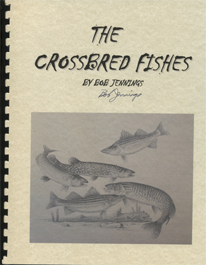
THE CROSSBRED FISHES, by Bob Jennings. Available from Bob Jennings, 3302 N 190 W., Switz City, IN 47465; (812)798-0783. This book is $30 postpaid.

FOR MUSKIE (MUSKY) FISHERMEN – THE CROSSBRED FISHES

Muskie fishermen went through a 10-year revival of interest in these great fish, and in the past year, very few books have been published about them and how to fish for them.

Well, welcome to the latest muskie title. Or, if you've an active imagination like Bob Jenning has, you're bound to be interested in Jennings' new book. He has always been interested in the “what-if,” and he began wondering  what if a big muskie cross-bred with with a striped bass or rockfish. The what-ifs of the unlikely chance of crossbred fish, such as the RO-OX,, OX-RO or the STR-IKE seem unlikely.

However, Jennings wonders if such pairing could happen. Perhaps the RO-OX might come to be. It would be a crossbred fish. This near mythical fish comes from the merging of two words – ROckfish-esOX. This imaginary fish has the body of a striped bass and the head of a big muskie.

The OX-RO (esOX-ROckfish) has a muskie body but the head of a striped bass. The STR-IKE is a pike's head and the body of a striped bass.

The author feels that he and some of his friends have hooked and lost each of these three crossbred fish while fishing some southern lakes where muskie, pike and stripers have been planted. Who knows, but the possibility could happen I suppose, and artist Ken Bucklew did the drawings in this book.

The Crossbred Fishes is a spiral bound paperback book with 21 pages, and unlike most books, it is printed only on the right-hand pages. This book was published in 2011, and is limited to only 100 copies. Anglers working to build a muskie-book collection would be smart to order  a copy from the above address. Such small print runs usually sell out quickly.

Saturday, November 05, 2011

Grouse hunting interest pick up after the leaf drop

Grouse numbers are decent is many areas and very good in others.


Fall may be my favorite time of year but it lasts such a short time. The leaves peak in color by mid-October, the rain and high winds come, and soon all the beautiful color has lost its sparkle and lay dead and spent on the ground.

The leaf drop is over, and bird hunters are getting active. Grouse season runs through November, and from Dec/ 1-Jan. 1.

Most sportsmen know the next logical step is the first snow flurries, and in northwestern Lower Michigan, we'll usually have snow on the ground before Nov. 15.

Between now and the firearm deer season should offer good hunting.


But for now, after the leaf drop has ended, and the woods open up as the bracken ferns die off with the first heavy frost, other things come to life. Grouse hunters revel in this period.

This is a time for bird dogs, well oiled shotguns, sunlight glinting of birch and popple trees, and a brown and gray landscape as it prepares for winter. This is a time when ruffed grouse feed heavily on wild grapes, and the longer the fruit hangs on, the more pungent they become and the sooner we see wildly flying grouse. Some believe those birds that fly into houses and kill themselves are slightly addled by the grapes.

It's a time when a good pointer can lock up on a grouse holding 20 yards away, and if the dog is staunch, one foot will be held high and the tail, as rigid as a fireplace poker, will be pointing at the sky. The dog will be quivering from the strain and pent-up excitement.

Open woodlots make grouse hunting fun now.


The flush is anticlimactic, the ending punctuation mark of a wonderful sequence of dogs criss-crossing the cover, following tiny ribbons of birdy scent before slamming to a solid point. The nose is wafting draughts of grouse scent, and the bird holds until his human friend walks in and puts the bird up.

At the shot, some birds will fall and others will fly a zig-zag pattern through the trees, twisting and turning as they put more distance between them and the shot charge that will follow. Often they will fly head-high through the woods while at other times they skim close to the ground in their bid for escape.

Ruffed grouse never fail to surprise me with the fury of their explosive flush. I'm startled even though I expect it, and that delay in my reaction time always allows the bird to get much farther away before I can recover and shoot.

As much as I love grouse hunting, I also enjoy hunting woodcock but few are still around now. They tend to sit much tighter than grouse, and when flushed, can perform all sorts of aerial evasive tactics. These birds look lopsided, and seem to fly about like a knuckleball. They wobble, dip, dart, seem to fall sideway out of the sky, and on rare occasions, they will tower like a hovering helicopter over the tag alders.

Just as they start to tower, the hunter jerks off a shot at the same instant the bird falls unharmed to the ground. Following the bird, and trying for a second flush will work on occasion, but often the bird will flush wild, far from the gun, on the second try.

Hunt wild foods like wild grapes and you’ll find some birds.


There is something about hunting the tag alder runs and 10-foot-high popples, often growing so closely together it's difficult to bring the shotgun into play. Sometimes a woodcock seems like he would be easy to hit with a scattergun, and the next moment hunters wonder how they ever manage to knock one down.

The flight birds, down from Canada and the Upper Peninsula will often arrive in another eight or 10 days, and are much different than locally raised birds. Sure, they look much the same, but when a flight settles into a covert, and the hunter is lucky enough to be in the right spot at the right time, hunting these birds can be a delight.

I've had days (three that I remember well) where me and another hunter and one dog, would flush 100 woodcock in a morning. We'd often flush two or three grouse and a few snipe as well. We never shot a limit of woodcock each, even when the limit was five birds daily, and it wasn't important to do so.

It was always after a cold rain, the woods were drenched, both of us took a number of pratfalls on slippery downed brush, and we came away from each hunt well pleased with the dog work. Our work, manning the shotguns, left something to be desired, but that is woodcock hunting.

The next few weeks, including early December, will provide the best grouse hunting of the season, and although I find it difficult to see those flushing birds these days, it doesn't diminish my love of gunning and being afield with a brace of fine pointers.