Wednesday, October 13, 2010

Coyotes: Our noisy, unseen neighbors


Wiley Coyote, the cartoon character, is always being banged up and fooled by the Roadrunner. In true life, coyotes are anything but as stupid as they are portrayed in those cartoons or by people who produce such idiotic stuff for kids.

The coyote of today is well acquainted with humans, and although they usually avoid a face-to-face confrontation with humans, they have learned to live in close proximity to us. They are our noisy but rarely seen neighbors. I heard my first yodel-dog tonight as I walked back to my house. They’ll tune up again about 11 p.m.

A good example of how these animals have become our wildlife neighbors is rather amazing. My wife and I looked out behind the house ;ast womter, and tracks led between the garage and the railing for our back deck. The tracks showed where the animal sniffed around under the bird feeder, and then walked across the back yard, around the end of the house, and cut down to the road and crossed.

The ‘yote was casing our joint looking for a plump kitty-cat.

This happened at night. We didn't see the coyote, but I checked the snow on the back deck for tracks. Apparently this coyote’s curiosity would take it only so far.

People misunderstand coyotes. However, we may be the best thing that ever happened to them. We clear land, plant crops, and game animals and birds come to those crops. We manage to provide a place where coyotes can check around for a somewhat steady food supply.

Do you have a house cat that has turned up missing? If so, the cat is probably gone forever. A coyote will eat anything, but one of its favorite meals is house cat. The bigger and fatter and slower, the better.

Turn Tabby loose to wander around all night, which should never be allowed, and it's likely the little puddytat will wind up a blood-smeared mess. The first coyote that spots the cat will have it for a meal unless the pet can make it up a nearby tree. Free-roaming cats are a nuisance and destroy game and song birds.

Coyotes have learned to live near humans. We don't bother them unless we spot one or two animals running together and are prepared for a shot.

It's rather up in the air right now, but only man and wolves, are natural enemies of the coyote. A wolf will kill any coyote or fox it catches, but so far there doesn't seem to be many wolves in the Lower Peninsula although they have been documented in recent years. One was caught in a trap several years ago, and one or two other wolf tracks have been found, but it's doubtful we have many wolves below the big bridge.

We have a few wolves in the northern Lower Peninsula but many coyotes.

Coyotes fear wolves, if they coexist in the same area, but fox and coyotes avoid the larger predators whenever possible.

There is no shortage of coyotes in the Lower Peninsula. They are common around Detroit, which I assume still holds a tenuous grip on the title of Michigan's largest city (it has dwindled from over 2 million in 1980 to about 900,000 in 2010. Many nights I've stepped outside, and listened to coyotes howl and yap while listening to the whine of tires traveling down the many expressways.

There are, near where I live, at least 10 coyotes that live on whatever they can find. These animals are resourceful, and the mother and father of a litter will raise their pups. The little ones yap at night during all seasons, and it's not uncommon to hear five or six in one area and another five or six a half-mile away.

A man I know shoots two or three coyotes every winter. Another kills a dozen ore more. One might wonder why. For those who know little about coyotes, consider this: They are the most active predator of wild turkeys. They can and will kill dogs and cats, and are very effective at killing and eating whitetail fawns in the spring shortly after birth.

Last spring I went for a walk to check my food plots, and found two dead fawns. Or rather, I found what remained of them. In each case, there were tiny fawn hooves on the ground and a ball of wadded-up deer hair. That was all that remained of the baby deer.

The spring fawn-drop is when many deer are killed.

If I could find two dead fawns, without really trying, I suspect it would be quite easy to find more if I really went looking into some of the bedding areas. Coyotes are curious and inquisitive animals, and they've learned to live next door to humans and prosper because of it.

And just think: some of those animals are just outside our door. It would have been a treat to see the animal but daylight sightings seldom occur.

Posted via email from Dave Richey Outdoors

Tuesday, October 12, 2010

Hunt natural foods as well


Bow hunters have a deeply ingrained habit. They hunt the food sources.

For many, that means the edge of a corn field where bucks and does move in and out. It could mean a huge soy bean field where deer are conspicuous as the only upright objects in the field.

If you hunt the beechnut trees and the oak flats, and good mast is laying on the ground, this is a pretty good bet as well. Oak mast, and to a lesser degree, beechnuts are a staple in the diet of deer that roam near such nut trees.

There are more deer food than corn, soy beans & other truck crops.

However, many hunters overlook other deer food. The forget about the less common stuff. Years ago I had a stand where I could see deer approaching for 200 yards from their bedding area as they moved to a nearby soy bean field.

The bean field was huge, and there weren't many deer in the area back then, and I had the opportunity to watch this buck come. It took him an hour to reach my stand area only 75 yards from the field.

I had a pit blind next to an uprooted tree, and my pit was in the soft earth ripped up when the tree went down. One side of the root wad hung three feet over my head, and shielded me from the sun and rain, and covered me in shadow.

The buck, one step above a basket rack, fed every night in the beans. This boy was as regular as the 11 o'clock news, and I watched him walk out of the brushy swale where he bedded down. He moved 10 yards out, stopped to browse on something, poked around a bit more, moved closer, and browsed on something else, and with every few steps he would get closer to me and the bean field.

This buck was feeding, and at the time I didn't know what it was. I made up my mind that if I shot the buck that night or didn't shoot it, I was going to learn what that deer was feeding on before he reached the dining table loaded with high-protein soy beans.

He kept coming, and if he stayed his course, he would cross 15 yards from me and offer a quartering-away shot. I relaxed, watched for other deer, but again, there were far fewer deer in those days. Little did I know I would be learning a trick that few people know they know.

Thirty minutes later he nibbled at something, lifted his head, took several more steps and stood, quartering-away and looking off toward the field. It was easy to make my draw, take my time aiming, and make a smooth release.

Watch what natural browse deer eat in your hunting area.

The buck kicked up his back legs, and darted out of there in a panicked 75-yard run before collapsing near the field edge. Two or three does were in the field, and they looked up, studied the area for a moment, and went back to munching soy beans.

That buck taught me more than just about deer feeding in a soy bean field. He could have been heading for an alfalfa, barley, cabbage, clover, corn, oats, potatoes. rape, rye, rye grass, sugar beet, winter wheat or any other farm crop to have dinner. Deer are catholic in their appetite, and will munch on almost anything.

Protein levels are high in clover and legumes, such as soy beans. But a deer's appetite goes far beyond these truck crops. It's some of the wild stuff that grows and that deer eat, that can provide the often overlooked other food source for people to hunt.

Deer make wise use of the aforementioned acorns and beechnuts. They also eat wild apples and pears. There used to be one single pear tree near my home, and a nearby fence row was 15 yards away and it held one gnarly old oak. It didn't produce acorns anymore, but it offered a spot for a tree stand. More than one buck met his fate by coming to eat on the pears.

Deer are often known as random tip browsers. They will nip a bud off a twig here, one over there, and they have a wide range of things they will eat besides farm crops, fruit and nuts.

Some examples of what Michigan deer eat beside truck crops.

Michigan deer will eat balsam, basswood, cherry, dogwood, dwarf sumac, blackberry leaves, black cherry, ground hemlock, orchard grass, red maple, red osier, spruce, tag alder tips, white cedar, wild grapes and the leaves. Many other wild growing weeds also serve as fodder for a browsing whitetail deer.

Find a neighbor who has ornamental shrubs planted around the house, and watch it for a few days in December. You'll soon learn which trails deer use to come to feed on the shrubs, and a savvy bow hunter can set up on them very easy. Stay away from the houses because of Michigan's "safety zone," which is 450 feet, and ambush them as they move down a trail to feed.

Hunters who can locate a wild food source has found the banquet table. Some wild foods are eaten only in the winter, but many are a mainstay at other times of the year.

Learn these foods, spend some time checking for deer movement around these natural food sources, and it can pay off. If deer are slow or reluctant to come to croplands, go looking for wild-growing foods.

It can pay off ... big-time.

Posted via email from Dave Richey Outdoors

Monday, October 11, 2010

Rain & cooler weather can make deer move


It could be felt in the air. The air felt cold and heavy with moisture this morning while retrieving the local newspaper, and I muttered to myself that it was soon going to rain.

Birds and animals feel a falling barometric pressure better than most humans, but those who have suffered broken bones, nerve damage, and assorted and sundry little problem as we slip and slide through life will usually be able to predict such weather changes.

I awoke today, and it felt as if Ringling Brother or Barnum & Bailey's circus elephants had used my spine as s place to practice their soft-shoe routine as I tried to sleep. I broke my back 40 years ago, had surgery to fuse two vertebrae together and repair a severely damaged sciatic nerve in my left leg.

Three months after surgery, and during my recovery period, I fell and broke the vertebrae above the first two breaks. The surgery, and the second break, set me up for four decades of back and leg pain.

An autumn storm with a falling barometer and rain in the air always seems to settle in my low back. It throbs and my left leg hurts. Neuropathy om both feet now makes long walks painful.

Watching the local weather has becomes more of an issue with me. I rarely watch the Weather Channel because its forecasts cover too broad of an area. A few minutes outside will often tell me more about what I need to know.

If birds are perched on the power lines, it forecasts a low pressure center that will often spin the wind and may bring rain. For me, that is not a good enough excuse to not go hunting.

Of primary importance is a steady or reasonably steady wind direction. Swirling winds make hunting difficult unless you are in an elevated or ground-level coop with closed windows.

For me, a soft rain like we experienced a week ago is perfect for deer hunting providing the wind doesn't get squirrelly. Of course, we had two or three periods today when it looked like rain but it never materialized.  We may bet some needed rainfall tonight. Anyone sitting outside in it, even with good rainwear, might get wet but that's part of hunting.

There is something about a low-pressure center that puts some deer on the prod, especially if the present weather is being chased by something much more severe. I look for those days each fall when a storm is predicted late in the afternoon, and I try to get out two hours earlier than normal so I'll be on hand when the animals move ahead of the upcoming storm.

If the weather appears it often will settle in with high winds and buckets of rain about noon, unless the weatherman calls for clearing skies in the late afternoon or early evening as the storm pushes through. I may set out the morning hunt or crawl into an elevated coop to look for those few deer that always seems to move in nasty weather.

Predicting deer movements during rainy weather is fraught with problems. Often the storm starts and ends at an inconvenient time, and sometimes the animals move well after a storm blows through and sometimes they do not. A key factor to look for is a temperature drop.

I've sat out in rain storms, and hunted in rainy weather, for over 50 years. What has all those years taught me?

The only thing I can swear to is that hunting in the rain can be productive on some days and unproductive on others. It also has taught me that an achy-breaky back is my signal to find a spot, crawl into it and set out and hope for the best.

Sitting out doesn't give my sore back any relief, but on some occasions, a nice buck at the beginning of a dramatic temperature change will walk within bow range and for 10 or 15 minutes as I watch the animal, it takes my mind off my aches and pains.

I let the buck walk most of the time, and in some small way that makes me feel better. It means I've fooled the animal, could have made a killing shot, and chose not to. That's what makes me feel really good.
It could be felt in the air. The air felt cold and heavy with moisture this morning while retrieving the local newspaper, and I muttered to myself that it was soon going to rain.

Birds and animals feel a falling barometric pressure better than most humans, but those who have suffered broken bones, nerve damage, and assorted and sundry little problem as we slip and slide through life will usually be able to predict such weather changes.

I awoke today, and it felt as if Ringling Brother or Barnum & Bailey's circus elephants had used my spine as s place to practice their soft-shoe routine as I tried to sleep. I broke my back 40 years ago, had surgery to fuse two vertebrae together and repair a severely damaged sciatic nerve in my left leg.

Old bone injuries help in forecasting weather changes.

Three months after surgery, and during my recovery period, I fell and broke the vertebrae above the first two breaks. The surgery, and the second break, set me up for four decades of back and leg pain.

An autumn storm with a falling barometer and rain in the air always seems to settle in my low back. It throbs and my left leg hurts. Neuropathy om both feet now makes long walks painful.

Watching the local weather has becomes more of an issue with me. I rarely watch the Weather Channel because its forecasts cover too broad of an area. A few minutes outside will often tell me more about what I need to know.

If birds are perched on the power lines, it forecasts a low pressure center that will often spin the wind and may bring rain. For me, that is not a good enough excuse to not go hunting.

Of primary importance is a steady or reasonably steady wind direction. Swirling winds make hunting difficult unless you are in an elevated or ground-level coop with closed windows.

For me, a soft rain like we experienced a week or 10 days ago is perfect for deer hunting providing the wind doesn't get squirrelly. Of course, we had two or three periods today when it looked like rain but it never materialized.  We may bet some needed rainfall tonight. Anyone sitting outside in it, even with good rainwear, might get wet but that's part of hunting.

We won’t melt in rain but pick sites along trails leading to food or bedding cover.

There is something about a low-pressure center that puts some deer on the prod, especially if the present weather is being chased by something much more severe. I look for those days each fall when a storm is predicted late in the afternoon, and I try to get out two hours earlier than normal so I'll be on hand when the animals move ahead of the upcoming storm.

If the weather appears it often will settle in with high winds and buckets of rain about noon, unless the weatherman calls for clearing skies in the late afternoon or early evening as the storm pushes through. I may set out the morning hunt or crawl into an elevated coop to look for those few deer that always seems to move in nasty weather.

Predicting deer movements during rainy weather is fraught with problems. Often the storm starts and ends at an inconvenient time, and sometimes the animals move well after a storm blows through and sometimes they do not. A key factor to look for is a temperature drop.

I've sat out in rain storms, and hunted in rainy weather, for over 50 years. What has all those years taught me?

It’s hard to shoot deer while sitting out a rainstorm indoors.

The only thing I can swear to is that hunting in the rain can be productive on some days and unproductive on others. It also has taught me that an achy-breaky back is my signal to find a spot, crawl into it and set out and hope for the best.

Sitting out doesn't give my sore back any relief, but on some occasions, a nice buck at the beginning of a dramatic temperature change will walk within bow range and for 10 or 15 minutes as I watch the animal, it takes my mind off my aches and pains.

I let the buck walk most of the time, and in some small way that makes me feel better. It means I've fooled the animal, could have made a killing shot, and chose not to. That's what makes me feel really good.

Posted via email from Dave Richey Outdoors

Sunday, October 10, 2010

Grunt up a buck ((tags: dave,richey,Michigan,outdoors,buck,deer,frequent,pauses,soft,grunt,grunt,call,stop,callin


The 8-pointer was slowly making his way along the edge of a thick tag alder run, and was crosswind to me. I gave one short, and one slightly longer grunt. Both were rather obnoxious sounding.

Not to the buck, though. He stopped in his tracks, swiveled his head in my direction, and slowly turned toward me. There is only one big-time rule to follow when using a grunt call for deer.

If the buck heads in your direction, don't call again. If the animal comes 50 or 100 yards, stops and looks around in obvious confusion, turn your head away from the deer, and give one soft and muffled call. The buck is looking for a direction, and you can say "Over Here" with one grunt. Put the call away and get ready for a shot.

David Hale of Knight & Hale Game Calls (above) shows off a nice buck he grunted in.

On came the deer, and he swaggered to within eight yards, and stopped. He milled around for a minute or so, snuffling the air, and then turned broadside. My FirstCut 90-grain broadhead took him behind the front shoulder and exited the brisket. He went 40 yards and folded up.

I've used calls on bobcats, coyotes, deer, ducks, elk, foxes, geese, moose and wild turkeys. If any one thing holds true, it's that animals and birds can usually pinpoint almost exactly where the call is coming from.

I've used many calls from a tree until several years ago. I've used all types of deer calls including those made by A-Way, Knight & Hale, Primos, Stratton Game Calls, Woods-Wise and many others.

One problem that has always always concerned me was that I know deer and other critters can lock onto a call's precise location. Who has ever seen a deer grunting from an elevation position? I haven't.

This call can work when used properly.

H&M Archery Products of Willis, Mich. <www.stringsling.com> has a novel call that I've been using for four years. Their philosophy is that deer don't climb trees so why should a hunter call from a tree?

They produce a call with a 14-foot length of coil-kink resistant rubber latex tubing that another 12-foot length of tubing can be attached to, and a hunter can sit 15 feet up a tree and lay out the other 11 feet of rubber tubing, and call from a tree but the grunt comes from ground level where it sounds most natural.

Any condensation occurs in the tubing, not in the call. This helps eliminate freeze-up in cold weather.

I begin with the 14-foot length but soon added another length that allows the call to be places off to one side of my tree where an investigating buck will be properly positioned for a shot.

The nice thing is this tubing arrangement will fit most tube-type calls. It puts the sound at ground level where it is most effective.

Many hunters blow a sequence of grunts that is much too long. I keep my grunts short, pause and grunt again for several seconds, and then stop. Ten minutes later try calling again. It also helps to be rattling while calling to re-enact a calling sequence, and it offers a double-barreled approach to calling deer.

There are many different types of deer vocalizations but the grunt call works well. I've had little or no success with a fawn bleat, and only minimal success with a doe bleat. I seldom try them anymore.

I personally have had little success after the rut but before or during it can be thrilling.

One thing that works is to grunt if you see a buck. I've called in numerous bucks that were unseen, but calling works very well on visible bucks. It gives hunters a chance to judge the deer's reaction to the call, but if the deer come and then stop coming, muffle the call and grunt softly one more time. If they keep coming toward you, do nothing but get ready to draw and shoot.

One of the most exciting things about deer hunting is grunting in a good buck. The noises that come out of an inhale, exhale or inhale-exhale call may sound like your hunting camp buddy two hours after a plate of refried beans, but the grunt call does work.

As is true with everything else about bow hunting whitetail bucks, nothing is 100 percent except Uncle Sam tapping you for a yearly donation and that some day you will pass on to your just rewards. That said, grunt in a good buck and if he charges in with his neck hairs standing up, you will quickly be a convert to using a call.

Once, a number of years ago, I spotted a buck 100 yards away. A grunt was made, the buck turned and came to within 15 yards, and no shots were taken. The buck eventually walked off, and another grunt sequence brought him running back to the call again.

This sequence was replayed four times before the buck was allowed to wander off on his own. It seems to work equally well on old or young bucks. Just experiment with calling sequences but just don't call too much or too loud.

Trust me, it can pay off ... on a somewhat regular basis. A grunt call should become a part of every deer hunter's repertoire.

Posted via email from Dave Richey Outdoors

Saturday, October 09, 2010

Remembering some very long shots


Granted, we are already in the archery deer season, not the firearm season, but one recurring thought today kept running through my head like a needle stuck in the groove of an old 45 rpm record.

I got to thinking of several of my long shots. Long shots made with a rifle on caribou, mule deer and whitetails. The ones that tell you that you've practiced long-range shots, know how the rifle shoots, and are capable of taking and making such shots.

A long shot means different things to different hunters. There is a television show that specializes in one-shot long-range kills. I've watched it several times in the past, and they've stretched things out a bit farther that I have but not by much.

Long shots requires lots of practice and a flat-shooting rifle.

I own a Winchester pre-1964 Model 70 in .264 Winchester Magnum, and my first scope was a 1.5X8-power Weaver with fine crosshairs. It hit the market, if memory serves me right in 1961 and I bought the rifle and scope  in 1962 and 48 years later it still shoots better than I can hold it.

Back in those days I did all my own reloading of ammunition for that cartridge, and I played with loads ranging from a 77-grain Norma to a 165-grain Hornaday. Each bullet weight would shoot to the same point of impact, and my vision was keen back then, and I could shoot.

One year, while hunting the Sleeping Bear National Lakeshore sand dunes, I had my son David with me. I told him where to lay on the ice-cold dunes, and where to watch, and that if a buck came out on a deer drive, it would almost run over top of him.

I saw the buck come out, and just as straight as a string, it ran at my son. No shots, and it went past him on a dead run, only to stop between 325 and 350 yards away on another dune. I took a quick sitting position, locked in on that buck and sent a 140-grain airmail package at him. He dropped, and that was it.

Another year, while hunting near the Platte River, I spotted one of the biggest does I'd ever seen walking on the far bank of the river. It was an honest 300 yards away, and when the rifle cracked, the deer fell to a well-placed shot.

A few years ago, while hunting the Kaibab along the north rim of the Grand Canyon, a good mule deer jumped up at 200 yards, went bounding off in that bouncing pace of theirs. Contrary to popular belief, mule deer bucks don't always stop to look back. This one never stopped.

He ran down a valley that led down into a side canyon. My guide and I ran just below the rim on one side, and we could see the buck and a doe running across the opposite side of the canyon. The buck and doe finally stopped when they felt it was safe, and started browsing.

We worked as close as possible, and this was the last day of my hunt, and the guide said: "That buck is 400 yards away. Can you hit and kill him at that distance? We can't get any closer."

Could I hit that muley buck that far away?

I found a scrub tree nearby, scraped some pointed rocks away so I could sit down to hold the rifle steady. I cranked up that Swarovski  scope to 12 power, studied the buck with a firm rest. I settled the crosshair at the top of his back (my rifle was sighted in to be three inches high at 100 yards), took a deep breath and shot downhill at the buck. A second passed before I heard the bullet hit that mulie buck, and down he went. It was a clean one-shot kill.

The longest shot I ever made was in Canada's Northwest Territories a dozen years ago. I was hunting Central Canada Barren Ground caribou, and the guide and I found a huge herd of 3,000 to 4,000 animals down in a big mountainous bowl. There was no cover for a stalk.

My guide held my ankles as I leaned over a steep cliff, and I shot free-hand at the largest bull that was bedded down directly below us. I had no support, and it was a dumb thing to do but I hit that huge bull.

The caribou -- every last one of them -- left that bowl, climbed a ridge across from us, and finally my bull stopped. We went down into the bowl, made our way across it, and eventuall we ran out of cover, and the bull was staring at us.

"I say 500 yards," was my guess while the guide thought it was farther. I took a firm rest after laying my backpack on the last big boulder of the right height, and I studied that great stag. I'd be shooting into a stiff cross-wind at a wounded animal at least 500 yards away.

I know my rifle, know what it can do, and in my early 20s when the rifle was purchased, I shot crows at 300-350 yards in an open field. I felt this shot was possible, and with great patience, I leaned into the stock, settled the crosshairs for where I thought I should hold, and squeezed.

Two second later came the sound of the bullet hitting that bull and down he went. I paced off the distance, and I was doing my best to take 36-inch steps, and 535 steps later, I walked up to that great bull.

It was the longest shot of my life at a wounded animal.

That animal was big, but I had no clue just how big he was until we later put a tape measure to him. He wound up the first year in the No. 9 position in Boone & Crockett. The last I looked he was down to about 100, and I could care less. Whenever I look at him, and the great long rear points, I relive the long-range shot of my lifetime.

Long-range shooting isn't something I encourage. There is too much risk of missing, but if a hunter shoots often and knows his rifle and where it will hit at 250 yards, making a 350-400-yard shot is fairly simple. Luck was riding on my shoulder on the 535-yard shot even though I was confident I could make it.

In the end, people don't ask "Can you?" Instead, they ask "Did you?" And I did.

Posted via email from Dave Richey Outdoors

Friday, October 08, 2010

Controlling human scent


Humans have some funny notions, and oddly enough, some people believe them. Our beliefs often are very strong about things concerning hunting, and we sometimes believe them even if they are not true.

The problem is our Daddy or Gran'daddy told us those hoary old thoughts were true. Some of these myths have been passed down from one generation to the next, and most lack any basis in fact.

For instance: we may think we smell just dandy after a bath or shower using a liberal dose of shampoo and soap. We think we smell as natural and pretty as a rose garden, and it's possible that we may smell dandy to ourselves and other humans, but a whitetail deer would probably think we stink.

To a deer, people stink no matter how clean they are.

To a deer, we probably smell as bad as Peppy La-Pew, the skunk, after a face-to-face with a speeding 18-wheeler and getting squashed. We, as humans, can smell the pungent odor of roadkill skunk. Deer, if they get downwind of us, can smell us as easily as we smell Peppy's lingering odor.

I used to be able to smell a fox if I was within 50 yards downwind of the animal, and then in a teen-age quarrel with a beefy guy much larger than myself, I hit him in the fist with my nose and my sniffer hasn't worked right since. Nor have my fighting abilities, so that fight at age 19, was my last. Sadly, the nose still doesn't work right.

But, this is about fooling deer. A reader wrote today and asked what scent eliminating sprays work. I advised him that he had several options, and one was to buy a Scent-Lok suit. It's the route I choose even though my Scent-Lok suit is now old and tattered and about wore out.

He wanted to know what he personally could do to eliminate his personal odor. He was looking for a shortcut to success without saying so, and even when using the scent-eliminating sprays or Scent-Lok clothing, it is not a cure-all for all of a person's hunting ills.

However, scent-eliminating sprays and Scent-Lok suits can work in much the same way as deer scent or fishing lures do. If the angler or hunter believes in them, their use will usually make that person a better sportsman because hunters are more likely to take the necessary precautions to avoid being winded than other hunters.

Drawing down on deer is great practice as a loudmouth once learned.

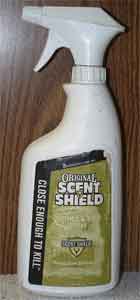
Many years ago, while toiling for The Detroit News back when they still had a weekly Outdoor Page, I was sent some Scent Shield scent-eliminating spray. Me and several other sportsmen were hunting deer in the Club Country of Montmorency County as the guest of a good friend.

A guy I invited on the hunt shot a button-buck the first night as it stood 12 yards away, staring at him, and he was bragging on his bow-shooting prowess. He asked what I saw, and I told him I'd drawn down on 15 different deer that night, including two antlered bucks, and chose not to shoot for a variety of reasons. The important reason I didn't shoot was because both animals were small 1 1/2-year-old bucks.

One thing led to another, and he as much as called me a liar, saying that no one can draw on a deer without getting spotted or winded. I told him that he was dead wrong, and he wanted to bet some big money.

"OK, sport, you've been bragging up your new video camera," I said. "I'll prove it tomorrow night. I'll draw down on every deer I see within my shooting range, and you can videotape the action but don't be spooking my deer. I'll be a nice guy and not take your money but I'll teach you a lesson about opening your mouth before engaging your brain."

I climbed up into an oak tree. I'd seen a bunch of deer follow a trail on the far side of a rundown fence next to the big oak. I donned my old Scent-Lok suit, sprayed my boots, groin, legs, torso, butt, back, arms and gloves. I sprayed the Scent Shield on the inside and outside of my cap and my face mask.

The guy was crosswind along a fence-row about 50 yards away where he could see me and the deer as they stepped over the fallen fence. Each time one came by, I drew on the animal and aimed at it as if I was going to shoot before letting up. The first 26 animals were all button-bucks, does and doe fawns, and as the herd began to build 25 yards downwind of me, it became tougher to draw without one of the deer spotting my super-slow movements.

I successfully drew on all 26 deer, one at a time as they passed my tree, and No. 27 was a decent buck. He walked out, I drew, aimed and killed that animal.

I drew on 26 deer without being spotted, and shot the 27th deer, a nice buck.

The joker now had to believe it could be done. He had videotaped me drawing on all 27 deer as they stood directly downwind of me. I wrote that story for The Detroit News, and Scent Shield, the first maker of scent-eliminating sprays, was off and running, and Michigan sporting goods stores sold out of the product overnight.

Lately I've been using Vanishing Hunter spray, which is made by Buck Fever Synthetics in nearby Manton, Michigan. Phone them at (888) 824-9894. I'm also using Scent Killer from Wildlife Research Center in Ramsey, Minn. I go through the same ritual day after day: everything gets sprayed good, and I don't get winded. However, in all fairness, I'm either in an elevated coop or downwind of the travel trails.

I'll also trickle some milkweed fibers into the breeze every few minutes. If any drift downwind to the trail I'm hunting, I pick up and head elsewhere or won't hunt. Getting winded ruins more hunts than anything else.

I know how to sit still, and haven't spooked an incoming buck or doe in many years. Scent-eliminating sprays and Scent-Lok suits certainly have a major place in a hunter's repertoire but nothing can beat being downwind of deer.

I keep all of my hunting clothing and knee-high rubber boots in an air-tight plastic tub. I take the tub out of the car, carry it 50 yards away, sit on a folding chair, and either wear my Scent-Lok suit in cooler weather or lightweight camo clothing in warm weather. I stay away from the car once I've sprayed down my clothing.

Walking hard and fast to a hunting stand can get a guy (or gal) all sweaty, and  that isn't good. The moisture soaks into clothing, and although we may not be able to smell ourselves, it's dead certain that a deer can smell us. I'd rather take an extra 10 minutes to reach my stand, and be cool and collected, than rush and have my clothing saturated with perspiration.

Whenever I use scent-eliminating sprays, everything is sprayed. The front and back of my hunting pants and shirt, my boots, gloves, face mask and hat. I stay away from gasoline and exhaust fumes, and I'm clean when I head into the field. Some people kid me about my fetish for being scent-free but I shoot more and bigger bucks than they do and have more opportunities for good shots.

The key thing is to pay particular attention to those areas that are most likely to get sweated-up during a walk. This would include the head, underarms, groin, rump and feet. Such areas get sprayed thoroughly before every outing, and since I usually hunt seven days a week, my hunting clothing is washed on a regular basis.

Washing camo clothing should be done in Atsko SportWash. It has a gentle cleansing action and does not contain brighteners. Tide and other common household detergents used to wash our clothes contain brightening agents that "make whites look whiter." Me, I want my camo to look dull so it blends in. I don't want bright-looking camo clothing.

I've seen people wearing old camo clothing that has been washed so many times that it is faded out and almost glows in sunlight. I have poor vision, but if it looks bright to me, it must look like a blinking neon light to an incoming deer. The animal may not see the hunter but it can probably see the unusual light-colored blob in the tree. Guess what? That light-colored blob happens to be you. It may be time for new camo clothing.

Using the proper cleansing agent and the proper scent-eliminating spray can help hunters score providing they are properly set up in a good spot, play the wind, do not move, know when to draw, and don't make any noise.

Neither Scent Shield, Vanishing Hunter, Scent Killer or even Scent-Lok clothing can keep hunters from making that one mistake that can and will spook deer. If they get pegged by deer, nothing will enable them to salvage a shot at a wary animal.

These hunter accessories can only make good hunters better. And you've got to be plenty good and scent-free to keep shooting good bucks, year after year, and you can take that little tidbit to the bank.

Posted via email from Dave Richey Outdoors