Showing posts with label spots. Show all posts

Sunday, January 15, 2012

Teasing Winter Bluegills

gills-tackle

A good assortment of tiny ice jigs or flies in colors is needed.


Bluegills have an endearing habit. Once hooked, they swim at right angles to the pull of the line and it makes them feel much larger than they actually are.

The other day before all the rain was a case in point. A small lake not far from Traverse City had six inches of ice. I eased onto the lake, checking the ice as I went, and reached an area pock-mocked with frozen holes left behind by other anglers.

A few things have been learned about catching winter bluegills, and one is to auger a bunch of holes and then let the noise settle down. Start fishing in the first hole drilled, and the reason is it's had the most time to settle down from the commotion of drilling other holes.

It’s my preference to use short, limber spinning rods.


I prefer a short soft-action spinning rod with a wee spinning reel and one- or two-pound test clear or green mono. I like tiny ice jigs in a variety of colors. I also like a thin wire rod bobber rather than a float (bobber) because of the sensitivity of some bluegill bites.

I also use thick coiled rod holders that sit on the ice. There's a big reason why this technique works so well.

A tiny ice jig of silver, silver-blue, silver-green, silver-orange, orange, yellow, red and white and almost any other color combination will work, but if one color isn't producing fish, tie on a different color. Experiment with fishing depths, lure colors and jigging action.

My rod is inserted into the coiled rod holder, the jig is baited with a mousie or wax worm, and slowly lowered to bottom. The rod holder is set on the ice and jigged an inch or two and allowed to dangle in the water column for several seconds before being jigged again.

Ice rod holders keep the rod, reel and line up off the ice.


I drill my ice holes three feet apart, and use two rod holders with a line down each hole. Watch the tiny wire bobber on the ice rod, and if it moves a fraction of an inch, set the hook.

Some anglers go to one-pound mono because bluegills can be so finicky during winter months. Too much jigging can spook fish, and learning to spot that delicate bite when a ‘gill sucks on the bait’ requires some experience.

Often the hooking and landing of one fish will lead to a strike on the other line. As one fish is reeled to the surface, keep an eye on the other line. if the spring bobber moves, up or down, set the hook.

One thing some anglers don't know is that a bluegill will push the bait upward slightly, and the trick then is to lift the rod and rod holder up until the fish is felt, and then give it a soft hook set.

Bluegills will hit in one spot and then move on in search of food. Try a different hole, and if it doesn't produce a bite or a fish within 10 minutes, try another spot. Sitting in one spot and fishing just one or two holes doesn't produce as good. The thing I like about these ice-rod holders is an angler can walk away from them for a minute to try a nearby hole, and if a fish hits while you are prospecting, the fish will often still be hooked when you return.

Successful bluegill anglers move around and fish different holes


Of course, sitting on a bucket with a rod in hand will work. Anglers can still use the wire rod bobber or use a tiny bobber that floats on the water.
Remember to keep jigging strokes very short (an inch or two is plenty), and don't jig too often. Too much jigging action can spook fish.

The whole jigging thing is nothing but a tease. Bait the tiny ice jig or ice fly, and move the baited lure up and down slightly, and it doesn't hurt to try to move it sideways on occasion. Shivering the lure in place can be deadly at times, especially when fish are really picky.

Bluegill fishing is a great way to spend a winter day. Fish near the edges of green weed beds, and try to avoid exaggerated movements. Keep everything low key, use light line, and prospect a bit for fish, and catching a mess of bluegills can be fun and provide some mighty fine eating.

Don’t forget: Get solid information on ice thickness, and even though some angler fish on one inch of ice, it’s never recommended. Be safe!

Saturday, January 14, 2012

Winter archery makes us better shots

Indoor archery shooting gives hunters practice all year

Many people from all over the state have told me they shoot in an archery league to stay sharp during the winter. Others have developed other rather ingenious ways to conduct winter practice.

The primary function is to shoot enough to pick up the bow, draw, aim and shoot without feeling any discomfort. Stay away from shooting of any kind for a month or more, and the bow often feels a bit heavy or uncomfortable in your hands. The trick is to stay comfortable with a bow all winter.

My basement has a 25-yard archery range in it. I can shoot every day if the mood moves me, which it often does.

This allows me to shoot all winter 

Shooting a few arrows makes the bow feel five pounds heavier than it really is, and the back and shoulder muscles get sore easily. Shooting is the best cure for any of these problems, and it makes accurate shooting much easier.

If a person just has no place to shoot, they can still draw their bow and develop some strength training. Here are several examples of things one can do during winter months to stay comfortable drawing a bow.

A buddy does his shooting out in his cavernous garage. A target is set up at one end of the garage, and he can shoot at distances from 15 to 25 yards. Of course, on a bitter cold day, five or six shots is about all he can handle. He needs a small wood stove inside to make shooting warmer and more fun.

Another friend has a 17-yard archery range in his basement. He is talking about cutting a hole in the wall which would allow him to shoot at 25 yards, and it would more closely simulate shooting from an enclosed hunting blind.

Practice at shooting while sitting or standing 

He practices standing up and sitting down while shooting, and this is good. As a rule, he normally shoots while sitting. He can don some fairly heavy clothing similar to what he would wear for December hunts or he can wear lighter clothing to simulate shooting in October.

Still another gent I know does shoot some, but he walks around his house, comes to full draw, centers the sights on the nearest light bulb, telephone or drawer pull, and he finds it is excellent practice. Of course, he doesn't release the string, as in a shot.

Most people when they draw on a deer have to fiddle around a bit to get their sight pin on target. All of that uses up time, and if the buck is walking away, it makes people hurry. When they hurry, they usually make a mistake and take a bad shot or miss entirely.

Not this guy. He practices all winter drawing an empty bow and concentrating on putting the sight where he wants the arrow to go. He works hard at it, and when he is shooting he will do the same thing with an arrow on the string. The bow comes up and back, and the arrow is on its way. This only comes from perfect practice.

Look at your situation and determine what you can do 

Such practice makes target acquisition quick and easy. He always nails his anchor point, and if he is on his anchor point and the sight is on the target, a twitch of the finger on a release sends the arrow downrange to where he wants it to go.

Practice can take many forms, but it's important to become somewhat committed to handling your bow during the winter months. I shoot as often as possible, as I follow my no-nonsense method of drawing, achieving my anchor point, aiming and shooting.

It gives me the daily practice that I need, and the result is that when it comes time to shoot a deer during bow season, I am ready. My muscles are tuned up, my eyes are sharp, and when I hit my anchor point, a slight adjustment tweaks my aim and the arrow is gone.

Many hunters wait until two or three weeks before the season opens, to start practicing. It's better than nothing, but the people who are the finest shots practice shooting on a regular basis.

Their muscles are all peaked out at a comfortable draw weight, and their eyes automatically center on the aiming point, and all it takes is to touch the trigger, and the arrow goes where it should. It's simple.

That's why good hunters practice all winter.

Monday, September 12, 2011

Look for bucks in hard to hunt spots

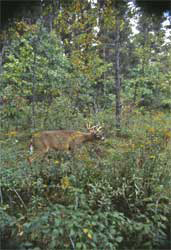
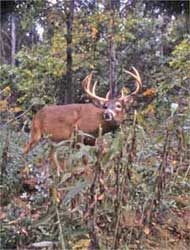
This big buck was photographed in a very small thicket.


The hunter who pays attention to deer movements will soon find some out-of-the-way spots where big bucks like to lay up. Some of those locations are easily hunted and some are not.

Some of these out-of-the-way spots are found while hunting other game species. Some of the little hidey-holes where bucks hole up are so small that one wonders if there is enough cover for a cottontail rabbit to hide.

Take it from me: it doesn't take much cover to hide a big whitetail buck. Keep that thought in mind.

Some of my friends hunt in widely scattered locations. Many also hunt upland game birds, cottontail rabbits and snowshoe hares, wild turkeys and other game. The observant ones find hard-to-hunt buck hideaways far more often than people who hunt only one place. Always take note where a big buck is seen & where he goes.

A friend pays attention to such things, and as he walked past an overgrown apple orchard after a hard rain, he spotted a big deer track going over the fence. He'd tried to get his pointer to work into it in search of birds, and the dog refused to go.

Being a patient gent, he walked his pooch around the orchard, and found the way the buck left that orchard. He also noticed that the tracks went past a big pine tree. Two days later he scaled that tree in the late afternoon after putting the dog in the truck kennel, and took his bow with him. Thirty minutes before the end of shooting time a buck that grossed 152 points jumped the fence and walked past his tree.

He's no stranger to seeing big bucks. This one passed the tree at 22 yards, and my friend shot him. It is still his largest buck, but it points out the reasons why hunters should be more attentive to deer sign.

Another guy was out chasing ruffed grouse, and walked past a sumac patch on top of a hill with a good view in all directions. The man stopped to re-tie his boot laces, and was 20 feet from the sumac patch, and out busted a big buck. He was laying up there because most people walked past the sumac without stopping, thinking the cover was much too sparse to hold a deer.

A friend tells the story of hunting ringneck pheasants near a river, many years ago. He was hunting along its edge. A rooster flushed wild at 30 yards ahead of the dog, and he swung and winged the bird.

It caught its balance in mid-air, cocked its wings and soared part-way across the river and landed on a tiny island of marsh grass and a few stunted trees. He checked the water depth, and it was only shin deep, and he crossed. His dog caught some scent, pointed, and as he approached the dog, a big buck jumped up and bolted across the river. He watched the buck splash across, crisscrossed the tiny island, and kicked up a pheasant and downed the bird.

He kept that oddball sighting in mind, and once the firearm deer season opened, he and a friend waded across to the island. One went to the upstream end while the other walked through, and sure enough, they jumped the buck and killed it with one shot.

Talk to some farmers, and they all have tales of bucks laying up in tall weeds along their line fences or next to a barn. They push deer out of swampy little tangles perhaps 20 feet across. These bucks hold in such tiny bits of cover because few people think to look there.

The thing is that bow hunters can dare to be different. They don't have to follow a stated doctrine that everyone throws at them. They can walk through an area so small that it takes less than 10 seconds to get through, and often they find the home of a big trophy buck that no one knows about.

Cattail marshes hold bucks, and I remember a nice buck that a friend shot as it came out of the cattails. He knew that buck was there, and when he shot it, the buck wheeled and dove back into the cattails and died there. Cover can’t be too thick for bucks.

Don't stick with the status quo this year when the bow season opens. Check things out. Know where the tiny patches of heavy cover are in your hunting area, look for those little nooks and crannies, and try to figure where a buck will come from or go to when leaving. That information is knowledge you can put to good use this fall.

Try it this year. It may produce a nice buck that you've probably overlooked for years.

Friday, September 09, 2011

Change things THIS year


Bunches of deer or just one. A new hunting spot can certainly help.


Some things never change. Many deer hunters choose the same tree for a stand, walk the same trail into and out of a hunting area, and nothing ever changes.

Many will sit on the same stump, along the same runway, as they did 10, 15 or 20 years ago. It's difficult for many sportsmen to break their old habits, and some deer hunters never try. It becomes a tradition to again hunt where a buck was killed sometime in the far distant past.

They often wonder: If it was good 20 years ago, it should be a good spot now. Won't it?

Maybe yes and maybe no. That tradition of returning, year after year, to the same spot has probably saved the life of more bucks than poor shooting or a lack of preseason scouting.

Sadly, clinging to a traditional spot, even when it no longer is good, is a lesson in frustration. It also leads to fiery claims by skunked hunters that the Department of Natural Resources' reports of deer numbers for whitetails are grossly inflated.

Perhaps this season is the time to cast aside the traditional old haunts, and think about trying a new area. Too many people never realize that food and habitat conditions can and do change, and if the landowner doesn't do something to make the land produce more food and offer more cover, the deer will move on. It's as simple as that.

Deer are animals of farmland and woodland. Granted, some deer live in deep forest and many live on farms, and that's a fact of life in this state.
If you agree that a new hunting location should be tried, where should hunters start in their search for a new spot to test their luck or skill?

Hunters can start with the DNR. They keep track of deer trends, and know which counties have the highest deer numbers and which ones produce the largest deer. The county extension agent often deals with farmers and other landowners, and they also can help.

Determine if you want to hunt the Upper or Lower Peninsula, but if you've read hunting reports here or elsewhere about deer hunting prospects, the U.P. is not the place to go. The area with the most deer is south of an east-west line from Bay City to Muskegon.

Start asking questions. Learn which counties produce big bucks and lots of deer, and learn why deer numbers are high in such areas. Determine the availability of state or federal lands nearby, but both state and federal land is quite sparse and over-hunted in the southern Lower Peninsula.

Spend time scouting two or three different areas. Determine which ones offer the best combination of land, cover, deer foods, bedding cover and access. Walk around the land, and check for well-used deer trails leading from bedding to feeding areas and back.


Look for buck rubs and deer scrapes now. Check barbed wire fences for bits of hair that indicate deer passing through the area.


Talk with nearby landowners to determine their idea of hunting pressure. Often, in agricultural areas, the major hunting pressure is from the landowner and his or her family and close friends.

Consider the possibility of leasing hunting rights. Fees vary depending on length of the lease, property size, whether it is ideal or marginal deer habitat, and what it offers the hunter.

No one owes today's sportsman anything in terms of hunting private property. I manage my land to produce big bucks, and crop lands are rotated and some timber is cut. Doing so helps maintain good hunting, but it's a never-ending learning process to keep up with where whitetails travel after crop rotation and timbering takes place.

I spend many hours scouting for good spots. Deer habits change, food supplies change, and hunting pressure can make deer seek quieter areas. A hunter doesn't know these things unless they spend time in the field on a regular basis.

Public lands feature too many hunters in narrowly confined areas, and the hunting pressure is too high. Food supplies are far better on private land than state or federal lands. Private property holds deer, and, in many areas, it supports more whitetails than public land. For this reason it's easy to understand why more people lease hunting land even though the price of leasing acreage is rising.

Whether a hunter leases private land, hunts on public land, or manages to wangle an invitation from a landowner, scouting is a never-ending problem. Hunters who don't scout old land or new land run a major risk of not being successful.

Knowing what lies over the next ridge and why deer travel one trail and not another is why some sportsmen bag whitetail bucks year after year, and why some hunters never tie their tag to the rack of a good buck.

Monday, January 31, 2011

Hard to hunt spots


Old orchards like this hold bucks 


The hunter who pays attention to deer movements will soon find some out-of-the-way spots where big bucks like to lay up. Some of those locations are easily hunted and some are not.

Some of these out-of-the-way spots are found while hunting other game species. Some of the little hidey-holes where bucks hole up are so small that one wonders if there is enough cover for a cottontail rabbit to hide. Take it from me: it doesn't take much cover to hide a big whitetail buck.

Some of my friends hunt in widely scattered locations. Many also hunt upland game birds, cottontail rabbits and snowshoe hares, wild turkeys and other game. The observant ones find hard-to-hunt buck hideaways far more often than people who hunt only on place.

Always take note where a big buck is seen and where he goes


A friend pays attention to such things, and as he walked past an overgrown apple orchard after a hard rain, he spotted a big deer track going over the fence. He'd tried to get his pointer to work into it in search of birds, and the dog refused to go.

Being a patient gent, he walked his pooch around the orchard, and found the way the buck left that orchard. He also noticed that the tracks went past a big pine tree. Two days later he scaled that tree in the late afternoon after putting the dog in the truck kennel, and took his bow with him. Thirty minutes before the end of shooting time a buck that grossed 152 points jumped the fence and walked past his tree.

He's no stranger to seeing big bucks. This one passed the tree at 22 yards, and my friend shot him. It is still his largest buck, but it points out the reasons why hunters should be more attentive to deer sign


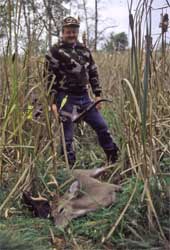
Larry Barrett with buck shot in cattails 


Another guy was out chasing ruffed grouse, and walked past a sumac patch on top of a hill with a good view in all directions. The man stopped to re-tie his boot laces, and was 20 feet from the sumac patch, and out busted a big buck. He was laying up there because most people walked past the sumac without stopping, thinking the cover was much too sparse to hold a deer.

A friend tells the story of hunting ringneck pheasants near a river, many years ago. He was hunting along its edge. A rooster flushed wild at 30 yards ahead of the dog, and he swung and winged the bird.

A winged pheasant led me to a big buck one day


It caught its balance in mid-air, cocked its wings and soared part-way across the river and landed on a tiny island of marsh grass and a few stunted trees. He checked the water depth, and it was only shin deep, and he crossed. His dog caught some scent, pointed, and as he approached the dog, a big buck jumped up and bolted across the river. He watched the buck splash across, crisscrossed the tiny island, and kicked up the pheasant and downed the bird.

He kept that oddball sighting in mind, and once the firearm deer season opened, he and a friend waded across to the island. One went to the upstream end while the other walked through, and sure enough, they jumped the buck and killed it with one shot.

Talk to some farmers, and they all have tales of bucks laying up in tall weeds along their line fences or next to a barn. They push deer out of swampy little tangles perhaps 20 feet across. These bucks hold in such tiny bits of cover because few people think to look there.

The thing is that bow hunters can dare to be different. They don't have to follow a stated doctrine everyone throws at them. They can walk through an area so small that it takes less than 10 seconds to get through, and often they find the home of a big trophy buck that no one knows about. Cattail marshes hold bucks, and I remember a nice buck that a friend shot as it came out of the cattails. He knew that buck was there, and when he shot it, the buck wheeled and dove back into the cattails and died there.

Look for thick cover, it can’t be too thick for bucks


Don't stick with the status quo next fall when the bow season opens. Check things out. Know where the tiny patches of heavy cover are in your hunting area, look for those little nooks and crannies, and try to figure where a buck will come from or go to when leaving. That information is knowledge you can put to good use this fall.

Try it this year. It may produce a nice buck that you've probably overlooked for years.