Showing posts with label develop. Show all posts

Saturday, January 14, 2012

Winter archery makes us better shots

Indoor archery shooting gives hunters practice all year

Many people from all over the state have told me they shoot in an archery league to stay sharp during the winter. Others have developed other rather ingenious ways to conduct winter practice.

The primary function is to shoot enough to pick up the bow, draw, aim and shoot without feeling any discomfort. Stay away from shooting of any kind for a month or more, and the bow often feels a bit heavy or uncomfortable in your hands. The trick is to stay comfortable with a bow all winter.

My basement has a 25-yard archery range in it. I can shoot every day if the mood moves me, which it often does.

This allows me to shoot all winter 

Shooting a few arrows makes the bow feel five pounds heavier than it really is, and the back and shoulder muscles get sore easily. Shooting is the best cure for any of these problems, and it makes accurate shooting much easier.

If a person just has no place to shoot, they can still draw their bow and develop some strength training. Here are several examples of things one can do during winter months to stay comfortable drawing a bow.

A buddy does his shooting out in his cavernous garage. A target is set up at one end of the garage, and he can shoot at distances from 15 to 25 yards. Of course, on a bitter cold day, five or six shots is about all he can handle. He needs a small wood stove inside to make shooting warmer and more fun.

Another friend has a 17-yard archery range in his basement. He is talking about cutting a hole in the wall which would allow him to shoot at 25 yards, and it would more closely simulate shooting from an enclosed hunting blind.

Practice at shooting while sitting or standing 

He practices standing up and sitting down while shooting, and this is good. As a rule, he normally shoots while sitting. He can don some fairly heavy clothing similar to what he would wear for December hunts or he can wear lighter clothing to simulate shooting in October.

Still another gent I know does shoot some, but he walks around his house, comes to full draw, centers the sights on the nearest light bulb, telephone or drawer pull, and he finds it is excellent practice. Of course, he doesn't release the string, as in a shot.

Most people when they draw on a deer have to fiddle around a bit to get their sight pin on target. All of that uses up time, and if the buck is walking away, it makes people hurry. When they hurry, they usually make a mistake and take a bad shot or miss entirely.

Not this guy. He practices all winter drawing an empty bow and concentrating on putting the sight where he wants the arrow to go. He works hard at it, and when he is shooting he will do the same thing with an arrow on the string. The bow comes up and back, and the arrow is on its way. This only comes from perfect practice.

Look at your situation and determine what you can do 

Such practice makes target acquisition quick and easy. He always nails his anchor point, and if he is on his anchor point and the sight is on the target, a twitch of the finger on a release sends the arrow downrange to where he wants it to go.

Practice can take many forms, but it's important to become somewhat committed to handling your bow during the winter months. I shoot as often as possible, as I follow my no-nonsense method of drawing, achieving my anchor point, aiming and shooting.

It gives me the daily practice that I need, and the result is that when it comes time to shoot a deer during bow season, I am ready. My muscles are tuned up, my eyes are sharp, and when I hit my anchor point, a slight adjustment tweaks my aim and the arrow is gone.

Many hunters wait until two or three weeks before the season opens, to start practicing. It's better than nothing, but the people who are the finest shots practice shooting on a regular basis.

Their muscles are all peaked out at a comfortable draw weight, and their eyes automatically center on the aiming point, and all it takes is to touch the trigger, and the arrow goes where it should. It's simple.

That's why good hunters practice all winter.

Thursday, January 12, 2012

Putting together a fishing- or hunting-book collection

steelhead-fishing

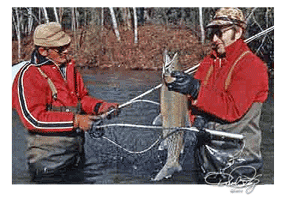
Need a book on steelhead fishing, I’ve got several to choose from


It has become very obvious in the last 25 years that people who fish or hunt often are well-schooled, have graduated from college and are accustomed to learning new things in their leisure time.

Many anglers and hunters strive to stay well informed. They want to read things they can learn from, and over many years, I've worked with many people to help them build an excellent outdoor-related fishing and hunting library.

It's no brag, just fact: I have collected fishing and hunting books for more than 50 years, and am in the midst of compiling a major bibliography of fishing and hunting books published in the English language. This research book is only half finished, and the bibliography features some 1,300 typewritten pages that list between 25,000 and 30,000 titles.

I work on the bibliography as data and information arrive


It covers books on all types of fresh and salt water fishing, muskie fishing, waterfowl hunting, turkey hunting, decoy collecting, Atlantic salmon fishing, trout fishing, fly casting, and much more.

I know what books are out there, I know what is needed for a research library for an angler or hunter, and I'm accustomed to doing research. A teacher friend wanted an obscure book to show to his class, but didn't have the book and couldn't find it. He knew the author's name and book title, and asked for help. I found his book within 15 minutes.

It's not always that easy, but I've spent years searching for some rather obscure book titles, and this is a service some people need. They need help determining which books to buy, learn how much the books will cost, and then hire someone to do the search work.

Others  need to have their present collection checked out, and determine its value for an estate sale, for insurance purposes, or to determine what the value is for a gift donation. I perform such appraisal work on a fee basis determined by what a sporting book collector needs to have done.

And work is the right word for doing appraisals. It is a long and time consuming task.

Of the two, I most enjoy working with people who are just beginning to establish a collection of books on their favorite fishing or hunting topic. I've worked with some to build their collection of muskie fishing titles, and helped others who collect deer hunting or turkey hunting books, and some who specialize in Atlantic salmon, tarpon or trout fishing. One thing I don't do is stray out of my field of fishing and hunting titles.

Finding books for clients can be easy, very difficult, nearly impossible, or a thrilling challenge. The challenge topics are the most fun because it is like hunting for a diamond in a coal pile. It's dirty work but look how much fun it can be when you find one.

Books, like bananas, often come in bunches


I just found 12 muskie books for a client. When we spoke, and I told him of my find, he sounded just like a child at Christmas. He was pumped.

Before we start I try to sit down, or next best, via email or a phone call, and discuss what the client wants to accomplish in a particular genre. I've helped a few collectors locate some very scarce and rare African hunting books, but each collector is different in his or her wants.

I’m big on collecting turkey hunting books. I own most of them but are now looking for some of the really scarce titles for myself and some clients.
But find a key book, and their joy is similar to taking a first-time trout fisherman out and putting him or her into a 10-pound steelhead. It's fun for me and them.

There is, as is true with all types of work, some expenses involved. Doctors and attorneys have been good clients, and their busy fast-paced work life doesn't leave much time for looking for books. They give me a list of titles, or ask me to prepare a list, and I go to work.

I'm helping a muskie-book collector finish up his collection right now. Many of the books are reasonably common; some are hard to find; a few are most difficult to locate, and two or three are nearly impossible to locate.

There is a general theme to my advice for budding book collectors. Try for the hardest books first. They are very difficult to find now so get them while they are still available on occasion, and fill in the collection of lesser valued books as time and money permit.

Collectors or investors require a solid, workable plan


Many people I've dealt with provide me with a value guide that tells me how much they can spend over the period of a year, and I begin looking for key books within that price range. In every genre, there are cornerstone books that are very important acquisitions. I always suggest a new collector decide which books they want first (with some advice from me), and we work toward that goal.

I've learned that although there are many who are interested in deer hunting, there is a plethora of titles to choose from. I determine which authors and titles are most collectible.

Books -- good books -- appreciate at 10-12 percent yearly, and sometimes as much as 15 percent for a few books. I would never suggest collecting fishing or hunting books as a means of making money, but only a fool would ignore the fact that good books increase in value while poor books do not.

My thought is to help a new collector pursue this hobby with an eye toward acquiring very difficult books whenever possible. I urge them to enjoy the books while they are alive, and when they pass on, the books will probably be sold in an estate auction. I can lend assistance in planning ahead for this unfortunate day when the beloved books will eventually pass into someone else's hands for a tidy sum of money.

Planning ahead is what makes precision collecting not only a hobby, and provide good reading while allowing the sportsman to acquire more angling and hunting skills, but in the end, provide loved ones with a significant investment.

I buy fishing and hunting books, sell them, and will help collectors get started or improve their collection.

If you are interested, drop me a note at dave@daverichey.com. I'll be happy to help whenever possible.