Showing posts with label phase. Show all posts

Friday, October 21, 2011

First rut phase will start soon

The moon was big and bright last week, and what few deer moved then, did so right at the end of legal shooting time. An hour later, the fields were full of deer.

This brings up the eternal question: Is hunting during the full moon a waste of time? No type of deer hunting, in my humble opinion, is a waste of time.

My experience during full moon periods is probably quite similar to yours. The deer often move late, and not many deer move during legal shooting time, but I've seen exactly the opposite on several occasions over 55 years o hunting whitetails.

There haven't been an over-abundance of good deer hunting days during the full moon period, but there have been a few spectacular nights that I well remember. However, I take a different approach to hunting than many do.

I love deer hunting, regardless of the moon phase. Shooting a deer every time a person hunted would soon rob this pastime of its enjoyment. For me, being afield with a bow in hand is more important that the time of year or the moon phase.

It's very obvious that it's impossible to hunt from inside your home. We have to be out in the field, and each morning and/or evening hunt, is very important. I don't pay much attention to the moon phases -- I just go hunting, day after day, putting in my time as I wait for a big buck to move my way.

The rut is still about two weeks away, and I'll hunt every chance I get during that period but trying to pin down the peak of the rut to a specific day or days is much too scientific for my tastes. I figure if I hunt every day, regardless of the moon phase or rut phase, I'll have my opportunity. It's up to me to cash in on those occasional moments when I happen to be in the right spot at the right time.

The one thing I do know is that during the rut the bucks seem to move more during that period from 10 a.m. to 2 p.m., and hunters who can be afield then often find bucks moving. I've seen many days during the full moon and the rut when bucks move fairly well during the middle part of the day.

Hunting deer is my life. So why should I concern myself with counting days after the second full moon during the fall, or picking an arbitrary day to pinpoint when the rut starts.

Hunters who are in the woods will know when the rut starts. Those same hunters who are afield at various times from sun-up to sundown during the full moon will also see bucks. It's a matter of persistence, patience and practice that puts bucks at risk around me.
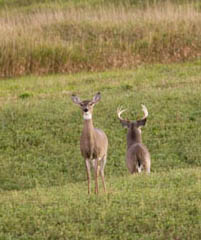
There are three basic rut phases: pre-rut, the rut, and post-rut. Approximate start-end dates for each time period would be Oct. 23-Nov. 5, Nov. 6-15 and Nov. 16-30, respectively. These dates can fluctuate two or three days, and warm weather, heavy hunting pressure, and other factors can  speed up or slow the rut.

Watch the deer for clue. If you see a doe, and it stops and looks back, and then runs off as a buck approaches, you are in the pre-rut or chasing phase of the rut. If the ground scrapes you've been watching or hunting over show a distinct lack of deer sign, that means the rut has started.

The primary rut or peak of breeding activity takes bucks and does away from the scrapes, and if a buck you've been hunting suddenly disappears, he may be a mile or more away tending to a doe.

For all intents and purposes, the peak of the rut can produce buck sightings during the mid-day hours. Most breeding takes place at night but a buck will breed a doe whenever she will stand for him. Hunting the post-rut can be really good or really bad, and much depends on the deer in your area. Remember this: humans do not all gain sexual maturity at the same time, which explains why some fawns are still wearing spots although its something of an oddball situation.

Some does have fawns late in the summer because they were bred in December or January. Such late births only mean the young does were born late, matured late, and came into their first estrus late.

Since we don't really know when does in our area will reach their first estrus, it well could be early next year. However, most of the does will be bred between the end of October and middle of November.

I suspect most hunters do not understand the rut, and the only way to learn is to be out in the field often, and watch the deer. The more time we spend hunting, normally means the more successful we will be.

It certainly works that way for me.

Tuesday, October 26, 2010

Hunt during mid-day now


My wife Kay shot this 12-point in Alabama during the January rut with these tactics.


The buck was banging its antlers against a tree, and I listened to him working a scrape for 30 minutes late last October. The buck was within 20 yards of me but was screened by thick brush and invisible.

I sat in my tree stand and listened. He was close enough to hear the urine hitting the scrape, and he was upwind and the pungent ammonia odor was strong. He worked that tree over, yanked at the overhead licking branch, and for all the noise and commotion he made, the buck was impossible to see.

I checked the spot the next day. He'd been working two scrapes, and one was eight inches deep and as big around as two large turkey platters. The buck had pulled the old licking branch down, and I replaced it. It suited him just fine because the scrape had antler tine marks and a hoof print in it, and the new licking branch looked pretty ragged. The second scrape was opened up, and the licking branch was chewed to a frazzle.

That buck had chewed the licking branch to a frazzle & punished the scrape.


What was even more interesting was that the buck had opened up a third scrape. Huge clots of wet earth was piled at the north end of the scrape, and he had made it the night before. How do I know?

Buck scrapes have dirt and debris piled at one end or another, and if the dirt is piled at the end closest to thick cover, it generally means the deer is tending that scrape in the evening as he leaves the bedding area for a night of chasing cute little does.

This told me several things: One is the rut had not started but the chasing phase had set in. This chasing phase lasts several days before the full rut starts. As long as fresh activity is seen at the scrape, and it is being tended one or more times daily, the rut has not begun. Once the scrapes show no sign of activity, that means the rut is underway.

One thing few hunters realize is that the mid-day hours just before and during the rut can produce a fine buck. A person just needs to be there at the right time/

This buck may have had other nearby scrapes it had been working, but once a buck is shot and is taken out of the woods, another buck will usually take its place. Nature abhors a vacuum, and when a big brown trout or a big whitetail buck is removed, another moves in and takes over.

Hunting from 10 a.m. to 2 p.m. works well during the chasing stage and the rut. If possible, be in your stand by 9 a.m., and sit patiently. The bucks will move during the mid-day hours.

I first learned of this phenomenon many years ago while hunting ruffed grouse. Two days in a row a buck was seen darting away from me in the same area. I checked the area, found his scrapes, and went back and set up a stand 30 yards downwind of it. The buck came by that first day at about noon, wind-checked the scrape from downwind, and offered me a 12-yard shot.

Hunting the pre-rut and the rut during mid-day hours can pay off. Sure, many can't take time off work to hunt those hours, but keep it in mind for weekends. Hunt near natural funnels between bedding and feeding areas, and once the rut kicks in, start hunting the heavier cover.

Hunt the heaviest cover near feeding areas.


My only real problem with hunting the mid-day hours is a personal one. I'm good for three hours maximum in a tree before everything gets sore. I'll stick it out until about 2:30 p.m., grab a bite to eat, and then hunt from 4 p.m. until legal shooting time ends. It means spending long hours in a tree, but it can pay big dividends with a husky whitetail buck.

This method has worked for me, and can work for you regardless of where you hunt. Try it this fall and see if it doesn't produce action at a time when no one is hunting. It's rut hunting's biggest secret, and now only you, me and several hundred thousand other people also will know it.

Posted via email from Dave Richey Outdoors