Showing posts with label knowledge. Show all posts

Sunday, July 01, 2012

Wading tricks to remember

DRO, Some Wading Tips 06.30.12
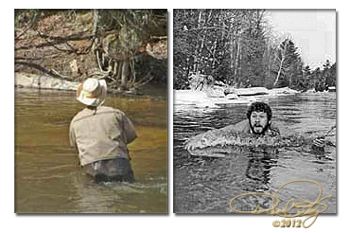
A wading angler fly fishes while another swims in fast water

Water is great stuff. It's wonderful to drink, the right stuff for showers, great to wade in, fun to fish in, and a necessity when hunting ducks in the fall.

However, it is not fun to swim in at this time of year. Here's what happened.

The Betsie River has strong currents in certain locations and dark water. High water complicates things even further because it dirties up once the spring run-off occurs. Seeing bottom becomes problematic or impossible.

Certain areas can only be waded with caution. I knew two early-spawning steelhead were on a bed, and proper positioning had me in the key location to cast a wet fly. Time after time the fly passed their nose, and time and again the male and female parted to allow the intruding fly to swing past.

It may have been the 50th or 60th cast when the male separated early, moved toward the fly, and sucked it in. The hook was set and the fish jumped once. It darted upstream, and fought hard until it began to tire.

The buck steelhead, his cheeks and gill covers the color of orange-pineapple ice cream, put his broad side to the current and started drifting downstream. I was fishing a familiar area, one I knew like my backyard.

It was necessary to stick close to the bank, and with the river swollen with run-off, I knew it would be tippy-toe as the fish tugged its way downstream. The first six steps took me into waist-deep water.

"Cool," I thought. "This isn't too bad. The bottom shelves up 10 feet from here."

That 10 feet was a real treat. Five feet into it my toe bumped against a submerged log that had washed in on high water, and with the water pushing hard on my back, over I went with a mighty splash.

The strong current turned me upside down, rolled me around, sent me feet-first and then rump-first, down around the bend. The fish was still on, tugging at my rod as it was held up out of the water, but a one-armed breaststroke just wasn't cutting it. The river carried me 100 yards around the bend, and as I came to a shallow gravel bar, I heaved my rod up on shore.

My waders were filled with water, and the current ground me into the gravel bar, and finally I was able to get to my hands and knees and crawl across the gravel to shore where I floundered like a beached whale. I grabbed a sapling, pulled myself to my feet, and bent over to dump some water from my waders.

My butt plunked onto the bank as I pulled my waders down and then off, and emptied them back into the river. The temperature was in the mid-20s with a 10 mph breeze, and I had to get my rod and head for the car. Shivering had set in.

My rod was pulled from the brush, and as I reeled in my line, the rod suddenly came alive in my hands. One hundred yards downstream the steelhead bolted into the air, flipped its tail like a farewell wave, and we came undone.

There was a steep hill to climb, and as I reached my car another angler stopped to ask about the fishing. He then noticed I was soaking wet.

"Fall in?" he asked. Here was a man with a magnificent grasp of the obvious.

"Nope," I said, "a big steelhead took me water skiing. The problem was he couldn't pull quite hard enough to keep me up on top. He got away, and all I got was a short but wet and wild ride down the river."

It had been a neat experience. Mind you, it's not one I wish to try again anytime soon, but one that has carved a special niche in my memory.

Some wading tips

  1. Fasten waders tight, and a raincoat over the waders, and cinch a belt tight around your waist and over top of the raincoat and waders. This will keep most of water out of your waders.
  2. Wear a manually inflatable life preserver.
  3. Wear the proper sole for the bottom contour being waded. It could be clears or felt soles.
  4. Wading a stream isn’t like walking down a sidewalk. Shuffle one foot and then the other, and turn sideways to the current. If you turn your back to the full force of the water, it will push you over in the current.
  5. Use a wading staff if necessary. I have back and leg problems from earlier injuries, and a wading staff if helpful to me.
  6. Read the water ahead of you, and learn your wading capabilities. A fast-water rapids, with large boulders or rocks, and when coupled with very strong current, can be a formidable challenge. If you fall, you’ll be out-of-control, and if you hit your head, you could drown.
  7. Look ahead and study the water. Look for a clay or sand bottom, and avoid both if possible. Get too deep in the water, and sand will wash out from under your feet. Get on clay in deep water, and the current push down the slippery surface.
  8. Should fall in, and lose your balance, don’t panic. Try swimming, and if possible, throw the rod and reel into the brush. If that is impossible, throw the rod and reel away from you to prevent becoming entangled in the line. And then swim as if your life depends on it, which it may.
  9. If you are thrust onto a gravel bar, try to keep the current from pushing you off the bar. Try to get to your feet.
  10. Remember, above all else, keep your wits about you and do not panic. To do so may lead to death. Remain calm.

Posted via email from Dave Richey Outdoors

Tuesday, February 28, 2012

The essence of a quick and honorable kill

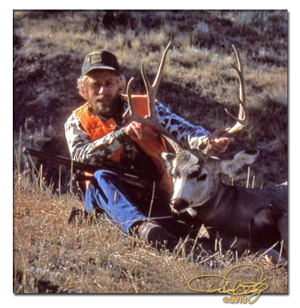
A long shot on a mule deer is possible with practice

muledeer

The truest form of respect to an animal sportsmen hunt is the ability to make a clean, killing shot, whether with a bow, muzzleloader, pistol, rifle or shotgun.

The thing that many anti-hunters are against are wounded animals. I have people contact me, and some say they are ill-prepared for the shot. A bad hit is the result of jittery nerves, buck fever and an inability to shoot straight when an opportunity presents itself.

People who regularly hunt make killing shots. Most of them hunt with a bow, even during firearm seasons, but others also hunt with a muzzleloader or center-fire rifle. When they aim at a deer, and pull the trigger, the animal goes down and dies instantly.

Learn how and practice aiming for an instant kill

There is no long, lingering chases to finish off the animal. There is no long hours spent blood-trailing a deer for miles. There are no cases of someone taking a hasty shot, and making a bad hit.

These hunters have one thing in common: they can shoot straight, and they don't miss. One man has shot eleven bucks, and he takes only one each year. Five were taken with a bow and none ran over 75 yards, and four died when the arrow sliced through both lungs.

The other two deer were taken with a flat-shooting rifle with a 140-grain pointed soft point. Both deer were hit low behind the front shoulder, and both deer died instantly where they stood.

Another man shot a big 10-point last fall after he had hunted the animal into December. The buck made a mistake, walked past the hunter, and one arrow killed the buck. It went just 50 yards and tipped over.

What do these men have that other sportsmen don't have? They have the patience to wait for a clear shot, and possess the ability to put an arrow or bullet in that proper location that causes instant death.

They practice shooting all year. The centerfire rifle usually doesn't come out of the gun safe until just a week before the Nov. 15 firearm deer opener for many people. They may shoot the rifle a dozen times in one day before the season opener, and they feel they are familiar with their bow or firearm. They know that when the rifle's cross-hairs center the heart-lung area that the deer is dead but doesn't know it just yet.

An old hunting question has been around for more years than I can remember, and it goes like this: People don't ask, can you? They ask, did you?

The ones that can, do; Those that can't, tell stories

Good hunters know that when they put the bow sight behind the front shoulder of a buck, that animal will go down. They shoot regularly, never exceed their shooting abilities by taking long bow shots, and they know how and when to draw and shoot. The deer they shoot are unaware of danger because these hunters play the wind every day and can sit still on stand.

These men and women are not casual hunters. They work hard to learn as much about deer as possible. They know how and where deer travel, and soon learn when the animals will come near their stand.

They never take hurried shots, and never take a low-percentage shot. They know that tomorrow may offer a better opportunity, and are willing to wait until all conditions are in their favor. They never make a mistake when shooting game, and they respect those animals they hunt.

I once shot a 6X5 elk in New Mexico at 350 yards. Elk are big critters, and when my Swarovski scope's crosshairs settled low behind the bull's front shoulder just as he finished bugling and he'd emptied his lung, the trigger was squeezed and the bull died instantly.

Another time I shot a very nice mule deer across a side canyon along the north rim of Arizona's Grand Canyon with a 7mm Magnum at 450 yards. One shot, and down he went. My guide said he'd never seen such a shot. There was nothing for me to say because I'm accustomed to long shots. But then, I practice shooting a lot.

Hunters must practice, and I don't pretend to specialize in long shotsm but I only shoot when I know from past experience that I can make that shot. Some of it is a result of  practice, and some of it is knowing that the shot can be made with confidence. Both of these shots, no brag, were instant kills.

Hunters who can do this on a regular basis have no need to brag about their prowess, never make the deer appear dumb or stupid, and they never show the animal any disrespect. Many have learned over time that hunting means more than just killing, and also know that the meat from these animals will grace their table all year 'round.

They know that hunting is something more, much more, than killing a small deer with tiny antlers. They are willing to pass up young bucks, knowing that two or three years on a buck will allow them to take a trophy buck of their dreams.

More so, they are hunters, 365 days per year, and that is why many are so deadly in the autumn woods. They have the patience, skill practice and common sense to do everything right. They don't have to think long and hard about it but just react to the situation.

Thinking too hard on anything can make it more difficult than it should be. And that, my friends, is a direct quote.

Posted via email from Dave Richey Outdoors

Sunday, November 28, 2010

A gift that keeps on giving


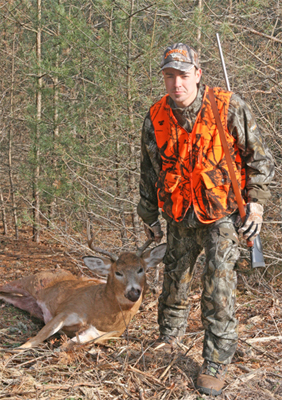
Eric Kerby of Traverse City poses and drags out a nice firearm buck.


Deer hunting has always had its roots steeped deeply in family tradition, and it’s one of the biggest reasons why Roger Kerby of Honor, and his brother Paul Kerby of Mancelona, are two of the state’s best deer hunters. But they take their deer hunting more seriously than most.

Roger’s son Eric Kerby of Traverse City  is in his 20s, and is becoming a chip off the old block when it comes to hunting whitetails. He’s picking up some of the tricks from his father and uncle, and during the firearm season this year, he saw more bucks than most hunters saw does.

“I used to think that some of Dad’s deer success was a matter of luck,” Eric said. “After hunting with him and Uncle Paul for a few years, I’ve come to realize that both of them make their own luck. They just work harder at hunting than most hunters do, and the hard work pays off.”

They are not lucky. Their know-how and skill help them make their own luck.


Roger got a 10-pointer, Paul got an 8-pointer, Eric got a 7-pointer and Nancy, Roger’s wife, got a nice 7-pointer this year while hunting Benzie County. If you’ve not been paying attention lately to deer trends, Benzie County has beautiful scenery but it doesn’t hold many deer.

Eric credits his father with teaching him some of deer hunting’s finer points. They often sit for two or three hours in the morning and evening in areas they feel should be hotspots, but inbetween those two time periods, they take turns pushing deer to each other. They don’t just hunt early and late; they are out hunting every day after work and all day on weekends.

They hunt all day when not working.


“A hunter can spend a lot of time doing little mini-drives for each other,” Eric said. “We don’t move deer on every drive, and may only move a handful of animals in one day but one of those few deer may be a buck. We know where and how deer usually travel, and not every drive pays off. In fact, many drives fail for one reason or another but some do produce results.

“My father used to guide deer hunters years ago, and he has an uncanny sense of knowing where -- and why -- deer follow a certain pattern of movement when our group starts working through a piece of cover. He knows where bucks will go, and usually will have someone sitting motionless and quiet at that spot, waiting patiently for the buck to arrive.”

In fact, it was on one of these mini-deer drives when Eric was on the receiving end of his father and Uncle Paul’s deer-driving skills. They slowly pushed the cover while Eric sat still, and the buck busted out of dense cover and was quickly lost as it ran into a thicket. The deer knew both men were on his tail, and the buck had to make the next move soon.

Eric seemed to sense the buck slowly moving his way.


“I kept watch, and the buck remained hidden for a couple of minutes,” he said.  “Suddenly, the deer left the heavy cover and started down a little funnel that led to more cover. I had plenty of time to raise my rifle, but this was a time Dad had talked about many times in the past: pick an open hole in the heavy cover, and when the buck moves into it, aim well and shoot.”

The bullet knocked the buck flat, and it never moved. Eric has shot other bucks on these hunts in the past, but each time it happens, he knows there is no luck involved. And now, Roger and Paul know that Eric has been paying attention and is learning as he hunts. And learning on the job gives a person an in-depth education that can never be gained by hunting only one or two days a season. What his father knows has come from nearly four decades of deer hunting.

And now Roger is passing his knowledge down to his son. It’s a precious gift that keeps on giving, and Eric is planning on passing his skills on to his upcoming first-born child.

Posted via email from Dave Richey Outdoors

Sunday, November 21, 2010

Tips on bow-shooting bucks


The above title may be misleading to some hunters. Everyone who owns a bow, and who hunts for deer, thinks they have it figured out.

Well, some do and some don’t. It’s not quite as easy as some people would make you thing. The December archery season starts in about a week on Dec. 1, and there is still some time left to help a beginning bow hunter develop some skills.

Without a word of bragging, very few people have shot as many bucks as I have, and learning to shoot them consistently means doing several things right and in the proper sequence.

I’ve hunted deer with a bow since 1955.


Practice is very important but perfect practice means doing everything right, every time. Without an exception.

Shooting a buck with a bow is more difficult than simply drawing back and sending an arrow shaft and broadhead downrange toward the animal. A great deal of concentration is required, and it’s advisable to have total concentration when aiming and taking a shot, but telling you this can't make it happen. You must do it.

Total concentration only comes from many, many hours of practice and countless hours in the field studying whitetail bucks at bow range. Hitting a paper target consistently is quite easy because it doesn’t breathe and it isn't moving. Nor is it alive and study everything around it for danger.

A buck often has his head up or down, is moving or standing still, is listening intently for anything that may represent danger, but deer are basket cases of raw and seemingly exposed nerve endings. They are flighty, suspicious even of birds flying overhead, and require far more skill to arrow than a paper target. They are living, breathing and cautious animals. Scratch your nose at the wrong time and it’s all over, and you’ve possibly missed your only chance of the season.

All good bow hunters develop their own particular shooting style, and it works well for them. Some people have a step-by-step procedure they follow, time after time, and it will produce bucks for them. Each person must develop their own method that works.

Develop a personal checklist, and do everything right, every time.


I know a woman who uses a step-by-step mental checklist. Here is what works for her: Keep both eyes on the buck, wait until the deer offers the best broadside or quartering away shot, know the exact yardage to the animal, watch the buck with both eyes open, come to full draw, center the sight on a specific hair behind the front shoulder, double-check that a firm anchor point has been attained, take a deep breath, let it out, double-check the aiming point and anchor point, and touch the release trigger.

These specific steps come into her mind as Step 1, Step 2, etc. She has shot more than 125 bucks, and still she follows her step-by-step procedure … every time. It ensures that she doesn't miss a step, and the mechanics of doing so enables her to calm her nerves before making a killing shot.

I know many hunters who have a similar procedure when it comes time to shoot. One piece of advice is that once you establish the deer is a buck, and once you decide to shoot, forget about the antlers on its head and concentrate on where the arrow must hit the animal for a certain killing shot.

All too often, a hunter spots a big buck, gasps at the size of the antlers, and hurriedly rips the bow back to full draw and whistles an arrow toward the deer. If they have been awed by the mass of antlers, it's very possible that they will shoot at the antlers.

Establish that the deer is a buck, and then forget about the antlers.


Forget the head gear, and aim for a killing shot. I've never seen a hunter kill a buck by shooting it in the antlers, but have seen bucks that were hit in the antlers run off, unhurt but much wiser.

Mechanical skills are exceedingly important, but so too is the art of total concentration. Let everything in your mind drift away, and concentrate on making a smooth and deliberate draw. Keep the head up with both eyes open, and concentrate only on the target area. Don't lose your focus, and don't lift your head when you shoot to see where the arrow hits. Lift your head and you’ll miss the animal.

More deer are missed because the hunter lifts his/her head at the shot to see if they hit the deer. I know I hit the deer when I see the vanes disappear into the buck's chest and hear that fluttering sound as the wounded animal takes out my Game Tracker string.

Properly done with the required amount of shooting skills and mental concentration, shooting a buck is fairly easy. Hunters with a one-track mind, and the ability to focus on the job at hand, are the ones who arrow a buck every year.

Those who get caught up in the moment, and allow their mind to wander while aiming and shooting, are those who require more practice and must acquire a higher level of patience. Never take a hurry-up shot, and never lose your concentration.

Practice, and keep all of these little things in mind, and shooting a buck will become much easier.

Posted via email from Dave Richey Outdoors