Showing posts with label skill. Show all posts

Friday, September 02, 2011

Make your own deer hunting luck


Locating trophy whitetail bucks requires several things: a spotting scope, good binoculars, a high vantage point, the ability to stay downwind of the animals, and perhaps a tiny bit of luck.

You'll notice I said nothing about a bow or firearm. Those may be needed when hunting in the near future, but locating a good buck means spending a good bit of time in the field with the above mentioned items.

One of my buddies, Rich Johnson of Isppeming,  locates Upper Peninsula bucks by sitting high on a rocky outcropping overlooking a crop field with close proximity to some heavy cedar swamps. He sits quietly, often 500 yards or more from where the deer are seen feeding in an open potato field, and studies them with binoculars or a spotting scope.

Another friend uses a tall free near a busy highway. John Davey of rural Petoskey knows the deer won't be crossing the road during daylight hours, so he has constructed a safe and sturdy stand that sits 30 feet off the ground and just off the road right-of-way on his land. He crawls into it, fastens his full-body safety harness, and studies the deer and how they approach the field in the early evening.

"Sometimes I crawl into the same tree while it is still dark, wait for the dawn, and check out how deer exit the feeding area," Davey said. "After several early morning or late afternoon visits, I know where the deer are coming from and where they are going ... and which trails I should be hunting on different winds."

The savvy sportsman does this in several locations, and long before the bow season opens he knows where the deer travel. And best of all, he knows how he will set up on them once the season opens.

Knowing where deer bed down, where they feed and their exact travel routes, can be pin-pointed during the late summer months. These areas will not change unless humans move into the area when deer are normally moving.

I used to have an elevated coop in the middle of an open field. I could see 250 yards to one end of the field, 350 yards to the other end, and the field was about 400 yards wide. Walking in to this elevated coop was a snap, and I'd do it long before the deer would start moving.

The coop had stood in place for 15 years, and deer had come to accept it as a permanent fixture. It had plexiglass windows on all four sides, and a flat floor that allowed the use of a tripod and my Bushnell spotting scope.

I dressed in camo clothing, and had two stools in the stand for use during the firearm and muzzleloader seasons. In mere seconds, a deer that was spotted was instantly brought into sharp focus. It was easy to tell where the buck had come from, and backtracking that animals trail wasn't important. I knew the swamp he bedded in, and the trails he used to enter the field to feed.

The value of my spotting scope was it allowed me the opportunity to zero in on the buck's rack, and determine his size. On many occasions, if I had a friend who really wanted to shoot a decent buck, I knew which stand would be the most productive, where the buck would come from, and when he would show up.

This pre-season scouting, and timing of when bucks arrived, became so skilled that I could predict within two or three minutes when the buck would walk in front of a particular stand. It paid off for many hunters, and if I told them the buck would arrive at 7:23 p.m., they came to realize that I had these bucks pegged. It led to a good number of hunters shooting their first buck.

Johnson told me that that he had been able to do with pre-season scouting, "isn't difficult but, it can be time consuming.” What works for me can work for you, but getting out into the field, laying down some foot prints, and studying deer from afar requires a large investment in time.

"My success comes from a large measure of sweat equity in covering large areas, climbing trees or rocky ledges, and being there when deer move, I no longer trust my memory, but for the past 10 or more years, I write down exactly where and when I spot a nice buck. I watch him until I know all his travel routes."

Some hunters are willing to invest that time, and give themselves a better chance at scoring on a nice buck, and some are not. It's hot, dirty, dusty work, and the bugs can be bad. The results can be commensurate with the effort and work spent gaining in-depth knowledge of a deer and their travel routes.

Many hunters rely on luck to put them in the right spot at the right time, and other sportsmen make their own luck by knowing when to be at the right place at the right time. The big difference is, skill will normally out-produce luck almost every time.

Me, like many of my friends, prefer to make our own luck. It's much more fun that way.

Sunday, November 28, 2010

A gift that keeps on giving


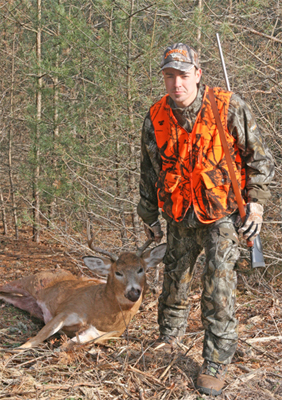
Eric Kerby of Traverse City poses and drags out a nice firearm buck.


Deer hunting has always had its roots steeped deeply in family tradition, and it’s one of the biggest reasons why Roger Kerby of Honor, and his brother Paul Kerby of Mancelona, are two of the state’s best deer hunters. But they take their deer hunting more seriously than most.

Roger’s son Eric Kerby of Traverse City  is in his 20s, and is becoming a chip off the old block when it comes to hunting whitetails. He’s picking up some of the tricks from his father and uncle, and during the firearm season this year, he saw more bucks than most hunters saw does.

“I used to think that some of Dad’s deer success was a matter of luck,” Eric said. “After hunting with him and Uncle Paul for a few years, I’ve come to realize that both of them make their own luck. They just work harder at hunting than most hunters do, and the hard work pays off.”

They are not lucky. Their know-how and skill help them make their own luck.


Roger got a 10-pointer, Paul got an 8-pointer, Eric got a 7-pointer and Nancy, Roger’s wife, got a nice 7-pointer this year while hunting Benzie County. If you’ve not been paying attention lately to deer trends, Benzie County has beautiful scenery but it doesn’t hold many deer.

Eric credits his father with teaching him some of deer hunting’s finer points. They often sit for two or three hours in the morning and evening in areas they feel should be hotspots, but inbetween those two time periods, they take turns pushing deer to each other. They don’t just hunt early and late; they are out hunting every day after work and all day on weekends.

They hunt all day when not working.


“A hunter can spend a lot of time doing little mini-drives for each other,” Eric said. “We don’t move deer on every drive, and may only move a handful of animals in one day but one of those few deer may be a buck. We know where and how deer usually travel, and not every drive pays off. In fact, many drives fail for one reason or another but some do produce results.

“My father used to guide deer hunters years ago, and he has an uncanny sense of knowing where -- and why -- deer follow a certain pattern of movement when our group starts working through a piece of cover. He knows where bucks will go, and usually will have someone sitting motionless and quiet at that spot, waiting patiently for the buck to arrive.”

In fact, it was on one of these mini-deer drives when Eric was on the receiving end of his father and Uncle Paul’s deer-driving skills. They slowly pushed the cover while Eric sat still, and the buck busted out of dense cover and was quickly lost as it ran into a thicket. The deer knew both men were on his tail, and the buck had to make the next move soon.

Eric seemed to sense the buck slowly moving his way.


“I kept watch, and the buck remained hidden for a couple of minutes,” he said.  “Suddenly, the deer left the heavy cover and started down a little funnel that led to more cover. I had plenty of time to raise my rifle, but this was a time Dad had talked about many times in the past: pick an open hole in the heavy cover, and when the buck moves into it, aim well and shoot.”

The bullet knocked the buck flat, and it never moved. Eric has shot other bucks on these hunts in the past, but each time it happens, he knows there is no luck involved. And now, Roger and Paul know that Eric has been paying attention and is learning as he hunts. And learning on the job gives a person an in-depth education that can never be gained by hunting only one or two days a season. What his father knows has come from nearly four decades of deer hunting.

And now Roger is passing his knowledge down to his son. It’s a precious gift that keeps on giving, and Eric is planning on passing his skills on to his upcoming first-born child.

Posted via email from Dave Richey Outdoors

Sunday, November 21, 2010

Tips on bow-shooting bucks


The above title may be misleading to some hunters. Everyone who owns a bow, and who hunts for deer, thinks they have it figured out.

Well, some do and some don’t. It’s not quite as easy as some people would make you thing. The December archery season starts in about a week on Dec. 1, and there is still some time left to help a beginning bow hunter develop some skills.

Without a word of bragging, very few people have shot as many bucks as I have, and learning to shoot them consistently means doing several things right and in the proper sequence.

I’ve hunted deer with a bow since 1955.


Practice is very important but perfect practice means doing everything right, every time. Without an exception.

Shooting a buck with a bow is more difficult than simply drawing back and sending an arrow shaft and broadhead downrange toward the animal. A great deal of concentration is required, and it’s advisable to have total concentration when aiming and taking a shot, but telling you this can't make it happen. You must do it.

Total concentration only comes from many, many hours of practice and countless hours in the field studying whitetail bucks at bow range. Hitting a paper target consistently is quite easy because it doesn’t breathe and it isn't moving. Nor is it alive and study everything around it for danger.

A buck often has his head up or down, is moving or standing still, is listening intently for anything that may represent danger, but deer are basket cases of raw and seemingly exposed nerve endings. They are flighty, suspicious even of birds flying overhead, and require far more skill to arrow than a paper target. They are living, breathing and cautious animals. Scratch your nose at the wrong time and it’s all over, and you’ve possibly missed your only chance of the season.

All good bow hunters develop their own particular shooting style, and it works well for them. Some people have a step-by-step procedure they follow, time after time, and it will produce bucks for them. Each person must develop their own method that works.

Develop a personal checklist, and do everything right, every time.


I know a woman who uses a step-by-step mental checklist. Here is what works for her: Keep both eyes on the buck, wait until the deer offers the best broadside or quartering away shot, know the exact yardage to the animal, watch the buck with both eyes open, come to full draw, center the sight on a specific hair behind the front shoulder, double-check that a firm anchor point has been attained, take a deep breath, let it out, double-check the aiming point and anchor point, and touch the release trigger.

These specific steps come into her mind as Step 1, Step 2, etc. She has shot more than 125 bucks, and still she follows her step-by-step procedure … every time. It ensures that she doesn't miss a step, and the mechanics of doing so enables her to calm her nerves before making a killing shot.

I know many hunters who have a similar procedure when it comes time to shoot. One piece of advice is that once you establish the deer is a buck, and once you decide to shoot, forget about the antlers on its head and concentrate on where the arrow must hit the animal for a certain killing shot.

All too often, a hunter spots a big buck, gasps at the size of the antlers, and hurriedly rips the bow back to full draw and whistles an arrow toward the deer. If they have been awed by the mass of antlers, it's very possible that they will shoot at the antlers.

Establish that the deer is a buck, and then forget about the antlers.


Forget the head gear, and aim for a killing shot. I've never seen a hunter kill a buck by shooting it in the antlers, but have seen bucks that were hit in the antlers run off, unhurt but much wiser.

Mechanical skills are exceedingly important, but so too is the art of total concentration. Let everything in your mind drift away, and concentrate on making a smooth and deliberate draw. Keep the head up with both eyes open, and concentrate only on the target area. Don't lose your focus, and don't lift your head when you shoot to see where the arrow hits. Lift your head and you’ll miss the animal.

More deer are missed because the hunter lifts his/her head at the shot to see if they hit the deer. I know I hit the deer when I see the vanes disappear into the buck's chest and hear that fluttering sound as the wounded animal takes out my Game Tracker string.

Properly done with the required amount of shooting skills and mental concentration, shooting a buck is fairly easy. Hunters with a one-track mind, and the ability to focus on the job at hand, are the ones who arrow a buck every year.

Those who get caught up in the moment, and allow their mind to wander while aiming and shooting, are those who require more practice and must acquire a higher level of patience. Never take a hurry-up shot, and never lose your concentration.

Practice, and keep all of these little things in mind, and shooting a buck will become much easier.

Posted via email from Dave Richey Outdoors