Showing posts with label calm. Show all posts

Sunday, July 01, 2012

Wading tricks to remember

DRO, Some Wading Tips 06.30.12
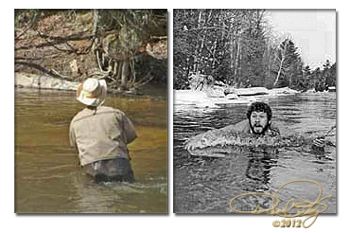
A wading angler fly fishes while another swims in fast water

Water is great stuff. It's wonderful to drink, the right stuff for showers, great to wade in, fun to fish in, and a necessity when hunting ducks in the fall.

However, it is not fun to swim in at this time of year. Here's what happened.

The Betsie River has strong currents in certain locations and dark water. High water complicates things even further because it dirties up once the spring run-off occurs. Seeing bottom becomes problematic or impossible.

Certain areas can only be waded with caution. I knew two early-spawning steelhead were on a bed, and proper positioning had me in the key location to cast a wet fly. Time after time the fly passed their nose, and time and again the male and female parted to allow the intruding fly to swing past.

It may have been the 50th or 60th cast when the male separated early, moved toward the fly, and sucked it in. The hook was set and the fish jumped once. It darted upstream, and fought hard until it began to tire.

The buck steelhead, his cheeks and gill covers the color of orange-pineapple ice cream, put his broad side to the current and started drifting downstream. I was fishing a familiar area, one I knew like my backyard.

It was necessary to stick close to the bank, and with the river swollen with run-off, I knew it would be tippy-toe as the fish tugged its way downstream. The first six steps took me into waist-deep water.

"Cool," I thought. "This isn't too bad. The bottom shelves up 10 feet from here."

That 10 feet was a real treat. Five feet into it my toe bumped against a submerged log that had washed in on high water, and with the water pushing hard on my back, over I went with a mighty splash.

The strong current turned me upside down, rolled me around, sent me feet-first and then rump-first, down around the bend. The fish was still on, tugging at my rod as it was held up out of the water, but a one-armed breaststroke just wasn't cutting it. The river carried me 100 yards around the bend, and as I came to a shallow gravel bar, I heaved my rod up on shore.

My waders were filled with water, and the current ground me into the gravel bar, and finally I was able to get to my hands and knees and crawl across the gravel to shore where I floundered like a beached whale. I grabbed a sapling, pulled myself to my feet, and bent over to dump some water from my waders.

My butt plunked onto the bank as I pulled my waders down and then off, and emptied them back into the river. The temperature was in the mid-20s with a 10 mph breeze, and I had to get my rod and head for the car. Shivering had set in.

My rod was pulled from the brush, and as I reeled in my line, the rod suddenly came alive in my hands. One hundred yards downstream the steelhead bolted into the air, flipped its tail like a farewell wave, and we came undone.

There was a steep hill to climb, and as I reached my car another angler stopped to ask about the fishing. He then noticed I was soaking wet.

"Fall in?" he asked. Here was a man with a magnificent grasp of the obvious.

"Nope," I said, "a big steelhead took me water skiing. The problem was he couldn't pull quite hard enough to keep me up on top. He got away, and all I got was a short but wet and wild ride down the river."

It had been a neat experience. Mind you, it's not one I wish to try again anytime soon, but one that has carved a special niche in my memory.

Some wading tips

  1. Fasten waders tight, and a raincoat over the waders, and cinch a belt tight around your waist and over top of the raincoat and waders. This will keep most of water out of your waders.
  2. Wear a manually inflatable life preserver.
  3. Wear the proper sole for the bottom contour being waded. It could be clears or felt soles.
  4. Wading a stream isn’t like walking down a sidewalk. Shuffle one foot and then the other, and turn sideways to the current. If you turn your back to the full force of the water, it will push you over in the current.
  5. Use a wading staff if necessary. I have back and leg problems from earlier injuries, and a wading staff if helpful to me.
  6. Read the water ahead of you, and learn your wading capabilities. A fast-water rapids, with large boulders or rocks, and when coupled with very strong current, can be a formidable challenge. If you fall, you’ll be out-of-control, and if you hit your head, you could drown.
  7. Look ahead and study the water. Look for a clay or sand bottom, and avoid both if possible. Get too deep in the water, and sand will wash out from under your feet. Get on clay in deep water, and the current push down the slippery surface.
  8. Should fall in, and lose your balance, don’t panic. Try swimming, and if possible, throw the rod and reel into the brush. If that is impossible, throw the rod and reel away from you to prevent becoming entangled in the line. And then swim as if your life depends on it, which it may.
  9. If you are thrust onto a gravel bar, try to keep the current from pushing you off the bar. Try to get to your feet.
  10. Remember, above all else, keep your wits about you and do not panic. To do so may lead to death. Remain calm.

Posted via email from Dave Richey Outdoors

Monday, August 15, 2011

Watch for bears in the woods and swamps during bear season

A bear this size, at close range, is a formidable animal. Be aware of nearby bears.


Bear hunting is a special brand of outdoor adventure where the hunted can become the hunter. It's when the tables can be rapidly turned on a sportsman, and where things can get very interesting very quickly. It doesn't happen very often with black bears, but when one attacks, it's not good news. A grizzly will maul and bite a human, often inflicting horrific injuries, but the person often lives.

Black bear, even though they are the most common bruin of all, are perhaps the most dangerous. Their attack may continue until the victim is dead. It has happened many times across North America, and in many cases, the human doesn't survive such a brutal mauling.

Someone in North America gets mauled by a black bear every year.


I lay no claim to being a black bear expert, but have hunted bruins, photographed them, and have had them approach within three feet of me. Each experience is one to learn from, and to hope it never happens again. A human best hope he does everything right if a bear gets within three feet of him. One wrong move, and it can mean terrible trouble.

I've never been truly frightened of a black bear even when they've come within spitting distance on a dead run. Knowing some things about bears can help you cope with the animal when things turn sour, and an angry bear is only feet away. What you do may truly affect the outcome of the encounter.

This is not meant to frighten you, but the Michigan bear hunting seasons open next month. Realize, first of all, black bears are very unpredictable. Don’t trust them.

Whenever bears are baited or being run with hounds, humans may find themselves within close proximity of a bruin, and neither one knows it. Throw in the fact that the bear may be a sow with young cubs, and there is the potential for disaster.

Once while photographing a black bear in Canada's Northwest Territories I was downwind of a foraging bruin. It turned, looked in my direction just as I took a photo with a flash. It startled the animal, and it came walking slowly toward me. It was straight upwind of me.

I talked to the animal in a fairly soft voice. I kept my voice level, and it approach close enough that I could have touched it, which I knew would be a mistake. The animal continued to circle me, and as it moved around me, I turned with it and continued to face it and talk. The bear got downwind of me, caught my scent, and circled back the same path as before and slowly walked away.

Talk to a bear in a soft, level ton. Don't scream or shout.


One important thing in bear encounters is to keep a clear head. Don't scream at the animal, and realize that a wild bear can sense anxiety and fear. The same is also true of a junkyard dog. Running from a bear is a bad thing to do because they are impossible out-run. Watch the animal, and read the messages it gives you.

Know this: bears, especially sows with cubs, will often make a false charge toward a person. They can walk, trot or run, but you'll hear teeth clacking, deep growling, and then the bear will stop at 10 to 20 feet.

It is defending its turf and its cubs, and a slow dignified retreat with soft talk while facing the animal can put an end to the whole business. However, it doesn't always end that way.

Know what to do, and do it, in a bear-man confrontation.


The trick is to stand your ground until she stops. Step backwards slowly for a step or two, and talk to the bear. If it does nothing, take two or three more slow steps backwards. This allows the animal some space, and gives it a chance to save face. Its enemy is retreating to avoid what could be a deadly confrontation. Just don't make any quick moves, and pay some attention to your footing. If you fall down, it could trigger an attack that would be difficult to defend against.

Watch the bear. Keep a level head, and don't crowd the animal. If it comes, turn with it, but watch its head because the body will follow the head. Study its actions intensely. A bear that becomes increasingly agitated is now a deadly animal and the risk of an attack escalates.

A bear that approaches within 15 to 20 feet and stops, its ears laid back against its skull, and is clacking its teeth and growling, is a dangerous animal. A bear that does that, and then begins slamming its front feet against the ground, has become truly dangerous. Back up and try to defuse the situation with a slow retreat and a soft voice. Don't step toward a bear that is stomping its front feet.

Do not run. Never run from a bear because it's like running from a mean dog: the chances are it will trigger a charge. A full-blown charge with foot stomping, growls, ears laid back, and clacking of teeth is something that will stir your guts into soup and give your mouth a coppery taste. This is no time to lose your head and do stupid things.

Continue to face the animal but try a slow-moving retreat. Chances are the bear doesn't want to force the issue, but this posturing can be a prelude to a mauling and death or a close call. In many cases, the humans’ movements or lack of them may act as a catalyst that triggers an attack.

Allow a bear to save face. Give it a way out of a bad situation.


Saving face is no different with a bear than with a barroom bully. Sometimes the issue can be resolved without incident; other times, it can only be resolved with force. A man alone, unarmed, is not capable of fighting a faster and stronger bear. A few instances have been noted of a bear-man fight, including one here in Michigan, and they are the stuff of wild tales ... except some of them are absolutely  true.

Few people will ever face a false charge, and even fewer will come to grips with a full-blown charge. Those who face the latter (and it's difficult to determine one from the other until the attack occurs) and live to tell the story are a rare breed in today's society.

I've faced three, and all were defused after several troubling minutes, but the best advice is to stand tall, make yourself look as big as possible, talk (don't scream) to the animal, and give the bear a chance to save face without injury to it or you.

Backing away or stepping aside when a bruin is very close can leave you with a wildly beating heart, a dry mouth and your life, providing you do everything right. The chance of a bear attack anywhere is rather remote, but it pays to have some knowledge of what to do well before such a need is standing only 10 feet away.

Especially if the bear has a surly attitude and you are wondering how you ever got into such a situation. Just remember: keep your head, don't lose control, and you may have a hair-raising tale to tell.

Make a mistake at this critical point, and even the best Hollywood make-up artist won't be able to make you recognizable to your family.

Thursday, November 25, 2010

Tricks of the wind

There are two types of wind conditions I don't like when deer hunting. One is when there is no wind, and the other is when the wind swirls.

Everything is dead silent when there is no wind, and deer in such atmospheric conditions are very tough to hunt. They don't move much and are spooky. I much prefer a bit of a breeze, preferably from any direction other than the east.

The second type of wind condition is the one that swirls, first one way and then the other, and these quirky wind shifts make it difficult to determine where to sit for an evening hunt. Invariably, the wind will shift to a different direction about the time you sit down.

There are times when it's impossible to hunt properly.

Tonight's wind was of the latter variety. It began out of the east, and then it swirled to the west, tracked back to the south, and then it returned to an easterly breeze with a stiff cold wind and a 25-degree temperature.

I decided on a ground blind simply because I could get inside, close the windows, and none of my scent would be carried to the deer. If a deer came that I chose to shoot, i'd crank open the window just enough for a clean and accurate shot.

Now, my stand choice tonight was where I shot a nice buck a few years ago but tonight the deer were very hard to find. A few were seen moving through some tag alders, but only two or three antlerless deer showed themselves.

I kept watching the soft breeze, and it would then gust from my ground set to where the deer were, and then the wind would switch the other way. This back-and-forth wind movements kept the deer edgy, and as a result very few animals moved.

A friend sat in an elevated coop in a huge pine, and saw several deer but the breezes at ground level where shifting from one quarter to another. The deer were spooky everywhere.

He saw a decent buck and several does, but nothing was within bow range and none were shooters. It was as if the fickle wind was playing tricks, and he kept his shooting windows shut and sat back to watch the few deer that did move.

Another friend sat in a pit blind, and although the deer tore up the area the day before, there was very little action tonight. The hunter never saw a deer of either sex, and the only living creature spotted was a ruffed grouse pecking around in the nearby foodplot.

Such nights of swirling winds do occur periodically, and there is precious little a hunter can do about it. Hunting is something that involves an investment of time, and hunters who aren't willing to put forth the time and effort, will have poor hunting.

I don't dislike such nights of swirling winds. They are a part of our lives, both the deer and mine. They must cope with it 24 hours a day, while I deal with it for three or four hours once or twice a day.

The winds may swirl, and they may bluster, and the deer may or may not move. The best advice is to put in your time, accept the variable winds and gusty breezes, and work hard to puzzle out hunting locations that will work for most of the various wind directions.

Take a stab at hunting the various winds. Know that sometimes you will get winded, and other times the deer will pass by without catching your scent. The more a person hunts during such swirling wind conditions, the more we learn about trying to determine the best places to hunt and how to outwit a buck.

I made a wrong guess tonight, and when the wind swirls, it's easy to guess wrong. I didn't see any big whitetails, and only a small doe, but each day afield offers hunters new insights into what makes deer tick.

Once you get it figured out, and are 100 percent accurate each time you hunt, call me up and let me in on your secret. So far, guessing the swirling wind directions and how they affect deer travel has been a tough puzzle to solve

You guess right sometimes, guess wrong often, and none of it makes much sense. The one thing we know is that deer are never shot from inside a house, and we must spend time afield to stand any chance of achieving any degree of hunting success.

Posted via email from Dave Richey Outdoors

Sunday, November 21, 2010

Tips on bow-shooting bucks


The above title may be misleading to some hunters. Everyone who owns a bow, and who hunts for deer, thinks they have it figured out.

Well, some do and some don’t. It’s not quite as easy as some people would make you thing. The December archery season starts in about a week on Dec. 1, and there is still some time left to help a beginning bow hunter develop some skills.

Without a word of bragging, very few people have shot as many bucks as I have, and learning to shoot them consistently means doing several things right and in the proper sequence.

I’ve hunted deer with a bow since 1955.


Practice is very important but perfect practice means doing everything right, every time. Without an exception.

Shooting a buck with a bow is more difficult than simply drawing back and sending an arrow shaft and broadhead downrange toward the animal. A great deal of concentration is required, and it’s advisable to have total concentration when aiming and taking a shot, but telling you this can't make it happen. You must do it.

Total concentration only comes from many, many hours of practice and countless hours in the field studying whitetail bucks at bow range. Hitting a paper target consistently is quite easy because it doesn’t breathe and it isn't moving. Nor is it alive and study everything around it for danger.

A buck often has his head up or down, is moving or standing still, is listening intently for anything that may represent danger, but deer are basket cases of raw and seemingly exposed nerve endings. They are flighty, suspicious even of birds flying overhead, and require far more skill to arrow than a paper target. They are living, breathing and cautious animals. Scratch your nose at the wrong time and it’s all over, and you’ve possibly missed your only chance of the season.

All good bow hunters develop their own particular shooting style, and it works well for them. Some people have a step-by-step procedure they follow, time after time, and it will produce bucks for them. Each person must develop their own method that works.

Develop a personal checklist, and do everything right, every time.


I know a woman who uses a step-by-step mental checklist. Here is what works for her: Keep both eyes on the buck, wait until the deer offers the best broadside or quartering away shot, know the exact yardage to the animal, watch the buck with both eyes open, come to full draw, center the sight on a specific hair behind the front shoulder, double-check that a firm anchor point has been attained, take a deep breath, let it out, double-check the aiming point and anchor point, and touch the release trigger.

These specific steps come into her mind as Step 1, Step 2, etc. She has shot more than 125 bucks, and still she follows her step-by-step procedure … every time. It ensures that she doesn't miss a step, and the mechanics of doing so enables her to calm her nerves before making a killing shot.

I know many hunters who have a similar procedure when it comes time to shoot. One piece of advice is that once you establish the deer is a buck, and once you decide to shoot, forget about the antlers on its head and concentrate on where the arrow must hit the animal for a certain killing shot.

All too often, a hunter spots a big buck, gasps at the size of the antlers, and hurriedly rips the bow back to full draw and whistles an arrow toward the deer. If they have been awed by the mass of antlers, it's very possible that they will shoot at the antlers.

Establish that the deer is a buck, and then forget about the antlers.


Forget the head gear, and aim for a killing shot. I've never seen a hunter kill a buck by shooting it in the antlers, but have seen bucks that were hit in the antlers run off, unhurt but much wiser.

Mechanical skills are exceedingly important, but so too is the art of total concentration. Let everything in your mind drift away, and concentrate on making a smooth and deliberate draw. Keep the head up with both eyes open, and concentrate only on the target area. Don't lose your focus, and don't lift your head when you shoot to see where the arrow hits. Lift your head and you’ll miss the animal.

More deer are missed because the hunter lifts his/her head at the shot to see if they hit the deer. I know I hit the deer when I see the vanes disappear into the buck's chest and hear that fluttering sound as the wounded animal takes out my Game Tracker string.

Properly done with the required amount of shooting skills and mental concentration, shooting a buck is fairly easy. Hunters with a one-track mind, and the ability to focus on the job at hand, are the ones who arrow a buck every year.

Those who get caught up in the moment, and allow their mind to wander while aiming and shooting, are those who require more practice and must acquire a higher level of patience. Never take a hurry-up shot, and never lose your concentration.

Practice, and keep all of these little things in mind, and shooting a buck will become much easier.

Posted via email from Dave Richey Outdoors