Showing posts with label bears. Show all posts

Thursday, July 05, 2012

Bears in the berry patches

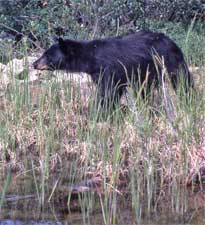
A black bear feeding on summer berries is still alert to danger.
photo courtesy Dave Richey Outdoors ©2012
Several days ago, while visiting an archery shop, I heard the first reference to picking berries. The word was some early raspberries were out, but we needed more rain.

So, we had two rain showers. I don't know whether we've had enough rain to do the berries much good, but I plan to get out and check it soon. I'm thinking red and black raspberries and blueberries next month. I love them on my breakfast cereal. The larger blackberries pop out this month and next,

I love all kinds of summer berries. I can get red and black raspberries near home but have to travel to some remote locations for the others. The travel doesn't bother me, but in these remote locations there are others critters that love wild berries.

They are called black bears. Several of the areas where I pick black raspberries and blue berries are areas frequented by bears.

Two things of major important occur in July and August. We reach the point when female bears come into estrus, and male bears are cruising in search of females. Most of the breeding is done by adult boars, but  since they like berries, it's not all that unlikely that a bruin could be feeding in a berry patch.

Be aware of bear habits and habitats


Most of the time bears will go out of their way to avoid humans. However, bear cubs are much like small children who are so into having fun, they could get close to human berry pickers. Should that happen, and should the sow bear be close to cubs, it could lead to some trouble.

The easiest way to solve this problem is to make enough noise by talking as you walk through the swamps, uplands and hardwoods. Bears, especially adult animals, are always alert to the sound of humans nearby.

Given any kind of chance, bears will retreat to a more quiet area when humans are not found. They often feed on berries, wild apples, cherries and other fruit during the night, but bears do move during daylight hours. So, it means taking a load of common sense into the woods with you. Make more noise once you get near the berry patch, and look around for bears.

Pay some attention to the photo above. The bear is sitting down behind some brush as it feeds in a berry patch. The image doesn't jump right out at you, but the animal is easy to see if you are looking for a black object.

If you happen onto a feeding bear, it makes sense to move to a different berry patch where there are no bruins openly feeding on the fruit.
Make a quiet retreat, but don't running off yelling at the top of your lungs. Once well away from the area, continue to make some noise. If you go back to the berry patch, approach it with human voice talks and progress slowly. A cautious but noisy approach will usually find the bear long gone.

Continue to use common sense where moving down rows of blueberries. Bears, by nature, are rather curious animals but there is no logic and no sense in remaining silent when heading for the nearest berry patch.

Perhaps you've never seen a bruin in that patch, but that doesn't mean a bear couldn't be in there feeding. They are rather silent feeders, and make little noise when walking if they are suspicious of humans nearby.

Common sense and awareness keep men and bears out of confrontation


I've taken quite a few photos of wild bear, and don't photograph tame bears, and you've got to work pretty hard to fool an adult bruin. One other tip is to figure out where the wind is blowing to, and get in the wind with it at your back as you enter a berry patch. Having the wind at your back means a bear will smell you before it sees or hears you, and will be long gone before you get close/

Understand that no one knows everything about bears, and what is written here is written by a man who has hunted bears often, and has had a few confrontations with sows and cubs. Remember this: bears are normally docile and will move away from humans if given the chance, but black bears are more unpredictable than most of the other bear species.

Being unpredictable means you should never trust them. I've written numerous stories about some of my experiences, but don't expect bruins to always act as they have with me. This is not mean to be a frightening story, nor is it meant to keep people from finding berry patches and picking berries.

It is meant to give people a heads-up about bears that breed and feed on berries during the summer. A word to the wise should be sufficient.

Monday, August 15, 2011

Watch for bears in the woods and swamps during bear season

A bear this size, at close range, is a formidable animal. Be aware of nearby bears.


Bear hunting is a special brand of outdoor adventure where the hunted can become the hunter. It's when the tables can be rapidly turned on a sportsman, and where things can get very interesting very quickly. It doesn't happen very often with black bears, but when one attacks, it's not good news. A grizzly will maul and bite a human, often inflicting horrific injuries, but the person often lives.

Black bear, even though they are the most common bruin of all, are perhaps the most dangerous. Their attack may continue until the victim is dead. It has happened many times across North America, and in many cases, the human doesn't survive such a brutal mauling.

Someone in North America gets mauled by a black bear every year.


I lay no claim to being a black bear expert, but have hunted bruins, photographed them, and have had them approach within three feet of me. Each experience is one to learn from, and to hope it never happens again. A human best hope he does everything right if a bear gets within three feet of him. One wrong move, and it can mean terrible trouble.

I've never been truly frightened of a black bear even when they've come within spitting distance on a dead run. Knowing some things about bears can help you cope with the animal when things turn sour, and an angry bear is only feet away. What you do may truly affect the outcome of the encounter.

This is not meant to frighten you, but the Michigan bear hunting seasons open next month. Realize, first of all, black bears are very unpredictable. Don’t trust them.

Whenever bears are baited or being run with hounds, humans may find themselves within close proximity of a bruin, and neither one knows it. Throw in the fact that the bear may be a sow with young cubs, and there is the potential for disaster.

Once while photographing a black bear in Canada's Northwest Territories I was downwind of a foraging bruin. It turned, looked in my direction just as I took a photo with a flash. It startled the animal, and it came walking slowly toward me. It was straight upwind of me.

I talked to the animal in a fairly soft voice. I kept my voice level, and it approach close enough that I could have touched it, which I knew would be a mistake. The animal continued to circle me, and as it moved around me, I turned with it and continued to face it and talk. The bear got downwind of me, caught my scent, and circled back the same path as before and slowly walked away.

Talk to a bear in a soft, level ton. Don't scream or shout.


One important thing in bear encounters is to keep a clear head. Don't scream at the animal, and realize that a wild bear can sense anxiety and fear. The same is also true of a junkyard dog. Running from a bear is a bad thing to do because they are impossible out-run. Watch the animal, and read the messages it gives you.

Know this: bears, especially sows with cubs, will often make a false charge toward a person. They can walk, trot or run, but you'll hear teeth clacking, deep growling, and then the bear will stop at 10 to 20 feet.

It is defending its turf and its cubs, and a slow dignified retreat with soft talk while facing the animal can put an end to the whole business. However, it doesn't always end that way.

Know what to do, and do it, in a bear-man confrontation.


The trick is to stand your ground until she stops. Step backwards slowly for a step or two, and talk to the bear. If it does nothing, take two or three more slow steps backwards. This allows the animal some space, and gives it a chance to save face. Its enemy is retreating to avoid what could be a deadly confrontation. Just don't make any quick moves, and pay some attention to your footing. If you fall down, it could trigger an attack that would be difficult to defend against.

Watch the bear. Keep a level head, and don't crowd the animal. If it comes, turn with it, but watch its head because the body will follow the head. Study its actions intensely. A bear that becomes increasingly agitated is now a deadly animal and the risk of an attack escalates.

A bear that approaches within 15 to 20 feet and stops, its ears laid back against its skull, and is clacking its teeth and growling, is a dangerous animal. A bear that does that, and then begins slamming its front feet against the ground, has become truly dangerous. Back up and try to defuse the situation with a slow retreat and a soft voice. Don't step toward a bear that is stomping its front feet.

Do not run. Never run from a bear because it's like running from a mean dog: the chances are it will trigger a charge. A full-blown charge with foot stomping, growls, ears laid back, and clacking of teeth is something that will stir your guts into soup and give your mouth a coppery taste. This is no time to lose your head and do stupid things.

Continue to face the animal but try a slow-moving retreat. Chances are the bear doesn't want to force the issue, but this posturing can be a prelude to a mauling and death or a close call. In many cases, the humans’ movements or lack of them may act as a catalyst that triggers an attack.

Allow a bear to save face. Give it a way out of a bad situation.


Saving face is no different with a bear than with a barroom bully. Sometimes the issue can be resolved without incident; other times, it can only be resolved with force. A man alone, unarmed, is not capable of fighting a faster and stronger bear. A few instances have been noted of a bear-man fight, including one here in Michigan, and they are the stuff of wild tales ... except some of them are absolutely  true.

Few people will ever face a false charge, and even fewer will come to grips with a full-blown charge. Those who face the latter (and it's difficult to determine one from the other until the attack occurs) and live to tell the story are a rare breed in today's society.

I've faced three, and all were defused after several troubling minutes, but the best advice is to stand tall, make yourself look as big as possible, talk (don't scream) to the animal, and give the bear a chance to save face without injury to it or you.

Backing away or stepping aside when a bruin is very close can leave you with a wildly beating heart, a dry mouth and your life, providing you do everything right. The chance of a bear attack anywhere is rather remote, but it pays to have some knowledge of what to do well before such a need is standing only 10 feet away.

Especially if the bear has a surly attitude and you are wondering how you ever got into such a situation. Just remember: keep your head, don't lose control, and you may have a hair-raising tale to tell.

Make a mistake at this critical point, and even the best Hollywood make-up artist won't be able to make you recognizable to your family.

Monday, August 08, 2011

Bear hunting season opens next month


The author’s first bear with a bow. Sometimes, this is all one sees of a bear.

Me and black bears go back a very long time. There have been a large number of close encounters with bruins over 45 years, and some potentially dangerous confrontations have taken place and I’m still respectfully writing about them.

Bears are very curious but can be very dangerous animals and are among my favorite wildlife species to hunt. Granted, they can do great bodily harm and can kill a guy if they choose, and if the opportunity presents itself, but mostly they want to be left alone. They can be downright curious, just like people, but after more than  four decades of making a full-time living as an outdoor writer, it's been my pleasure to have crossed paths with bruins on many occasions.

My hunts began in the late 1960s. No permit application was needed back then. A hunter walked into a store, bought a bear license, and went hunting.

Now, with new and different rules, there are more bears moving into new areas.


Those early hunts were fun because I sat on the ground, usually within 20 feet of an active bear bait, and hunting from tree stands were not legal for bear or deer hunters at the time. The first bruin I killed was with a bow at six feet. It wheeled, ran off into tall marsh grass, and I was right behind it, clueless and stupid in the middle of a dense Upper Peninsula swamp.

The animal went down on its back, and as I came running through the tall marsh grass behind it, my right foot came down two inches from its open mouth as it let out a death moan. My next step, I swear, was a 20-foot jump. It really wasn't that far but that animal scared me silly under those circumstances. Circling back, the bear was approached from behind, but it was dead.

Another time I saw nine different bears on opening day of the fall bear season. A big bruin frequented the area but wasn't seen the first day although nine smaller bears showed up to feed at various times from dawn to dusk. The larger bear came to visit the second day, and offered an easy shot.

There have been several close calls with bruins of various sizes.


There have been some close scrapes with bruins including a stand-off with a sow with three cubs in Saskatchewan 10 years ago. Another close encounter came in the Northwest Territories as a foraging bruin was spotted and photographed from a distance of 20 feet. The bear approached to within three feet of me, circled all around as I stood my ground and kept turning to face the animal, and it never did anything except turn and walk away. Its ears didn’t go back, its neck hairs didn’t go up and there was none of that teeth-gnashing business.


Another close call came when a grizzly was encountered in Glacier National Park during an early snow storm as I hurried down the mountain ahead of this violent storm that threatened to close the mountain passes. We eyed each other at 20 feet for what seemed like long minutes but the standoff probably didn't last over 10 seconds, and the big bear ran off.

A few years later grizzlies went on the rampage one year and killed partially ate parts of some of the tourists. It was a nasty piece of business, and those big bears were hunted down and killed.

Another time, while hunting on British Columbia's Vancouver Island with Jim Shockey, my guide and I saw over 30 black bears on one mountainside at one time. We probably saw 60 different bears in one day, including one with a 22-inch skull that would have placed high in the Boone & Crockett record books.

I passed on that big bear for purely personal reasons.


That bear was not shot by me. I passed on it because the only thing that would have made the animal appealing to anyone was its huge skull. It had rub spots on both front legs like it had been wearing manacles, two huge bald patches were on its hips, and assorted other problems made that animal truly ugly. It was an old boar, probably in its last year of life, and I let him live.

I knew if I shot that bear the only reason for its death would have been the big skull. I left that bruin to feed after stalking to within 60 yards with my Knight .50 muzzleloader. I didn't need a record-book black bear that bad.

Outdoor writer/photographer Judd Cooney and I hiked into one of his bear baits in northern Saskatchewan several years ago, sat down 20 yards from a bear bait, and took photos. A sow with a pair of young cubs came to visit, and he asked if I wanted the sow to turn our way. I nodded affirmatively.

"Hey, bear, over here!" Cooney hollered. The bear backed up a step or two, turned to look our way, and I started shooting photos. Cooney repeated this exercise three times, and then the cubs came over for a visit. They sniffed my boots, crawled over our legs, and walked back to their mother.

Had any cub squalled we would have had an irate sow black bear all over us. The cubs behaved themselves, as did we, and they soon wandered off, making it a thrilling  adventure.

Hunting and being around bears all these years has been fun. There have been a few anxious moments when I’ve hunted down and killed bears that had been wounded by other people who were too frightened to go after the animal. I didn’t want a wounded bear in the woods that could cause serious injury or death to someone unfortunate enough to get too close to it.

There has never been a problem during my encounters or when hunting down those injured animals, but anytime a person gets within 50 yards of a wild bear, there always is an element of danger.

So far, I’ve been lucky. Now, with bad vision dogging ny trail, my memories of those times when bears got too close, are still vivid. Each time provided an adrenaline surge that exceeds even that of when a big whitetail buck walks within bow range.

There is a special kind of magic to bear hunting. One only has to remember that this animal you hunt is fully capable of putting you in a casket or a hospital bed. That, my friends, adds some adventure and spice to the hunt.

Face a real or false charge  from a tooth-clacking, foot-pounding, enraged black bear, and you’ll experience something that may wake you from a sound sleep for many years to come as you relive that hunt. Bears have the capability of putting the fear of God into a person, and it’s always wise to remember that.

Thursday, April 21, 2011

I get excited by severe weather


I thumped this bruin with two well-placed rocks. He left us alone.


There's something about storms that light my fire. I'm not certain just why I find them so intriguing, but I suspect it began near Flint when brother George and I were 10 years old.

We were outside playing catch. Even though I had (still have) small hands, I could throw a knuckle-ball. George was the person who could catch it.

He had a little nickel curve ball and I had my wobbling knuckler. It's what we did in the early 1950s. Occasionally one of us would uncork a wild pitch, and one of us would go chasing the ball down the street.

Head for cover when the big winds come blowing in.


Suddenly, from out of nowhere, up came a big wind. Mind you: we were skinny little kids, and I doubt either of us weighed over 60 pounds. The wind was so strong we had to push hard against it to get indoors.

What we had felt was the outside winds of a massive tornado that followed an east-west road about seven miles south of our home and in the north end of Flint, and it covered two or three miles before lifting back up into the turbulent clouds and disappeared. It left nothing but death and destruction behind.

Several people were killed, and the big wind would destroy three or four houses in a row, lift up to dodge a house or two, and drop down again for more devastation.

It made a big impact on me, and several years later, Max Donovan of Clio and I were traveling back-roads. He had me drive, and we were in Tuscola County when I saw a twister coming across a field at us.

"Out-run it," Max hollered. He had an old gutless station wagon, and it was no contest. The tornado hit us, lifted the car two or three feet into the air, and then slammed us back down. My foot was still standing on the accelerator, and away we went, no worse for wear.

In 1970, my father and I joined another father-son team from Ontario, for a northern Ontario fly-in trip. We were crossing a large shallow lake that was filled with big pike when a storm popped up. We fought to keep from capsizing for two hours, and finally wallowed ashore on a deserted island. We waited until the storm passed, bailed out our boats, and went fishing, again none the worse for wear.

The Indian guides blamed me for pointing at the unnamed island.


That storm was the edge of a tornado that hammered its way through Sudbury, Ontario, causing massive destruction. We weren't in the actual tornado but caught some of the heavier winds generated by it.


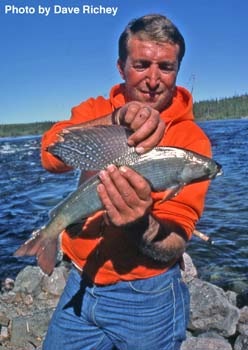
This Arctic grayling was caught on the Northwest Territories Great Bear Lake.


Some years ago, the sky turned that dark greenish-purple color as clouds rolled and tumbled in the southwestern sky with an ominous sound. The direction was a good clue for possible severe weather, and I watched the tops of nearby maple trees bend almost flat as my wife screamed for me to come inside.

No twister for us, but a neighbor a mile away watched a tornado demolish his brand-new garage. Again. no injuries and the neighbor had insurance on his garage. It was a big inconvenience, that's all.

Kay and I got caught in a hellish big storm on Great Bear Lake in Canada's Northwest Territories in the late 1970s. This lake is just slightly smaller than Lake Michigan. The lodge owner came by in a much larger boat, and took Kay with him. My guide and I followed the larger boat for miles, rising 12 feet into the air on the crest of a wave, and then we'd plunge into the trough with water all around us.

Up we'd go, and there would be the larger boat with Kay aboard, and it was pulling slowly away from us. We traveled into the waves within 10 feet of a sheer rock wall six feet away, and one mistake would find the waves pounding us and our boat into bloody tin foil against the rocks.

We made it into a safe haven called Gunbarrel Inlet, and there were several boats milling about with smoke rising from a small wood fire on shore. I asked someone why they were not up near the fire.

A bear had reportedly "chased" them from shore and out into their boats.


"A bear chased us away," came a reply. I told my guide to head for shore. I put more wood on the fire, shucked out of my rain-soaked rain gear, and stood steaming near the roaring blaze. The first head we'd had in hours..

Someone hollered "Bear!" from a boat, and pointed down the shore. Here come a 200-pound black bear, and I picked up a rock and hollered at him. The bruin stopped momentarily, and I took several steps closer, and my old pitching days came through. No knuckle-ball ball this time but a high hard one that thumped his rump. The second rock was a bean-ball, and he ran off. We returned to the warming fire. We were chilled to the bone.

So the snowstorm and it's eight inches of snow a few nights ago really didn't seem to be anything special. We may see lots of snow, some strong winds and moaning sounds from the eaves, but as far as storms go, this one didn't have the making of anything worth writing about.
But what am I writing about. I've already mention tonight's storm, so in some way, it does influence my thoughts. Personally, I'd just as soon seen it get cold and freeze up the slop for two or three days and then go away.

The most recent storm can't even compare with a few of them during the winter when we'd see 15-20 inches of snow. Storms are interesting, but these little guys are nothing but a little bump in the highway of life. Storms that can kill a guy are those worthy of great respect.

Monday, August 23, 2010

Your favorite outdoor pastime


I'm an outdoor writer, and if we base that on the large number of writing and photography awards on my walls, a decent one at that. I enjoy writing about all types of fishing and hunting but I always could use a little bit of help from my readers.

Send me an email at <dave@daverichey.com> and tell me what you most like to read. Is it bear hunting, and some of the hair-raising pieces I've written about my personal bear-hunting experiences over the past 40 years?

Or, might it be bow hunting for whitetail deer? It's my favorite passion, but I also want things to be appealing to you. I realize that it's impossible to satisfy everyone, but with 55 years of hunting and some 250 or more deer under my belt, I can write all day about whitetail hunting techniques.

I want to hear your thoughts.

How about salmon fishing? It's still the big deal on the Great Lakes these days, but all isn't peachy across the state. The Lake Huron salmon fishery isn't quite as good as it once was , and this year the action has been good on Lake Michigan. Will it hold up or not? Let's hope so.

Walleyes have ripped the top off the container holding the biggest angling attraction in the state, and snatched it away from salmon 12-15 years ago. Walleyes are easier to catch, taste wonderful on the table, and they match the moods of those people who don't care to bounce around on the larger Great Lakes.

Where does duck and goose hunting stand on your list of things to do? Do panfish (bluegills, crappies and sunfish) rate high marks, and how about stream fishing for steelhead?

It seems that steelhead fishing (and catching) has slowed a bit from its manic pace of 15 years ago. Do you still thrill to the cold water tightening your wader-clad legs in the spring and fall, and do you enjoy the frosty nip of steelhead in mid-winter below power dams?

Fall salmon fishing in the rivers can be a hoot, and these tackle-busting fish can stir up a bunch of fun for anglers who learn how to catch them with bait, fly, plug or spinner. Hook a 20-pounder in heavy, fast water, and you are in for a long-distance fight that could cover a quarter-mile of river.

Is it salmon or steelhead fishing in our Great Lakes tributaries?

How about hare, rabbit and squirrel hunting? These game animals are what most hunters grew up chasing after. They still rank high marks among hunters.

Let's face it: I don't know anyone who doesn't enjoy wing-shooting for ruffed grouse and woodcock. It's easy to factor ringneck pheasants into that equation too, and to a lesser extent, quail during an open season.

This state needs a mourning dove season again, and even with a season, the nay-sayers would still have plenty of doves cooing during the day, spattering decks with their droppings, and scaring smaller song birds from the feeders. Other states have dove seasons, and their bird populations have not declined nor disappeared, and it's time for Michigan hunters to take some of the birds that we raise.

For a money-strapped DNR, a dove season could help. Studies prove that hunting really doesn't affect bird numbers in this state, and most states south of Michigan have a season. The idea was soundly trounced in recent years, but perhaps it's time for the state to study the matter again.

Most of you know I love muskie fishing, and I enjoy writing about this type of fishing -- one man, one fish, who will win? In most cases, the muskie almost always wins. It's those occasional days when the Muskie Gods smile, and grant us a good battle with a big fish, and that really turns me on. I have never kept a muskie, and don't plan to start now.

Do you enjoy my occasional rantings about how the Traverse City area is growing too fast? It is expanding in all directions except due north, and one wonders when and where it will stop. Perhaps when Cadillac, Honor, Kalkaska, Northport and other small cities become Traverse City's suburbs.

Ethics and poaching problems are major issues for me. How about you?

How about my occasional pieces on the ethics of fishing and hunting? We, as anglers and hunters, must impose our personal code of ethics on our outings. We can't be winking at the fish and game laws, and continue to feel these laws are made for everyone but us. People must study their own brand of ethics, and see if it fits in with those of society.

I spent many years writing outdoor magazine articles, 25 books on fishing and hunting, and 23 years were spent writing about fishing and hunting for a major daily newspaper. Few people would write to the editors and tell them what they wanted. Now, the only boss I have is you folks, and many of you do write. I still would like a sense of direction or I'll continue to do as I've done for nearly seven years with this daily weblog.

Which is to write about what I think you would like to read. I try to keep my daily topics timely, but some input is certainly welcome. Which of you is willing to take five minutes to write a note with your thoughts?

And, don't forget: I have over 600 books for sale and more than 800 outdoor magazines dating from the early 1920s, Looking for a birthday, Christmas or Father's Day gift, outdoor books and magazines make a great gift.

Bring 'em on, and don't be bashful. I wouldn't ask if I didn’t want to hear your opinions.

Posted via email from Dave Richey Outdoors