Showing posts with label arrows. Show all posts

Thursday, February 16, 2012

We all make dumb hunting mistakes

bowmistakedeer
There are few people who can tell me they've never made a mistake when going head-to-head with a mature whitetail buck. I've made some really colossal and stupid mistakes.

Making a little mistake that means nothing is not bad, but when a mistake costs you a shot at a good buck at spitting distance, that is something a person will live with forever.

Preaching to the choir is easy because you've made some mistakes, as have I, and we well know the feeling of anger and frustration at ourselves when we mess up.

Fess up! Remember some of your bow-hunting mistakes?

One year a nice buck came past me every night. My stand was in a cedar tree atop a 10-foot knoll. My stand was eight feet up the tree, and when I sat in the stand I was about 20 feet above the trail the buck followed night after night.

The buck was upwind of me, and never looked up at that cedar tree. One day I could hear the buck grunting as he followed his scrape line. He stopped, broadside to me, and as I made my draw, the arrow fell off the rest and rattled through the branches to the ground.

The buck looked up, and then went back to pawing his scrape. I nocked another arrow, began my draw and again the arrow fell off the rest. That buck never hung around long enough to see what made that second tinkling sound.

The question often arises about shooting other critters while deer hunting. I no longer do so, but once while sitting in the same tree stand as noted above, twigs and needles kept falling down on me. I looked up, saw nothing, and five minutes later down came more bark and needles.
I looked up again, and this time saw a big porcupine scratching around on the tree. Not thinking, I drew back, aimed and shot the porkie. It wobbled around, and suddenly I realized what could happen. The animal could fall on my head.

I stepped to the extreme edge of the stand, got two hand-holds and one toe-hold, and down he came onto my stand. A foot nudge sent him toppling over the edge where fell to the ground with an audible thud.

The porkie waddled off, walked down by the scrape below me and died. No deer came visiting me that night.

I could have been wearing a wounded porcupine on my head.

Another time I was in a different stand near an open road that was bordered by a small field, and I was watching a buck 100 yards away. A late arriving hunter came down the two-track trail, knew I was in that stand, and waved at me as he drove past. It's a normal reaction, and I waved back. The car disappeared, and so did the buck. The buck had seen my friendly wave and skedaddled for heavy cover.

Once I was bow hunting in late December, and was sitting in a hay bale blind near a corn field. I have asthma and hay fever so I downed a Benadryl pill to keep from sneezing, crawled inside and soon there were deer in the corn and eating away, unaware of my presence.

One deer was a nice buck, and I'm inside the hay bales, trying to get a shot at the deer. I needed just another inch or two for a shot, and darkness was coming. I tried to force the issue without making any noise, and damned if the two rectangular hay bales didn't move a bit. The small bales moved several inches, and there I went, falling out of the blind and almost on top of the buck.

It's questionable who was more surprised: me or the buck.

All the deer ran off, and at Show and Tell after hunting ended, everyone had a good laugh at my expense. I laughed too as I replayed my smooth move for the other hunters.

Falling out of a ground blinds really requires skill.

One of my dumbest moves came several years ago. We decided to take a different car than the one we normally drove to our hunting land. I'd taken my bow out of the car to shoot a few arrows, and put it back in the car.

The dumb thing was I had transferred everything, including Kay's bow, into the other car. Habit, being what it is, made me put my bow in the car we normally used. I dropped Kay off at her stand, and drove to where I would hunt.

I got my hunting clothes out, got dressed, grabbed my back pack, and started looking for my bow case. It was forehead slapping time as I remembered putting it in the other car.

I spent that afternoon and evening watching deer through my binoculars and spotting scope. It seemed as if all of them were laughing at me, but it was probably just a figment of my imagination.

Wednesday, March 03, 2010

Solid planning eliminates costly mistakes

Anyone who tells me they never make a deer-hunting mistake has probably never went head-to-head with a big whitetail buck. Anyone who hunts often is bound to make an occasional mistake.

Making a mistake, and learning from it, are two different things. I try to sit down, dig deep into my memory bank, and recall past hunts. Do it often enough, and be honest with yourself, and everyone will find one or more occasions where they messed up and it cost them a good buck.

I got caught with a phone call just as I was heading out the door one afternoon two years ago, and I had to talk with the person. What should have been a five-minute chat turned into 15 minutes of conversation.

I parked near my spot, started walking 200 yards to my stand and bumped into a buck already on the move. Had my call lasted only five minutes I would have been in my stand and ready to shoot that deer.

Make one mistake and the big buck runs off.

Can that problem be fixed? Sure it can. Limit the call to five minutes, and hurry. The other obvious alternative is to not take the call, and return it after the hunt is over. That really makes the most sense.

A friend was hunting elsewhere, and was almost to where he would park when he had a flat tire. He didn't want to change the tire in the dark, so he jacked up the car, removed the flat, put on the spare, and headed for his stand.

A buck was standing directly in front of his tree stand, and each one spotted the other at the same time, and the buck ran off. An unseen doe blew and snorted for 30 minutes, and he never saw another deer that night. It's all about timing.

The solution is obvious. Change the tire in the dark. Deer hunting is about priorities, and hunting ranks high above changing tires or anything else that comes in second place.

Think and plan ahead before leaving home. Try to eliminate those costly mistakes.

Another mistake I made one time was spotting a buck back in the alders, and its rack was lost in the dark twisted branches. It was easy to pass on that buck because it didn't have a big body. Small body, small deer. Right?

Wrong. It's true that most big people have big bodies and big feet, but it's also true that small people have small bodies and big feet. The same thing applies to deer. Small bodied deer can have small feet and a big lusty rack.

I've seen several heavy-antlered deer that simply look small because their body is small. Chances are it's a 2 1/2-year-old buck, but I've seen a few deer of that age with very impressive antlers.

The buck I had dismissed as being small turned out to be a small-bodied animal with a great big rack. Apparently this deer used enough protein to build as big a body as it needed, and any excess of protein and trace minerals went into building a trophy rack.

It's not a giant buck but a nice one. No human errors were made this day.

It happens. Not often enough, but just often enough to fool a hunter when it stands back in the tag alders and the antlers are difficult to judge. I've replayed that missed chance dozens of times.

The thing is that mistakes happen to everyone. We have an error in judgment, a lapse in our thinking process, or we simply are caught daydreaming about something else, and the opportunity for a shot at a big buck comes and goes. Deer will seldom wait for you to get your hunting act together.

It's easy for me to preach to the choir. You know, pay attention, don't get distracted, be ready for a shot at all times. We've all heard the choir sing before, and still we make occasional mistakes.

We're human. That's all there is to it. We do make mistakes but should try to minimize their number.

The biggest thing to do, and also the hardest, is maintain full and complete attention to what is happening around you. Don't daydream, don't be messing with your bow, don't put the release in your pocket, and don't lose your primary train of thought. Keep your focus!

Be alert, and if you can't do that every minute of every hunt, remember that I've told some stories about miscues I've made. Stand tall, and tell your buddies how you messed up.

The whole world needs a good laugh these days.

Posted via email from Dave Richey Outdoors

Saturday, February 27, 2010

Establish A Winter Practice Routine

Several people I know have small archery ranges in their basement, but they are narrow and limited in length.

One man I know has a 17-yard range in his basement, and it serves he and his wife well. They can go downstairs any time they please, and shoot a dozen or two dozen arrows at the 17-yard target. He cut a shooting hole through a plywood partition, and now they can now shoot 25 yards.

It helps keep their muscles limber, and their shooting eye in good working order. They can pick up their bow, and shoot standing up or sitting down. It offers them a fine way to practice.

Some archery shops have leagues, and that is another good way for winter hunters to continue practicing without having to go outside and wade through the snow. League shoots are fun because there is always some camaraderie among the shooters along with the competition.

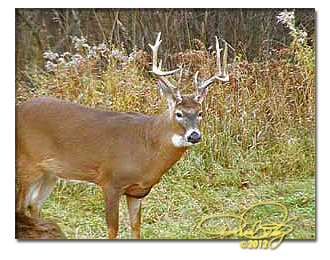
This deer wouldn't offer a clean shot unless the hunter was behind and off to one side.

But one man I know has a 3-D course set up in his back yard. There is one tree stand location with two targets, and four ground targets. He goes over the area with a snowblower after every snow, and keeps the lanes reasonably open for he and his wife ir friebds to shoot.

Of course, during a winter like this one, it's rather hard to stay ahead of the snow. It's even more difficult to keep shooting lanes open, and the snow has to go somewhere. He's constantly moving his 3-D targets, and any miss means a lost arrow until spring arrives and the snow melts.

There is a distinct advantage to shooting outdoors during the winter months. Each archer is dressed in clothing similar to what they would wear during a December bow hunt, and they can learn to judge when fingers are warm enough to help them shoot straight. It also seems to toughen up their body, allows them to build up a tolerance to the cold, and makes them less miserable in cold and snowy weather.

Another friend has a long garage, and it has a small wood burning stove that he keeps going all winter. One corner of the garage is set up solely for the purpose of winter target practice.

His longest shot is 20 yards, and he has targets set at 10, 15 and 20 yards. He also has built an easily moved shooting window to replicate hunting from inside a coop.

He fashioned it out of a single sheet of plywood with braces at the bottom so it will stand erect. He has the shooting window positioned so it will be at the perfect height for taking shots while sitting down. He shoots all of his deer while sitting, and he can easily move his targets or the shooting window to make shots easy or difficult.

He also has a rheostat on his garage lighting system. He can make the garage as bright as noon on a sunny day or he can dim the lights to simulate those shots taken during the last few minutes of legal shooting time. One year he took his used Christmas tree out of the house on New Years Day, stood it up where a buck appeared to be coming out from behind a tree.

Taking a shot at any of these deer means knowing the exact distance. Winter practice can help.

It added a degree of realism to his target shooting. He even went so far as to build a ladder stand at one end of his garage, and could practice shooting down at targets from a height of about 10 feet.

Does all of this practice help these hunters? All of them shot bucks last year, and none of them missed a deer, and every one of these folks were able to bow-shoot a buck and place the arrow with enough accuracy that not one animal traveled over 75 yards before dropping.

Winter archery practice is important.

Is this taking things too far? I don't think so. I mentioned above that I shoot every day, but I do it inside where it is warm and dry. Shooting outdoors, from a tree stand, or inside a garage means these folks are as serious as a heart attack when it comes to shooting and killing a deer.

My hat is tipped to anyone who practices shooting during the winter, spring and summer months. Come fall, they are ready to hunt. And when a buck offers a shot, and they decide to take it, that deer's life is measured in mere seconds because they won't miss.

Posted via email from Dave Richey Outdoors

Thursday, February 25, 2010

Remembering The Good Old Days

Every now and then my mind carries me back to the so-called "good old days." Everything seemed larger than life when we were kids, and first getting involved in bow hunting was a big deal to me.

I really can't recall my first bow hunt, but I had an old recurve that I used. It seemed as if that bow was as tall as me, but that is the fun part of remembering things from 50-60 years ago. Our mind sometimes plays tricks on us.

My thoughts take me back to an era when very few people hunted with a long or recurve bow. This was long before the first compound bow was invented, and I remember the problem of trying to find straight wooden arrow shafts.

Constant practice was needed to keep muscles toned for a quick draw, an even faster aim, and a sure release. There were no tree stands in those early days, and the only rubber boots we owned were four- or five-buckle Arctics that were only worn during winter's snowy months.

Bucks in the "old days" were often seen in the open once the snow fell.

The deer seemed much larger back then than now. Of course, I suspect that was because I was much smaller, and our size difference was a result of being younger.

Most of the hunting in those days came during the traditional November 15-30 firearm season. Blaze or Hunter Orange clothing wasn't worn in those days for one simple reason: it hadn't been invented yet.

Most of us wore green-and-black or red-and-black checked wool coats and pants. Ours were often hand-me-downs from an older brother, and sometimes we hunted in whatever clothing we had. We knew about dressing in layers, and often wore everything we owned to stay reasonably warm. A few people had some of the old WWII camouflage, which really wasn't very good.

We never worried much about human scent, and seldom took any precautions about hunting the wind. Many hunters simply walked into the woods, found a stump or uprooted tree to sit on, and would watch where two or three trails came together. If they happened to choose a downwind position, they might shoot a deer if they could sit still and not spook the approaching animal.

I was fascinated by whitetails in those days. I'd often go hunting. It soon dawned on me that if I was upwind of deer, I seldom got a shot.

One of the first things I learned was to hunt the wind. I learned that a hunter downwind of a whitetail buck was seldom winded. I learned to hunt deeper in the thick cover so I'd have a chance at a buck before the guys lined up outside of the cover would see deer.

It didn't take long for me to learn that a long bow or recurve wasn't made for long-distance shots, and found most of the bucks I shot at were between 10 and 15 yards away. I became an instinctive shooter because there were few sights in those days. I drew back, aimed down the arrow shaft at the buck, and when the sight picture looked right, I made my release as smoothly as possible. After time, those shots often killed that buck.

Early bow hunting meant getting back into deep cover away from other hunters.

There are memories of scouting for deer. It was easy to find the main runways, and I avoided other hunters as if they had smallpox. The more hunters in an area, the greater the chance of the accumulated noise and human scent spooking deer long before dawn arrived.

So I hunted deeper in the thick cover, planned my adventure with teenage expectations, and studied deer. I wanted to learn all I could about these animals, because deep down inside, I knew that the more we knew about whitetail deer, the better success we would have.

Weekends, holidays, days off from work, all would find me in the woods. I spent countless days studying them from afar, and many of those lessons I learned as a teenager are still being practiced today.

After all these years I'm still addicted to deer hunting with a bow.

Hunting deer is much more than a casual thing for me. It is something I happily admit to being addicted to. Spending time in the woods, studying and watching deer, is as much a part of my scouting procedures as it was 50 years or more ago.

Perhaps the bucks were bigger back then, and perhaps they weren't, but it makes little difference now. The good old days didn't occur six decades ago, they are here today. Lots of deer doesn't make the deer hunting better. Hunting one buck, and concentrating one's entire efforts on that single animal, is what makes hunting so much fun.

After all of these years, there is nothing better than going one-on-one with a whitetail buck. If he makes a mistake, you'll get a shot. If you make a mistake, chances are good you'll never know he was nearby and how close you were to getting a close and clean shot.

For me, that's what makes hunting whitetails with a bow, such a worthwhile endeavor. The one-on-one experience is still addictive.

Posted via email from Dave Richey Outdoors