Tuesday, August 24, 2010

Doubting anglers just dont understand


A friend stopped by the other day with a buddy of his. The other gent wanted to meet me, and have a discussion about steelhead fishing.

The chat began mildly enough when we shook hands, and we made small talk for a few minutes. Then, in a burst of what seemed like pent-up anger, he questioned me about my past steelhead fishing.

"You've written that you have caught 100 steelhead in one day, and another time you wrote that you'd probably landed nearly 10,000 steelhead in your life," he said. "I think both statements are a crock. No one can catch that many steelhead these days.

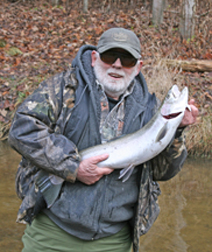
The guest who wanted to argue his views in my home.

Mind you, this dude was a guest in my home. I don't take kindly to insults, and statements that I might be lying.

I agreed that he was probably right. It would be most difficult, if not impossible, these days to catch 10,000 steelhead in a lifetime. I also added that he must have missed something from both stories he’d read. I learned years ago that people read what they want to in a story, and then wish to argue their mistakes when they are wrong.

"First of all, Bud, I wrote that two of us caught 100 steelhead in one day, and will gladly introduce you to the other man who has a much shorter fuse than mine," I said in an even voice. " Call him or me a liar, and you'll find yourself with a rocky future."

"But ... but," he stammered. And I then told him it's not polite to interrupt someone when they are speaking. He quickly shut up.

I told him he should go back and re-read each story before mouthing off.

I explained that the 100-fish day happened over 25 years ago, on a cold and snowy day with lots of wind, and most steelhead fishermen were home or working. We happened to find a big school of fish, and it seemed as if none had eaten in a month. Almost every orange-colored fly we pitched to them resulted in a strike.

We quit fishing once with nearly 60 fish that we had caught and released unharmed. We went for breakfast, checked another stream, and headed back to the hotspot for a second round. We were up to about 85 fish when my buddy tripped and fell, got soaking wet and headed for the car and some  welcome heat.

I stuck with it, caught what it took to hit 100 fish, and kept only one small male steelie that had inhaled a fly through his mouth and was hooked in the gills from the inside. The fish was bleeding heavily and would die so I kept it. My hand on 10 Bibles on that one.

And then, the case of approximately 10,000 steelhead. I'm 71 now, and began steelhead fishing at age 11. By the time I was 15, I was catching between 100 and 200 steelies each year, and that was from the Sturgeon River between Indian River and Wolverine. Mind you, that was back in the early 1950s.

My steelhead fishing career now spans 60 years.

By the time I was 18 in 1957, I was fishing even more often, and the fish numbers shot up to about 300 steelhead per year. Some of those fish were caught during a "temperature run" during the summer months, which caused these Burt Lake fish to seek comfort in the cold river water. Competition? There wasn't any.

By my mid-20s, I was fishing steelhead along the Lake Michigan shoreline. Favorite streams were the Betsie, Little Manistee and Platte rivers, and those rivers held lots of fish and very few anglers.

It was really amazing, and seldom would I keep a fish. I would have six or eight 30-fish days each year, and always put the fish back. A quick, hard fight, and a swift release and no harm to the fish.

I began guiding salmon fishermen in 1967 when the spawning runs first began, and most of my clients cared nothing about steelhead. Everyone wanted salmon, so I'd give them lessons and once they learned how to cast, I'd "go check for other hotspots." I always carried my Black Beauty fly rod, and I always looked for steelhead holding downstream of spawning salmon where they gobbled free-drifting salmon eggs and were suckers for an orange fly.

Those fish were always caught and released, and I'd return in a few minutes to check on my people and lead them to new batches of salmon. I guided for 10 years, spring and fall, and not once did my clients go home without a limit of fish. Not only was I the first fly-fishing wading guide in the state for anadromous browns, salmon and steelhead, but I pioneered this fishing and developed many of the tactics in common use today.

Whenever I had a free day, I would check rivers to keep track of the runs, and the best way to do that was to fish. There were countless days, especially in November and December when the rivers were full of steelhead and everyone else was deer hunting, working or at home, close to some heat. Those months can be brutal on a steelhead stream but it doesn’t bother the fish.

I could easily say I personally landed 400 to 500 steelhead each year during my guiding years, which would mean 4,000 to 5,000 fish during those 10 years. One also must remember the limit back then was five fish daily, and seldom would I not catch my limit. Again, more than 99 percent of those fish were released.

One also must remember that the big push by the Michigan Steelheaders really didn't get underway until the mid-1970s. Back then, people who had caught three or four steelhead in a lifetime were introducing their friends to the sport.

Years ago there were more steelhead than anglers to fish for them.

High steelhead numbers held through the early 1980s, and although I no longer was guiding, I was still fishing hard in the spring and fall. It was great: I'd fish for steelhead in the morning, and bow hunt for whitetails in the afternoon and early evening. It was great fun.

Do I know precisely how many steelhead I've landed? I had caught over 8,000 steelhead by 1976 when I quit guiding. I know I've caught well over 2,000 fish since then, and if it hasn't reached 10,000 by now, I'd be very surprised.

I'd consider myself a fish hog and a poacher if I'd kept everything I caught, but nearly all fish were released after a fast, spirited fight. Most spring steelhead are soft-fleshed and not tasty, and they don't freeze well. I only fished for male steelies in the spring, and never bothered fishing for the females. I avoided hooking the hens, and that kept the males near the females.

Nowadays, with my vision problems, I don't fish steelies as hard or nearly as often as I once did, and that is a good thing. Bowlers become expert by rolling 20 games or more each week, and steelhead fishermen become better anglers by fishing daily.

I courteously ushered the head-shaking gent to the door and on his way. I don't know whether he believed any of this or not, and it really didn't matter if he did or didn’t. All I know is that for many years the numbers of river steelhead caught far outnumbered the anglers who were qualified to fish for and catch them.

Those who could, did. Those who couldn't, bad-mouthed the hot sticks. There's nothing new about jealousy among anglers.

Posted via email from Dave Richey Outdoors

Monday, August 23, 2010

Your favorite outdoor pastime


I'm an outdoor writer, and if we base that on the large number of writing and photography awards on my walls, a decent one at that. I enjoy writing about all types of fishing and hunting but I always could use a little bit of help from my readers.

Send me an email at <dave@daverichey.com> and tell me what you most like to read. Is it bear hunting, and some of the hair-raising pieces I've written about my personal bear-hunting experiences over the past 40 years?

Or, might it be bow hunting for whitetail deer? It's my favorite passion, but I also want things to be appealing to you. I realize that it's impossible to satisfy everyone, but with 55 years of hunting and some 250 or more deer under my belt, I can write all day about whitetail hunting techniques.

I want to hear your thoughts.

How about salmon fishing? It's still the big deal on the Great Lakes these days, but all isn't peachy across the state. The Lake Huron salmon fishery isn't quite as good as it once was , and this year the action has been good on Lake Michigan. Will it hold up or not? Let's hope so.

Walleyes have ripped the top off the container holding the biggest angling attraction in the state, and snatched it away from salmon 12-15 years ago. Walleyes are easier to catch, taste wonderful on the table, and they match the moods of those people who don't care to bounce around on the larger Great Lakes.

Where does duck and goose hunting stand on your list of things to do? Do panfish (bluegills, crappies and sunfish) rate high marks, and how about stream fishing for steelhead?

It seems that steelhead fishing (and catching) has slowed a bit from its manic pace of 15 years ago. Do you still thrill to the cold water tightening your wader-clad legs in the spring and fall, and do you enjoy the frosty nip of steelhead in mid-winter below power dams?

Fall salmon fishing in the rivers can be a hoot, and these tackle-busting fish can stir up a bunch of fun for anglers who learn how to catch them with bait, fly, plug or spinner. Hook a 20-pounder in heavy, fast water, and you are in for a long-distance fight that could cover a quarter-mile of river.

Is it salmon or steelhead fishing in our Great Lakes tributaries?

How about hare, rabbit and squirrel hunting? These game animals are what most hunters grew up chasing after. They still rank high marks among hunters.

Let's face it: I don't know anyone who doesn't enjoy wing-shooting for ruffed grouse and woodcock. It's easy to factor ringneck pheasants into that equation too, and to a lesser extent, quail during an open season.

This state needs a mourning dove season again, and even with a season, the nay-sayers would still have plenty of doves cooing during the day, spattering decks with their droppings, and scaring smaller song birds from the feeders. Other states have dove seasons, and their bird populations have not declined nor disappeared, and it's time for Michigan hunters to take some of the birds that we raise.

For a money-strapped DNR, a dove season could help. Studies prove that hunting really doesn't affect bird numbers in this state, and most states south of Michigan have a season. The idea was soundly trounced in recent years, but perhaps it's time for the state to study the matter again.

Most of you know I love muskie fishing, and I enjoy writing about this type of fishing -- one man, one fish, who will win? In most cases, the muskie almost always wins. It's those occasional days when the Muskie Gods smile, and grant us a good battle with a big fish, and that really turns me on. I have never kept a muskie, and don't plan to start now.

Do you enjoy my occasional rantings about how the Traverse City area is growing too fast? It is expanding in all directions except due north, and one wonders when and where it will stop. Perhaps when Cadillac, Honor, Kalkaska, Northport and other small cities become Traverse City's suburbs.

Ethics and poaching problems are major issues for me. How about you?

How about my occasional pieces on the ethics of fishing and hunting? We, as anglers and hunters, must impose our personal code of ethics on our outings. We can't be winking at the fish and game laws, and continue to feel these laws are made for everyone but us. People must study their own brand of ethics, and see if it fits in with those of society.

I spent many years writing outdoor magazine articles, 25 books on fishing and hunting, and 23 years were spent writing about fishing and hunting for a major daily newspaper. Few people would write to the editors and tell them what they wanted. Now, the only boss I have is you folks, and many of you do write. I still would like a sense of direction or I'll continue to do as I've done for nearly seven years with this daily weblog.

Which is to write about what I think you would like to read. I try to keep my daily topics timely, but some input is certainly welcome. Which of you is willing to take five minutes to write a note with your thoughts?

And, don't forget: I have over 600 books for sale and more than 800 outdoor magazines dating from the early 1920s, Looking for a birthday, Christmas or Father's Day gift, outdoor books and magazines make a great gift.

Bring 'em on, and don't be bashful. I wouldn't ask if I didn’t want to hear your opinions.

Posted via email from Dave Richey Outdoors

Sunday, August 22, 2010

Custom bamboo fly rods


TRAVERSE CITY - Quality. It's hard to define but you know it when you see it.
That was what happened when I first saw one of Bob Summers bamboo fly rods.

Priceless quality was present in the rod's fine craftsmanship, the hand-tooled cork grip, the pleasing lines of cane fibers along its length, and the whispering smoothness as a fly line shooting forward on the cast.

The difference between a store-bought graphite fly rod and one made of bamboo is as obvious as a punch in the eye. A cane rod feels alive in your hand, waiting only to be put into action.

A master bamboo rod craftsman.

But the difference doesn't end there, said custom rod builder Bob Summers of Traverse City. The quality workmanship of bamboo fly rods far surpasses machine-produced rods of fiberglass or graphite.

"I've made custom-built bamboo fly rods since 1956," Summers said, flexing one of his hand-crafted rods. "I've watched anglers fish with bamboo, fiberglass, graphite and boron composite rods, but in the end, discriminating anglers always come back to a fine cane rod. Bamboo is a traditional rod-building material, and has been for many years."

Summers, who began working for the Paul H. Young Rod Company in Detroit, and then moved near Traverse City, eventually set up his own shop along the Boardman River in 1974 and hasn't looked back. His goal is to produce, by hand, the finest bamboo fly rods in the world.

That he has done so is readily apparent by longstanding orders from satisfied customers. He doesn't need many new clients; he does need more time to fill his present orders and to fish more often for bass, carp or trout.

Say what? Bass? Carp?

Summers would be the first one to stand up and say that bamboo fly rods are not just for Atlantic salmon or trout. He has caught striped bass on his rods, and one of his favorite sports these days is wading the shallows of Grand Traverse Bay for spring carp, a hard fish to land. He deliberately fishes for other species just to prove that cane rods are tough enough to meet the challenge.

"The best bamboo is Tonkin cane, which comes from southern China," he said. "It has more power fibers than any other cane, and it is these fibers that create the semi-parabolic action that has become a trademark of my fly rods."

A semi-parabolic action means the finished rod flexes clear down into the handle rather than just in the tip section. This type of action is found in every powerful rod ever made.

Beautiful to look at and to use, and a wise investment at this time.

"I never knock other peoples rods because beauty often is in the eyes of the beholder," he said. "A graphite rod, to me, is cold looking but a cane rod is a thing of beauty. The cane is rich in color, and casting is easy."

Much is made in fly-casting circles of a rod's ability to throw a tight loop. Summers feels a tight loop is more the result of a qualified caster than rod function, and he can throw as tight a loop with a bamboo rod as anyone else with a glass or graphite model.

"Bamboo rods simply cast better," he said, giving a casting demonstration. "The line speed is slower, and the fly line disturbs the water less when it and the leader lands. It spooks fewer fish.
"
He believes a willing angler can learn how to fly cast better with bamboo than with any other rod material. Much of this is because of the flexing action coming from six strips of cane glued together to form the rod.

"Quality, to many older anglers, is more important than price," Summers said. "There are 40 to 50 hours of handwork that goes into every rod I build. I completely manufacture everything myself, from cutting the cane strips to making my own ferrules, reel seats, rod cases and caps."

The only thing he doesn't make are the rod guides. He can, and does, make customized cork handles for rods if desired, and can form them to the buyers hand. Such tiny attention to details is what separates a hand-built rod from a mass-produced one.

"This is a labor intensive business and I don't compete with a company that mass-produces fiberglass or graphite rods," he said. "I buy the best Tonkin cane available and age it for several years before using it
"I also buy the finest cork for handles, and a two-pound bag will cost several hundred dollars. There is no skimping on quality, and that's why many of my customers own several rods of different sizes so they can fish in a variety of situations."

Take care of a bamboo fly rod and it could last a lifetime.
A quality bamboo fly rod is an investment in time and money. The rod needs tender loving care to prevent it from taking a "set." A set is an unnatural bend or curve in the cane that results from standing it in a corner with weight on the tip or by continuously pulling fly line down from the tip.

"Normal usage and care can help anglers protect their rod," he said. "Wipe the rod down with a damp cloth after use, and let it dry before putting it into a cloth bag and then in an aluminum rod tube. A minimum amount of care will give the owner a lifetime of service."
Not everyone can or will own a Bob Summers fly rod, and this is as it should be. A quality bamboo rod is a thing of beauty, and in the right hands, it can deliver a fly to the water with exquisite grace while providing the owner with a sense of well being.
One could ask of little more from any fly-fishing rod.

Bamboo Fly Rod Sidebar.

What: The custom production of bamboo fly rods.

Where: Bob Summers, The R.W. Summers Company, 90 River Road East, Traverse City, MI 49684. Phone (231) 946-7923.

Rods: Summers offers 11 different Tonkin cane rod models. They include four Midge models: a 5'6", 6'2", 6'4' for No. 4 lines and a 6'6" for a No. 3 or 4 line. They come with two tips, bag, tube, 2-ring reel seat and black aluminum for $1,875.

Models No. 75 and 735: a 7'0",  No. 75 for a No. 5 line and a 7'3" No. 735 for a No. 4 or 5 line. They come with two tips, bag, tube, 2-ring reel seat and black aluminum for $1,875.

Model No. 260: A 7'6" rod for a No. 4 line. It comes with 2 tips, bag, tube, 2-ring reel seat and black aluminum for $1,875. An aluminum and wood screw-lock reel seat is an additional $60.

Model No. 275: This is a 7'6" rod for a No. 4 line. It comes with two tips, bag, tube, 2-ring reel seat and black aluminum for $1,875. An additional $60 is needed for an aluminum and wood screw-lock reel seat.

Model No. 856: This is an 8-foot rod for a No. 5 or 6 line. It too comes with two tips, bag, tube, hood cap and ring reel seat for $1,900. Add $60 for an aluminum and wood screwlock reel seat.

Model No. 827: This is a 8'2" rod for a No. 7 line. It features two tips, bag, tube, hood cap & ring reel seat for $1,900. Add $60 for an aluminum and wood screw-lock reel seat.

Model No. 8689: An 8'6" rod for a No. 8 or 9 line. It comes with two tips, bag, tube, aluminum and wood screw-lock reel seat for $2,000.
Prices may change without notice.

Posted via email from Dave Richey Outdoors

Saturday, August 21, 2010

Old outdoor magazine: Our outdoor legacy

It’s difficult to know where we are going unless we know where we have been, and looking through old outdoor magazines is a pleasant way to spend free time. If you are like me, and are a hopeless romantic when it comes to all things related to fishing, hunting and reading about these pastimes, perhaps this is a good time and a wonderful way to gain a greater understanding of our outdoor heritage.

Careful storage of Ben East’s valuable magazine collection


I have carefully stored those old outdoor magazines (as many as 802) and other historical files, in a temperature and humidity controlled, smoke-free environment for 20 years. Now, after reading and studying them, it’s come time to part with 802 magazines from various publications. Storage space has become very limited, and this calls for a drastic but necessary decision to let some of these scarce magazines go to collectors and lovers of fine sporting art.

Why collect old outdoor magazines? Frankly, the front cover illustrations on older magazines were graced by full-color drawings by leading wildlife artists of that era, and they have become very collectible. These color cover drawings had the power to inspire a reader, to make them dream of a fishing or hunting trip that would be the capstone event of their sporting lives.

These drawings evoke a sense of the wilderness and of wild places and things. The artists could capture some of what today’’s photo-illustrated covers cannot. I get goose bumps looking at those old covers, and as a kid of 12 years, my twin brother George and I had our own subscriptions to Field & Stream, Outdoor Life and Sports Afield, the Big 3 outdoor magazines of that earlier era. We greeted each magazine arrival with great anticipation, and read the articles from beginning to end, cover to cover.

Learning about our outdoor heritage


We immersed ourselves in the outdoor literature at a time when outdoor writing only meant writing about fishing, conservation issues and hunting. They were my link to the past, to another era when the outdoors only meant the consumptive sports of fishing and hunting. These were not spectator sports, but were participant sports where what you caught or killed was eaten.

What these magazine covers did, and something current outdoor magazines can’t do, is show human emotions. The drawings could be funny, gritty, raw or tug at your heart strings. One could see dejection, happiness, sadness, or it may portray a funny scene. Each cover had an emotional element that was readily apparent when seen, and the covers depicted things that readers could relate to.

Those stories, and particularly the color covers and inside b/w and color art, were the stuff of excitement. The writers wrote Me and Joe stories where people went fishing and hunting, and the reader was welcome to come along for the literary ride. We shared vicariously in the writers’ defeats and successes, and felt as if we were right at their elbow as they made the final stalk on a big ram or caught a heavyweight bass.

We traveled to far-off countries, hunted lions and tigers with Jack O’Connor and other firearm writers, and came away with wild and vivid experiences. Those stories carried us off to one adventure after another.

Meet some of the legendary magazine writers

Those were not the days of the how-to story. Instead, those writers knew how to capture the imagination and the thrill of an outdoor experience and weave it into a great read. Many of those writers were legends in their own time. Men such as:

Russell Annabel

Charles Askins

Havilah Babcock

Erwin Bauer

Vereen Bell

Ray Bergman

Joe Brooks

Nash Buckingham

Chester Chatfield

Bert Claflin

Eugene Connett

Paul Curtis

Byron Dalrymple

Henry P. Davis

Ben East

Charles Elliott

Corey Ford

Arnold Gingrich

Hugh Grey

Sparse Grey Hackle

Roderick Haig-Brown

Van Campen Heilner

Ray Holland

Cal Johnson

Elmer Keith

John Alden Knight

Claude Kreider

Robert Page Lincoln

Jason Lucas

Art Macdougall

Gordon MacQuarrie

Jack O’Connor

Ozark Ripley

Ben Robinson

Robert Ruark

Andy Russell

Archibald Rutledge

H. P. Sheldon

Fred Streever

Edwin Ware Smith

Burton Spiller

Tap Tapply

Harold Titus

Ted Trueblood

Townsend Whelen

Frank Woolner

Lee Wulff

Ed Zern


and many others held our minds captive in their hands as we read along and enjoyed every moment of every story.

Meet and treasure the outdoor illustrations of these legendary artists

However, as great as these writers were, it was the artists who drew the color cover illustrations that took our mind away from other things and captivated us with the artistic mastery of their drawings. There were artists named

Robert Doares

Charles Dye

William Harnden Foster

Arthur Fuller

Howard Haskell Hinton

John Newton Howitt

Lynn Bogue Hunt

Francis Lee Jaques

Marguerite Kirmse

J. F. Kernan

Bob Kuhn

Harry Livingston

Edwin Megargee

Harold Megargee

Wiley Miller

P. B. Parsons

William Schaldach

G. Tyng

Walter Wilwerding

Edgar Wittmack


and many others.

Here’s the deal

A total of 802 of these magazines will be offered for sale but there are far too many to list here. If you are interested in some great old outdoor magazines from Ben East’s personal collections, send a personal check for $10 with the word magazines in the subject line, and I’ll send the complete list which notes the magazine name, date of publication, a listing of some of the authors in that issue, and notes on the artist and topic of that particular cover.

Your $10 fee will be refunded from the cost of the first purchase of $50. Orders of $50 or more will be shipped free. I can send scans of the covers but please limit your choices to three scans per order.

Various magazines being offered

Magazines include

  • Boy’s Chum
  • Field & Stream
  • Fishing Facts
  • Fishing & Hunting Guide
  • Forest & Stream
  • Fur-Fish-Game
  • Great Lakes Fisherman
  • Hunting & Fishing
  • Hunter Trader Trapper
  • Michigan Sportsman
  • National Geograpic (only one)
  • National Sportsman
  • Outdoor Life

Posted via email from Dave Richey Outdoors