Thursday, October 07, 2010

Beating up on the salmon


Hundreds of coho salmon were holding in the clear current of the Platte River near Honor, Mich., and as guide Mark Rinckey and I looked around, we never saw another fishermen.

Anglers were conspicuous by their  absence. He handed me a jar of spawnbags, and take my choice. The jar contained pink spawnbags and yellow ones.

"Take your pick," he said. "Yesterday's guide trip produced lots of salmon on the yellow bags. Pick your favorite."

Pink or yellow-mesh spawnbags work best.

So my choice was pink, and I hooked a two-pound jack coho (a precocious two-year-old fish) on the first cast. The fish fought the limber rod and four-pound line before coming to the net.

"These silvery youngsters are really good to eat," he said, unhooking the fish and placing it on the string. "We're catching a mixed bag of Chinook salmon, cohos and the occasional steelhead. The best of the steelhead fishing will begin in about 10-14 days as the salmon run ends.

"For now, it's mostly salmon. Once in a while we catch some adult 9-10-pound cohos, and they are pretty wild.

We were using lightweight 10-foot rods, the four-pound mono and a No. 8 hook with spawnbags. Two or three small splitshot are crimped to the line about 18-24 inches above the baited hook.

I baited up again, and sticking with what worked before, threaded a pink spawnbag on the line. It took several casts before an adult coho picked up the bait rolling along bottom, and as a tap was felt on the line, the hook was set.

An adult male ripped off on a 20 yard run, jumped once, turned and ran back downstream, switched directions again, and headed back upsteam. He wallowed on the surface, and unexpectedly the hook pulled free.

Hard hits and short runs are the rule right now.

"I haven't had a strike on yellow," he said, "pink seems to be the color. I'll keep trying it because I know it works."

I was into another jack coho, and this guy was two pounds of high-stepping dynamite and fought like a fish three times his size. One thing is true about river guide Mark Rinckey of Honor: it's possible to get ahead of him, but look out when he  works things out.

We never compete against each other when we fish on a busman's holiday -- a day when he doesn't have a trip -- but the man is a magnet for fish. He promptly hooked a big adult male coho, fought it hard for 10 minutes, and then it burrowed into a beaver house along the bank, crocheted the line through a maze of small alder sticks and broke off.

"I lost a coho and Chinook salmon to the beaver house yesterday, and if a big fish wants to go there, it's hard to stop them on four-pound line. Many of the adult fish are still silvery from Lake Michigan. The trick, if possible, is keep the fish away from debris in the water."

He then hooked another jack, fought it to a standstill, netted it, and added it to the stringer. I then hooked another good fish, and lost it after a five-minute struggle as it rolled in the line and broke free.

Seven fish for four hours, and several lost fish, is common.

Time passed as we went through one dry spell after getting hits and failing to hook up. The salmon were cooperating, but were hitting light. The soft takers were hard to hook well.

The sun was well up in the sky, shining bright and full on the water, and the wind died for a spell. Action slowed until the wind picked up slightly, riffled the water, and the salmon began hitting again.

We fished hard for about four hours, and landed seven salmon including one of about eight pounds. The jacks averaged from two to three pounds, and we danced with the fish during the morning. Eventually, as with many things in life, all good things must come to an end.

Dances with salmon can be a pleasant interlude for river fishermen before the fall steelhead runs pick up in a couple of weeks. Until them, anyone looking to book a guided salmon trip on the Betsie or Platte rivers, can call Mark Rinckey at (231) 325-6901. He also is booking steelhead trips for late-September, October and November.

Light line, nice fish and autumn color go together like bacon, eggs and toast. Some dates are still available, and anglers are advised to call soon to arrange a great fishing trip.

Posted via email from Dave Richey Outdoors

Wednesday, October 06, 2010

Surf fishing is good now


If there is anything that turns me on, it is prowling a secluded Lake Michigan beach and casting bait or lures over the edge of the first drop off. The results of that one cast can be explosive.

This is the time of year when most of the coho or Chinook salmon have moved upstream but some stragglers may be caught from shore. The occasional brown trout or steelhead is also a possibility although the steelies are about ready to move upstream to follow the spawning salmon.

Of these two species, the brown trout are most unpredictable. Brown trout numbers have dwindled in recent years, and it would be nice if the DNR planted some fish.

Fishing such spots can be a hit-or-miss fishery.

Rivermouth fishing can pay off from now through times when it is too brutally cold to fish. Many anglers can be seen fishing off a mouth as the wind gusts and drives bone-chilling cold rain or snow into your face. Sometimes the action is good enough to make fishermen fight the cold weather until they limit out on steelhead or browns.

However, most of the time, the fishing will be strictly for steelhead. A brown trout is a bonus. Anglers must learn to read a rivermouth in order to know where to fish.

Watch to see where the river current meets the lake water, and the current flow often depends to a arge degree on wind direction and wave action. Often, a sand bar can build off a river mouth, and the current will curve one way or the other around the sand bar.

I remember once when me and a dozen other fishermen found a school of fall steelhead and a few browns off the Platte river mouth pm a foggy day. The fish could be seen swimming only 10 yards away, and every fish seemed to weigh six to 10 pounds. A few of the browns were even larger.

We used spawnbags tied with orange or yellow mesh material, and we added one or two tiny Styrofoam kernels to the egg sack. This helped the bait to float up just off bottom.

Bait produces mostly steelhead while spoons work best for brown trout,

Our fishing rig was simple. We ran our 6-pound line through a 1/4-oz. egg sinker and tied the line to one end of a barrel swivel, We then tied in a four-foot length of 4-pound leader, tied on a hook, baited up, and cast into the water where the river current and lake water met.

The bait would roll along bottom, and usually it may roll only a few feet before we felt the tap-tap-tap strike as a steelhead picked up the bait. We'd give the fish a bit of slack, let the line come tight again, set the hook, and then watch the explosive jumps of an angry and wild fish.

We hooked a few brown trout that day, but most of the catch were steelhead. If a spot stopped producing, we'd move 50 to 100 yards down the shoreline as we continued to fish the river current flowing into the lake.

Often, the fish would hold on the deep-water side of a drop off. Deep is a relative thing. Where we were hooking fish that day was only five or six feet deep, but the fish were on one side of the sand bar and we were on the opposite side. They couldn't see us, and they seemed to act like an outfielder camped under a high fly ball waiting for the bait to fall down to them.

Once the bait hit the water the fish would grab the spawnbag. We didn't get a hit on every cast, but rarely did we make three casts without hooking a fish.

Try casting spoons in the same areas.

We also experimented with casting 1.4-oz. Devle Dogs or Little Cleos with a silver, silver-blue, silver-green, silver-orange or pearl-colored spoon. The lures would be cast out past the fish, allowed to sink, and retrieved just fast enough to bring out the best action. It seemed to work best on the brown trout in that school.

Timing this event is a crap-shoot. It often happens sometime after early October. Either develop a local and reliable contact in your favorite fishing area, or try it on weekends.

A river mouth can get crowded, and if your neighbor hooks a fish, it's important to get the bait or lure in fast to avoid a serious tangle. Two or three lines tangled by one fish creates a great deal of wasted time for everyone concerned.

Fishing the surf is fun. Lots of fresh air, usually a good group of guys who are willing to help each other, and if one hits the right day, it can be some of the most exciting and spectacular light-line action of the year.

Posted via email from Dave Richey Outdoors

Tuesday, October 05, 2010

East-Wind Hunting Spots


It's just human nature. Many hunters fall in love with their opening-day ground blind or tree stand because they've thought about it for months on end.

Does this mean his so-called hot spot will be good on opening day? Perhaps it will and maybe it won't. It all depends on wind and weather conditions, and sadly many people don't play the wind properly when deer hunting.

One major problem hunters face is setting all of their stands for the prevailing wind direction. During Michigan's bow and firearm deer seasons, the prevailing direction is south and southwest in October, west to northwest in November and northwest and north in December.

Be smarter than an east wind. Find a good spot to hunt.

So here is this hotspot stand set up for early-season hunting. It has the stand downwind for a south or southwest breeze. Good thinking! Once the season has opened, Joe Hunter has been thinking about it for weeks and plans to sit in favorite stand and shoot a deer that he this he has patterned.

However, if you've followed wind patterns the past several years as I have, you'll remember that nearly half of our October days featured a northeast, east or southeast wind. An east wind, unless stands are specifically placed for such wind currents, makes other stand locations nearly impossible to hunt without being detected by approaching deer.

It's easy to advocate having two stands in key hunting locations for an east wind, but it's sometimes quite difficult to find good spots where it will work. And, there is the obvious cost of another stand for that hunting, Some hunters will hit the hip for another stand but most sportsmen will not.

Most bow hunters, like me, prefer hunting out of a tree. One way to get around this problem is to hunt from an elevated coop. Keep the windows closed until it's time to take a shot. It's certainly not like being out in the breeze, and feeling the wind on your nose or cheek, but it allows a hunter to effectively hunt at times when bad winds blow.

Coop or box blind hunting tactics.

A choice can be made. Hunt from an enclosed coop or don't hunt. To hunt out in the open when the wind is wrong simply courts trouble.
The best way is to look at how deer travel, especially on an east wind, and locate that one key spot where whitetails filter through. Try to be downwind of the whitetail traffic, and don't move.

Fishermen have long known that angling success often takes a nose dive on an east wind, and deer hunters - especially bow hunters - know the same holds true for them when hunting on an east wind.

I've long known that an open tree stand may cause your scent to drift to the deer when the wind huffs from the east. An enclosed and elevated wooden blind with shooting windows can save the day.

One thing is certain. The hunter who deliberately puts himself upwind of deer on an east wind will probably ruin that hunting spot for the rest of the season unless he can prevent deer from smelling him. A simple V-shaped wooden structure, and forced down between two limbs with just enough room to shoot, gives the hunter something to stand on. It can work if a box-type blind is not available.

Just try to stay downwind or at least crosswind whenever possible. Hunting on an east wind requires some checking around, some good luck, and the ability to pick the ideal tree. It's not easy, but good thinking and proper placement, can make the hunt work.

Hunt cross-wind or down-wind when east winds blow.

If an east wind blows, and your stand is not placed properly for that wind, it's better to sit out the day than to risk spooking all the deer from that location. Once deer are spooked from your hotspot stand, the odds are that they either won't roam past that site or will approach it with a great deal of caution.

So try to be a savvy hunter. Play the wind like a fine violin, and never discount the ability of a whitetail deer to catch your scent,

Hunt the wind with caution and good sense, and learn when and how to hunt the east wind, and don’t it on a regular basis. Good luck.

Posted via email from Dave Richey Outdoors

Monday, October 04, 2010

Bow Quivers ... On Or Off


Life is about making personal choices and decisions. None of us must follow other hunters like a flock of sheep, and do everything as others do.

This applies as well to bow hunting as anything else. Every bow hunter worthy of the name has his or her way of doing things, and often they turn out right. We all learn from the best teacher, experience.

Bow quivers are a case in point. Should hunters leave the quiver on the bow while sitting in a stand and shooting or should they take the quiver off to minimize weight and to remove one unnecessary item that could easily tangle in tree limbs and mess up a shot?

Hunters swing both ways on bow quivers but not me.

I'll go first, and throw my hat in the ring and voice my opinions. I climb into a tree stand, and after attaching my full-body safety harness to the tree and my body, I sit down, and use the haul rope to raise my bow from ground level. The bow quiver is then removed and placed elsewhere on the tree after an arrow is removed. I often hang the quiver on a nearby limb where it will help break up my silhouette.

Once the quiver in hung, I unscrew the broadhead and attach my Game Tracer string behind the 100-grain FirstCut broadhead, and screw it into my Maxima carbon arrow shaft.

I attach the release to the bow string, stuff the lower limb of my C.P. Oneida Black Eagle bow into my left boot, and relax. I hunt and shoot sitting down, and my stands are positioned so bucks usually come from behind me and on my left side.

I shoot sitting down, and stow my bow limb in my rubber boot.

If the buck follows his normal pattern, he will approach from behind and on my left side. I'm right-handed, so when the buck comes within shooting range, and looks the other way, I start my draw and as I reach full draw, the lower limb clears my boot and is clear of my leg, the stand or any tree branches.

This allows for a minimum of movement, is very quiet, and oh so effective once a hunter becomes used to it. This method of drawing a bow wouldn't be possible if my bow quiver was still attached.

The arrow shafts, vanes or even the quiver could get caught up in clothing, limbs or branches. But there is another reason why my quiver comes off my bow when I begin hunting.

It reduces the overall bow weight. Not much, mind you, but when hunting in a variety of locations, sooner or later a bow quiver is going to hang up on something. I remove all possibilities of that happening by taking it off and hanging it some place where it is out of my way.

I want my bow in my hands at all times with my release on the string.

Whenever I watch a television show, or hunt with someone who always leaves his or her quiver on the bow, it makes me wonder how many lost opportunities have occurred because of that quiver.

A bow is a one-shot piece of archery equipment. It's not like hunting with a bolt, pump or semi-automatic firearm. Unless the wind is very strong and noisy, second shots at a buck are so rare as to almost be nonexistent.

A bow quiver on a bow, doesn't speed up getting off a second shot at a deer. It is somewhat awkward to reach to the quiver, pull out another arrow, reach across the bow to nock the arrow and prepare to shoot. Chances are, any self-respecting buck with heavy headgear will be gone if you miss the first shot.

I often use my bow to help camouflage my upper body and head. I wear a face mask while hunting, and can still turn the bow inside my left boot so the handle and upper limb breaks up my silhouette. If a deer offers a shot, a simple and slow half-turn of the wrist will point the bow toward the animal as the hunter comes to full draw.

Such a movement may or may not be necessary, and that is a debatable point, but it would be impossible to do with a bow quiver attached. For me, that is a strong reason for removing the quiver.

Many hunters, including some of the television hunters, hang their bow. A deer approaches, and they are risking being caught by a sharp-eyed deer. Me, my preference is to hold my bow where there wasted movements that could spook the animal. Holding a bow with quiver attached becomes just too awkward to hold or to hang.

The slight added weight of a bow quiver (even a three-arrow quiver like I use) can allow a hunter to unknowingly cant the bow to that side. Is it enough, under the pressure of a nearby buck, to throw the arrow off its intended course?

I don't know and don't care to test the theory. My preference is to shoot a bow unencumbered by a quiver. It's my thought that it simplifies things, reduces weight, eliminates canting, drops a few ounces of weight and besides ... it works for me.

Anyone willing to plead their case for keeping a bow quiver on a bow while hunting is encouraged to contact me. You won't change your mind, I won't change mine, but I'd love to hear your philosophy.

Posted via email from Dave Richey Outdoors

Sunday, October 03, 2010

Thinking back to other bow openers


I sit here at this computer, staring at a blank screen, and contemplated today's topic. Remembering this year’s and past bow season openers is a walk in the park for the past 10 years or so, and on a few other key days.

Each of these bow opener was something special in its own way. Four year's ago, the opener provided sightings of several bucks but nothing within my 15-yard limited shooting range. That changed the second day when a big 8-point and a 10-point locked antlers within 10-15 yards of me and my pit blind. I shot the big 8-point, and it's the earliest buck I've killed with a bow in 25 years.

Two years ago I saw a massive 12-point and a big 8-point sail past my stand and only 12 yards away, but they were blocked by the first tiny snarl of tag alders. The deer would have provided shots had they not been in the tags. I knew the 12-point was there, and saw him six times during the bow season but could never get a high-percentage shot.

Seeing the big bucks and shooting one depends on one’s skill and luck.

I passed up five bucks on opening day that year, and eventually shot the big 8-point during the rut as he was chasing a doe. I killed the buck, but probably shot too soon because the 12-point was probably nearby. A rifle hunter 250 yards from me shot that 12-point on the second day of the firearm season.

The year of 1989 was when Michigan had perhaps the largest number of bucks in history. That year it was possible to shoot two bucks with a bow and two with a firearm, and does if you had the proper tags.

That year, on opening day, I saw seven different bucks within bow range and passed on all of them. I'd seen a big 10-point, and spent my time hunting him,  and in mid-November, just before the firearm season would start, I shot a big buck that weighed well over 200 pounds but he only wore spikes. Those spikes were formidable. They were as big around as a silver dollar and nearly a foot long.

It was that same year that I passed up 47 whitetail bucks within bow range during the month of October. I drew down on each one as if planning to shoot, but I let up and let the little guys live. I shot a pair of 8-points, a nine-point and that spike. It was an odd year; lots of bucks but very few racks of any size.

The bow opener has always been attractive to me. It's like the last-Saturday-in-April trout-season opener. I wouldn't miss either one.

This is a vitally important season opener for me.

It's a time when bucks of all ages are more gullible than at any other time of the hunting season. Recent bow hunts have been much more exciting than those of years ago, at least in terms of nice bucks. I did hunt last year’s bow opener but shortly after that injured my back  that had been messed up several years before, and it was a painful year for me. I hunted only five days last year, the fewest days in 59 years of bow hunting.

I remember well the 1972 bow-opener, and it was the first year the DNR offered Successful Deer Hunting patches. I wanted one bad, and was hunting near my old hometown of Clio, just north of Flint.

I had a pit blind dug at the base of a hillside, and right near the edge of a soy bean field. A fence-row behind me was crowded with sumac, and I sat in the pit and waited. It wasn't too long before a fat and hefty 8-point came feeding by within 20 yards. The buck stopped, turned at a quartering-away angle to watch some other deer, and my Shakespeare recurve came back and the arrow cut in and lodged against the off-side shoulder as the animal raced away.

My first Successful Deer Hunter patch from 1972.

The deer could have headed for heavy cover but he raced out into the middle of a muddy bean field and dropped. I slogged through the mud, tagged my animal, and skidded it out near the road where he could be loaded into the car. I drove him to a deer check station, had him checked, and obtained the first of what is now a complete set of Successful  Deer Hunter patches, and that complete set is now worth a very good chunk of money.

Other bow openers have come and gone, and for the most part, I no longer shoot bucks on the opener. Other than three years ago, and taking a second-day buck, I usually wait until the rut before shooting a good one.

Bow hunting means vastly different things to different people. I view it as the first day of the rest of my year that will be spent hunting deer. It is important to me because it marks a very special day in my life when everything in the world seems right and I revel in the glory of autumn.

Having a bow in hand is just the frosting on a bow hunter’s cake.

Posted via email from Dave Richey Outdoors

Saturday, October 02, 2010

Hunting’s five stages


I spent an hour on the phone recently with an old friend. Jim Dabb retired from the DNR more than a decade ago, and we've been friends for about 30 years because of our ongoing interest in Hunter Education.

His job, when he retired from the DNR's Law Enforcement Division, was to oversee all of the Hunter Education programs in the state. He was the go-to guy for the newest rules, where training sessions would be held, and much more.

He was one of the greatest friends a legal hunter could ever have. He'd spent years as a conservation officer in the field, got yanked to Lansing for his final time on the job, and put in those last years riding a desk and doing what had to be done to get as many children (and parents) involved in a Hunter Education class as possible.

Hunter Education was his state-wide job.

We met when I began running The Detroit News' Hunter Education Program in 1980, and 20 of my 23 years as the paper's staff outdoor writer were spent honing our two-day program each September. The paper scrapped this wonderful program back about 2000, but training kids and their parents is something that still moves me.

Dabb and I discussed what he calls "The Five Stages Of A Hunter." It is a continuing maturation process that takes hunters through these various stages. Wisconsin has done numerous studies on this, and I shall report more on it again at a later date.

*Shooting is the first step in this process. A novice hunter wants to shoot his or her bow or firearm. It can be nothing more than plinking at tin cans or stumps in the woods, although some novices start out wanting to hunt and shoot.

This shooting can fall into two distinct areas: one is to practice shooting at a target or at game in season. It's been proven that the more a hunter shoots a bow or firearm, the better their skills become providing they have capable assistance from other caring sportsmen. Kids, in particular, love to hear the firearm go bang but must be taught the responsible use of a firearm and the dangers of careless use.

*The second stage in hunter development, Dabb says, is limiting out. They want to kill a limit of ducks, rabbits, ruffed grouse, squirrels woodcock or deer.

This is a stage many hunters find themselves mired in, but some feel the purchase of a small game or big game license should guarantee them a full bag limit.

A hunting license guarantees them only the right to legally hunt in season.

What many sportsmen don't realize is the purchase of a license guarantees them only the privilege of going hunting in a legal manner. It means they can legally hunt, and nothing else is granted.

*The third step in the progression of a hunter is learning techniques. The hunter seeks out advice from longtime sportsmen, reads hunting magazines or weblogs like this one, watches videos and reads books. Those who read, and practice what they learn, are the best hunters.

They want to work with bird dogs or hounds, hunt with a centerfire or muzzleloading rifle, and they study various methods of hunting the rut, hunting deer in cornfields, how to call wild turkeys or other game-birds, and they are on a quest to soak up knowledge about hunting.

*Step No. 4 is the trophy stage. "This," Dabb said, "is where hunters want to shoot the biggest buck in the county, the largest bear, the ringneck pheasant with the most bars on its tail."

This stage often becomes the macho period in a hunters life where they want bragging rights. They want to be known as a good hunter, and nothing but the biggest and the best will do. Sadly, some will jump on a plane, fly somewhere on a canned hunt, and shoot the critter within a matter of an hour or two, and be on their way home the same day.

*Last but certainly not least is the Sportsman Stage. This is where the hunter acknowledges the fact that he/she can become the supreme predator, and the kill no longer becomes the sole reason why we hunt.

The kill is the end result of a hunt, but a true sportsman can have a successful hunt without firing a shot. It means pitting one's skills against an animal while giving the game the greatest chance to escape. It is ethical hunting, fair-chase hunting, and the hunt becomes more important than the kill.

This final stage often isn't attained until middle-age, and with some, they never reach this level. It is where the wind on the cheek, spotting a deer, hearing the gobble of a wild turkey -- when all of these and many other things become more important than pulling the trigger. It's when we start caring about and respecting what we hunt.

Take a long look at this issue, and ask yourself: which category do I fall in? If you've read this blog for very long, you'll know that I'm in the fifth stage. Killing is no longer why I hunt.

I hunt to have hunted. I hunt to have spent time outdoors, and have been at it long enough to learn that the buck that got away will be remembered long after the deer we shot has been forgotten.

Posted via email from Dave Richey Outdoors

Friday, October 01, 2010

Keep scouting as you hunt. ((dave richey, Michigan, outdoors, check trail cameras, be alert to travel pattern changes, move))


Deer hunting is fascinating when you start with a plan, and the first time you hunt a new spot, you see deer.

I didn't hunt this morning and hunted up until the end of legal shooting tonight. Preseason scouting put me into the deer, and they did what they've done all summer. About 7 p.m., they crossed a road where my wife and I were hunting, and I saw five deer.

Four were big does and two fawns, but the fifth deer came right at the end of legal shooting time. Buck or doe? I really can't say for dead certain.

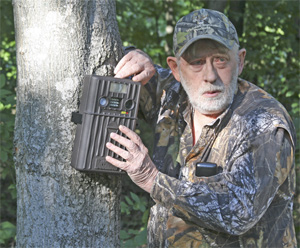
I'll be check my trail cameras tomorrow to see what moved.

It was 20 yards away, its head was down but it looked like and acted like a buck. This spot, several miles from home, is a place where we have permission to hunt. I scouted it often during the summer, and didn't see lots of deer but did see a few really nice bucks. This deer tonight may have been one I'd seen in a bean field two or three weeks ago.

Perhaps it's wishful thinking to try to pin a buck label on that deer. It was back in some deep and very thick cover, and my glimpse of the animal standing 20 yards away with its head down, made it impossible to see antlers in that thicket.

However, that spot during the summer months when the bucks were traveling in bachelor groups, as they still are, makes me think it could be a shooter buck.

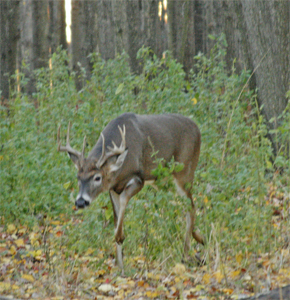
Trail camera make good sense and here's a nice young buck.

Legal shooting time had ended when this showed up just before a heavy rain, and the arrow was off my bow, and the woods just got darker and darker with every passing moment. The downpour began and the animal drifted off without giving me a look at it's head.

What tickled me more than anything was setting up in the right spot tonight. I rarely shoot a deer early in the season, and tomorrow I'll be in another spot where we have permission to hunt. All of these spots have bucks but making the right connection with them often takes more than one day. I've hunted the same buck all season in the past and didn't get a shot within my acceptable range.

My scouting continues as I move from area to area, from ground blind to tree stand to pit blind, and hunting different locations helps me keep my focus on what's important to me: the hunt. It means far more to me than shooting another buck or doe. in many cases, I'll fill a doe tag simply because by doing so I am doing my part to keep doe numbers down and give nice antlered bucks more time to grow.

So, no deer today but I had an outdoor shower. Now I think I'll head for one inside with some warm water. I'll be hard after 'em again tomorrow.

Take care and hunt safely.

Posted via email from Dave Richey Outdoors