Tuesday, September 07, 2010

There’s a kind of hush ...


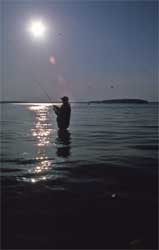
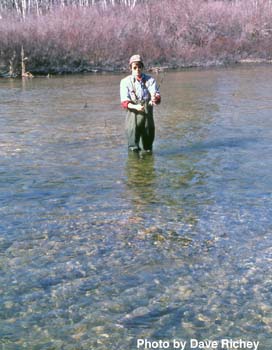
The Betsie River flowed smoothly downstream toward Lake Michigan, and acted as if it was in no big rush to get there. My wader-clad legs had carried me into thigh-deep water, and the comparative coolness of the water felt refreshing.

There was a trout rising near a sweeper but I had to move six inches deeper in hopes of putting the fly just upstream from the current seam the fish was feeding in. One step, and another, and my boots put me into the sweet spot.

Some fly line was pulled through the guides and the river murmured around me. The sounds of river music began washing away the dog-day blues.

A silent and stealthy approach, and a well-placed presentation, was needed.

A No. 12 Adams, my go-to fly when I don't know what else to try, was knotted to my tippet after several frustrating minutes of trying to  push a 4X tippet through the eye of the hook. Tying the leader to the fly line is easy and could be done in the dark but tying tippets to flies is a major challenge these days.

The fish rose every few minutes, but he wasn't willing to take my offering. Meanwhile, in preparation to cover that fish, it was time to soak up the sounds of silence.

The river, in this location, made little noise. No audible gurgles, no hissing of water around the tip of a sweeper, and no rushing water sounds. There was a kind of hush all over the river as if even the birds and insects felt it was a time not to be very active, and they got no argument from me.

Hot summer days wear me out. High temperatures and high humidity combine to sap me of any excess energy. The same results occur with strong windy showers like we had today.

Casting in the wind wasn’t easy but most of the gusts were missing me.

My thought was to reach the river,  pull on my warm-weather waders, step into the knee-deep water, hitch up my waders like an old lady pulling on her girdle, and then put together my rod.

It was shady here, and it was a blessing of sorts. I stood, listening to the music flowing through my head, studied the stream flow, listened to the water dripping off the pines, and spotted a rising fish. A few steps closer and then I stopped.

A few more steps, and I stopped again to tie on the fly, and then I was within easy and accurate casting distance. I stood, silence wrapped around me like an invisible cloak, and made one false cast and the leader rolled over and the fly landed four feet above the riseforms I'd seen earlier.

The line was mended once, and the fly drifted past his feeding spot. Another false cast to shake a bit of water off the hackles and tail, and another cast was made to the same spot without a rumble.

Five casts were made, and it was unlikely that any wading noise had spooked the fish. A sixth cast was made, and again the fly was centered in the seam of current where he fed.

Too big, I  thought, thinking perhaps a smaller fly was in order. One size smaller to start, I thought, and a No. 14 was tied to the tippet after a 10-minute battle with a hand-held magnifying glass, my reading glasses and a lot of luck.

All the other paraphernalia was stowed in my fly vest, and then a 10-minute wait for my eye to regain its proper perspective for the scene in front of me,  and then a cast put the fly in the right spot. It was difficult for me to see the Adams, and it sat astride the surface in a perky sort of way.

Switching to a slightly smaller size proved to be the right move.

Nothing happened, a roll cast, once to dry the fly, and it was laid back in the same spot. The line was mended, and then the fish hit. Mind you, it wasn't a smashing strike but more of a sip of the fly off the surface. A soft salute with the rod tip caused the fly to bite home, and then came that old familiar  bend in the rod that felt the soft touch of an old friend.

The river brown wasn't big but he had been out-thought, and had responded to a quiet approach, a change in fly size when it became apparent the larger fly wouldn't work, and besides, in the  deep shade of the cedars and pines where I stood, the rain seemed a long ways away.

I tussled with him going at it mightily when my rod pressure was calm, patient and with just enough pressure to make him do all of the work. He came to me reluctantly, and it was a male of about 14 inches. Not a lunker but good enough for the present day.

I didn't want to work too hard with a really big fish. Calm, easy, and no sense in working too hard after taking a tumble in my back yard. Out came my hemostats, and they gripped and twisted the fly loose.

He swam off, free again, and setting him free made me feel  good. I stood for a few moments in the cool of the shade before wading ashore. One fish was enough to keep my hand in, and it satisfied any need I had to fish for trout on a soggy, rainy, windy day.

Posted via email from Dave Richey Outdoors

Monday, September 06, 2010

We really needed this rain


Rain is a necessary commodity. It has many uses other than messing up vacation plans.

The Great Lakes are still low, as are many inland lakes. The woods were bone dry, and when it's as dry as it has been, the chance of a wild fire (once called forest fires) goes up.

Farmers have been looking for rain, and what we've been given in the past several days has ended our drought conditions. A drought occurs when the ground is baked dry, and dust puffs up with every step. It's what we've had for several weeks.

Rain over the past 10 days may save our food plots. only time will tell.

The rain, including that which rumbled through the area about midnight last night, was a heavy downpour. The problem with that is it fell so hard and fast that little soaked into the ground. It's better to get a steady rain that slowly soaks the ground than a deluge.

My food plots were looking miserable, and I'm hoping the rain came in time to save this years crops. Two or three clover patches were looking very poor, especially during that spate of dry 90-degree weather.

If some rain continues, as is forecast, we may still have decent food plots. My Imperial Whitetail Clover, Brassic and Purple-Top turnips, plantings were almost burned up by the hot sun two and three weeks ago. and I'm keeping a close watch on it. Drought conditions just do not produce the quality of food plots that some people desire.

Many farmers are wondering if they will be getting a decent second-cutting of hay this year. Corn fields seem to be growing well but some feel a second cutting of hay may not be in the cards this year. It's much the same with clover and other things planted in food plots.

Some state areas have had plenty of rain while other locations, such as around Traverse City, had suffered. I'd counted on making three or four plantings.

I suspect my proposed fall plantings will be put off until spring.

I will hold off on ther plantings until next spring, and see how my plots make it. Instead, I'd been thinking of some winter wheat planted on some of my woods trails to give the deer some greenery to eat this fall, and it might come up and provide an early food source next spring when deer need a nourishing early source of easy-to-find nourishment. Such a planting this fall is now in doubt.

I've said this before, and will say it again, but I'm not well learned in planting and growing things. I discuss my food plots with people I trust, and then hope the weather conditions are suitable for producing good crops.

It's one of these late-in-life situations where I hope to put something back into the resources, provide better cover and food for the animals and birds. I'm learning that Mother Nature has a somewhat perverted sense of humor: she teases us with rain, and then sends it north or south. To add insult to injury, she often decides to send us more snow.

My eyes are peeled for my Imperial Whitetail Clover plantings. Some seems to be greening up a bit, but most of our crop was brown and down. We  did the soil tests, planted at the proper time, had a bit of rain early, and then the drought began just as it did in 2007.

Giving back to nature is my prime motivations for putting in food plots.

It's difficult watching a crop go downhill, but I now have a better understanding of what farmers go through on a year to year basis.  A drought serves no one, whether a farmer growing crops for market or a sportsman who plants crops for the wildlife.

Nature and the weather can be incredibly cruel at times. We invest our sweat equity into seed, fertilizer and lime, and hope for the best. The best this year can bring will be to have a mediocre crop, and it will only happen with even more rain, sunshine and warm weather.

I'm keeping my fingers crossed.

Posted via email from Dave Richey Outdoors

Sunday, September 05, 2010

Shoot once and straight, and don’t miss


Many years ago several of us adopted a basic bow-shooting philosophy, and it is every bit as important to us today as it was back then. We called it the Shoot Once, Shoot Straight And Don't Miss philosophy.

It is a philosophy to aspire to, and we've taught it to thousands of bow hunters over the years. The philosophy is easily understood, simply stated, and if archers follow it beginning a little over three weeks when the bow-deer season opens, there would be fewer wounded deer.

Here is the whole philosophy pulled together as concisely as possible.

*Shoot Once -- How can there be any misunderstanding about this one? Bow hunting is vastly different than hunting with a firearm where one or more shots can be easily taken.

A bow hunter, 99 percent of the time, will have only one shot at a deer. A miss or a wounded animal will send the deer in hasty retreat. About the only time a second shot might be taken is to finish off a mortally wounded animal.

*Shoot Straight -- This and the next basic tenet of this philosophy are most important. Shooting with accuracy only comes from consistent and perfect practice. If the practice is faulty, the shot will be faulty as well.

This means controlling your breathing and nerves, drawing when the buck is unaware of your presence, hold your head up with both eyes fixed on the proper spot for a killing shot, aiming properly once you've achieved a firm and consistent anchor point, making a smooth release, and holding your bow steady without moving it (follow through) until the arrow hits your aiming point.

There is little excuse for error unless the arrow hits an unseen twig, but it's up to the hunter to know that twig is there and to take a clean broadside or quartering-away shot. All other shots are low-percentage opportunities, and should never be taken. If you don't have a high-percentage shot, wait for another opportunity. Don't trust to luck.

Work up a step-by-step checklist of all the things to do before shooting.

*Develop a mental checklist, and run through it in order before releasing  the arrow. If you plan to hunt from a tree, practice shooting from an elevated position.

*Know your limitations. If you can't consistently hit the kill zone on a deer at 25 yards, but can hit it at 20 yards, a 20-yard shot is your maximum effective shooting distance. Know what you can and cannot do, and never exceed your limitations. A miss, or even worse a wounded deer, can be the only two plausible results of exceeding your effective shooting range.

Shooting a deer is easy if you do everything right in sequential order.

*Don't Miss -- This is the culmination of all of these facets of this hunting philosophy. If the above two facets are followed to the letter, and you never exceed your limitations, and always achieve a firm anchor point and aim properly (and don't drop your bow arm at the shot), you will hit and kill that deer.

This simple philosophy is easy to write about but a bit more difficult to put into practice. It requires total hunter concentration, complete focus on all of the minute details, and it means knowing your bow and at what distance is your limit of accurate shooting.

Follow these simple rules -- Shoot Once, Shoot Straight & Don't Miss -- and you'll be eating venison this fall and admiring the antlers of a nice buck. You can bet on it.

Posted via email from Dave Richey Outdoors

Saturday, September 04, 2010

10 tree stand safety tips ((dave richey, Michigan, outdoors, tree stand safety is your business, safety harness, be alert))


Some great story ideas come from my readers, and one that came in recently was this question: what are the major things bow hunters should remember when hunting from an elevated coop or a tree stand?

It’s a good question and worthy of an answer. I put some thought into it and  here are some important things to remember. They are in no particular order except for No. 1. It is very important to all deer hunters

1.)    Knowing how to hunt the wind is paramount to success. The really savvy deer hunters test the air movement several times during each hunt because the wind seldom stays from just one direction. To be an effective tree stand hunter, one must either be directly downwind of the deer or across-and-downwind. I use milkweed seeds once they have dried out, and release  one or two several times during a hunt. If any seeds blow toward where the deer come from, get down and leave rather than spook the animal. Learn to play the wind, learn how to stay downwind, and more deer will provide you with better shot opportunities.

10 important tree stand tips to remember.

2.)    Know your equipment. It’s always nice to have a new bow, but a hunter must become familiar with their bow. We must know what the bow will do under any given circumstance. If we shoot an unfamiliar bow, and find ourselves having a problem hitting the sweet spot of our anchor point, the chance of a miss or wounded deer is very possible. Become familiar with the bow to the point where drawing, aiming and shooting becomes mechanical. Good shooting makes deer hunting easier.

3.)     Know your ideal shooting distance. It’s important to know your limitations and never exceed them. Your ideal range may be 30 yards, but in a wooded environment during that 30-minute period just after sundown, judging 30 yours can be tough. Most hunters find their effective shooting range is shorter in a shadowed or wooded spot. Never try to stretch your established shooting distance because it seldom pays off.

4.)    My favorite trees for a stand are cedars or pines, but it’s not always possible to find such a tree. Hunting from hardwood trees can be equally productive if the hunter chooses the right tree. I prefer deer that come from behind me. I can usually hear them coming, and there is no need to move until it’s time to shoot as the buck walks past and is quartering-away. Obviously, this means knowing exactly where deer travel and then choose a tree wisely that allows the prevailing wind to be in your favor.

5.)     Any hardwood tree can work but it must be positioned absolutely perfect. Make every attempt to situate the stand so that you can achieve full draw without being seen and without any noticeable movement. Reach full draw, allow the deer to walk past and shoot when it is quartering away. If it sounds easy, it’s because it is easy for a patient hunter.

My  favorite tree stand location is in a cedar where deer approach from behind.

6.)    Check your tree stand before each use. If it squeaks or makes noise when climbing into or out of it, it will make noise when you sit or stand to shoot. Eliminate any and all noises while checking for any defects. A squeak at the wrong moment will send bucks heading for thick cover far away.

7.)    Avoid cutting wide shooting lanes like the spokes of a bicycle wheel around your stand. Instead, look for holes in the vegetation where a killing shot can be made. It’s one thing to remove a few twigs here and there, and still another to remove all the brush. Deer travel where they do because of the brushy cover. It helps conceal their movements.

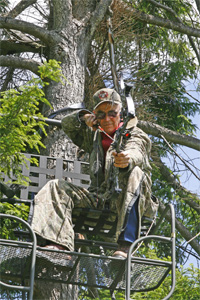
8.)    Always wear a safety harness. Most tree stand accidents occur when climbing into, out of or when moving up or down the tree. Even with a harness, always maintain three firm contact points with the tree. This means two hands and one foot or two feet and one hand. Falls can occur when only two contact points are used. Wear the safety harness, make certain it is securely attached to the tree and get accustomed to wearing it. The life you save may be your own.

9.)    Practice shooting from an elevated position. Shooting at a steep downward angle can cause your anchor point to shift. Learn how to shoot sitting down to remove most of the movements required. And know how your arrows fly when shooting down at a steep or moderate angle. Practice that before shooting at a deer.

Never hunt from a tree stand without a safety harness. A fall can be crippling or deadly.

10.) How high is too high to hunt? It’s a matter of personal comfort and feelings,       but most of my tree stands are fixed at 15 feet. A hunter who sits will be shooting from 18 feet while a standing hunter will be shooting from about 21 feet. I know people who hunt 35-40 feet in the air, and such heights can be very dangerous. Learn to play the wind, know how to sit still, know when and how to draw on a deer, and 15 feet is plenty high enough for a killing shot.

It all seems pretty easy when everything is broken down into its component parts. Work through this list this month as you prepare your tree stands, and pay particular heed to each point. They are meant to help ensure success.

Posted via email from Dave Richey Outdoors

Friday, September 03, 2010

One man’s baggage ...


Baggage is accumulated as life passes before our eyes. We begin life naked and squalling, and if we live long enough, our busy lifetime of travel in the outdoors will leave us with an accumulation of priceless baggage.

Most of these things are not valuable from a monetary standpoint but they are priceless because they produce fond fishing and hunting memories.

Our baggage consists of the odds and ends and other accumulations of momentoes and memories from a lifetime spent on the water and in the fields; in the marshlands and woods; on the ground and in a tree.

Memories are triggered by thoughts, sights, smells, sounds, tastes and touches.

This baggage is both mental and physical; things that can be held, looked at, and reminisced over. Memories can be found everywhere for a pack-rat like me, and I keep them around for a good reason: every mounted animal, bird or fish, every hat, my bows, firearms, fishing rods -- all have many stories behind them. These momentoes help sustain my life.

For instance: on the wall between my mounted fish is a Shakespeare glass fly rod. I used it every day during my 10 years of guiding brown trout, salmon and steelhead river fishermen, and the stories that rod could tell would be wonderful. Over 10,000 salmonids were caught with that rod, and it was finally retired in 1979 after I landed a 30-pound Chinook salmon.

I heard a muffled creak in it as the brute of a fish was beached, and after removing the fly and rolling the fish upright and holding it until it could swim away, I retired that rod and it now hangs in a place of honor where I can look at it every day.

My junk room (basement) has over 300 different hats hanging from the rafters. There is a unique story behind every one, including one from Detroit's Homicide Squad that states: "Our day starts when yours ends." Typical cop humor.

Hats are favorite tools of mine, and I often wear a different one each day.

There are hats from Alaskan hunts, fishing trips in New Zealand, product hats worn on one fishing trip or hunt, and hats from friends who know I collect them. However, the only hats I keep are those with a fishing or hunting tale that goes with them. I could spend hours studying this worthless hat collection that has provided over 50 years of fishing and hunting memories for me.

Here is a signed copy of Robert Traver's (John Voelker) "Testament Of A Fisherman." It was signed by him on Feb. 1, 1982 and states: "To my fellow writer and fisherman, Dave Richey, with all good wishes." It's worth very little except to me because I valued my friendship with Voelker and often think of him even though he passed away years ago. I look at his Testament, read it at least once each week, and it's priceless memento.

It's been my privilege to belong to the Outdoor Writers Association of America (OWAA), which I joined in 1968, and on my wife's office walls are many writing and photographic awards. Four stand out: OWAA's prestigious Ham Brown Award and the Excellence In Craft Award, Michigan United Conservation Club's Ben East Award For Excellence In Conservation Journalism, and the Michigan Outdoor Writer's exalted Papa Bear Award for Excellence in Craft.

There are many other writing awards, but these four remind me of my 43 years spent writing outdoor copy for my valued readers.

One favorite item was buying Michigan’s No. 1 fishing license and salmon-trout stamp.

The other day, while sorting through some of my life's baggage, was fun. There was a box containing all of my fishing and hunting licenses from my teen-age years to now. I have most but not all of my earliest fishing and hunting licenses from this state, and some date back to the 1950s. One year I bought fishing license No. 1 and 2 and the No. 1 and 2 salmon-trout stamp for me and my wife. No. 1 of each normally go to the governor, but a new DNR employe sold me that license and stamp because she didn't know that was one of the perks of being a governor, whether they fish or not.

It takes a few minutes but eventually a thought brought a heralded moment of fishing from my 1957 fishing license, and those old licenses still have the required Trout Stamp attached. One license held a stamp of Michigan's old Fish Car that was used by the Department of Conservation (now the DNRE) to carry trout to northern streams for stocking.

One man's baggage is another man's treasure trove of outdoor memories. Such is the case with some of my bear, deer and turkey patches. My lot in life is to record as much of our fishing and hunting heritage as possible, and to present it in a way that others can enjoy. Take a moment now, and think about some of your little pieces of life's baggage and what joys they have given you over the years.

We can travel through a life of fishing and hunting, and retain most of our memories. Because, if nothing else, those thoughts will spark a fire in sportsmen.

That fire will blaze into a full-blown recollection of a memorable day or event in our lives that must be remembered long after our ability to hike the hills and wade the streams has ended. Memories give us great pleasure in this life.

Posted via email from Dave Richey Outdoors

Thursday, September 02, 2010

Remembering some old hunting stands


Today seemed to be one of reflection. My topic on this somewhat rainy day is about some tree stands and ground blinds from many years ago. Many were memorable but some where very bad.

It is rather amazing how a stand can be productive for several years, and then fall flat and into disfavor. It's not so much the blind or stand wouldn't still produce a nice whitetail buck, but for whatever the reason, I no longer hunt there anymore. In a few cases, the tree had fallen during a windstorm and no other good tree was nearby.

Sometimes a stand dies a sudden death because crops are planted elsewhere, or because another nearby stand turns hot. In some cases it is because the stand is no longer just right for the prevailing wind direction, is uncomfortable to sit in, or for many other reasons.

Very few huntings continue to produce year after year.

Thirty years ago I had a crooked tree that was so uncomfortable to sit in that a person needed a Posturpedic mattress, chiropractic adjustment  and time in bed to recover. The tree produced plenty of bucks over the years but anyone who hunted there needed a new mattress, and that set became known as the Posturpedic tree. It’s still there but the tree stand was moved to a more comfortable spot.

Another old favorite tipped over years ago. It was a dead popple tree near a fence crossing, and it was in steady demand by me and some friends. It was great on an east wind and unters could sit there, watch deer walk to the fence hole, step through and offer a clear shot.

I hunted it one night, heard a creak deep in the dead tree, and didn't move after that. I climbed down, and walked away, looking back at what once was a popular stand. It fell down the next day, and no other nearby tree could offer such an advantage. When it went down, a long-standing tradition went down with it.

The old Execution Knob was a pit blind on a hill. It offered a great view of the area, and it was made for firearm hunting only. I can't remember how many bucks were taken from that stand. but if I had a Ben Franklin ($100 bill) for each one, it would go a long ways toward paying me a healthy payment this year.

The Knob grew into disfavor. Why? Who knows, but I quit hunting it once we were able to hunt from elevated stands with a firearm. A new bow coop now sits on Execution Knob, and it produced a really big whitetail buck last season.

The Lakeshore coop was another favorite. There were two elevated coops, one on the south and one on the north side of the beaver pond, but this corner coop set on the ground alongside the main north-south road. The area also has an elevated coop now.

If offered clear shots for 200 or more yards to the north and south along the shoreline, and people who sat there during the firearm season always shot bucks that the hunters in the other two nearby stands never saw. It too fell into disfavor, and was moved elsewhere.

Anything that has been there long enough can be used for a stand.

There once was an old foundation back in a field, and it was crumbling and falling into the basement. One day a buddy had a bright idea, and pushed the rest of the cement into the basement, filled it with dirt, packed it down, put more dirt on top, and built a 15X30-foot building filled with windows on all four sides.

It offers shots in four directions. The only bad thing is that hunting in the old foundation was like hunting from a gigantic pit blind. Every day an ermine would come out for a visit, stare at the hunter, and go on about his business of killing and eating. The ermine disappeared when the foundation was filled in.

Another stand that died a quick death stood 15 feet up an old willow tree. A person could only hunt from it on a calm day because it swayed in any kind of breeze. It got hit by lightning, and lost most of its branches. The tree is still there, but it hasn't been used as a stand in many years.

There are many other ground blinds and tree stands that have disappeared, but whenever I pass one of the better ones that is no longer being used, a bit of nostalgia settles in.

Nothing lasts forever, and that can certainly be said for ground blinds and tree stands. The deer change their patterns, move elsewhere, follow different runways dictated by food-plot locations and they stop getting used, and new and better stands take their place.

One of many pit blinds we’ve used are good bets.

A current favorite for my wife is a pit blind behind the house. It has a roof overhead, and small walls, and it’s been there long enough for all the deer in our area to have become used to it. This year I’ll have at least two stands set up  specifically for an east wind. Both should be in great spots.

But, on occasion, I still like to remember some of those blinds and stands that have gone before. All were good at one time, and were then replaced. It is like so many things in life. They get used until they are used up, and are quickly discarded.

It's fun, however, to remember way back when …

Posted via email from Dave Richey Outdoors

Wednesday, September 01, 2010

Cool, Rainy Weather: I Love It.


Today was (knock on wood) one of the coolest summer days I can remember over my 71 years. The temperature was in the low 50s at daybreak today and it wasn't broiling hot after the heavy early-morning rain.

And just think! The weatherman forecasts another four days of cooler temperatures and more rain. That will help bring more salmon into spawning stream

It's perfect weather for building up and working on my food plots. I've accomplished a bunch of work on my green fields, and recently decided to try watering with hose and sprinkler. The rain finally came today, and more is on its way.

I welcome today's rain and hope for more to come.

It has been a taxing effort to handle all the tree stand and ground blind preparation. If it doesn't rain hard tomorrow, I've got two, and possibly three stands to get up.

I always try to get all of this done in July or August, but the Traverse City newspaper had an article about this year's summer being one of the hottest on record. It said we've had 31 days of 85-degree or warmer weather this summer. I find it difficult to function in such extreme heat.

There is still some thought of planting a fall food plot now that we're getting some rain. I've done that the past three or four years, and have been hoping to go the full season with just my spring food plot.

I've enlarged one of my food plots, and may work on enlarging another in another location in Grand Traverse County that isn't near my home. My food plots near home were tore up last December as some neighbors cut firewood for their home heat with my permission.

Big unpicked cornfields concentrate late-fall deer.

Many of the deer last year were on my neighbor's cornfields because it became too wet in those fields to pick the corn. So, the deer had a major food source all winter and they didn't have to move far to find food.

My wooded trails still need a more work to firm them up, and  another location has grown up to  berry bushes, which I hope the deer will use for cover and food. Once I get the existing plots going, I'll still have some time to work on my home green fields and get them ready.

I've learned that the success of a food plot often depends on how the seed bed is prepared. Do it right, and with some rain and warm weather, it produces. Prepare the seed bed wrong, and no matter what you do, it ain't right.

I believe that some equipment made for use behind a 4WD ATV is in my future. I need something to turn up the ground, roll it over, and make it ready to be sprayed with herbicide and then limed and fertilized before planting.

Farming gear is needed but so is sweat equity.

Sweat equity is one part of producing great food plots but I'm growing tired of lugging large stones, piling them up, and then loading them into a sturdy wagon to be transported to the house for a replacement of grass on my lawn.

Most springs I will move 20-30 tons of rocks, and it's not bad when the mornings are cool but it becomes a potential killer on those 80-90 degree days. I refuse to work when it gets that hot.

I also refuse to work this hard another year without some mechanical help. I have no need for a big tractor, but do have a need for equipment that can be towed behind a 4-WD ATV to make my life easier. I plan on spending time this winter studying what is available on the market in a price range that I can afford.

I want a mower that is adjustable in height, a disc, a sprayer for lime, fertilizer and seed, and a cultipactor to flatten out the seed bed without driving the seed deep in the soil. Up until now, I've broadcast the seed by hand and driven over it with my Polaris and that pushes the seed just into the dirt.

My idea of ideal summer weather is temps of 70 degrees or slightly cooler. My metabolism slows down as the air temperature goes up, especially when moving rocks out of an open field with little or no shade.

This year one field will be planted with a clover mix. The other fields will be planted with brassica, clover, rape and purple top turnips.

Food plot plantings are something I strongly believe in, and I'll continue to do it as long as possible. In the meantime, between now and mid-September, let's pray for more rain.

It's not good for crops to become too dry or too wet, and it also can become a horrible fire hazard when we go weeks at a time without rain. Meanwhile, the cooler weather and rain is a welcome addition to my life.

Posted via email from Dave Richey Outdoors