Showing posts with label yelps. Show all posts

Saturday, April 14, 2012

Listening TO Only A Few Spring Gobblers

Jakes – shoot or let them walk by
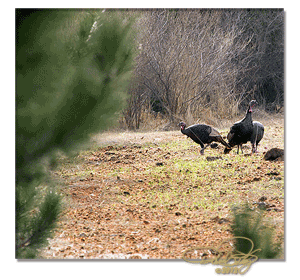
Wild turkey gobblers; listen to only a FEW spring gobblers.
Pick up on a FEW Spring Turkeys and listen closely
photo Dave Richey ©2012
It was a beautiful morning to be alive. I slipped out the door about 6:45 a.m. into 42-degree temperatures, and it felt wonderful.

The sun wasn't up yet but sharp spears of golden light shot upward from the eastern horizon, and my thoughts were on how beautiful the morning was. I stood there, a moment frozen in time, and waited for the sun to start bulging the horizon of the eastern sky.

It seems to start slow, and then the top surface of the ball of fire broke through, and up came the sun, growing more orange and red as it rose. It's a magic that I never tire of watching, and if there is a reason for rising before sun-up, it's to witness the rare beauty of dawn.

Watching a golden sunrise on opening day

I stood, transfixed by its beauty, and asked myself how anything could be any better. And then I learned how.

Off in the distance, so far away it could hardly be heard, came the very soft tree yelp of a hen turkey. She cutt once, just checking on the whereabouts of the other birds, and then a full-throated gobbler chimed in and the sound was loud even from a long distance away.

It's always amazing how loud a gobbler is when he roars as the sun comes up. The volume of sound is impossible to believe unless it is seen and heard up close.

He nailed that gobble with lusty exuberance for the day, and she gave another soft yelp. Big Daddy, still sitting in his roost tree, gobbled and then hit a double-gobble just to show everyone in the nearby trees who the Boss Gobbler in these parts happened to be.

Another Tom gobbled once, and again 10 seconds later, and then the Big Boss Man tuned up the woods again. The hen yelped a little bit more, just enough to keep the gobblers fired up, and then the Toms began gobbling back and forth at each other.

A gobble or double-gobble is pure Michigan excitement

Four individual gobblers were heard, and the fury of this sound was awesome. One or two small jakes tried to gobble but couldn't quite pull it off. Like adolescent boys, their voices were changing but they simply couldn't hit that low bass note and keep it going.

It was one of those days when I wished I could be sitting on the ground in my camo, a shotgun over my knees, and start lighting a real fire in their bellies. I love to listen to that low-pitched humming sound that gobblers make when they are close to a hen.

Many people have heard it, didn't know what it was, but if you are hunting and hear it, don't move because a gobbler is close. The sound doesn't carry far, and two or three years ago I was calling a gobbler for a buddy when I heard it.

"Don't move a muscle," I whispered. "There's a big gobbler behind us and he is very close. Don't move anything. We'll wait him out."

If you hear a gobbler spitting and drumming, sit still and don't move

That bird was within 15 feet of us, and I could hear him pacing back and forth in dry leaves, but he wouldn't circle around. We later learned that he had two big hens with him, and he was trying to lure my two hen decoys to follow along with him.

Unfortunately, I was too far away to hear this sound but I have no doubt that once the hens and gobblers flew down, that it would have been audible if the birds were close.

These birds on this delightful day serenaded the morning for 20 minutes while I stood and listened. And then, as if the switch had been thrown, they shut up and started moving.

I pulled the newspaper from the tube, walked back to the house, and stood on the back deck for another 10 minutes. The birds were indeed on the move, and I heard one gobbler rattle out his love song to the hens as they walked off in the opposite direction.

The turkeys, just like me, appeared happy to see the snow gone off the hillsides. All of winter's snow back in the hollows is gone, but I'll greet the dawn with the birds many times before the hunting season begins.

There's not much need for preseason scouting because I know the pattern of these birds and where they roost. I'll stay far away from them, hope they are not spooked out of the area, and each day they greet my distant presence with a gobble, is another memorable moment in my life.

Calling gobblers is more fun than shooting one

Somehow, I hope that's the way it may turn out but I have some doubts. It's been spring for five weeks, and I doubt many birds will be in the mood this spring. Some hen  birds have been seen on nests, and we're seeing very little gobbler activity if compared to past years.

But when my season open April 30, I'll be out there as usual, to greet the dawn with optimism. And I hope for just one lusty gobbler to call to me and my buddy. One chance may be it for this spring season, and we'll try to make the most of it.

Wednesday, February 23, 2011

Go chase a swamp ghost


Chuck Lunn of the Flint, Michigan area with a hefty snowshoe hare.

The sounds came drifting through the cedar swamp like choir bells on Sunday morning. Three golden-throated beagles were on the hot trail of a snowshoe hare, and the white swamp ghost was giving them a hard run on this winter day.
We'd walked into the swamp, and although snowshoe hare numbers are down in the northern Lower Peninsula, we found several tracks. The  dogs snuffled deep of hare scent in each track, and with a beller that seemed to shake snow off the conifers, away they went.
The chase was underway, and this hunt was more to listen to the deep bawls, the tenor yodeling bark of another hound and the steady chop of our strike dog. The cold trailer led the other hounds for 200 yards, and a minute later the beagles picked up the intensity of their barking.

Hound music is the result of beagles on a hot snowshoe hare track.

A hare was up and running, and the hounds passed within 50 yards of me but the snowie made it impossible to see. The cedars were heavily laden with snow, and seeing a white-on-white hare moving through the snow can be exceptionally difficult.
I moved over that way, cut the tracks, and stood by with a double-barrel Lefever 20 gauge. The other hunters were not in position yet, and the hare avoided any human contact. Ten minutes later the bawls and chops had turned and were heading my way once again, and I knew the dogs could be sight running the hare or be 500 yards behind.
The hare blasted through a narrow opening 20 yards away, stopped behind a cedar to look back, and there wasn't enough of the animal visible to shoot at. The hare wheeled, and disappeared following his original circle. Minutes later a shotgun coughed once 300 yards away through the swamp, and then the hounds fell silent.
We'd bagged one of the hares, and we'd already determined that no more than two hares would be taken from this spot. The hounds cast about for five minutes in search of another hare track, and then they jumped another snowie that had been pushed into moving from one area to another by all of the commotion.
Away went the hounds, inhaling snowshoe hare scent like a Hoover vacuum sucking up dirt. We stood, quietly talking as the hare led the dogs on a long oval loop, and a short time later we could hear the bell-like sounds of hound music heading our way.

Hares, when pursued by a small pack of beagles, are tricky & often hard to see.

We hurried to take up positions, and this hare sneaked past all of us, and then the white hare seemed to lengthen his stride. He took the hounds out of hearing, and 20 minutes later we were trying to cut the last set of tracks that had circled past us, and took up our positions.
Hare hunting is usually done in tight quarters where visibility often is measured in feet rather than yards, and we try to find a place where we can see for 10 to 20 yards. I was closest to it, and the dogs were still 200 yards away when I barely saw puffs of snow flying into the air.
The satchel-footed hare was by me and heading toward another hunter. I whistled loudly to alert the sportsman, but this hare was past him before he could raise his shotgun. The beagles dashed by, looking sideways at me as if to ask why I didn't shoot, and they too disappeared through the snow beneath the cedars.
Again, the snowshoe hare managed to elude us, and his circle again took the hounds out of hearing. It wasn't long before we could hear the chops and yelps of the hounds heading our way. I moved 30 yards, took up a different position as I'm certain the others were doing, and I waited patiently.

Look close when the hounds get near as the hare may right in front of the dogs.

The dogs seemed to be within 50 yards when the hare burst out around a low-growing cedar just 10 yards away. He stopped, turned to look back at the trailing hounds, and one shot ended that chase.
We caught up the dogs, put them on leashes, and decided to try another location. We try not to hunt the same snowshoe hare area twice in a year.
The second location showed a few tracks but nothing was fresh. The dogs couldn't pull enough scent from the track for them to follow, and we decided that two hours of listening to a mix of happy yelps of 13-inch beagles is just about as good as a winter day can get.
We ended the day with two snowshoe hares, and countless memories of  the happy sounds of a small beagle pack and the mad dashes of snowshoe hares. This is a pastime where, if a hunter desires, the hares can be passed up in favor of listening to continuous hound music.
To me, even though I did shoot a hare, the sounds of winter silence are best broken only by dog music. It reaches right down into my soul, and gives me ample reason to be standing knee-deep in a cedar swamp on a cold winter day.
It gives me something wonderful to look forward to each winter. A white hare on white snow can be tricky to spot, but if the truth be known, hound music and feeling snow fall down our neck is why we hunt these animals. Taking one or two snowies is important for the hounds, and in many ways, it helps seal our fate for future hunts.

Saturday, March 13, 2010

Calling practice in my basement

Is calling as important to a turkey hunter as some sportsmen would have us believe, or is calling just the frosting on a turkey hunters cake? If calling isn't, it should be.

It's one thing to choose a spot to ambush a gobbler when it walks by. It's still another to make the longbeard come looking for you, one or two slow steps at a time; its head up and looking, the roar of a return gobble, the sight of a snowball head moving slowly through the woods as it comes toward the call.

Turkey hunting is fun. Calling a gobbler to the bow or shotgun is just about as much fun as anyone can have. Is calling difficult and must we really be an expert caller to succeed?

Good questions. No, one doesn't have to be an expert, and calling is not extremely difficult. A diaphragm call is far more difficult to learn than an aluminum, crystal, glass or slate friction call. The wood box call is perfect because it is one of the easiest calls to master, and the easiest to use is the push-button call that produces realistic sounds.

The most difficult turkey call of all to master is the wing-bone yelper. Anyone who can run a yelping sequence on a wing-bone yelper or trumper is a person who has my admiration. It is extremely difficult to master, which is why few people use them in the northern states.

Calling is the pure essence of turkey hunting, Shooting a bird is anticlimatic.

There is one important thing to remember: turkeys, like humans, have different voices. I've listened to world champion callers, and once spent a week deer hunting with Dick Kirby of Quaker Boy Calls. He was prepping for the World Championship  of turkey calling, and he could make truly realistic turkey sounds that were as clear and pure as the brittle tinkle of an icicle breaking.

"Championship calling is different than an in-the-field situation," Kirby said. "Hunters who can cluck, cutt, purr and yelp can call birds. Championship-type calling isn't required because no two turkeys sound alike. The key is more about the cadence and rhythm of a call than the quality of the sound. The biggest secret is knowing when to call, which call to make and not to call too much. A caller who calls much too often will scare more birds than he will attract."

Box calls - Hold the call lightly in the palm of the hand. Many callers hold a box call horizontally, and draw the paddle across the top of the box. Some hunters, especially in southern states, hold the box vertically and hold the striker between index and middle fingers to strike the lip of the box. Both methods work well, and what it boils down to is using whichever method feels the most comfortable.

A turkey show was on television recently when the host was using a box call in a horizontal position, and would then hold the call in a vertical fashion. He didn't look very comfortable with either method. Use whichever feels best, and there's no need to switch back and forth.

Make a cluck by popping the striker (handle) against the top of the box. It is a sharp one-note sound. To cutt, make a series of sharp clucks in rapid fashion. Yelps are made by moving the handle across the lip of the box and cover the sound chamber to accomplish the two-note call. Purring is simple and works best early in the morning when birds are roosted; move the striker lightly and slowly across the lip of the box.

Diaphragm - Kirby could make astounding sounds with a diaphragm call but mine sound like a gobbler with bad adenoids. However, my diaphragm calls are effective. Remember, notes need not be competition perfect. Just understand the cadence of each call, and know when to make that particular call.

To cluck exhale air across the reed(s) and say "putt." Cutt by making three or four fast clucks quickly and sharply. They can be made loud or softly, and much depends on how far away the bird is and how he responds to the call. A soft cutt often excites birds when they are within 50 yards. A yelp starts out high (and can be strung out) and falls off into a lower note. Yelps can be strung together quickly or done just once but jaw, mouth and tongue movement can affect volume and tone. Experiment until it sounds good. A purr is fairly difficult to do, but I find it easier than breaking off the high end of a yelp into the lower tone. My yelps sound like a gobbler with tonsillitis but birds come to it.

Aluminum, crystal, glass or slate calls are quite easy to use but require both hands. I favor these calls when a turkey is a good distance away, and as the bird comes closer, I switch to the diaphragm call so both hands are free to handle the shotgun.

A successful hunt doesn't always end with a gobbler. The calling is the most fun.

All three materials require the use of a peg or striker. Strikers are made of glass, plastic or wood. To cluck, hold the striker like a ballpoint pen but turn the tip at an angle pointing toward your body and drag it toward you in a skipping motion. Press down harder to make a louder cluck. Cutting is done by making a series or fast and irregular clucks for five to seven seconds. Cutts can be soft or loud, and long or short in duration. Yelping is done by dragging the striker with some pressure in a circular motion or a straight line. The more pressure of striker against the call, the louder the sound. Purr by lightly dragging the striker across the call. This is one of my favorite calls early in the morning because it sounds like a contented bird.

A recording of these sounds make more sense for a beginner than me trying to put down what each sound is like. Hunters also can talk to an accomplished caller and learn these basic sounds.

Some gobblers are, by nature, downright call-shy. Gobblers often will call from the roost, and four or five Toms gobbling back and forth sends chills down my spine. As a general rule, don't call as often as a gobbler; let him wonder where the hen is and come looking for it. I often give one or two soft tree yelps after I hear the first crow calling at dawn. If there is no response, try again five minutes later. If a gobbler responds, sit still and say nothing. Wait for the gobbler to call again, and then softly cluck and purr for five seconds and shut up.

The gobbler will probably boom back a return call but let him wait again. As he gobbles, birds in other areas may respond with a gobble so wait for a few minutes after silence is restored. Try another soft purr, and if it is full light, slap a turkey wing against a tree or your pant legs to imitate a bird flying down, and give one short and soft yelp to sound like a hen on the ground.

A few other tricks that can work.

Muffle some calls like a hen moving around on the ground, and listen for the gobbler to fly down. Give him another yelp, and if he gobbles, let him come. If the bird stops 50 yards away, purr or softly cluck and scratch in the leaves with your fingers like a hen feeding. If the bird keeps coming, stay quiet and let him come. If the gobbler stops behind a tree within range, purr or cluck softly and shoot when he steps out and lifts his head.

If a gobbler hangs up, try a trick that has worked for me many times. Use two calls at once: yelp softly with a diaphragm call and with a box or slate call to imitate two hens calling for the big boy. This trick has produced a number of gobblers for me and my friends. Or, try creeping backwards and turn and call softly to imitate a hen moving away.

Try to set up so the bird can come into a semi-open area to look for the hen. Gobblers will move through thick cover if necessary but they like to see what lays ahead and if it appears dangerous. Calling isn't particularly difficult but it requires some practice. Do it in the car, not out in the field. The first time you call outdoors is when you have a shotgun in hand and a turkey roaring back in response to a yelp.

The above is just some of the basics of calling a wild turkey within range, and it represents some of the tricks that work. Give 'em a try, and work at learning something new every day. Studying turkey behavior and their calls will pay off with more enjoyment in the turkey woods.

Posted via email from Dave Richey Outdoors

Friday, March 12, 2010

Spring has sprung and some gobblers are calling

A new metal roof was installed on our roof a few years ago. I was outside yesterday before last night's heavy rain, looking up at what little snow that remained, and watched the last of it come down.

Mind you, I understand fishing and hunting, but the mechanics of metal roofs isn't in my bag of tricks. I was standing there, looking up,  and heard a hen turkey nearby cut loose. She sounded as if she was scolding a gobbler that may have been pestering her.

There was a soft rumble, and about 10 pounds of snow landed out in front of my somewhat foolish head. Thankfully, the snow was loose and not loaded with ice as it was several days ago.

There is, I suspect, a short period of education about metal roofs as the thought dawned me. I'm not the sharpest knife in our drawer, and after scraping snow off my head a few times, pulling out my shirt-tail and shaking out the snow that snaked down my back, a light went off telling me that standing under the edge of the roof could be adangerous piece of business to my longtime health.

A flock of hens are kept in line by two gobblers.

I walked away from the roof, stood out of harm's way, and listened as a gobbler 100 yards away and out of sight, gobbled at the hen. It appeared on this bright, warm and sunny day, that he was trying his best to pull together a harem of hens.

It's probably still a bit too early for him to get very excited about breeding hens, but for me, spring fever has set in. I'm eager to go back outside after this is written, and soak up some of the warmth that has been missing from my life since early last fall.

It's about 50 degrees, and one must stretch their imagination a bit to say that 50 degrees is warm, but all things are relative. Fifty degrees is warm when compared to the teens and the 20s of a week ago.

It's a day for doing very little except trying to get accustomed to a bit of warmth in the air. I still had to shovel off the front deck to clean things up, but that is fine by me.

It is a trade-off. Warm weather makes snow slide off my roof. In places, it misses the deck and falls over the railing. In other places it lands with a dull thud on the deck, shakes the house, and just lays there making a mess of things. In open spot, there is a deck railing that was destroyed two weeks ago by falling ice and snow.

I could do, as I once did, and figure if the Good Lord wanted snow there, He put it there and could make it go away. It seems the going-away part gets lost in the translation of my thoughts, and it also means that it's time to go to work.

I'm no longer fond of snow.

Shoveling snow isn't one of my favorite winter chores, but it is a necessary evil. Last summer I reached the age of 70, and with the vision loss in one eye, meant crawling up on the roof to clean it off three or four times a year was foolhardy and stupid. I agreed with that.

My balance is bad on slanted surfaces, and even worse when those surfaces are snow and/or ice-covered. My depth perception is off a twitch or two, and my family could see me sliding off the roof. Even worse than falling to the deck would be to fall and spread-eagle myself on the deck railing. It would probably ruin not only a day but many days, and it seems an unnecessary risk I wouldn't take.

So ... the metal roof was installed. All I need to do now is get a hard hat to wear, start paying more attention when the roof snow starts to melt, and pay more attention to my roof than listening for turkeys gobbling.

Listening to gobbler music is more fun than almost anything.

Oops, there was another gobble. I must be learning, because I'd moved away from the edge of the roof in time to escape the last  little bit of wet snow.

I stood, listening to him rattle the woods and kept trying to spot him through the trees. I haven't seen a hen or gobbler today, but I'm about to start looking for birds.

Maybe a couple of birds will come to stand back in the woods and watch the foolish human as he listens to them. Those birds are smarter than me. They walk around, eat and I've yet to see one with a show shovel.

Whoever said turkeys are dumb have no clue. I know better.

Posted via email from Dave Richey Outdoors