Showing posts with label rivers. Show all posts

Friday, December 02, 2011

Taking a crippled old dog out fishing

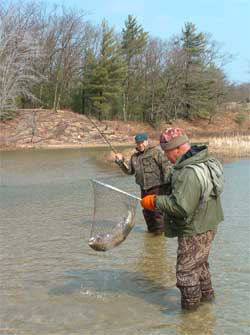
Mark Rinckey (with net) lands a Platte River steelhead for David Richey.


I was dreaming the steelhead dream, and my world was one of rushing river water, a jumping fish hanging in the sky with droplets of cold water hanging of its hard body, and there I stood: looking like a big doofus, with a broad grin on my face, and loving the experience.

Then I came out of my mid-day reverie, shook my head once, and the steelhead tugging me downstream was just a good dream at a bad time. The older I get, the more that some of the mistakes of my youth come back to haunt me.

Forty-one years ago, I fell off a fire escape, caught myself on one of the supports, and hung there 30 feet above a paved parking lot. I managed to climb hand-over-hand up the support to the edge of the fire escape, and pull my sorry butt up to safety.

Injuries have caused a weak left leg and weak lower back for me in past few years.


I'd broken two vertebrae in my spine, ruptured a disc, and when I slammed sideways into the brick wall after catching the support, the impact really messed up my back. Three months after back surgery, I slipped on some ice, fell on a piece of fire wood frozen in the ground, and broke the vertebrae above the first break.

That laid me up for a year, and even though I was writing magazine articles at the time, I had to do some from bed. I spent two or three months in a full-body cast, and finally, I was able to walk around. There's an old adage about outdoor writers having to be tough.

I finally got back to work, fished and hunted while traveling all of North America for magazine articles. My back always hurt, but like is true with hockey players, football players, I had to play with pain - day after day.

Then some joker in a BATA bus pulled out in front of me, and although I had my lap and shoulder restraint on, I had no time to stop. The impact as the car T-boned the bus, banged up my chest and ribs. You guessed it: this car didn't have an air bag. Some broken and fractured ribs happened even though the hospital originally told me there was nothing broken. It just took a couple of days to develop.

So, the last 10 years have had its way with me. My left leg has never really worked right, and was always weak. I compensated for the injury and weakness, and most people never knew there was anything wrong.

I knew, and hid the constant pain, and worked despite it. I retired from The Detroit News in May of 2003, and considered spending the rest of my life doing exactly what I did while working as a full-time staff writer - fishing and hunting.

Two years ago, the pain really started to increase. I had to take the occasional days off to rest my body, and then back I'd go again. Gradually, in the past two years, my left leg got very weak and wading rivers became nearly impossible. There has never been any "give up" in my vocabulary, but river fishing became more and more difficult for me.

I was at the point of forgetting about something that had been a part of my life for more than 60 years. I began trout fishing in rivers at 11 years of age, and now at 72, I was facing the grim prospect of never fishing a trout stream again because of bad legs and a bad back.

Here comes guide Mark Rinckey and my son David Richey to the rescue.

Well, I'm more than delighted to write and tell you that my steelhead fishing trip came true two days ago. My son David, of Sitka, Alaska, came home. I'd talked with guide Mark Rinckey of Honor, Michigan, (231-325-6901) and he felt they could get me out on the Platte or Betsie rivers. Frankly, they were a far more optimistic than me.

Rinckey says the warm autumn and little snow, has put a number of steelhead into the Betsie and Platte river. In the past 10 days, Rinckey's methods for other anglers had produced limit catches some days and only a couple fish on other days. However, during those 10 days, they had landed one 18-pound steelhead, two at 17 pounds and numerous fish up to 15 pound. Me, I'd be more than delighted to catch any steelhead.

You see, my left leg doesn't work well. For 41 years, it has been considerably weaker than my right leg. But, oh how I wanted to go, to catch one more steelhead, a game fish that I've fished for quite successfully for 61 years. I'd come to realize how much I missed the hiss of river current flowing around the end of a sweeper, and the sheer determination and dogged fight with a big steelhead was burning a hole in my heart.

We got to the river, and I pulled on my waders, took a few tentative steps on dry grounds, and I felt "I can do this." I walked at my pace, and they helped me down a short dropoff to the water's edge on the Platte, and we got into the water. Mark walked in front of me, David behind me, and we slowly crossed the river.

Mind you, it was the last day of November but the weather had been balmy. It was a bit cool but we were dressed for it.

He we go, getting The Old Man & his creaky bones into the river.


We got to a wide sweeping run against the far bank. Mark gave David some spawnbags, and he'd been here many times before, and hooked a steelhead right away and landed an 8-pound hen steelhead, all bright silver and glistening in the current. He fought it well, and soon the hook was twisted out and the fish was given its freedom.

We cast and cast, and Rinckey left me in the water near shore, and floated back and forth between my son and I. Eventually, it dawned on us that David had probably caught the only steelhead in that run or all the splashing had put the other fish down.

We crossed the river again with Rinckey leading and David following, and me in the middle. I got up and made my way back to the car, and felt great. I was fishing again, doing what I'd done for most of my 72 years. It was a wonderful feeling.

We drove to the Betsie River where Rinckey guided a client to an 18-pound buck steelhead a week before. He said this is where things will be tricky because the water was up, and the current strong.

"I'll be on one side of you and David will be on the other," Rinckey said. "If you stumble or the current sweeps your leg out from under you, we'll have you."

So, in this manner, we waded across the river in near chest-high water, got up on a shallow sand ridge, and walked downstream. Rinckey gave the instructions.

"David, go downstream 30 yards and cast right up next to the opposite river bank, and let it bounce downstream. This is where Ray caught the 18-pounder a week ago. He also caught two 15-pound here the day before yesterday. There are lots of fish in the river."

He pointed out to me where to cast, and cast the spawnbag out to show me where the spawnbag was supposed to go. I'd fished this hole many times before. I could feel the splitshot bouncing along bottom, and suddenly the line stopped.

I snapped the rod tip back and was into a good fish. The fish ranged about 40 feet, stopped and Mark and I eased down through knee-deep water. I'd eased back the rod, moving the fish inches closer, and he responded by making another short run and a half-hearted leap.

"He's hooked good in the corner of the jaw," Rinckey said. I'd pump and reel, and then the fish would take back the six-pound line. We fought a back-and-forth battle for 10 minutes before I could sense the fish tiring. At just the right moment, I eased the fish across the surface to Mark's waiting net.

The fish came to the net and my guide didn't miss this fish.


"You got him!" Rinckey roared in my ear as David yelped with joy to see The Old Man do again what The Boy had seen done hundreds of times before.

The steelhead, a buck weighing 11 pounds, was lifted from the net and held up for me to admire. It was sleek, with that pinkish-red blaze of color along its sides, and I drank in its beauty before asking him to gently release it.

We fished that hole relentlessly for another hour, and Rinckey asked how I was doing.

"My left leg is really getting weak," I said.. "I know we have to wade upstream, and I suggest we do so while I can."

He whistled up David, and we began the upstream trek, one on each side of me. Sheer determination showed on their faces, and I suspect on mine as well. I climbed out of the river like an arthritic hippo, wobbled a bit on my unsteady legs, and then we walked through the woods and up the hill to our vehicles.

I was choked up with emotion as I profoundly thanked both men for making this trip possible. Who knows what the future may bring when it comes to my lifelong passion of steelhead fishing, but this trip was one of the greatest thrills of my angling career. I also want to give thanks to the steelhead for giving me another thrilling battle on light line. It was a day I will never forget.

Saturday, March 19, 2011

When Steelhead go wild, Part II


The fish were still there. If anything, more steelhead had moved in. "Somebody has to do it," he said, wading in. "Might just as well be us."


The fish were like young baseball players: they often went for our first pitch. Kerby hooked up, and 10 seconds later I was into a bulldozing steelhead that ran at me, jumped clear of the water, and doused me with cold water from three feet away. It took 15 minutes to wear him down.

My philosophy is to beat 'em up. I seldom keep spring fish, and want them to spawn, so a long battle saps their strength, builds up lactic acid and they may die later. If they jump, I pull them off balance. If they dog it, I get below and make them fight the rod and current.

If they run at an angle I pull from the opposite side. It breaks their spirit, and I can usually land fish within five minutes. They recover faster than those landed after a prolonged struggle the current and rod pressure.

The sleet quit but the temperature dropped. Kerby tripped while chasing our 91st steelie, got soaked and once he landed it, he quit. The number '100' never came up but we both knew what the day's goal would be.

The 92nd steelhead was my smallest, and it took my fly so deep in its gills it would die even if released. It was stringered. Paul was soaking up car heat, and the wind began blowing upstream as it steadily grew colder.

The next six fish came easy, and were released. I was chilled through and shaking like an aspen leaf in a strong breeze, but would catch two more fish if it took all day. No. 99 grabbed a No. 6 Platte River Pink as it scratched along bottom. I saluted it with a snappy hook-set, and released it three minutes later.

The eternal fisherman question: Stick with the 'old reliable', or switch to a new fly?


New fly or old for Number 100? It was an easy choice; I'd use the same fly because my fingers were too numb to knot on a new one. My line flicked back over my shoulder and shot forward as I drove the fly above the school of fish that seemed to be growing larger as the minutes ticked by.

One cast, another and a third but no takers. Keep trying, give up or try a new fly? The body shaking was almost uncontrollable as another cast shot upstream, and stripped slowly with my left hand that had been wet all day. The fly ended its drift, and the line twitched and I set the hook.

This fish hit the air like an acrobat, tipped nose down, and sliced into the river like a high-board diver. The rod was up, throbbing from the run, and I stumbled downstream on leaden legs into the strong wind, trying to keep up. The fish slowed at the next small hole until I caught up, put more pressure on him, and he jumped again. This one, a chrome bullet of 12 pounds, leaped again before ripping off on a short run.

I caught up and sensed the fight was over. I was beat as it tried to tug the line under a bush, and I pulled it back and it rolled over in submission. I eased the rod back, and used my pliers to twist the hook free.

It was done. Two angers had caught 100 steelheads in one day. It was so cold, and I was shaking so hard, that it was all I could do to untie the small keeper fish and walk to the car. I opened the trunk, laid the fish on my raincoat, put my fly rod away and looked up to see the local conservation officer pull up.

"How's fishing?" he asked as he looked into my trunk. "Can I see your license? Cold, huh?"

I nodded, too beat to talk. I fumbled out my license, showed it, and he nodded. "Cold," he said, "it looks like the fishing wasn't very good."
"No," I said, the cold and weariness showing, "it wasn' good..."

He was walking back to his car and didn' hear the rest of the sentence because it was lost on the keening wind "...it was absolutely wonderful. It was the best steelheading day of my life."


STEELHEAD INFO SHEET


What: Steelhead fishing.

Where: The Platte River near Honor, Michigan. This stream flows into Lake Michigan's Platte Bay north of Frankfort.

When: The best spring steelhead normally occurs in late March of early April and continues for two or three weeks in the river downstream from Platte Lake. Anglers can find some fish in the upper river (it opens April 1) into early May. The best fall action is in October and November, and it peaks with the Nov. 15 firearm deer season opener.

Equipment: Anglers must match equipment to the area being fished. Some spots are wide open to allow for traditional fly-fishing with a floating fly line or a sinking-tip line. Other areas are so tight that flies may be used but splitshot is needed to take them to bottom. Fly rods and reels with fly lines must have at least 100 yards of 20-pound-test braided Dacron backing.

Approach: Polarized sunglasses are needed to cut surface glare to spot fish in holes or on spawning redds. Whenever possible, walk the banks to locate fish. Once fish are found, the trick is to get close enough to cast a fly with accuracy. Start downstream from the fish and move up one slow step at a time. Watch, and if they begin darting back and forth it means they are spooked. Stop, and if necessary, stand motionless for 10 minutes until they relax before moving closer. Move too fast and all fish will leave.

Flies: No. 4 or 6 unweighted or weighted flies are used. Two fly types exist. They are attractor or imitator patterns. Attractor flies are tied in bright colors like orange or yellow while imitator flies look like dark Hexagenia limbata mayfly nymphs. Some of my Great Lakes Steelhead Flies limited edition hardcover books are still available, in an edition of 900 numbered and signed copies and in mint condition, are still available from me at:
Scoop's Fishing & Hunting Books
PO Box 192
Grawn, MI 49637

Personal or business checks will be accepted, and a book will be sent once the check clears. The cost for a Mint copy is $60, postpaid
This book is the first ever published about Great Lakes steelhead fly patterns. The book, published in 1979, is long out of print, and difficult to locate.

Casting: Pick out one fish. The best choice when fish are on spawning redds is to fish only for male steelhead. Why? If the angler hooks a female, and it is landed or lost, the attraction for males is gone. Fish only for bucks, and quick repetitious casting to the same spot is needed to tease spring fish into striking. Don' expect hard strikes: spring steelheads pick up the fly and drop it.

Often, all the angler sees (in clear water) is a head movement as the fish picks up the fly and drops it. A fly line twitch indicates a strike, and some anglers use a brightly colored strike indicator to alert them to a take. Very few spring steelhead strikes on flies will be felt.

Catch and release: I've eaten some spring steelies and find them strong. One exception is with a two- to four-pound male. They can be tasty, but most of my fish are released gently without taking them from the water. These tips from a longtime fishing guide can help dispel rumors of the steelhead mystique. They will hit but an angler must fish hard, keep the fly near bottom, and recognize the strike when it comes.

Saturday, February 26, 2011

Why do we love trout water?


This angler caught this 18-pound brown trout from Little Bay de Noc.

Anglers for centuries have touted the mental and sporting values of trout fishing. But what is it we love so much that makes many anglers dream all winter about catching these lake and river game fish? Why, for goodness sake, would any person count down the days to the opener?
Why are 10-inch trout prizes to be cherished? Why should people spend good money to buy fine tackle just to catch a small trout and then release it? Or, on the other hand, why would anglers gloat over a 10-pound brown trout or a 14-pound steelhead?
What is it about this game fish that stirs our cerebral juices, captures our thoughts and engages our soul on a day like this, one day past the general statewide trout opener? It’s just one of many questions that trout anglers attempt to rationalize as they tour Michigan’s greatest trout lakes and streams.

Sometimes one would think there are more questions here than answers.

What follows are just a few of today’s idle thoughts that have made me wonder about my 60-year trout-fishing love affair. There are many thoughts that arise from trout openers I’ve enjoyed since the early 1950s.
Think long and hard on trout, and make a list of some of your favorite trout fishing thoughts. One often will find that the experiences, sights, sounds, and other sensory perceptions are far more important at the end of a fishing day than the fish we’ve caught. Here are just a handful of reasons why trout captured my soul more than a half-century ago.
  • These beautiful, colorful and fragile game fish are the canaries in our environmental coal mine. They are a key barometer of our times. What harms trout can't be good for humans, and when these species are gone forever, can our civilization be very far behind? It’s something to think about.
  • Brook trout are the prettiest of all. They come in four sizes: tiny, small, legal-size and lunker, each with an array of spotted beauty that hints of wild places that stir our senses. With their tiny blue spots, and white piping along the outside edge of orange fins, brook trout take first-place in any fishy beauty pageant. I look at a trout, all smooth-skinned, and painted up in all their finery, and the sight takes my breath away.

Trout fishing is easy, hard or nearly impossible based on personal restrictions.

  • Trout respond well to a careful approach and a delicate delivery. Fancy waders and top-of-the-line rods, reels and nets do not impress Michigan’s char and trout clan. They feed when hungry, fast when not, and nothing we do can or will change this pattern.
  • Trout inhabit some of the state’s most beautiful places. They live in a land of towering pine and spruce, beaver ponds, impenetrable cedar swamps, sparkling streams, gurgling meadow brooks, remote Upper Peninsula rivers dotted with waterfalls -- all such places are home to lake and stream trout, and humans are nothing more than infrequent visitors to their world.
As such, it behooves anglers to put back more trout than we keep. Conservation of wild trout means joining and backing such organizations as Trout Unlimited, who fight for our fish and their special environment.
Their needs include clean water and an environment that is friendly to the fish. They are truly game fish worth fighting for.
  • I fish because of soft dimpling rises, blanket hatches, selective trout, wild places, stream-side camaraderie with other like-minded fishermen, wild fish and the history and romance of trout fishing. Trying to outwit these game fish is for the thinking angler, not a gluttonous fisherman intent only on a full creel.

Anglers should fish for trout for many other reasons than to just catch fish.

  • One last and untapped trout bastions are our inland lakes. Such waters produce robust fish, and for those who learn lake-fishing secrets, the rewards can be many and great. Huge trout are taken from inland lakes that seldom, if ever, see a bait, fly or lure. These lake-dwelling trout are a thrill to catch, and doing so requires specialized skills.
  • My familiarity with trout forces me to fight for them and to proceed in a manner that gives each fish every advantage and opportunity to escape. Trout fishing means much more than a limit catch. This sport is and always should be a major challenge.
  • Seldom are trout kept. Trout deserve to be caught more than once, but on occasion I will keep a few small but legal ones for the frying pan. My thoughts are that big trout should be allowed to spawn and reproduce, and small ones should be released as gently as possible to avoid harming them.
  • There are places where brook trout live that rarely see a fisherman. These fish are naïve, easily caught, and some anglers take advantage of this small failing. Often, in such areas, the area may be over-fished in one day by a greedy angler. Catching a limit, day after day, doesn’t prove an angler is a good one.
  • For years it’s been my practice to fish those back-of-beyond spots where brook trout hold at the base of a root-flooded cedar. Such black swamps have produced numerous sightings of bear and deer as I slip slowly from tree to tree, dapping a fly or single-hook wee spinner in the water between tree roots. The fish come hard to fly or lure, are easily hooked, and quickly released without taking them from the water.
  • I have a problem with those who regard trout fishing as a social event. The fish are not impressed by our homes or the cost of our cars, so why clutter a stream with people who are there only to impress clients or other fishermen with fancy creels, fly rods and vests?
  • People go through three trout fishing phases. 
    • The FIRST is to catch as many fish as possible; 
    • The SECOND is to catch the largest trout possible; 
    • The THIRD is to exact a challenge from trout and tackle while giving the fish every chance to get away.

Trout fishermen go through distinct trout-fishing phases.

  • I'm in Stage No. 3, but can remember as a kid passing through stages 1 and 2. It's easy to remember the heavy catches, huge fish and the bragging of yesteryear, and I'm ashamed by the number of big trout taken during my earlier years. But those days are long gone, and my efforts now are far less than my heavy catches of 30-50 years ago.
  • For 10 years, guiding trout fishermen was my life and a major way to make a living. The hours were long and hard, the weather sometimes bitterly cold, and although memories of those days with large numbers of browns and steelhead still linger, they foster no strong feelings that make me want to return to that way of life. It was a tough way to make a living, pay bills and put cooked groceries on the table.
  • I fish for trout now because I want to, not to prove anything to myself or to others. I fish because of the tremendous enjoyment it brings, and the challenge of hooking trout from difficult places with tackle that gives every edge to these game fish.
  • I now fish for trout because fishing can sooth a troubled soul. It energizes tired fishermen, and it provides me with something I deeply love and something to look forward to in beautiful areas where it's not necessary to rub shoulders with other anglers. It offers me peace and solitude in a world of turmoil and unpleasant things.
That's me. A guy with simple ideals and needs that continue to make me very happy. And just think: an eight-inch brook trout can make me feel great for weeks on end.
No amount of money, big house or fancy ride, can do that for me.
Running water, cold water, wild places and wild fish, are why trout make me feel good in a way that I’ve tried to explain but find it impossible to convey any better than this. So, if you’ll excuse me now, I’ve had my say and now have a date with a trout river.