Tuesday, August 10, 2010

Bow hunting: Mental or physical?


It often occurs to me that hunting is more mental than physical. Granted, we walk into the woods, climb into a tree stand, and if a nice deer walks by and stands in the best possible spot, we draw and shoot.

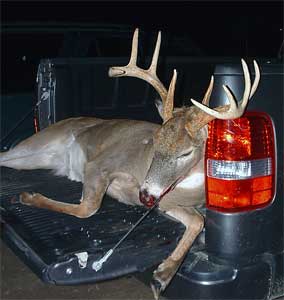
If our aim is on, and we don't miss, we track down the animal. It is field-dressed, loaded into the bed of a pickup truck, and hung up to chill out. That's the physical part, and dragging the buck out is the most strenuous portion of the hunt.

Ah, but the mental aspects of a archery deer hunt is a much different story. My claim is that a hunt is more mental than physical. How so?

Think about it. Hunting is much more mehtnal. Read on!

My belief is that almost everything about a hunt is mental. We must determine where to go, when to hunt, and which tree is the best one to use under present conditions. We must consider the wind, and wonder if our clothing is really scent-free or not.

Long before we climb into a tree stand, we've had to mentally decide how much draw weight is comfortable for us. We must choose from a wide range of bows, make the decision to shoot aluminum or carbon arrows, and we must think constantly about how to set up on that big buck we've seen several times while preseason scouting. Our choice of broadheads to use can tax our brain as we consider various brands.

We've defined our hunting area, climbed into position, and then must consider where we can and cannot shoot. It's a mental and slightly physical effort to scan the area for unseen twigs that could deflect an arrow, and should the buck show up, we must mentally calculate when to draw, aim and release the arrow.

We must mentally calculate the distance, decide whether this is a dead-on shot, or whether to allow the buck to pass while hoping for another chance on another day.

There are so many things to think about when hunting.

We must mentally prepare ourselves for a long or short wait. Only our mind can allow us to believe that the branch stub poking at our left hip really doesn't hurt. We must always be aware of what the wind is doing, and a wind shift, no matter how subtle, can spook a buck if he catches any scent.

The mental gymnastics increase when a buck shows up, because as likely as not, there will be a doe and fawn(s) nearby. We must mentally condition ourselves to watch all nearby deer, and not just the buck.

It makes little sense to do everything right up until the time comes to take a shot. If we forget about watching not only the buck but the other nearby deer, the chances are excellent that one of the other animals will spot the movement made while drawing a bow. If that happens, the game is up.

We must mentally calculate angles caused by shooting toward the ground from an elevated position. Once our mind computes the angle and distance, we must then focus on the precise point of impact where we want the arrow to hit. It's all mental except drawing the bow.

Drawing on a deer is both mental and physical, and the mental picture of locking in on the heart-lung area forces us to see that spot whether we shoot instinctively, with sights or a red-dot sight. Our mind must translate what our eyes see, and relay that information to our hands and eyes, and allow us to properly aim and concentrate on that precise spot.

Do you see the point? Physical is only walking in & dragging out a deer.

Our mental image of the deer in the right position, at a known distance and angle, must be maintained even if the animal moves. We must calculate any changes that must be made, and be ever alert to the one deadly enemy of shooting arrows: we must mentally concentrate on not lifting our head as we make the release.

To do so causes the arrow to go high, and it can result in a missed shot, or even worse, a wounded deer.

Mental concentration must be maintained until we see the arrow hit the deer, and then another mental exercise comes into play. Our mind must tell us exactly where the arrow hit the animal, and our mind must prevent us from saying it was a heart shot when in fact the deer was hit in the lower leg.

Hunting is much more mental than physical although few hunters ever see it that way. For many, it is idle time spent waiting for a shot. The true deer hunter knows better.

Success or failure is in your head. It's wise to think about this issue long before a shot is taken.

Posted via email from Dave Richey Outdoors

Monday, August 09, 2010

Greeting the dawn


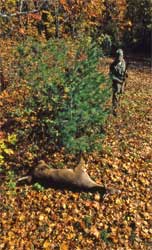
It’s not a big buck but this hunter did his scounting homework.

Anyone who greets the dawn in the field is getting a good jump on the day, and will most likely find game animals and birds moving. Do it just right, and it can be a kick-off to your preseason deer scouting.

I visited one of my hunting spots two days ago, and there was a comfortable breeze in the air, not too cool but certainly not warm. It felt good to be a bit chilly, and I walked in to a high hill where I could watch for whitetails without being spotted or winded.

The sun was still blushing the eastern horizon when a doe with two fawns wandered by, stopping here and there to nibble on alfalfa. They walked along the edge of a nearby green field, and sniffed at some new green growth, apparently to see if it was tender enough to eat.

Two bucks, both fuzzy-antlered with velvet, cut the corner of a fallow field, dipped down into a gully, came out the other end and disappeared into the woods. They were quickly followed by a spikehorn that had got sidetracked, and was now playing catch-up with his buddies.

Greeting the dawn to scout deer is one of the best times to be afield now.

The sun was rising above the horizon when I spotted a veritable gold-mine of turkey gobblers. Twelve gobblers were moving like a combat platoon, and they came across the top of the hill and crossed within 20 yards of me. I was sitting on the ground, knees up and Swarovski binoculars to my eyes. I had to lower the binoculars to better see the gobblers.

One bird had an honest 12-inch beard, and two had 10-inch beards, two had 7 1/2 to 8-inch beards, and the others were jakes. The sunlight glistened off their dark feathers, turning the colors from russet to gold to black and back again. They didn't know I was there, and they passed by and headed down into an open field where they would be out of sight of a nearby road.

I caught a glimpse of some animal moving through the timber, and never could see it well, but it appeared to be a coyote heading for a place to lay up for the day.

I didn't spend much  over an hour sitting, and it become apparent the critters were done moving. I walked the edge of an alfalfa field where mud remained from an earlier rain, and checked for tracks.

One big splay-hoofed deer track was visible, and it looked two-thirds larger than any other deer track I saw. Buck or doe? Hooves splay out in mud, and that could account for some of the size, but it could have been a deer of either sex. I knew of one very large doe in that area last year, and had heard reports of a good buck as well. It's always easier to think of it being a buck than a large doe, but thinking that doesn’t necessily make it so..

Watch field edges, the edges of swamps and woods, and watch where deer come from and go.

I used to hunt with a man who claimed he could tell the difference between a buck and doe track with 100 percent certainty, and under certain circumstances, I believe I can too. But, tracks in mud never seem to offer quite enough clues to its sex, and I need something more to go on than a widened track in soft mud.

Was today a scouting day? Absolutely. I could determine where the bucks entered the woodlot in the morning, and with a westerly breeze, even picked out a perfect tree. I'll have to watch in the morning more often, and then get serious about a stand once I know the bucks are using the same trail every morning.

I learned years ago, when hunting bucks in southern counties, that farmland deer will travel one of two or three trails in a given area. We sometimes had to flip a coin to determine which of two trails to choose from, and often the coin would lie to us. So much for gambling.

Preseason scouting doesn't need to be a major investment in time nor does it have to be done every day, but hunters should spend time scouting three or four times a week whenever possible.

An hour a day now can make a big difference once hunting season begins.

It's not only an important part of deer hunting, but it can be fun. My wife used to sit in a stand before the bow season opener, watch the deer and videotape them. By early September, she would have the buck of her choice on tape, and she would later lay claim to it with a well-placed arrow.

She always shot the buck she videotaped, and that proves that preseason scouting, from the spring on,  does work. And, it's fun.

Posted via email from Dave Richey Outdoors

Friday, August 06, 2010

Outdoor Ethics


My mother was a great believer in cod liver oil. It was good for what ailed us, we were told, and a dose of the stuff every spring was thought to cure all ills. Oddly enough, I don't remember my parents ever gulping the nasty stuff down.

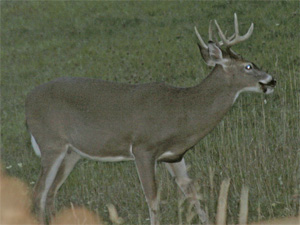
The buck’s antlers can be faintly seen but it’s past legal shooting time. Don’t shoot!

Hunting ethics, like a double-slug of cod liver oil, is pretty hard for some people to swallow. For many, ethics and especially fishing or hunting ethics, is a word as foreign to them as an ancient language.

Ethics often mean different things to different people, but ethics are always right.

Ethics are tough to explain to someone who has very little concept of such things being right or wrong. Some folks describe ethics as those things you would never do if you knew someone was watching.

But this business of fishing and hunting ethics goes much deeper. It treads on the philosophy that in life, there are laws that must be obeyed. Break those laws, and we face criminal punishment.

Ethics mean different things to different people. They are not laws, but they are generalized rules of proper sporting conduct. They are unspoken and unwritten rules of conduct that sportsmen should follow.

Ethical behavior means believing in and following these unwritten rules. Not because you must, but because common sense and a feeling of ethical action point us toward following them because it just is the decent and right thing to do.

There are a few unspoken ethical things that sportsmen should not do. Shooting a ruffed grouse on the ground while walking a two-track trail is one such thing we don't (or shouldn't) do. It much more sporting to flush the bird, and shoot while it is flying than while it is picking grit.

Shooting ducks or geese on the water is considered unethical for the same reason, especially on the first shot. Mature hunters never do it the easy way; they give game a fair chance to get away. The fairness doctrine is part of the ethics case. Most hunters can see the logic of finishing off a wounded duck or goose before it swims into the cattails.

Think! If you wouldn’t do it in front of someone else, then it is the wrong thing to do.

While being illegal, it also is unethical to shoot a deer with the aid of a light, shoot deer after shooting time has ended, or, as was so commonly done when bears could still be killed during the firearm deer season many years ago, to kill a bear in its den. It is unethical and illegal to shoot a deer in the water.

The law reads that a fish must be hooked in the mouth. A fish hooked off a spawning bed will often swipe at a fly or lure, and be foul-hooked somewhere on the head. Keeping that fish not only is unethical but illegal to boot.

Unethical hunting behavior is a deliberate "winking" at the laws. It is stretching the shooting time before or after it begins or ends, and most people would not do it if they knew someone was watching them.

The only person watching their movements and actions in most cases is themselves. The act of trespassing, and hunting on someone else's land without permission, is not only unethical but also is illegal.

I find it somewhat amazing how many wives have hunting licenses but are never seen out in the field. It's unethical to fill a tag for another person, but it is ethical for me to shoot an antlerless deer, use my tag to tag it, and give that meat to another person. It is illegal to fill your wife's deer tag by killing the deer for her. There is a major difference.

It is unethical and illegal for two or three fishermen to go onto a river, station one or more people downstream from a log jam, and have another person jump up and down on the logs to drive salmon or steelhead downstream to the waiting nets. Slobbish behavior always seems to be a part of unethical behavior on land or water.

I see it every winter when unethical winter anglers catch some tiny bluegills, throw them on the ice, and let the eagles and gulls feed on them. They keep the bigger fish, and kill the smaller fish. So what if it feeds the birds: it is unethical and illegal behavior.

The link between fish and wildlife laws, and ethical considerations, go hand-in-hand.

So much of angling and hunting ethics can be tied directly to fishing or hunting laws and unspoken rules, but ground-swatting a grouse is not illegal. It's just something that right-thinking sportsmen don't do.

Ethical sportsmen develop a habit of thinking about what they will do, and weigh their actions against what they would do if they knew you, me or a conservation officer was watching over them. Their conduct would change dramatically if they knew they were being studied.

I've had countless opportunities to shoot deer a minute or two after legal shooting time has ended. I could try to preserve my dignity by setting my watch back five minutes, but deep down in my heart, I would know that my actions were not ethical, and I would be unable to live with that weight on my shoulders or on my heart.

This business of fishing or hunting ethically is simple to determine. We follow the fish and game laws, think about our actions before we take them, and ask ourselves this question: Is this an ethical act or decision?

If the question cannot be truthfully answered with a "yes," than we've answered this burning question ourselves. What we do next is a matter of ethics and of obeying our fish and game laws.

Posted via email from Dave Richey Outdoors

Thursday, August 05, 2010

Some Deer-Hunting Thoughts


I hate the summer months, and although the salmon fishing can be great, we've had plenty of storms and heavy rains, both of which seem to scatter the salmon schools. Just about the time they form up again, along comes the next storm.

Sixty years ago when twin brother George and I were kids we would eagerly await our birthday and Christmas. As we grew older, we counted the days until the trout season opened on our home stream, the Sturgeon River in Cheboygan County.

Another two steps and a bow shot can be taken through the weeds.

Now that I'm old and gray, retired from a full-time writing and photography job, I still need something to dream about. Ten years of guiding fishermen, and having fished heavily since I was 10 years old, the trout opener still makes my pulse quicken but the bow season opener is what truly lights my fire these days, and it's still nearly two months away..

I've been shooting my bow lately, and it seems the accuracy is still there at 15 yards, and I've gone through my back pack, checked it two or three times just to make certain I have everything. All that is left is the wonderful feeling of mounting anticipation.

There will be spurts of preseason scouting, and then going back and checking on things I already know -- where the deer will move -- and my stands are already in place. I still have one to put up, and will probably take care of that chore tomorrow.

I've practiced some  from my front porch, and it is a perfect height to simulate a tree stand shot. My eyes are such that I know the severity of  my limitations, and I don't exceed my capabilities. If a buck or doe walks in, and either one is an animal I want, I'm fully capable of making the shot. It's a slightly different story if the animal is 20 yards away, and I'd never shoot at one 25 yards away. They look too fuzzy for a good identification and shot placement.

Practice is important, as is knowing your limitations for a clean, killing shot.

Some hunters I know by name, but have never hunted with, ask why I don't take 30-yard shots. I repeat what I said above, and the odd thing I've noticed, is they can't comprehend hunting without 20/20 vision.

I was the same way when my vision was keen. I wore contacts, and I've worn glasses of one kind or another, for most of my 71 years. Once our vision starts to tail off, it is a wise person who recognizes his or her capabilities and limitations. People who exceed their capabilities wound and lose too many deer.

So I think of cooling temperatures, and I practice my range estimation while walking in the woods. Trust me, estimating 15 yards is much easier than estimating 30 yards.

My vision, and my estimation of 15 yards, has been a major part of my life for the past 20 years. Over that period my vision has headed south in a big way, and it's one thing to arrow a buck at 30 yards. It's quite another thing to do so at 15 yards. More skill is involved at 15 paces.

It means honing your skills of sitting still, knowing when to draw, when to make a release, and concentrating intently on the heart-lung area. There is no margin for error at 15 yards. Make one tiny mistake, and the deer has you pegged and runs off making a big racket.

For me, shooting a buck or doe is easy. More than 260 deer have been taken over my lengthy bow-hunting career, and one may think I'm bragging. It's no brag, just fact; I've killed deer in many states, and when it was possible while I still worked at the newspaper, we would take the month of December off and head south.

Consistency in shooting accurately is critically important, regardless of where you hunt.

I've hunted Alabama, Arizona, Arkansas, Georgia, Idaho, Illinois, Iowa, Kentucky, Louisiana, Mississippi, Missouri, North Dakota, South Dakota, Ontario, Quebec, South Carolina, Tennessee, Texas and Wyoming, just to name a handful. Often December or January hunts are made in three or four southern states. It doesn't take long for the numbers to add up, and one thing my wife and I are proud of, is that we share our venison bounty with others.

So, indulge me with these periodic ruminations about deer hunting. I love it dearly, and I am good at it. Of course, if you've hunted deer for over 55 years and paid some attention to the details of each outing, the deer and the experiences will teach a hunter a great deal.

All we have to do is try to learn something new every hunting day. Bow hunting for whitetails is a never-ending education.

Posted via email from Dave Richey Outdoors

Wednesday, August 04, 2010

Answering some reader questions


Writing a daily weblog is like writing a newspaper column every single day. There are lots of things to write about, but without some reader input, it's impossible to tell whether I'm touching all the fishing and hunting bases or not.

I'm been keeping a list of questions readers have sent in for just such an occasion as this. Lots of people write and say I'm doing a good job, which is my daily effort, but it also helps to know what really turns your crank. Here are several notes from readers that may be of interest.

Recommend my website to your family, friends, neighbors and relatives.

Mind you, most of my readers are completely unknown to me. In some cases I know them, and in most other cases I do not. I know where only a few of my readers live, so for the most part, I respond to first-names only in this blog.

*Ralph wrote, saying he enjoyed my blogs and features on deer hunting, and wanted to know if I'll be doing more deer stuff this fall.

The answer is yes. I've written three books on deer hunting and hundreds of magazine articles, and the how-to and why-to stories will continue to flow. There are many topics I haven't covered although I've been at writing blogs for seven years. Lots of good stuff is coming.

*Pete wrote to say he doesn't own a boat, and must fish from shore, and he whipped up on me a bit for not writing more about carp and catfish fishing.

I told him I realize many people don't own a boat, but advised him that I've written a number of blogs on catch catfish and the "golden bonefish" -- better known as carp pieces. Even though many anglers don't fish for these rough fish, I know it is important to some readers. Keep reading, and realize that you can scroll back to Day One to read my blogs if you wish to read that much stuff just to find a carp story.

I try to help people find new fishing and hunting locations.

*Mike sent compliments on my blogs and features on bow, firearm and muzzleloader hunting, and wants more. It would be easy to write daily about hunting whitetail deer, but in fairness to all, deer and deer hunting is covered heavily in season. There is much more solid information coming in the months to come. Read it daily to stay current.

*Buzz wrote about one of my earliest stories about me and another man catching 100 steelhead in a day. He didn't believe it, as much as called me a liar, and I've never heard from him again.

The story was 100 percent true. Of the 100 steelies we landed, only one was kept because it sucked the fly deep into its gills, and was bleeding heavily. It was a small male and I kept it. This action happened about 20 years ago, and as God is my witness, it was true. It was one of those days when everything fell together: no other fishermen on the river, a fresh run of mint-silver fish, and brutally cold temperatures. We'd roll a fly through the hole, and the fish were on it instantly and they kept coming, a dozen at a time, and it was a memorable day.

*Jim wrote and asked for more stories from the Upper Peninsula. He says he does it all but doesn't read much about some of my Upper Peninsula trips. I promised I'd try to do more in the future, but I'm a one-man band, and it's impossible to be everywhere.

*I've heard from numerous budding outdoor writers. One, named Charlie who lives in Wisconsin, wants to get into writing. He wanted to know whether to jump head-first into outdoor writing and photograph, or free-lance on a part-time basis.

I’ve mentored many budding outdoor writers.

He is a teacher, and has written one story that I've read. I made several suggestions, and asked him to cut it back to 750 to 800 words and I'd run it. I'll run a story by anyone if it deals with fishing or hunting in Michigan, or in Charlie's case, bear hunting, which also is done in this state, and I haven't seen his shortened version. I don't have time for much editing, and if a story is good and meets my needs, I'll run it. If it is bad, I won't run it. Budding outdoor writers: try me but email  first.

*Richard ordered a book I had for sale, but failed to email me first to determine if the book was still available. He was upset when he learned the book had been sold earlier that day.

As nicely as I could, I told him that one of the great features of the internet is it allows almost instant communication. Any reader who finds a book they want on my Scoop's Books, should contact me to determine if the book or item is still available. Books are sold on a first-come basis, and I've began taking orders for books that people are trying to find. If I find a nice copy, I let them know, but this requires both parties to be on the same page.

Touch base with me on occasion, if for no other reason than to say hello and ask how is fishing. Communicate with me. Writing is a lonely business, and readers who have questions or would like to see a story on a specific subject, can serve their own purpose by touching base. Go to < dave@daverichey.com > and I'll answer as quickly as possible.

Keep reading, and enjoy the outdoors responsibly. -- Dave

Posted via email from Dave Richey Outdoors

Monday, August 02, 2010

Poachers talk too much


A guy e-mailed me, and was looking for a scarce book. He wanted to buy a copy, and I didn't have one to sell. We traded e-mail three times, just chit-chatting, and he proceeded to tell me about a big buck he shot last year.

This guy has bought a couple of books from me, is as honest as the day is long in his daily business job, and wouldn't think of cheating a friend. If he came to my house, and a $20 bill was laying on the floor, he would pick it up and hand it to me.

Good hunters like Rob Keck (above) do not need to break the law to shoot a good buck.

He could have not said anything, put the twenty in his pocket, and no one would have been the wiser. But he's not that kind of guy.

Except, he apparently cheats when he hunts. If he has a good buck pinned down, and the animal walks past him 10 minutes after legal shooting time ends, he would still take the shot.

That's what happened last year. He heard a buck grunting nearby, and he kept waiting for the animal to show up. The buck finally made his move, he said, 20 minutes after shooting time ended.

"The buck was following a doe," he said. "She led him all over the place, and soon the doe came past my stand and stopped. I knew the buck was nearby because I could hear its tending grunt. He was close."

The doe moved on, and he said the buck stopped in the same spot as the doe. It stood there, and all he could see was its bone-white antlers. He came to full draw, aimed at where he thought the chest was, and let fly with an arrow.

The buck ran off, and he quickly lowered his bow to the ground, and climbed down. He left his bow at the tree, and took up the blood trail. The buck covered 200 yards before it died. It was a gorgeous 10-point, and he asked if I had killed a 10-point that year.

His comment about poaching a big buck made me angry.

"No," I said, the anger audible in my voice, "I did shoot a very nice 9-point and a beautiful 8-point two years ago, but then, I don't break the law and didn't shoot my bucks after legal shooting time had ended.

"You are an honest man in many other ways but you'll cheat by shooting deer after dark. If someone called you a thief, you'd get madder than hell. But a game thief is what you are. I'm very disappointed in you, and wish you wouldn't have told me that story."

He didn't realize that shooting game after dark is stealing ... from every citizen in this state, and from the state of Michigan. Will you or I or the state miss that 10-pointer? Most likely not but that's not the point.

But if we compound that 10-point by all the other opportunistic honest hunters who cheat by breaking our fish or game laws, how many good breeding bucks have we lost? And how many, pray tell, small bucks will do the breeding. Small bucks and small does beget small fawns which often do not have the genetics to grow large antlers.

He was angry and hurt by my comments, and mentioned he would never buy another book from me and I told him that was good because I didn't plan to sell him any and didn't need his money. The truth of the matter is that I'm sure that a few others who have bought a fishing or hunting book from me over the years may have been guilty or a similar game-law violation.

I suspect that some people who read my daily weblog may have broken a fish or game law on purpose. And that is sad.

The difference is that most people don't say anything about their fish and wildlife crimes to me. My stance for many years has been the same when it comes to fish or game-law violations. I call the conservation officer or some other law enforcement officer if there is any evidence of wrongdoing. This guy is from out of state, and except for his story, I couldn't prove a thing.

Do I enjoy registering complaints? Absolutely not, but some time ago I wrote about fishing and hunting apathy. That apathy runs rampant with opportunistic poachers. No one wants to rat out Uncle Harry for the late-summer doe hanging in the barn, and buddies, friends, neighbors and relatives refuse to turn in old Bob who picks up some extra beer money by shooting and selling deer to out-of-the-area hunters.

No one wants to gripe too much about ol' Kenny, one of the best walleye anglers on the St. Clair River, who catches a ton or more of big spawning walleyes in April or May and sells them to restaurants for big money. He's a bit hard up, you know, and needs the extra cash.

Well, Kenny can do the same thing as the rest of us do. He can get himself a job or a second job, save some money, and be a legitimate, upstanding citizen rather than a thief who steals our natural resources.

Keep any personal poaching stories to yourself. I’m not interested in hearing them.

E-mail me, and ask to buy a book but please don't tell me about how you broke the law last year. I don't want to hear that sad story one more time. I am less than sympathetic for those who get caught.

In fact, I always root for the conservation officer. Will that cost me a book sale now or in the future? I don't know and don't care but perhaps it will teach the poacher a lesson they need to learn.

Most people I know are honest, and don't have to resort to breaking the law to shoot a buck. I root for them to succeed, and know they won't bend the law just to have bragging rights to something they don't deserve.

Posted via email from Dave Richey Outdoors

Sunday, August 01, 2010

Trust your hunting instincts


Gut feelings and instincts play an important role when hunting, and it took me several years to accept that my instincts and deep-down gut feelings are almost always right.

When my instincts tell me to try a different spot rather than my intended hunting stand, I now pay attention. If my gut feelings tells me that this particular stand is all wrong for this particular bow hunt, I pack up my gear and go elsewhere.

Choose hunting locations wisely.

It wasn't always that way. Many years ago I'd seen a guy sitting in the shadow of a huge root wad from a wind-topped oak. This was before tree stand hunting was legal in this state, and he always killed a nice buck on opening day of the bow season.

The next day I went back into the woods, and his little hotspot was empty. Fresh snow had fallen, and there were no deer tracks coming down the trail 20 yards away. Still I thought about sitting in that root wad, out of the wind, but a nagging thought kept saying: "Don't do it!"

I moved off down the trail, and 200 yards later came to a point where two other side trails merged with the one I was on. I checked around, found a decent downwind spot 20 yards away. It was a natural blind, and required no work to fix it up. A fallen tree provided a place to sit, a nearby big tree provided a firm back rest, and scraggly brush was behind me. A bit of brush with numerous open holes lay in front of me. It was a stand made to order for a bow hunter.

My butt hit the log, my back was against the upright tree, and I kicked snow and leaves out from underfoot so I could move slightly if there was a need. I was buck hunting, and it didn't take long until three does and fawns came down one of the side trails, and minutes later deer came down the other off-shoot trail, but nothing came down the main trail from where the other gent shot his buck the day before.

I sat still, and 15 minutes later a fat 6-point came walking down one of the side trails, and walked past at 18 yards without realizing he had some nearby company. One shot from my bow put that buck on the ground.

It was a hunch or a gut feeling, whatever you want to call it, but perhaps my instincts kicked in. All I can say is I had a feeling that if I sat where the other hunter had shot a buck that I wouldn't see a deer. There wasn't a single deer track moving on that trail. Yesterday's bow hunter put all the deer in the area on the other two trails, and my hunch had paid off.

Trust your instincts when choosing a stand location.

Another time, only two years ago, the wind was right for two of my tree stands. My wife was already in her ground blind, a friend was in his tree stand, and the wind was perfect for either one of the other two. I put a great deal of thought into choosing one over the other, and a coin toss would do but I wanted to take the element of chance out of my decision.

Finally I decided to hunt the one bow stand that had not been hunted yet that year. The other stand had been used twice, once by me and once by another friend. Both were good spots, the wind is perfect for ether one, so my instincts told me to hunt the previously unhunted spot.

It turned out to be a wise choice. I'd been in the stand only 30 minutes, and even though deep in the edge of a tag alder run, it wasn't dark but everything was shadowed. A soft rustle in the leaves alerted me to an approaching deer, and I sat and waited to see what would develop.

Two minutes later a fine 8-point eased out of the tags, and kept moving my way. The deer at this stand came from the upwind side of my stand, moved across in front of me on a trail 17 yards away, and I was ready.

Make a savvy choice, and it can put a buck in front of you this bow season.

The buck got to the right spot, and I was at full draw. I bleated softly once, and the buck stopped to look around, and the Maxima carbon  arrow slid between his ribs. He ran 80 yards through the woods toward the field, and this would be a short drag.

Both bucks could have gone elsewhere but instead they went into my freezer. My gut feelings told me which decision to make, and those two times and countless others, my hunches have proved correct.

If you find yourself facing a choice, run them back and forth, and your instinct will invariably be correct. And one more thing: don't second-guess your hunches. It usually leads to making a bad mistake.

Today's deer hunter must learn to think things out. The days of saying "Oh, that tree looks great for a tree stand" is long gone. Know why and where deer travel, and that will supply you with enough information to make the right decision some of the time.

Keep in mind that no game plan works every time. But that's why they call it deer hunting.

Posted via email from Dave Richey Outdoors