Showing posts with label trolling. Show all posts

Sunday, July 01, 2012

Muskie Fever’s Got Me

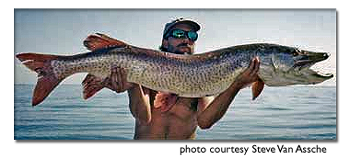
Lake St. Clair muskie guide Steve Van Assche with a muskie weighting between 35 and 40 pounds.
photo courtesy Steve Van Assche
Muskies have been a preferred fishing species of mine for more years than I can remember, and in many states plus Ontario and Quebec, and it’s my strong belief they are the most unpredictable, ornery, cantankerous and frustrating fresh water game fish in North America.

They hit well one day, but may then go several days before they decide to hit again. Sometimes they will follow a lure to the boat, look it over and sink out of sight with total disdain.

The result can be a bit like a baseball game. No hits, no runs, no errors, but in this case, no fish either.
Muskies are born with a nasty disposition, and they never seem to lose it.

They are finicky to an extreme, and each day the angler fishes, he believes this will be the one day he has waited all his life for. Once the day ends without a muskie or a strike, most anglers become mildly dejected. Some even quit fishing.

That soon passes as fishermen assume the philosophy: Well, maybe they will hit tomorrow. Sometimes they do but more often than not, they do not.

Muskie Fever affects different people in oddly different ways. It’s difficult for non-fishermen to understand that year after year, muskie fans will return to their favorite waters with high expectations. All they want is one legal muskie, but unless one fishes Michigan’s Lake St. Clair, that can be as lofty a goal as hitting the Lotto jackpot.

Lake St. Clair, on the Michigan-Ontario border, is the lake of choice for many catch-and-release muskie anglers. Many of these fish are caught trolling, and that’s fine. However, some anglers will stand and cast crankbaits, jerkbaits and spinnerbaits until their arm wears out.
For this latter group, catching a legal muskellunge is one of fishing’s most difficult pursuits. It’s even more difficult to catch a legal fish, but Lake St. Clair is producing some 50-inch fish. Anyone who has fished for muskies more than once know that a fish that size doesn’t come
along very often.

Stand-up casting has been my forte for many years, and I enjoy pitching a big plug or spinnerbait out, time after time, and it’s important to note a following fish can be as meaningful to some anglers as catching one.

Trolling is a terrific way to catch Lake St. Clair muskies, and I’ve had days with Captain Steve VanAssche of Harrison Township (586-783-8985) where our crew has landed over 20 muskellunge in one day. Some are smaller than legal size, some are just legal, and on occasion a fish weighing 30 or more pounds is caught. Planning ahead for a big fish is a waste of time. Put in enough hours, and you may catch a 30-pounder. Fish more often, and a 40-pounder is conceivable, and on odd occasions, some lucky angler may land a larger trophy.

The trick with trolling is using planer boards, and three lines are legal in Michigan waters while only one line per angler can be used in Ontario. Put six people aboard a boat, and you have six or 12 lines out, depending on where you fish, and it increases the odds of hooking a nice fish.

Trolling produces more fish but large fish can be caught by casting.

Muskie lures are basically large, and small ones are six inches long while large lures can be nine to 12 inches or longer. Oddly enough, Lake St. Clair produces some good fishing from the Fourth of July through October and November, depending on weather conditions. I’ve been on the lake on several occasions in truly bad weather, and it isn’t any fun.

The lake is large and shallow, and eight-foot waves are not uncommon, and the waves tend to run close together. This can lead to slow and easy trips back to the dock. The International boundary runs basically down the middle of the lake, but fishing laws are vigorously enforced on both sides of the border. It’s wise to plug in the boundary on your GPS unless you have Michigan and Ontario licenses.

There are any number of good trolling lures. The Wyle us a good plug, as are Homer LeBlanc’s Swim Whiz and other similar lures like muskie sized Rapalas.
Noted muskie angler Larry Ramsell with a 43-pounf Great Lakes muskellunge from Munuscong Bay in the Upper Peninsula.
photo courtesy Larry Ramsell
Casting anglers have a wider choice of lures. They can buzz spinnerbaits or bucktails fast over the tops of weedbeds.

Depth Raiders, sinking Rapalas, muskie sized Rebels work well, and Dardevles and Red-Eyes produce, but there are many other lures that will work.

The stand-up-and-cast angler is a glutton for self-inflicted punishment. He or she will stand, hour after hour, and make one cast after another. If a following fish is seen but doesn’t hit, they try a different lure or different color. No hits, they return every two hours in hopes of raising the fish again. Do it often enough, and a fish may hit.

They do a Figure 8 or Letter J rod-tip movement with the underwater lure at the side of the boat at the end of every cast, and once in a great while this method will produce a strike. It’s been my experience that most muskies that hit near the boat are never seen until they arrow up from bottom and slam the bucktail or other lure. It can be pretty spectacular,

My best time for catching muskies is between 10 a.m. and 2 p.m.

There are numerous good muskie lakes in Michigan for the angler that prefers to cast. Budd Lake at Harrison is a good bet, as is Skegemog Lake near Traverse City. Other lakes near Skegemog that produce the occasional muskie include Elk, Intermediate and Torch.

Lac Vieux Desert on the Michigan-Wisconsin border is a great lake and noted for its big fish. Iron Lake in Iron County produces some big fish, and Munuscong Bay in Chippewa County is another steady producer.
Indian River between Burt and Mullet lakes produces some fish. Long Lake at Traverse City produces very few muskies but those that are caught here will weigh 30 pounds or more.

Muskie fishing can be an addiction. What anglers become addicted to is not the fish as much as that heart-stopping strike, the feeling of tremendous power as a big fish strips heavy line off the reel, and the effort required to pump that hooked fish off bottom.
Sometimes the muskie will come to the boat, open his mouth, and the big lure will fall out. The fish slowly sinks from sight, and that hooks the angler again. We fish muskies, not just for the fish but for the adrenalin rush that comes when we have a solid hook-up.

The only cure for this malady is to go fishing again and again. The more time an angler spend on the water, the greater his chance for success. Muskie, slimy and ugly, grab hold of our emotions and only death or infirmity rids us of this passion.

Sunday, August 07, 2011

The fish that becomes and addiction

The


Dave Richey plays a big Lake St. Clair muskie.


Muskies have been a preferred species of mine for many years, in many states and the Provinces of Ontario and Quebec, and it’s my sincere belief they are the most unpredictable, ornery and cantankerous and unpredictable fresh water game fish in North America.

They may hit well one day, but may go several days before they decide to hit again. Sometimes they will follow a lure to the boat, look it over and sink out of sight with total disdain.

The result can be something like a baseball game. No hits, no runs, no errors, and no fish either.

There is very little about muskie fishing that is easy. Most of it is hard work.


Muskies are finicky, and each day the angler fishes, he just knows this will be the one he has waited for all his life. Once the day ends without a muskie or a strike, most anglers become mildly dejected.

That soon passes as fishermen assume the philosophy: Well, maybe they will hit tomorrow. Sometimes they do but more often than not, they won’t.

Muskie Fever affects different people in oddly different ways. It’s difficult for non-fishermen to understand, and year after year, muskie fans return to their favorite waters with high expectations. All they want is one legal muskie, but unless one fishes Lake St. Clair, that can be as lofty a goal as hitting the Lotto jackpot.

Lake St. Clair is the lake of choice for many catch-and-release muskie anglers. Many of the fish are caught trolling, and that’s fine. However, some anglers will stand and cast crankbaits, jerkbaits and spinnerbaits until their arm wears out.

For this latter group, catching a legal muskellunge is one of fishing’s most difficult pursuits. It’s even more difficult to catch a legal fish, but Lake St. Clair is producing some 50-inch fish but anyone who has fished for muskies before knows that a fish that size doesn’t come along very often.

Stand-up casting has been my forte for many years, and I enjoy pitching a big plug or spinnerbait out, time after time, and noting a following fish can be as meaningful as catching one.

Trolling with in-line planer boards is the best bet for Lake St. Clair muskies; here's Al Stewart with a 30-pounder.


Trolling is a terrific way to catch Lake St. Clair muskies, and I’ve had days with Captain Steve VanAssche of Harrison Township where our crew has landed over 20 muskellunge in one day. Some are smaller than legal size, some are just legal, and on occasion a fish weighing 30 or more pounds is caught.

The trick with trolling is using planer boards, and three lines are legal in Michigan waters while only one line per angler can be used in Ontario. Put six people aboard a boat, and you have six or 12 lines out, depending on where you fish, and it increases the odds of hooking fish.

The stand-up-and-cast angler is a glutton for punishment. He or she will stand, hour after hour, and make one cast after another. If a following fish is seen but doesn’t hit, they try a different lure or different color. No hits, they return every two hours in hopes of raising the fish again.

They do a Figure 8 or Letter J rod-tip movement with the lure at the side of the boat at the end of every cast, and once in a great while this method will produce a strike. It’s been my experience that most muskies that hit are never seen until they arrow up from bottom and slam the bucktail or other lure.

Michigan has many good muskie waters but Lake St. Clair is the nation’s best.


There are numerous good muskie lakes in this state for the angler that prefers to cast for them. Budd Lake at Harrison is a good bet, as is Skegemog Lake near Traverse City. Other lakes near Skegemog that produce the occasional muskie include Elk, Intermediate and Torch.

Lac Vieux Desert on the Michigan-Wisconsin border is a great lake and noted for its big fish. Iron Lake in Iron County produces some big fish, and Munuscong Bay in Chippewa County is another steady producer.

Indian between Burt and Mullett lakes produces some fish. Long Lake at Traverse City produces very few muskies but those that are landed often weigh 30 pounds or more.

Muskie fishing can be an addiction. What anglers become addicted to is not the fish as much as that heart-stopping strike, the feeling of power as a big fish strips heavy line off the reel, and the effort required to pump that hooked fish off bottom.

Sometimes that muskie will come to the boat, open his mouth, and the big lure will fall out. The fish slowly sinks from sight, and that hooks the angler again. We fish muskies, not just for the fish, but for the adrenalin rush that comes when we have a solid hook-up.

The only cure for this disease is to go fishing again. Muskie, slimy and ugly, grab hold of our emotions and only death or infirmity rids us of this malady.

Sunday, May 08, 2011

Light line, small spinners & big spring crappies

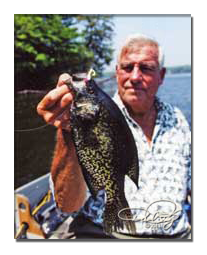
John Cartier holds a nice black crappie


The late John Cartier with a big crappie from Michigan's Hamlin Lake.


Very few things about fishing are really new. Granted, new reels, lines and lures may be new and different, but when it comes to catching fish, new techniques are slow to be developed. Most of what we really know is isn't really new, but  occasionally an angler may find it new to them,

I'm so mindful of a day I spent several years ago with the late John Cartier of Ludington, Mich. He was the long-time regional field editor for Outdoor Life magazine, and he was writing a book on cooking fish. My wife Kay was doing the lay-out for his self-published book, and we were visiting. A mix of business and pleasure.

“Feel like catching a bunch of crappies?” he asked. “It's mid-May, and I've got a sure-fire method for locating these tasty game fish, and once we've found them we can anchor and cast to the fish. Pere Marquette Lake has an excellent population of them.

The hope of learning a new fishing method was good news to me.


I'm almost always game for catching fish, and was more than a little curious about his method. It turned out that his method was a take-off on an old method of slow trolling a No. 0 Mepps Aglia spinner with a silver or gold blade. He tied a short leader to the hooks, tied in a No. 12 treble hook, draped part of a nightcrawler on the treble hook, and began trolling it slowly over eight feet of water.

“The trick,” he said, as we began letting out our lines on both sides of the boat, “is to troll this rig about 40-feet behind a slow-moving boat. Set your drag fairly light because crappies have a paper-thin mouth. A tight drag will tear the hooks out and you'll lose the fish.”

We'd covered perhaps 30 feet, when my ultra-light rod with 6-pound line jerked back toward the stern of the boat, and no hook-set was needed. I saluted the fish softly, and the black-and-white speckled crappie rose to the surface behind the boat. In he came, and the first of many crappies went into our live basket.

“Seen this method before?” Cartier asked. “I've been using it for many years, and it's a quick and easy way to find crappie concentrations in the spring. We'll keep trolling, and see if we can find a bunch of them. There are several fish shelters of old Christmas trees up ahead that a neighbor placed on the ice several years ago, and they are weighted down with cement blocks. The fish like to suspend around those brushpiles.”

We headed that way, and less than a minute later, just as Cartier told me we were going past the brush, we had a strike at the same time. Both of us were soon lost in the delight of hooking slab crappies on light line. He netted mine and then his, and held up both fish for inspection.

These crappies were big fish and hard fighters.

They were about 14 inches long with a big mouth, and when laid in Cartier's palm, they covered his hand and wrist. They followed their cousin into the wire mesh live well.

I told Cartier the only difference between my method and his was I used a small willow-leaf spinner with a single long-shank No. 10 gold hook. The method meant keeping the lure down about four feet, zigzagging a little one way or the other, and never getting into too deep water this early in the season. The fish like the lures presented slow, a good distance behind the boat, and the spinner blade barely turning over. Using a small electric trolling motor allows a slow and quiet approach when these fish are in the shallows.

“What I like about this particular method is that it's quite easy to survey a small lake or to section off various areas on a larger body of water, and it seldom takes long to find the fish. I usually start fishing in shallow back bays with a black marl bottom and some vegetation, brush or weeds. The water warms faster here, and that gets spring fish going.

This little bay was near his lakeside home. and it wasn't hardly big enough to be called a bay but it produced some nice fish. We head on down the lake, and finally found a spot where we caught several fish. We anchored, and began casting the same rig.

The crappies were there, and apparently hungry. We caught one fish after another, and soon had caught a limit  each of these tasty fish.

We each caught a limit of fine-eating game fish.


“It's time to quit,” he said. “We can head in, clean the fish and there's nothing better than a passel of spring crappies deep fried to a golden brown. Cartier's fish cook book has numerous recipes that can be used for cooking crappies, and he had a captive audience of hungry people.

He deep-fried some of the fish, and grilled some with another of his recipes, and along with some fried potatoes and baked beans, it was a fitting end to a fine day with an old friend. His fish recipes are interchangeable, and just a recipie and try it. Cartier been gone for a few years now, but this hard-boiled outdoor writer was a good and kind friend, an excellent writer and very knowledgeable about fishing and hunting. And I miss him.

Note: I have a few copies of his book, Best Fish Ever.
  • Only a few copies remain
  • If interested send a check for $15.95; postpaid to

David Richey
c/o Scoop's Books
PO Box 192
Grawn, MI 49637

Sunday, February 21, 2010

A Platte Bay Reunion

The waterspout dipped down out of a nasty looking storm cloud over East Platte Bay  that day, and we watched the water-borne tornado for two minutes before it lifted off the water and disappeared back into the black clouds.

"Neat," said Jack Duffy of Leland. "I've seen a fair number of them while chartering out of Leland for lake trout and salmon, but I've never seen one on Platte Bay."

The waterspout was the spice that comes from spending time with a good friend, outdoors at a location that we both truly love, and we were there ostensibly to fish for steelhead off the Platte River mouth. Actually, fishing for steelhead was just an excuse for the two of us to get together to spend part of a day at a place that holds many dear memories for both of us. This episode happened two or three years ago, and I just remembered it.

Late-fall can be a good or bad time for steelhead off the Platte River.

Duffy and I have been friends for more than 40 years, and we pioneered brown trout fishing back in the late 1960s and early 1970s when he lived in Midland and I lived in Clio. We fished those brown trout hard, and caught hundreds of fish to 20 pounds at a time when no one knew they existed, and then one day Lady Luck smiled and he caught a 31 1/2-pound brown that set a state record.

He was the only guy I know who  has caught a coaster brook trout off the Platte River mouth, and it weighed about five pounds. We've seen the Platte Bay fishery rise and fall over all of these years, and whenever we return to fish, we are really returning to a place where some great fishing dreams once came true. Granted, that doesn't mean that new dreams can't be realized but the  fish simply are not there in heavy numbers as they once were.

Duffy had two lines out with spawnbags fished just off bottom in the river current. It's a technique we've used all these years to catch steelhead, but the fish seemed conspicuous by their absence. They lay out there drifting with the river current, and nothing bothered them. He was using an old Shakespeare rod that he used to catch his former state-record brown trout in an attempt to relive some of his old memories.

Casting small spoons sometimes pays off but not on this day.

I cast Devle Dogs in several colors by wading out into the lake and casting into deep water. Enough casts were made to make my shoulder sore, and there were no hits, no runs and I made no errors. The steelhead, if any were present, were not interested in our offerings.

We discussed the places we fished in Platte Bay for browns, and noted that the Lombardi poplars that once lined the shoreline of  East Platte Bay are mostly gone now. They provided great landmarks at a time when landmarks played an important role in fishing. Duffy, like me, has aged and those memories of long ago are important to both of us. We discussed, in depth, the many brown trout we'd caught trolling on the bay.

We'd wade  into the surf, and I'd cast my lures  while he checked his spawnbags and replaced them with a new one. My lures were switched, and fan-casting them and varying retrieval speeds and sinking times were tried. The steelhead ignored our offerings as if there wasn't a fish in the area.

Our stories were told, we caught up on each others families, and discussed his chartering business and my writing business,  and decided that we are both fortunate to have a vocation and avocation that is the same: fishing. Duffy pulled his first line, and we were wrapping things up. We had shared yet another precious memory from this hallowed spot by seeing the waterspout.

He grabbed the other rod, and felt a slight pull, and I heard that old familiar squeaky voice I remember from nearly four decades ago: "There's a fish  hitting this spawnbag," he squeaked, giving the fish a bit of line. "He's taking more line out. Watch out there when I set the hook."

The rod tip came back, and the fish was hooked. We then talked about how many last-minute fish he and I have caught while fishing together, and it's a large number. The fish ripped off a bunch of six-pound line, jumped twice, all bright silver and glittery in the pale sunlight. Again the fish jumped, and he began working the fish back only to have it take out more line.

Slowly, and gradually with a minimum of pressure, the mint-silver steelhead started to lose the battle. Duffy played the fish gently, and led the fish up to the beach to a gentle landing. It was a hen steelhead with a small head and bright silvery flanks, and little did she know but this fish was the climax to another in a long line of unforgettable days we've shared.

A typical Lake Michigan brown trout like this were common may years ago.

Really, what can top a morning of fishing the surf of Platte Bay, remembering my brother George getting hooked in the head by an angler who only knew how to cast sidearm. We removed the hooks, and the wound bled hard, but it finally stopped, and we continued fishing. We discussed the big browns we once caught like they were hatchery trout, and we recalled those days, like today, when we had the whole area to ourselves.

We recalled. with great relish, that there is much more to fishing than catching fish. That one steelhead was about six pounds but it was the capstone to a wonderful day filled with great camaraderie, grand memories of other earlier times, and one nice fish. Seeing the waterspout was simply a bonus.

Posted via email from Dave Richey Outdoors

Saturday, October 24, 2009

Uncommon Fishing Experiences

Strange things happen while fishing, and many are remembered long after a limit catch has been caught, bragged about and eaten.

It was about this time of year 30 years ago when I was trolling Manistee Lake near Filer City with brother George, and Randy Colvin of Flint. We were trolling X-4, X-5 and U-20 FlatFish at putt-putt speeds.

I was trolling a U-20 silver FlatFish off the starboard side, Colvin was pulling a U-20 in grey-pearl off the port side, and George was using some weight and was fishing a chartreuse with red spot U-20 right behind the boat while running the outboard motor.

An against all-odds catch

It was a cold and blustery day when Colvin had a jarring strike. I began reeling my line in immediately when I felt the boat rock as he set the hook, and his line broke from a too-tight drag and too much hook-set. I'd made about 10 turns on the spinning reel handle when my rod tip shot down, and I was into a jumping fish that cleared the water behind the boat.

George reeled up, Randy reeled in his broken line, and that steelhead and I had a good battle. I gradually worked him out into deeper water, and soon he was swimming in circles 10 feet below the boat. I eased him to the surface where George slid a net under the fish.

No big deal here. But imagine our surprise when we learned that one small treble hook point of my lure went through the line-tie of Colvin's FlatFish. The odds of such a thing happening are well off the charts.

He howled that it was his fish, and me being a reasonable gent, suggested that his over-zealous hook-set and my finely timed retrieve was what led to my cleverly inserting a hook point of my lure through the line tie of his lure. Thus, any reasonable person should know that not only did I land the fish but also gained a new fishing lure.

I relented, after further reasonable thought, and gave him back his lure. I kept the fish. That seemed only fair to me.

Hooking the same big Chinook salmon three times

Another time, during my river guiding career from 1967 through 1976, I had occasion to fish the Betsie River with a fly rod and wet flies for chinook salmon. My clients had caught a bunch of fish, and being thoroughly tuckered out from running up and downstream after fish, had pulled up stakes after two days and went home.

A huge king was spotted upstream from a tree that had toppled into the water, and he was holding court with a big hen. I hooked that old boy once, and he ripped and snorted downstream, tangling my line in the fallen tree branches, and broke off.

I fished elsewhere for an hour, went back to the big king, and he was back out guarding the redd. I changed fly colors, rolled the dark fly in front of his nose, and he darted out to grab it. I set the hook, he uncorked a tremendous leap that landed him in the tree branches again. The line broke like sewing thread.

Two hours passed before I stopped by to pay him another visit. There he lay, alongside the nearly spent female, and they rolled up on their sides in unison, she discharging a stream of golden eggs while he let loose a cloud of white milt. They spawned until her eggs were exhausted and he could only muster one tiny puff of milt.

They had ended their spawning chores, and death would soon follow. I eased into the river again, made one cast, and the big male moved forward to intercept it. I set the hook, set it again, and literally forced him across the surface toward me. He slipped past me as I steered him clear of the tree branches and into the open river.

He headed downstream like a barge drifting out of control, and I followed him as fast as humanly possible. He rolled to the surface, thrashed around, turned sideways to the current, and he let the swift water carry him down to a deep hole. I knew the hole was clean of debris, and carried the fight to the now sluggish fish.

It was perhaps not the most noble end to his life, but he had fulfilled his destiny and would soon die, his carcass tumbling end over end downstream until it lodged in a log jam. I eased him toward shore, skidded his massive head up on shore, picked him up by the tail and it was over.

That fish, two hours later, weighed an honest 38 1/2 pounds on certified scales, a major catch on a fly and fly rod and 10-pound tippet. It's said that salmon are born orphans and die childless.

And that is a true fact, and I'd like to think this great fish (the largest Chinook salmon I've landed on a fly rod) graced my life and died in an honorable fight rather than succumbing to the wasting-away process that befalls all salmon. He blessed my life with his presence and his strength, and that memory will live with me until my death.

Three big brook trout from Algonquin Provincial Park

One last topic concerns a trip to Ontario's Algonquin Provincial Park for brook trout. My wife Kay and I hiked into a sparkling little lake as I carried a canoe on my shoulders. We began a slow tour along the first dropoff out from shore, and cast copper-color Devle Dogs toward shore.

Kay hooked the first brook trout on one of those Eppinger spoons, and it fought a stubborn battle on six-pound line, and I eventually netted a 5 1/2-pound lake brookie. It had broad shoulders abd within five minutes she caught another fish of about the same size.

Two hours later we pulled up to a big boulder along shore, and got out of the canoe to stretch our legs. My third cast produced a jarring strike, and a few minutes later I eased a five-pound brook ashore.

We fished the rest of the day without a strike but the size of those three brook trout have seldom been equaled elsewhere. It produced wonderful memories we'll both remember for many years.

Uncommon Fishing Experiences ((tag: Dave Richey, Michigan, Outdoors, brook trout, canoe, Chinook salmon, Devle Dogs, FlatFish, fly fishing, trolling))

Posted via email from Dave Richey Outdoors