Showing posts with label spinnerbaits. Show all posts

Sunday, August 07, 2011

The fish that becomes and addiction

The


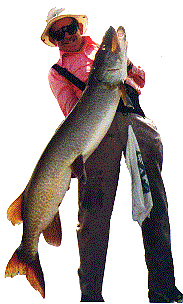
Dave Richey plays a big Lake St. Clair muskie.


Muskies have been a preferred species of mine for many years, in many states and the Provinces of Ontario and Quebec, and it’s my sincere belief they are the most unpredictable, ornery and cantankerous and unpredictable fresh water game fish in North America.

They may hit well one day, but may go several days before they decide to hit again. Sometimes they will follow a lure to the boat, look it over and sink out of sight with total disdain.

The result can be something like a baseball game. No hits, no runs, no errors, and no fish either.

There is very little about muskie fishing that is easy. Most of it is hard work.


Muskies are finicky, and each day the angler fishes, he just knows this will be the one he has waited for all his life. Once the day ends without a muskie or a strike, most anglers become mildly dejected.

That soon passes as fishermen assume the philosophy: Well, maybe they will hit tomorrow. Sometimes they do but more often than not, they won’t.

Muskie Fever affects different people in oddly different ways. It’s difficult for non-fishermen to understand, and year after year, muskie fans return to their favorite waters with high expectations. All they want is one legal muskie, but unless one fishes Lake St. Clair, that can be as lofty a goal as hitting the Lotto jackpot.

Lake St. Clair is the lake of choice for many catch-and-release muskie anglers. Many of the fish are caught trolling, and that’s fine. However, some anglers will stand and cast crankbaits, jerkbaits and spinnerbaits until their arm wears out.

For this latter group, catching a legal muskellunge is one of fishing’s most difficult pursuits. It’s even more difficult to catch a legal fish, but Lake St. Clair is producing some 50-inch fish but anyone who has fished for muskies before knows that a fish that size doesn’t come along very often.

Stand-up casting has been my forte for many years, and I enjoy pitching a big plug or spinnerbait out, time after time, and noting a following fish can be as meaningful as catching one.

Trolling with in-line planer boards is the best bet for Lake St. Clair muskies; here's Al Stewart with a 30-pounder.


Trolling is a terrific way to catch Lake St. Clair muskies, and I’ve had days with Captain Steve VanAssche of Harrison Township where our crew has landed over 20 muskellunge in one day. Some are smaller than legal size, some are just legal, and on occasion a fish weighing 30 or more pounds is caught.

The trick with trolling is using planer boards, and three lines are legal in Michigan waters while only one line per angler can be used in Ontario. Put six people aboard a boat, and you have six or 12 lines out, depending on where you fish, and it increases the odds of hooking fish.

The stand-up-and-cast angler is a glutton for punishment. He or she will stand, hour after hour, and make one cast after another. If a following fish is seen but doesn’t hit, they try a different lure or different color. No hits, they return every two hours in hopes of raising the fish again.

They do a Figure 8 or Letter J rod-tip movement with the lure at the side of the boat at the end of every cast, and once in a great while this method will produce a strike. It’s been my experience that most muskies that hit are never seen until they arrow up from bottom and slam the bucktail or other lure.

Michigan has many good muskie waters but Lake St. Clair is the nation’s best.


There are numerous good muskie lakes in this state for the angler that prefers to cast for them. Budd Lake at Harrison is a good bet, as is Skegemog Lake near Traverse City. Other lakes near Skegemog that produce the occasional muskie include Elk, Intermediate and Torch.

Lac Vieux Desert on the Michigan-Wisconsin border is a great lake and noted for its big fish. Iron Lake in Iron County produces some big fish, and Munuscong Bay in Chippewa County is another steady producer.

Indian between Burt and Mullett lakes produces some fish. Long Lake at Traverse City produces very few muskies but those that are landed often weigh 30 pounds or more.

Muskie fishing can be an addiction. What anglers become addicted to is not the fish as much as that heart-stopping strike, the feeling of power as a big fish strips heavy line off the reel, and the effort required to pump that hooked fish off bottom.

Sometimes that muskie will come to the boat, open his mouth, and the big lure will fall out. The fish slowly sinks from sight, and that hooks the angler again. We fish muskies, not just for the fish, but for the adrenalin rush that comes when we have a solid hook-up.

The only cure for this disease is to go fishing again. Muskie, slimy and ugly, grab hold of our emotions and only death or infirmity rids us of this malady.

Saturday, July 31, 2010

Make mine muskies!


It's already started. I had a dream last night, and there I was, knees braced against the stern, and a rod bowed almost double from the force of a big muskellunge that was steadily taking line.

This dream had some basis in fact, and it was three years ago when I first fought and lost a huge Lake St. Clair muskie that wouldn't come up off the bottom.

Muskie dreams are just what they are: dreams of big toothy fish. Occasionally my muskie dreams will contain combined elements from two or three different and unforgettable muskie fishing experiences.

What causes these dreams? Beats me, but I suspect it comes from thinking of muskellunge fishing.  Two years ago, I tipped an old buddy -- Larry Ramsell of Hayward, Wisconsin -- off to a Michigan hotspot I've known about for 30 years. I couldn't go because I was recovering from one of many eye surgeries, so I gave him a clue.

Larry Ramsell (above) of Hayward, Wisc. fishes all the great muskie waters.

The general locale was the St. Marys River in the eastern Upper Peninsula, which encompasses a large chunk of watery real estate. He and two others fished the first day and got lucky. They caught a 42-inch fish.

The next day one angler landed and released a small fish, another angler hooked and lost a large muskie, and then Ramsell nailed a 53 1/2-inch muskie that weighed approximately 45 pounds, and they still were nowhere near my hotspot.

Ramsell is a great muskie angler, and perhaps the most savvy of all. He recognized good muskie water, and fished it hard and caught fish.

A photo of Ramsell and his trophy fish appears above, and I'll probably dream of it tonight. However, to illustrate how fickle muskie fishing can be, Ramsell returned the following year and never caught a fish. A cold front moved in, and he and I fished in high winds and rain for two days without either of us having a strike.

The odd thing about muskie fishing is the reason we fish for muskies is it becomes a personal quest for a trophy fish. The above fish isn't Ramsell's first 40+-pounder, but very few fish of such honest sizes will tip the scales to that weight. He admits that the quest, the enduring search if you will, for an even larger muskie is what drives him and many others to travel widely and fish often for a larger muskie.

Satisfying that quest does occur, but not for everyone. I've hooked three or four 40-pounds in many years of fishing for them. The trick is to fish all the known big-fish waters but never fail to try other lakes. Nearby Long Lake undoubtedly holds 40-pound fish or even larger, but very few are landed. Most are hooked by accident by people fishing for other species, and invariably the fish breaks off and gets away.

Years ago, I boated a big muskie on Dale Hollow Reservoir, on the border of Kentucky and Tennessee. That fish weighed 36 1/2 pounds, and it is the biggest muskie I've landed. But this muskie fishing is like an itch that needs a good scratching. It’s something like poison ivy of the brain.

The only thing that relieves the itch is to go muskie fishing again. And always, lurking in the darkest corner of our brain, is the thought of our biggest fish. A quest to top that fish, and not necessarily to keep it, is what keeps us pounding the water.

Lake St. Clair is gaining the reputation as possibly the best muskie lake of all.

The Lake St. Clair fish I hooked three years ago was never seen. Fish hooked while trolling, and this is especially true if it is a big fish, is they will stay deep. It may roll on the surface toward the end of the fight, but they normally stay down until they get plumb wore out.

My unseen fish hit a down-rod on the corner of the boat, with the lure in the prop wash, and it ripped off yards of line. We cleared other lines, and that fish and I tussled for more than 20 minutes. I'd move it up off bottom, and down it would go again, and take out more line. Back and forth we went until I could sense the fish tiring, and it rolled under the surface where it was impossible to see the length and girth, and then rolled over and the lure came free.

Then there was a muskie hooked while fishing after dark. The lake was Murphy Lake in Tuscola County. Me and another guy were casting huge plugs that sputtered along on the surface with gurgles and small splashes from our muskie-size Hula Poppers and Jitterbugs.

"Blub-blub-blub" would come the sound as we retreived the surface lures with an occasional pause. My partner got a big backlash when his lure was near the boat, and a big northern muskie struck the lure and broke the line.

An hour later as we lamented the lost fish I had a massive jarring strike. I'd worked for an hour on those hooks, and they were razor sharp. That fish hit, and I pounded the hook home twice. That fish took out 30 yards of line, and I played her with a cool hand.

Even at that, the fish was a monster. One develops a sense for big fish after hooking a number of them, and I'd triggered that fish quick and hard. It was hooked well, and I played it under the light of a bright moon. Nearly 20 minutes into the fight, the fish ran toward the boat, rolled over, splashing us with water and we came undone.

I suspect the prolonged fight and the big hooks wore big holes in that fish's jaw, and when it rolled, the heavy lure fell out, and the giant muskie swam free.

Lost big fish often are the rule rather than the exception. Many simply get away.

I remember another big muskie that followed a Suick twice in three days on Wisconsin's Tomahawk Lake. It looked half as long as the 16-foot boat but I know it wasn't quite that big, but it was well over 50 inches long. Could it have hit that magical weight of 40 pounds?

Undoubtedly. My buddy from Wisconsin, who had seen and caught several very large muskies, estimated the fish at 55 inches and at least 45 pounds. That 'lunge still figures in an occasional dream.

Another time on Ontario's Lake of the Woods near Kenora, I had a savage strike at boat-side from an unseen muskie. The fish missed the plug after I began lifting it out for another cast.

The next thing I knew there was this enormous muskie camped three feet behind my Bobbie Bait. I kept the lure moving, plunged the rod into the water at the boat, and kept it moving. That fish followed it through several Figure-8 and J-stroke rod movements, and then it sank slowly out of sight without offering up to hit the lure.

How big was it? I had caught a brief glimpse, and it was well over 55 inches. Was it one of those legendary 60-inch fish? Beats me, but I know I saw that fish in my dreams for two or three years. Writing about it now may bring the dream back to life again.

Years ago, Craig Lake in the Upper Peninsula was a hotspot for big muskies. It was a small lake, hard to reach at that time, and motors were not allowed. A good man on the oars could row around the lake easily in two hours.

A buddy was fishing a spinnerbait when a muskie struck at the fast-moving lure and missed. I pitched a Suick over there, and the fish bulged the water behind the lure but didn't hit. I applied rod-tip English to the lure, and it followed the lure all the way to the canoe. That  fish probably weighed 40 pounds but we'll never know.

Later that day a buddy caught a muskie weighing 25 pounds at the opposite end of the lake. It would have been dwarfed by the earlier fish.

I've been privileged to have caught a great number of muskies in my life. I'm missed some very big fish, hooked some that were truly huge, and lost all but the Dale Hollow fish, and it remains my largest so far.

Will Lake St. Clair produce something big this year? I honestly think so. It produces plenty of muskies, and a goodly number of 40-45  pounders have been taken and several fish much larger have been seen. Luck, and being in the right spot at the right time, are things anglers truly need to be successful with these big fish.

It is very difficult to crack that hallowed 40-pound mark, and although some anglers do it each year, it is not a common situation. Granted, on occasion a novice will catch a truly big fish by accident or good fortune, but for dedicated muskie hunters, nailing a 40-pounder is why we chase these grand game fish.

And, once we crack that mark, we'll try for a 45-pounder. Go figure!

Posted via email from Dave Richey Outdoors

Sunday, March 14, 2010

One never has enough fishing-hunting books or lures

There are more tackle boxes in my basement storeroom that any sane man needs. Every one is almost overflowing with fishing lures, so why should I need more?

It's a bit like fishing and hunting books. A man can never have and read too many fishing or hunting titles, and I'm as guilty of buying more of each than I will probably ever need.

There are four huge tackle boxes filled just with muskie plugs, and a smaller one that holds some smaller muskie lures. I've got some 10-inch muskie plugs and great huge spinnerbaits in the big boxes. However, every year I see someone with a Bobbie or Eddie bait or a Suick painted in a color I don't have.

It doesn't mean that the other guy's oddly colored Suick hasn't worked for him. It could, and there I'd be without one painted in that strange color that every muskie fishermen needs to own. Sadly, seldom do they produce fish, but against all odds, they could!
 
There are two more beastly huge tackle boxes filled with nothing but salmon spoons and big salmon plugs. I own most colors of J-Plugs, Dardevle, Silver Streaks and other fishing spoons, but I keep bumping into newer sizes with different paint and  tape patterns that seem to beckon to me with eyes that look deep into mine and seem to whisper "Buy me and take me home!" It's the old siren song.

A big red-white Dardevle produced this big Isle Royale pike.

The eyes have it. I've been adding stick-on eyes to my lures for many years, and now more and more lures are being made with prominent and well-colored eyes. I think eyes make lures more appealing to fish but wonder if they really produce more fish.

OK, how about Herring Dodgers? I have two smaller boxes filled with them. There are red ones, white and yellow ones, chrome plated, some home-painted a dull black color (don't laugh because they work ... sometimes), half silver-half bronze, chartreuse models, and some with dazzling tape and some without. There are small ones, large ones, those of normal size, and Hoochies. Got me some of them too.

If we're going after lake trout I tote 50-60 different sizes, shapes and colors of cowbells and perhaps half that many different colors of P-nuts. Another tackle box is filled with various trolling weights for inland trout lakes, and some stainless steel needles to sew shiners onto my hook.

Dardevles are a favorite Canadian lure.

One tackle box is loaded with more Dardevles in a variety of colors although my best pike fishing comes with two color combinations -- red with a white stripe and silver back or yellow with five red diamonds and a brass back. There are other pike spoons and plugs in the box, and although most of my largest pike come on the two colors noted above, there are another two dozen other patterns for when the pike get picky. And then there is a box of spinnerbaits in several sizes that work for muskies and pike.

Oh my, I nearly forgot. One box is filled with body baits like Rapalas, Rebels, FasTracs, Long A Bombers and other similar lures. They too are in an infinite variety of great colors, and some have never been in the water but boy, do they look pretty.

Still another box is filled with wood FlatFish and Tadpollys from my guiding days when I used the dropback method on the Manistee River below Tippy Dam or when trolling Manistee, Pentwater or Pere Marquette lakes for late-fall steelhead. The FlatFish come in two varieties: those with the tiny treble gang hooks or with two larger hooks. In that box are extra hook hangers for the small treble hooks that I prefer to use.

I'm a big fan of vertical jigging on the Detroit, Kalamazoo, Saginaw and Tittabawassee rivers, and there are two heavy tackle boxes filled with jigs weighing from 1/8 to 1 ounce, depending on the depth of water and current speed at each location. Half of one box is filled with oodles of grub bodies and twister-tail bodies in a rainbow of colors.

And as nice as freshly painted jigs look in their trays, I often scrape the paint off and use just the bare lead and a lip-hooked minnow. It works!

One small box holds nothing but Mepps spinners, and another holds nothing but weight-forward spinners like Erie Dearies. Another small box is nothing special except it contains lures purchased when I was 15-17 years old from the Wanigas Fly Shop near Saginaw, Michigan. The shop was owned by Art Neumann, a co-founder of Trout Unlimited, and it holds a bunch of small trout-size spoons that are rarely seen these days except in a lure collection.

A body bait produced this big Georgian Bay, Canada walleye.

Then there are some collectible Heddon lures that I normally leave home, and other scarce Creek Chub Pikie minnows, etc. And did I mention two small boxes of ice fishing lures?

So, do I really need several more lures? Probably not, but once one or two new lures wink at me and catch my eye, I go into a feeding frenzy until I have them. Many times, after such a cabin-fever purchase, I try the lure once and take an active dislike to its action, color or lack of fishing-catching abilities.

Someone once told me that fishing lures catch more anglers than fish, and I suspect that is quite true. However, gazing upon tray after tray of various colors and sizes of lures makes me feel good.

So, why not, honey? All I need is two or three more $20 muskie lures. There are still a few Suick colors I don't have. You never know when one of these odd-ball color combinations will tempt a trophy muskie.

Posted via email from Dave Richey Outdoors